Nike has finally rolled out its growth plan, yet it will take a little time to deliver | On-site coverage of the Investor Day
Take Back Those Shares
After a dizzying fast-cut video, Elliott Hill, dressed in a black Nike flight jacket, walked onto the stage looking in great form.
"That video we just watched is a window," he said. "It shows us the true mindset of the world's top athletes: rise to challenges, never stop, and doubts will only push them to work harder."
At 8:30 a.m. local time on Tuesday, November 17, in the auditorium on the second floor of the Tiger Woods Conference Center at Nike's Beaverton headquarters, the venue was packed with analysts in suits, ready to hear how the CEO would lead the sportswear giant out of its trough.
The last time Nike held an Investor Day, NVIDIA's share price was around $2.55, and now it is $162; HBO's *Game of Thrones* had not yet finished its run; Caitlin Clark was only 15 years old and had just been selected for the U.S. U16 Women's Basketball Team.
That was 2017, when the management outlined plans at the conference to boost online sales, expand direct-to-consumer business and accelerate innovation. Over the following four years, the stock price rose more than threefold, hitting an all-time high of $177.51 at the end of 2021.
In fiscal 2026, Nike posted revenue of $46.4 billion, flat year on year; entering the new fiscal year, revenue in the first quarter fell by 4%. The stock price has returned to the level of 2014, down nearly 80% from its all-time high. "It's clear that we are not yet where we want to be," Elliott Hill said in his speech.
The answer he and CFO Dave Denton, who had just taken office 100 days prior, presented was a five-year timetable: taking fiscal 2027 as the base year, the company will add approximately $5 billion in new revenue by fiscal 2031, and operating profit will rebound from 6% to 12% to 14%. As for the Greater China region, revenue is expected to gradually stabilize over the planning period ending in fiscal 2031.
Growth is not linear. According to Nike management's vision, revenue will continue to decline in fiscal 2027 and 2028 (ending May 2028), but the decline will gradually narrow from a high single-digit rate; the real inflection point will not come until fiscal 2029, "when we expect revenue growth to be in line with the overall market."
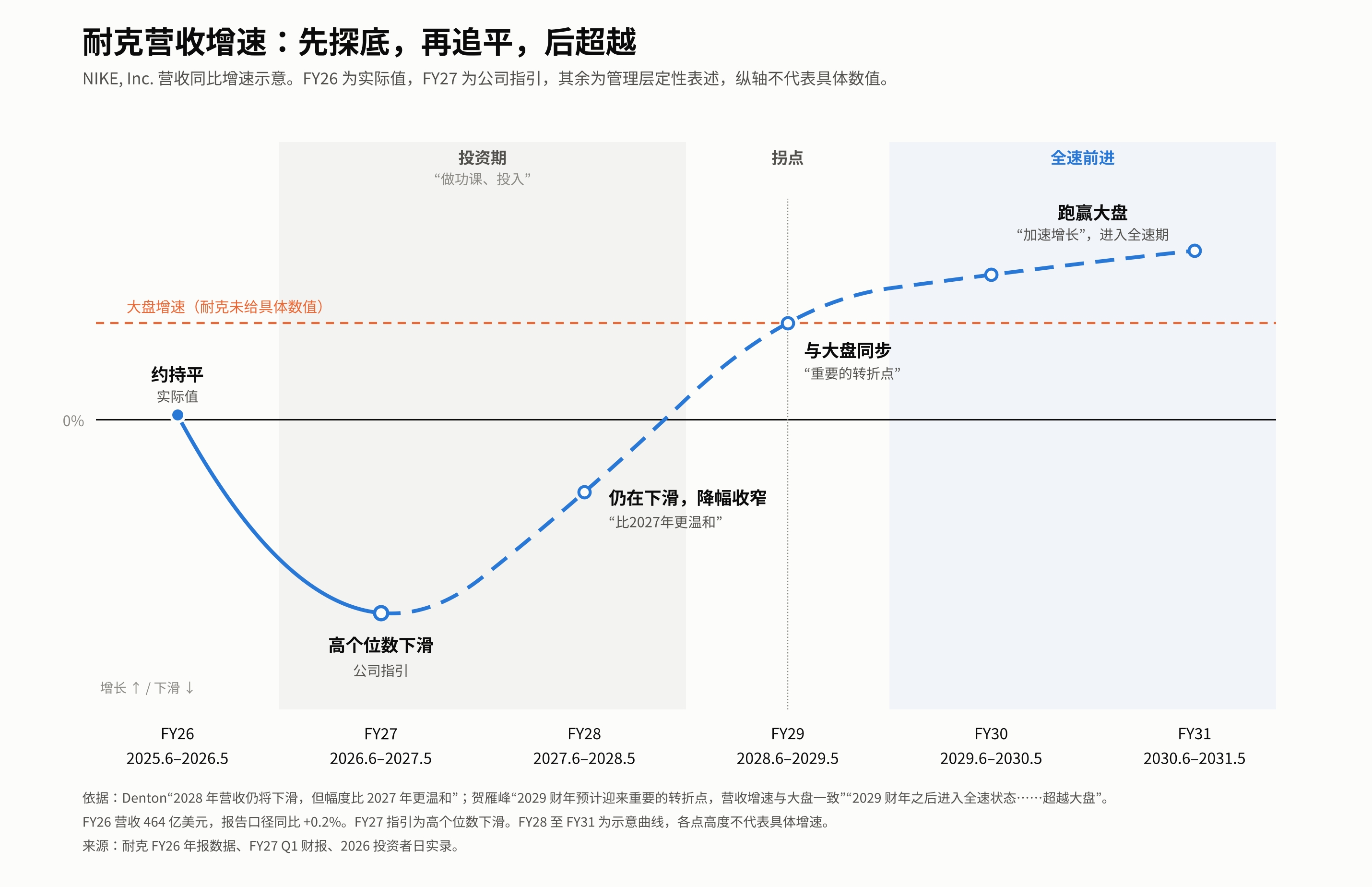
Nike expects to catch up with the overall market growth rate as early as mid-2028 | Illustration: 36Kr
The strategy aligned with this roadmap is named "Full Stride Ahead". Its core is three words: epic, connected, fast.
In terms of products, Nike will reshape its product portfolio, cut redundant shoe models, and increase the proportion of differentiated new products. In the market, the strategy has expanded from the "Three Countries, Five Cities" of the Win Now era to 23 key countries, where about 90% of revenue growth is expected to come from. In these countries, Nike will continue to deepen its connection with local cultures, and eventually build a replicable demand engine. At the production and delivery level, more apparel and accessories will be manufactured in the Americas and locations close to Europe; the logistics network will make greater use of third-party partners and increase automation. This part has saved about $600 million in fiscal 2026.
At the same time, Nike is rolling out a program called PACE to further improve operational efficiency. By fiscal 2031, PACE will save Nike approximately $2.5 billion per year, and the implementation process is expected to generate about $1.3 billion in one-time pre-tax expenses, including employee-related expenditures.
Some analysts believe the late-stage growth pressure of the new plan is too high, and the five-year roadmap appears overly cautious to the market. On the day Investor Day concluded, Nike's stock closed down 6.3%.
At the all-hands meeting after Investor Day, the management's tone became noticeably much more positive.
"We have everything we need to succeed," Elliott Hill said in an employee recording obtained by Bloomberg. He also acknowledged that a recovery of this scale "does take time, longer than I would like." Dave Denton put it more bluntly: "The shares that belong to Adidas should have been ours, they don't deserve them, so let's take action and get those shares back."
Over the past two years, Adidas CEO Bjørn Gulden has made public comments about Nike in a less than polite tone on multiple occasions. After holding back for a full day in front of Wall Street, Nike's management finally pushed back at the internal meeting.
Three Types of Demand
On Nike's more than 400-acre campus, there are over 40 buildings, most named after athletes, including Michael Jordan, Mia Hamm, Tiger Woods, and the largest one belongs to Serena Williams. Last autumn, the campus was renamed Philip H. Knight Campus after its founder.
"Our doors are a little taller than normal doors," a Nike employee told me, "because basketball players come here often."
I then asked a (not actually that) hypothetical question: what should be done with these buildings if a certain athlete gets caught up in a scandal?
"We won't make any changes," the Nike employee's answer took me by surprise, "because Nike always puts athletes at the center of everything."
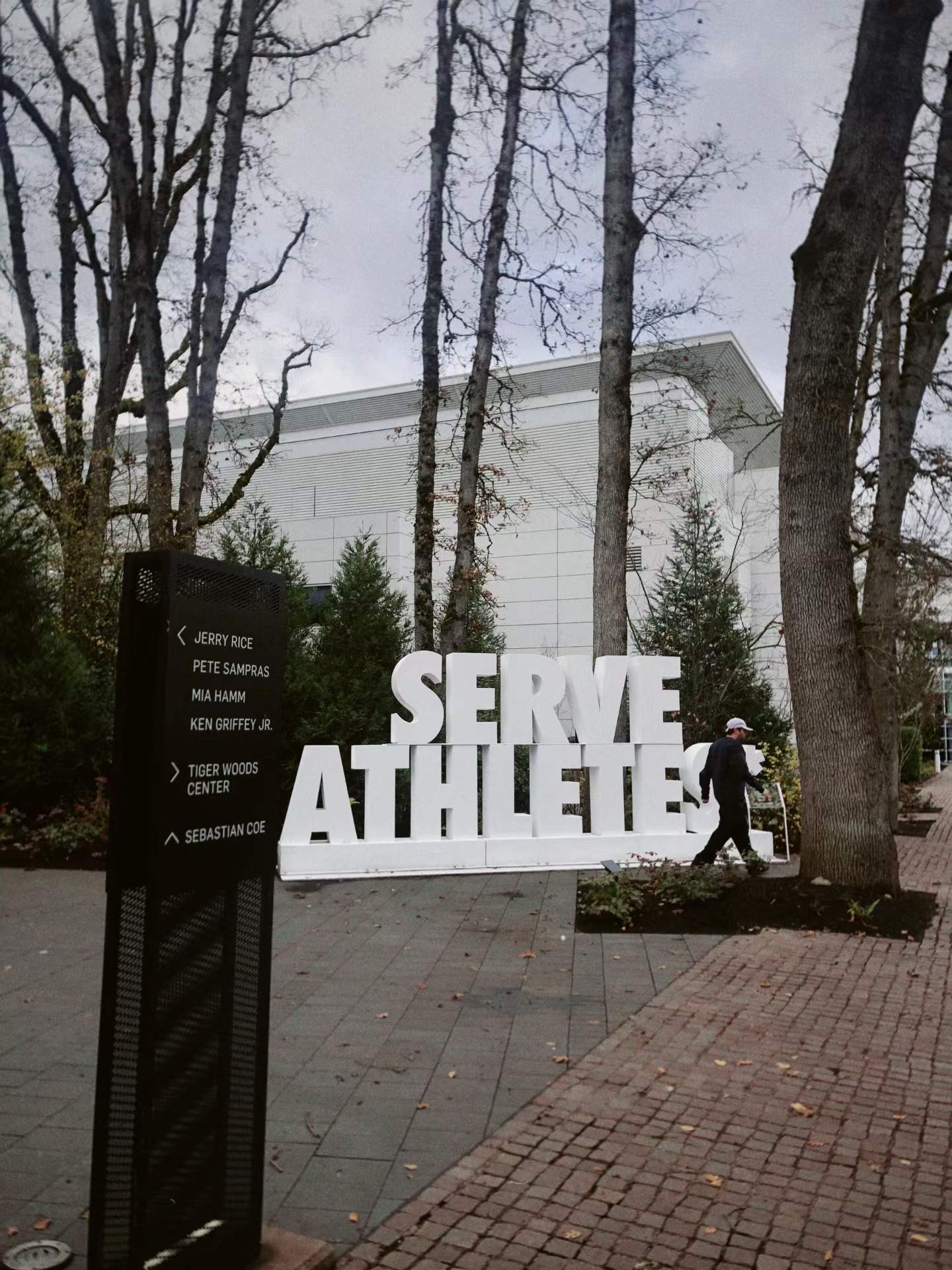
Nike employees' office building is named after Sebastian Coe, President of World Athletics, with a sculpture at the entrance that reads "Serve Athletes" | Photo by the Author
But engraving athletes' names on buildings is not difficult. What's hard is making athletes willing to wear Nike products. Over the next five years, Nike is betting on the latter. Of the approximately $5 billion in new revenue, $4 billion will come from the sport performance category, namely five key sports: running, training, football, basketball and outdoor.
The remaining $1 billion will be delivered by the lifestyle businesses of Nike Sportswear (NSW), Jordan and Converse. This segment once accounted for about 60% of the company's total revenue, and in the first quarter of fiscal 2027, NSW alone still accounted for "slightly less than half".
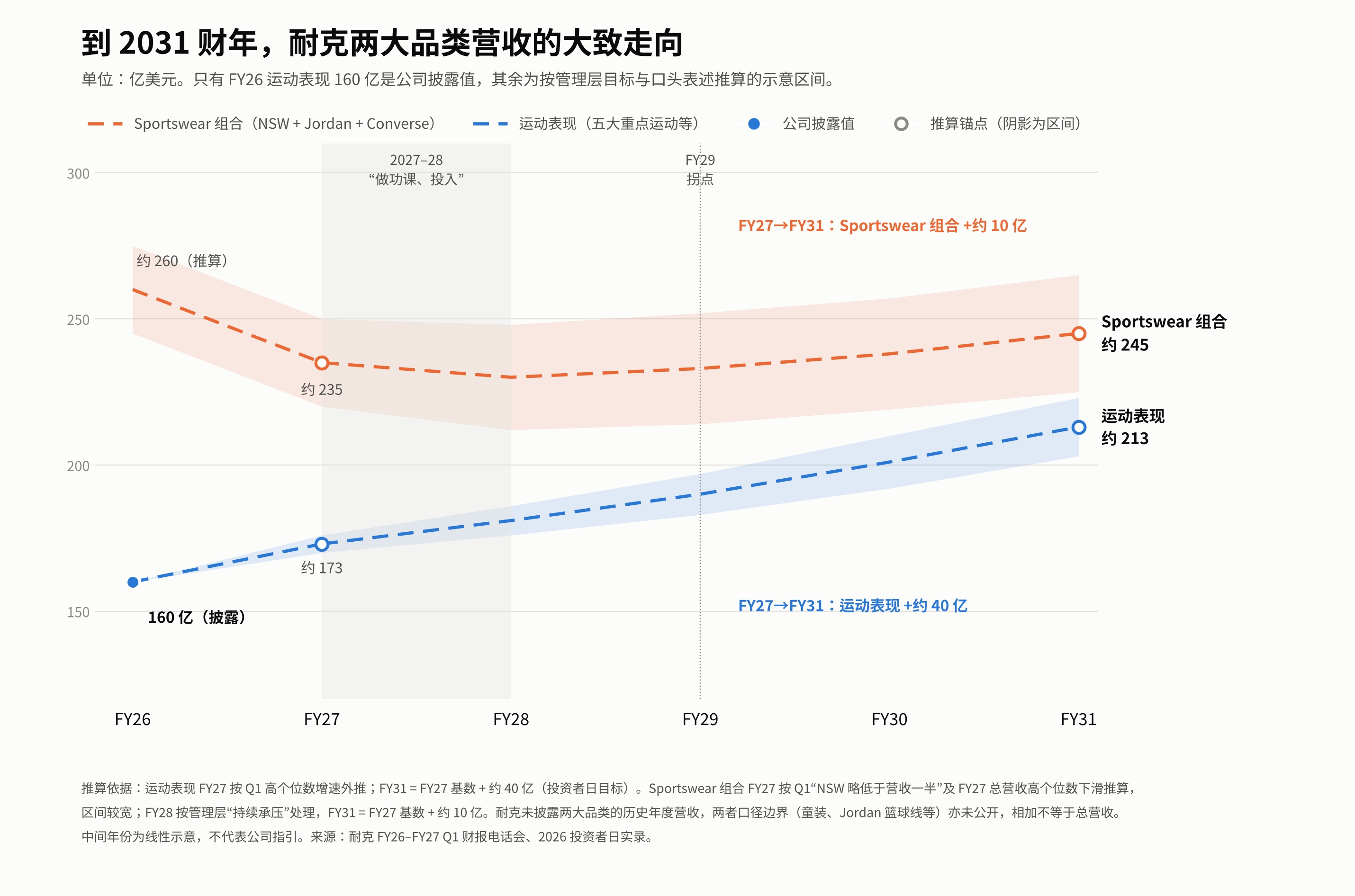
Revenue trend comparison of Nike's sport performance and lifestyle categories from FY26 to FY31 | Illustration: 36Kr
"Create epic shit" is a phrase that Phil McCartney, Chief Innovation, Design and Product Officer, often mentions. The line comes from Kobe Bryant, who would often ask the Nike team when working with them: "Show me the epic shit." "It reminds us to be bolder in creating things," Phil McCartney said.
McCartney now oversees product innovation for the three brands of Nike, Jordan and Converse. A large part of the $4 billion incremental revenue will come from his team. He outlined the roadmap at Investor Day: "Breakthroughs become products, products become technology platforms that serve millions of athletes around the world every day." Ultimately, all of this needs to "translate into demand and growth".
On the agenda of the Innovation Tour Day, the "Innovation Space" in the LeBron James Building was the only link where photography was prohibited. In this never-before-shown creation lab, Nike's designers showed reporters how the sole of Nike Free is cut, and how 3D printing technology can produce a sports bra that is as thin as a cicada's wing but fully supportive.
The more mature Air technology has developed a new platform called Tuned Air, which will be applied to running scenarios early next year and then hit the shelves of Nike Sportswear in 2028. The last Air iteration was VaporMax in 2017, which together with the subsequent Max 270 has sold more than $10 billion in cumulative revenue.
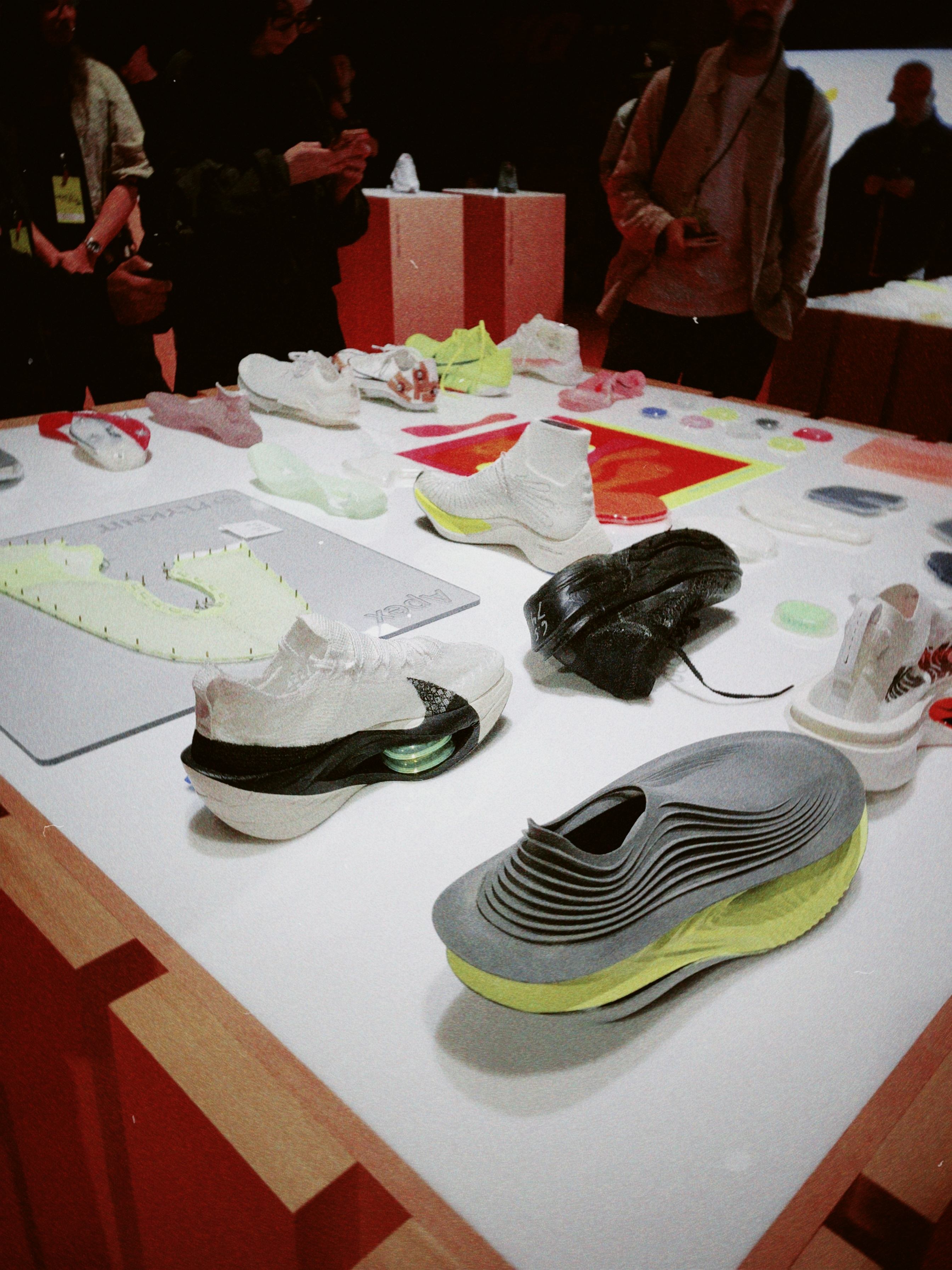
Air technology can now be applied to more scenarios | Photo by the Author
The lifestyle business including Sportswear, Jordan and Converse is still a segment Nike cannot ignore. This business was once the main driver of revenue and growth, and the goal of adding $1 billion in new revenue over the next four years is far from ambitious. Therefore, the management's plan is to use a smaller, more focused product portfolio to achieve this $1 billion target.
"Less than 10% of Sportswear footwear revenue comes from new models or updates to existing models... we are cutting the number of shoe models by half... By fiscal 2031, we expect the revenue share of new shoe models to reach around 40%." Amy Montagne, Nike Vice President, said during the presentation.
Of course, reducing supply does not automatically equal creating demand. "Cleaning up the market is a starting point, not a strategy," Elliott Hill said in his speech. In addition to leveraging AI, 3D printing and nearshore production to improve response speed, more focused production also requires advance planning.
"We are organizing Sportswear's merchandise around specific consumer insights and different style preferences, just like we organize the sport performance business." Elliott Hill said during the October earnings call.
Amy Montagne further elaborated that the company has identified three distinct consumption habits among athlete groups, "with different style preferences and self-expression methods". To better respond to these differentiated demands, Nike will focus on promoting three transformations: creating more innovative and differentiated products; deepening connections with local cultures; and establishing a replicable full-price demand growth model.
We got a glimpse of part of the plan during the subsequent Sportswear Breakout session.
The first group of people are generally obsessed with retro sports culture and Nike's classic silhouettes. At the front of the exhibition space are the Moon Shoe in beige and black-and-white colorways. This old shoe model born in 1971 was first released as a regular model only this April, priced at $105. Opposite are the "Studio Fleece apparel series with the fastest growth rate in history", Birkenstock-style AJ slippers, and next to them are those classic AJs in different colorways.
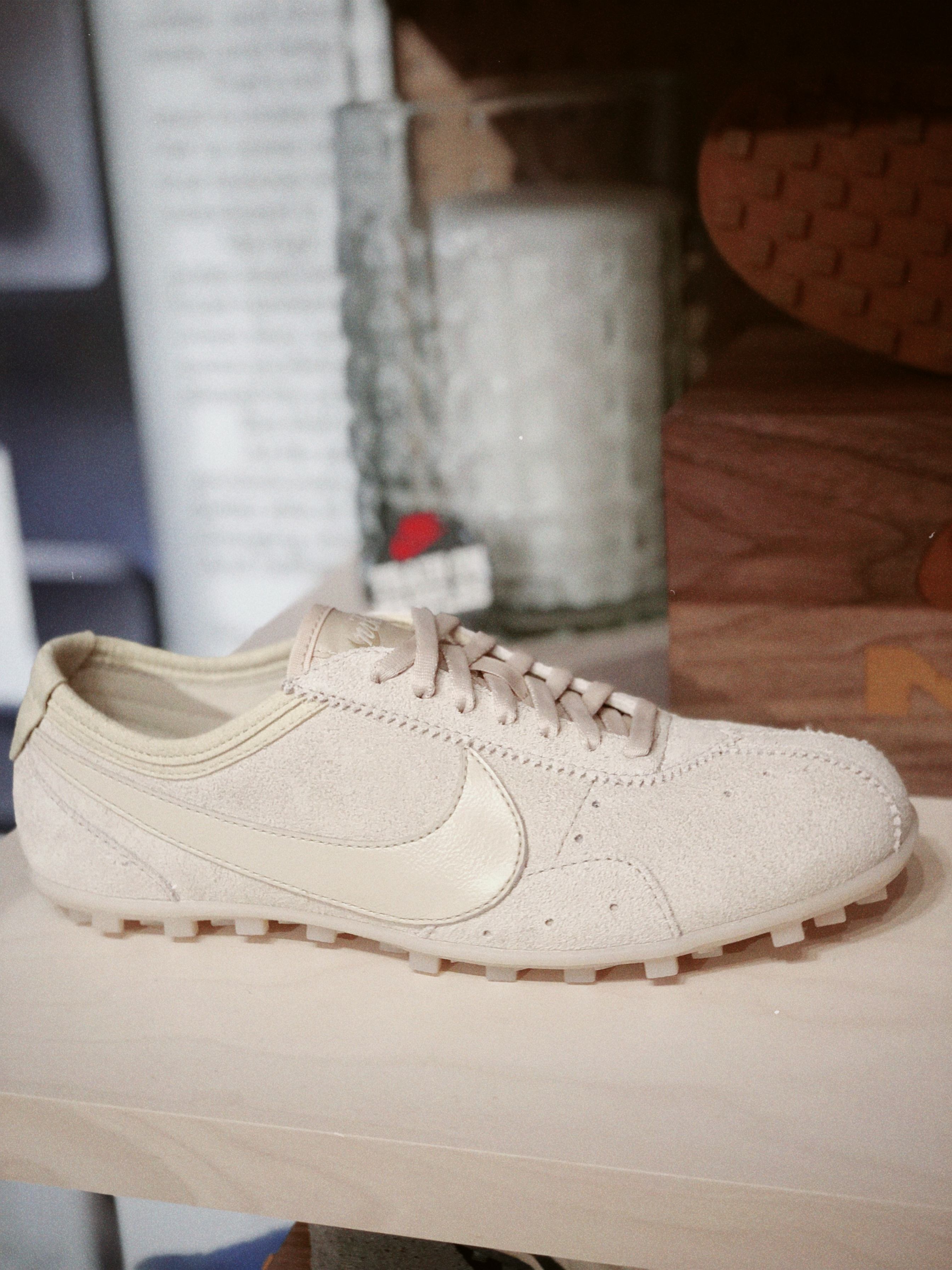
The initial momentum of Nike's Moon Shoe dates back to 2025, with a collaboration with designer brand Jacquemus | Photo by the Author
The second group of people may be slightly older, love the outdoors and nature, and pursue low-key and practicality beyond performance. A whole wall of the showroom is hung with parkas, coach jackets, short down jackets and flight jackets made of performance fabrics, with regular cuts suitable for commuting, far less avant-garde than the previous NikeLab and Japanese streetwear collaborations.
The third group are very young consumers living in cities like Seoul, London and Shanghai, who are extremely sensitive to trends and styling. These products are developed by Nike's local teams, covering layered mixes of sportswear and formal wear, silhouette-cut bottoms, the use of Y2K and retro elements, and stylized processing of special fabrics.
Montagne's "win city by city" has taken concrete shape here: marketing budgets flow more to local creators and communities, and local teams have greater say in products and merchandise portfolios.
More Localized, But More Popular?
China once again became the focus of analysts' questions at Investor Day. The Greater China region is Nike's second largest national market after the United States, and also the market under the most obvious pressure at present. But the market size is still growing. According to Nike's estimates, the current size of the sportswear and footwear market in Greater China is close to $67 billion, and it is expected to reach about $80 billion by 2030, with an average annual growth of about 5%.
"Among the 23 key countries, there are obviously a few special ones, and China is at the top of the list," said Cathy Sparks, Nike Group Vice President and Greater China General Manager, in an exclusive interview with 36Kr after the speech.
This October, when Nike announced the PACE reform, it unveiled a new regional structure: starting from fiscal 2028, the four major regions will be merged into three. North America and Latin America will be merged into the Americas region, Greater China and Asia Pacific will be merged into the Asia Pacific and Greater China (APGC) region, and the Europe, Middle East and Africa region will remain unchanged.
Many previous reports interpreted this adjustment as a "downgrade" of the Greater China region. But according to 36Kr's understanding, the Asia Pacific region headquartered in Singapore has not yet announced a leader, and for a long time in the future, the operational focus of this region will still be the Greater China region. Cathy Sparks also said in her speech that after being incorporated into APGC, the China business headquarters will still be located in Shanghai.
Earlier this year, Nike formed a local original product team in Shanghai, and its first capsule series was launched on November 12. The series includes a total of 10 new styles under the Nike Sportswear and Jordan lines, taking 122 days from initiation to launch, less than half of Nike's global apparel development cycle.
The reason for starting with these two product lines, as Cathy Sparks explained, is: "We know we are not meeting the unique needs of this segment of consumers in China, so we first directed the team there." She expects that due to the fast-changing styles of Nike Sportswear and Jordan series, about half of this product line will be created by the local original team in the future. By fiscal 2028, the local original team will grow to more than 100 people, double the current size.
Flavia Cervantes, Nike Greater China Vice President of Local Original Product Teams, previously revealed in an exclusive interview with 36Kr that the local series will expand to more professional sports fields in the future. Cathy Sparks confirmed this statement and listed specific directions: football, children's products, and racket sports that are growing rapidly in China (tennis, pickleball, platform tennis).
"We have also started to explore what a local original outdoor series could look like." After that, the local original team will also cooperate with the global team to develop lifestyle footwear, "I believe that by then, these products will resonate not only in China, but also in more parts of Asia."
Products that fit the habits of young consumers and strictly control supply volumes are performing well at present. Cathy Sparks revealed that the two new retail concepts launched this year, ACG Base Camp and NikeSKIMS pop-up store, have received "very strong" feedback