New Progress of Google "RSI": Achieve Sustained RSI Through "Self-Improving Memory"
Once the model is switched, the carefully optimized agent harness may immediately fail to adapt to the new environment. A harness evolved specifically for Claude may even bring negative returns to Gemini. Therefore, after model migration, the inherited modifications need to be re-evaluated to determine which ones are still valid and which need to be revised.
The harness manages the agent's context, tools and execution flow. Recursive Self-Improvement (RSI) will propose, evaluate and filter modifications based on feedback, but if only the final harness is carried during migration, there is often a lack of modification reasons, expected goals, test results and evaluation scenarios, leading to repeated trial and error, and even incorrect modification of inherited components.
To this end, Google team proposed "Self-Improvement Memory" (SIM). It is oriented to the optimizer responsible for optimizing the harness, and saves the experience in the improvement process. They refer to the setting of continuing to optimize the harness after the benchmark or strategy model changes as "Continuous Recursive Self-Improvement" (CRSI).

Paper link: https://arxiv.org/abs/2611.18856
Model change is only one of the scenarios. Changes in task data may also require adjustments to the original fixes. In the text classification experiment, the FewShotAll harness evolved in the source phase has a starting score of 72.92 on the target test suite, which is lower than the 75.72 of the initial version. The task completion level that originally only checked whether the command was executed successfully may also need to further check whether the feasible solution is optimal.
Facing these changes, SIM groups the modifications according to the harness problems they handle. Each group of records includes modification reasons, expected results, actual observation results and evaluation scenarios. Both the proposer who proposes modifications and the selector responsible for filtering can access this information to judge whether the previous changes should be retained, revised, replaced or deleted.
This memory will also be continuously updated with optimization. New problems correspond to new entries, and subsequent attempts and results under the same problem are appended to the existing records. In this way, the optimization in the target phase can not only use the experience accumulated in the source phase, but also continue to record new attempts.
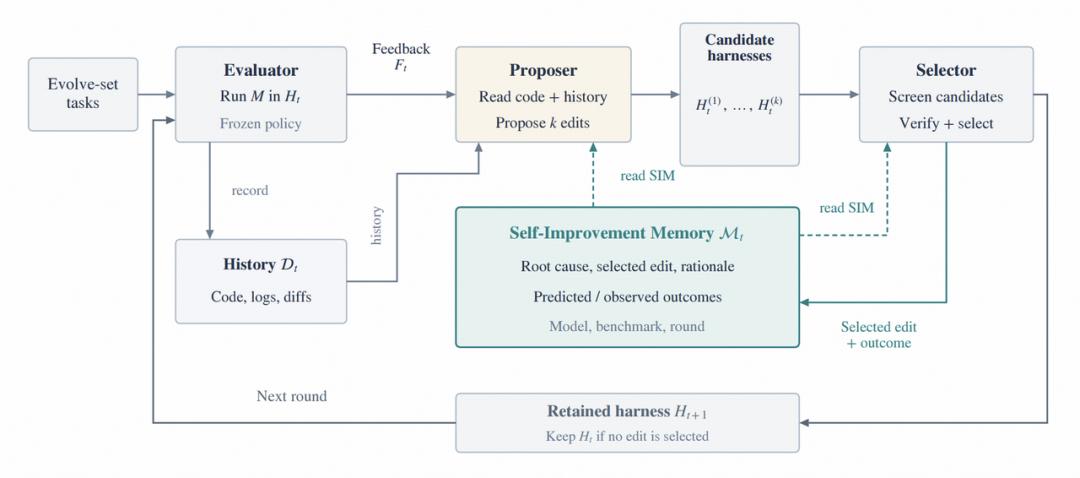
Figure | SIM in the outer optimization loop of agent
CRSI distinguishes two types of transitions. Cross-dataset continuous optimization keeps the strategy model fixed and changes the benchmark test. Cross-model continuous optimization keeps the benchmark test and data division fixed and changes the strategy model. Both types of settings require the harness in the source phase and target phase to retain compatible executable interfaces, so that existing optimization methods can continue to adopt the original proposal, evaluation and filtering processes.
In order to investigate whether the improvement experience is helpful for subsequent optimization, under the migration conditions, they compared the complete SIM, the one that only carries the harness, and the one that only retains the root cause of the problem; all three share the same source evolution harness. In addition, Cold Start starts from the seed harness, and matches the number of optimization rounds and candidate solution budget.
They conducted experiments in 4 fields. The final score of the complete SIM in 6 cross-dataset settings and 4 settings migrated from Opus to Gemini is higher than that of continuous optimization that only carries the harness and only retains the root cause of the problem. The comparison results support their proposed practice of continuing to retain modification history and evaluation results beyond problem diagnosis.
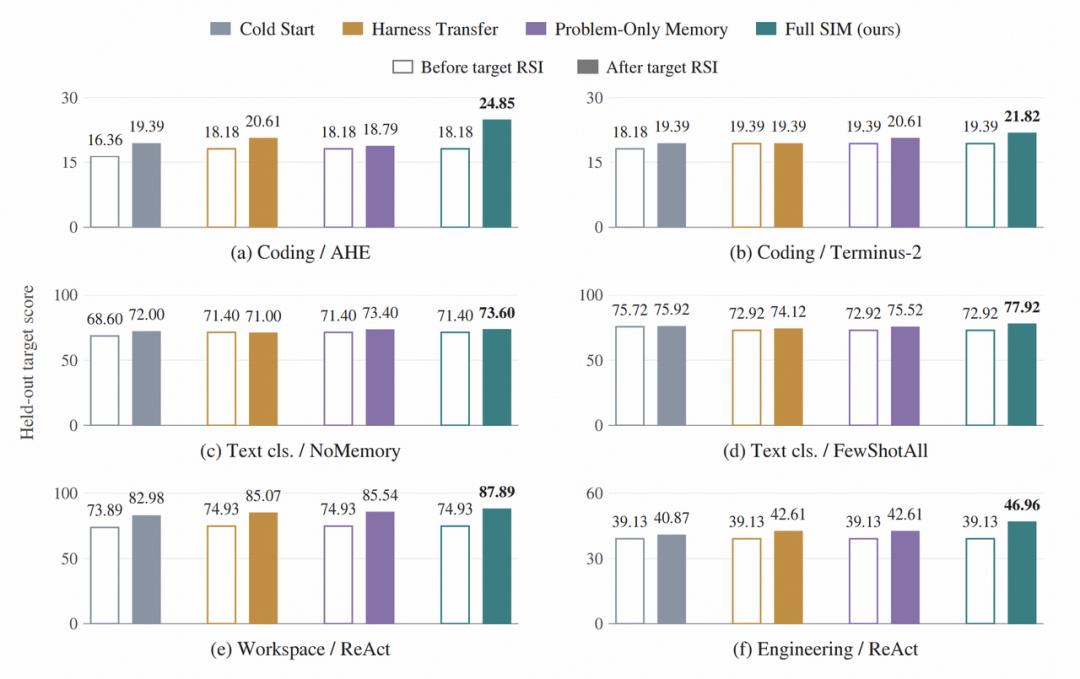
Figure | Cross-dataset CRSI
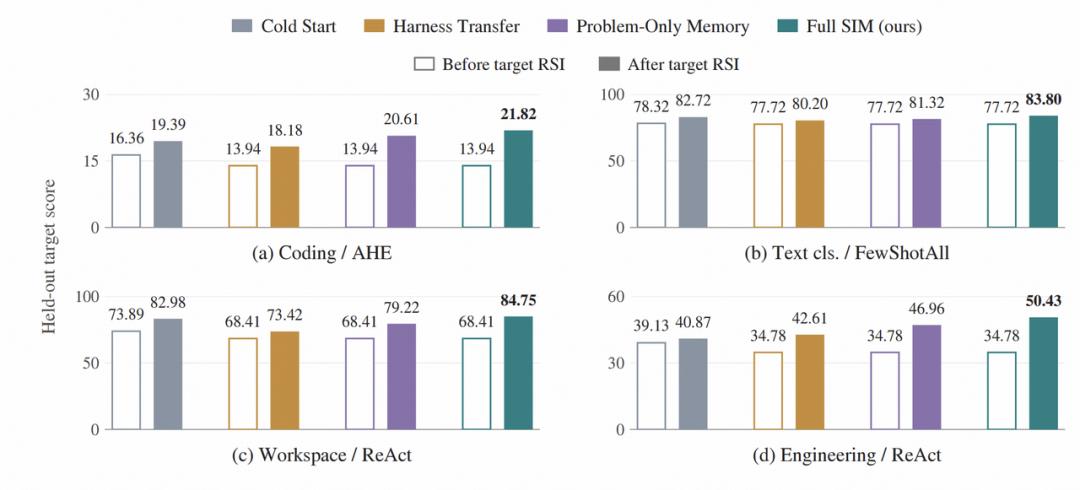
Figure | Cross-model CRSI from Opus 5.5 to Gemini 3.8 Flash, with benchmark test and data division kept fixed
Aiming at the differences between independent optimization processes, they also carried out 10 groups of paired comparisons in the programming field. Each group of subsequent optimizations starts from the harness obtained from the same independent source phase run, comparing the two conditions of using SIM and only carrying the harness. SIM achieved improvements in 9 of the groups, with an average final score 2.36 points higher and a p-value of 0.003.
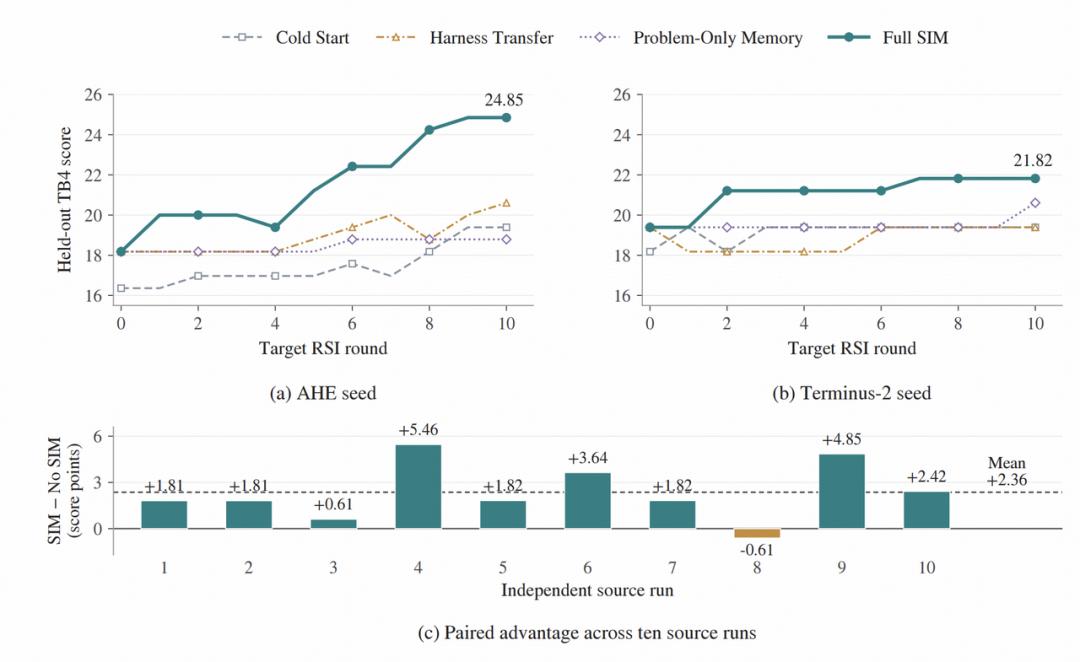
Figure | Programming optimization, TB2.1 → TB4
Of course, this study also has some limitations. Limited by the calculation budget, independent RSI repeated experiments are concentrated in the programming field, and each condition in other fields is run only once. The study covers settings with compatible harness interfaces, and the planning and search process of the optimizer remains fixed. In addition, these comparisons evaluate SIM as a complete process, including both inherited memory and memory updates in the target phase optimization.
This article is from the WeChat official account "Academic Headline" (ID: SciTouTiao), written by Zhang Jiayi, and published with authorization from 36Kr.