K-shaped Differentiation in the 2026 Software Industry: Who Is Rising and Who Is Disappearing
In early 2026, a phenomenon that is easily misread emerged in the global software industry.
On one hand, there is widespread panic that "software will be eaten by AI": enterprises can use AI for programming and build their own internal systems; AI Agents are replacing the menus, forms and seats of traditional SaaS; valuations of software companies have dropped sharply.
On the other hand, some software companies are hitting new growth records.
In October, Reuters reported that the US Software and Services Index hit a new high in 2026. The performance of Salesforce, ServiceNow and Accenture exceeded expectations, and the annual increase of cybersecurity companies CrowdStrike, Fortinet and Palo Alto Networks even reached three digits.
This is not a misjudgment of the industry, but a sign that the industry is diverging.
AI does not push all software to the same end point, but splits the software industry into two curves with completely opposite directions.
The upward end is equipped with real business processes, data assets, industry knowledge and continuous delivery capabilities; the downward end still relies on simple functions, number of seats and low-threshold replication.
This is the K-shaped divergence of the software industry in 2026.
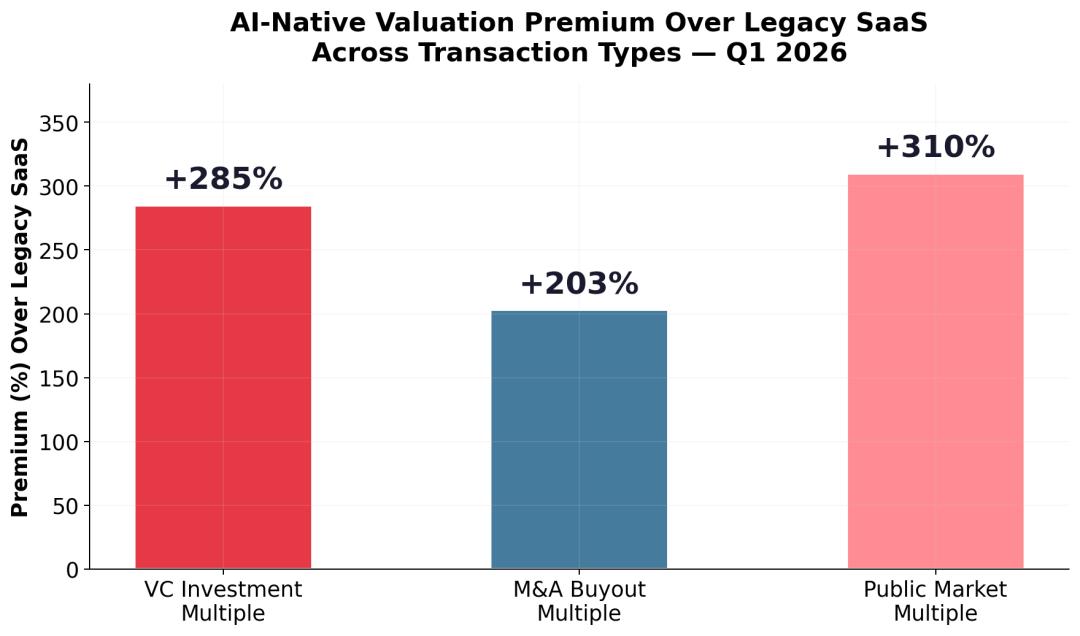
Illustration: Valuation premium of AI-native software relative to traditional SaaS. Data source: SaaSRise The AI Software Valuation Report 2026.
I. The software industry has not disappeared as a whole, and what disappears first is the "old value of software"
At the beginning of this year, the software sector once suffered a sharp sell-off.
The US Software Index fell by more than 26% from the end of January to the low point in April, and the market called this round of decline "SaaSpocalypse". Investors are worried that enterprises no longer need to buy software, but can generate software themselves with AI.
This narrative is not completely unreasonable. If a product only moves manual processes to web pages and provides several forms and approval buttons, AI programming will indeed reduce the cost of replacement.
But the point is, when enterprises buy software, they never only buy the interface.
Enterprises are also purchasing data structures, permission systems, system integration, compliance capabilities and responsibility assumption after errors.
Therefore, what is really eroded by AI is not all software revenue, but the most easily replicable part of the value in software.
This is also why the software index later rebounded. In the earnings season from April to May, ServiceNow recorded revenue of 3.77 billion US dollars in the first quarter of 2026, a year-on-year increase of 22%; Salesforce's Agentforce achieved annualized recurring revenue of 1.2 billion US dollars, a year-on-year increase of 205%.
The market rediscovered that:
AI will reduce the production cost of software, but will not necessarily reduce enterprises' demand for reliable business systems.
II. The first upward line of the K-shape: evolving from "functional software" to "business execution system"
Software in the past was mainly responsible for recording.
CRM records customers, ERP records orders, customer service systems record work orders, and financial systems record vouchers.
After AI is introduced, enterprises hope that software can further participate in judgment and execution: predict customer churn, arrange service tasks, automatically generate quotations, identify abnormal transactions, and even directly complete part of business actions within the authorization scope.
This creates a watershed.
Some software only adds a chat window, where the system gives a response after the user sends a question; other software embeds AI into the real workflow, enabling AI to read business data, call tools, trigger approvals and complete result delivery.
The former is function upgrading, while the latter is system reconstruction.
In the future, the pressure faced by traditional software enterprises will come from large model costs, Agent product investment, hybrid pricing and competition from AI-native companies; but at the same time, task-based Agents may also drive the continued growth of the application software market.
According to Gartner's forecast, by the end of 2026, about 40% of enterprise applications will be connected to task-based AI Agents, while this proportion was previously less than 5%.
This means that the future competition among software enterprises is not "whether there is AI or not", but whether AI can enter the business closed loop.
A truly valuable AI CRM should not only help salespeople write emails, but also be able to identify customer signals, update customer status, arrange next actions, and let salespeople know the basis for each judgment. AI ERP should not only generate reports, but also be able to detect inventory anomalies, propose solutions, and trigger approvals when payment and price changes are involved.
The evolution of software from "recording system" to "execution system" is the first upward line of the K-shape.
III. The second upward line of the K-shape: vertical software is gaining new moats
The most easily replicated capability for AI is general capability, while the hardest one to replicate is industry context.
A general model can generate contract summaries, but it may not understand the claim nodes in construction projects; it can generate medical texts, but may not understand the compliance boundaries of hospitals; it can analyze supply chain data, but may not know how to divide delivery responsibilities in a certain industry.
Therefore, vertical software with deep industry data and complex business processes may gain greater value precisely because of AI.
The advantages of vertical software come from industry workflows, proprietary data and deep embedding in customer operations. Investors and acquirers are focusing on four key points: whether the core platform is stable, whether the data is unique, whether AI brings verifiable returns to customers, and whether AI functions can maintain reasonable profits.
This is also an important contrast:
The narrower the industry software seems, the less likely it is to be replaced by general AI.
Because what they master is not a set of simple functions, but a complete set of industry operation modes.
For example, software for construction, logistics, medical care, law, field service and supply chain is shifting from "post-event recording" to "prediction and disposal". Equipment maintenance, cargo delay, customer churn and expense violation all require long-term training with industry data.
When AI is embedded in these software, what customers buy is no longer a tool, but a set of industry decision-making infrastructure.
IV. The third upward line of the K-shape: security, data and infrastructure are rising in value
AI makes software easier to generate, and also makes enterprises more worried about software abuse.
Who can access the data? Which interfaces can Agents call? Will the model take sensitive information out of the system? After an automated action goes wrong, can it be paused, rolled back and held accountable?
These issues have led to a rapid rise in the value of security, identity, data governance, observability and compliance systems.
The growth of traditional security demand also lies in the fact that AI expands the attack surface, and also expands enterprises' demand for identity control, model security and automated defense.
In the past, the software industry emphasized "getting things done faster". In the AI era, another requirement is added: getting things done within controllable boundaries. This will bring a new layer of software value:
- Whether the data is traceable;
- Whether the permissions can be subdivided;
- Whether there are logs for Agent actions;
- Whether high-risk actions can be manually taken over;
- Whether business results can be audited.
These capabilities are not necessarily the easiest to demonstrate, but they are the easiest to enter the core budget of enterprises.
V. The downward end of the K-shape: three types of software are being repriced
The first type is software that only has functions but no processes
If the core value of the product is only to generate a text, sort out a form, or complete a simple query, AI can easily turn it into a model call or internal script.
Such products must enter the real workflow of customers as soon as possible, otherwise their functions will become more and more similar, and the price will get lower and lower.
The second type is software that only has seats but no results
In the past, software was charged by the number of users. As long as employees logged in, the software was valuable.
But when an Agent can replace multiple low-frequency users, customers will start to ask: why should I pay for each seat? What business results does this system actually bring?
This will force SaaS companies to rethink their billing methods, gradually shifting from seat-based charging to task-based, usage-based, result-based and hybrid models.
The third type is software without data and customer relationships
AI can replicate functions, but it cannot easily replicate long-term accumulated data, customer trust and organizational processes.
On the contrary, if a software company has neither unique data nor deep embedding in customer business, and can only rely on advertising, traffic and low-price customer acquisition, its defense capability will become weaker and weaker.
Business models that are truly AI-resistant usually have five characteristics: deep embedding in key processes, mastery of data or data rights, vertical industry capabilities, scenarios with complex supervision and compliance requirements, or combination of software with services and hardware.
These five points essentially answer the same question: why can't customers easily replace you?
VI. China's software industry will not disappear as a whole, but will enter a more brutal stratification
The fundamental situation of China's software industry does not show "overall disappearance".
According to industrial data cited by 21st Century Business Herald, in the first four months of 2026, the national software business revenue increased by 10.9% year-on-year. However, the profit growth rate of the industry is significantly lower than the revenue growth rate, and AI R&D investment, labor cost and price competition are compressing the profit margin.
The real problem for China's software industry is not whether there is a market, but whether growth can be converted into profits.
Some enterprises will continue to maintain revenue through project-based systems, low-price competition and customized development; other enterprises will embed AI into ERP, CRM, supply chain and financial processes to compete for higher-value business results. The latter is more likely to gain valuation revaluation.
The 2026 China AI Agent Industry Development Research Report released by 36Kr Research Institute shows that China's enterprise-level AI Agent market is moving from proof of concept to proof of productivity, and the market size is expected to grow from 212 billion yuan in 2025 to 3.32 trillion yuan in 2029.
But market growth does not mean that every Agent company can grow.
The companies that finally survive may not be the best at making demos, but the ones that best understand industry processes, can best connect to enterprise systems, can best prove ROI, and can best assume delivery responsibilities.
VII. What enterprises really need to judge is not "whether to do AI"
Under the K-shaped divergence, the most dangerous action for software enterprises is to regard AI as a mandatory function to add; the most dangerous action for enterprise customers is to treat all AI as a substitute for traditional software.
The real questions that should be asked are:
First, has AI entered the irreplaceable business process?
Second, does the product have the customer's own data and operation records?
Third, can the value brought by AI be quantified?
Fourth, can the system control permissions, costs and risks?
Fifth, if customers stop using the product, will their business be immediately affected?
If there are no answers to these questions, the product is likely to be at the lower part of the K-shaped curve. On the contrary, software that embeds AI into key processes, converts industry data into decision-making capabilities, precipitates one-time delivery into continuous products, and allows customers to see clear business results, has the opportunity to stand at the upper part of the K-shaped curve.
Conclusion: What disappears in the software industry is not companies, but software value without results
The software industry in 2026 is not as simple as "AI companies win and traditional SaaS loses".
A more accurate statement is:
AI-native companies are seizing new entry points, traditional software companies are competing for the reconstruction right of old systems; vertical software has become more important because it masters industry context, while general functional software is repriced due to the decline of replication cost; security, data and governance have become new infrastructure, and simple interfaces and functions are gradually losing premium.
Therefore, what software enterprises really need to answer is not "do we have AI", but:
When customers no longer pay for the function itself, which business result can we be responsible for?
This is the most important watershed in the software industry in 2026.
Upward-selling companies sell results, processes and certainty.
Downward-selling companies are still selling functions, seats and imagination space.
This article is from the WeChat official account "ToB Product Innovation Research Society", author: Da D, published with authorization by 36Kr.