Google, nicknamed "North American Soybean Bun", has finally fought its way back to the very center of the AI game table.
Google is truly back this time.
On November 18, Google DeepMind lit up the neon sign of Gemini 4 Neon.
This is the 4th elemental model launched by the Gemini 4 series in just 7 weeks. If you take a look at the official long list of benchmark scores and the actual test feedback from the community, you will find that it is accurately positioned at an extremely comfortable "sweet spot": it has hardcore intelligence close to, even partially surpassing flagship models, while cutting the cost per single task to roughly half of that of its competitors.
In the Reddit tech community, picky developers have rarely given overwhelmingly positive reviews, calling it "incredibly cheap and terrifyingly powerful". Ordinary users who pay $19.99 per month for a Google AI Pro subscription are even more overjoyed: they do not need to upgrade to the Ultra tier, and can directly use the near-flagship level model in the Gemini App. Coupled with the densely launched model and tool matrix throughout November, Google AI, which once lingered on the edge of the card table, has finally returned to the center of the table.
The only thing that confuses programmers around the world is probably Google's mysterious naming convention. From Argon at the end of September, Carbon at the end of October, to Hydrogen in mid-November and the current Neon, the names are neither sorted by atomic number, nor arranged alphabetically or by capability level.
Some serious netizens on Hacker News even listed all the chemical properties to find patterns, and finally complained despairingly that Google probably picked the elements randomly out of a hat, and naming them after Starbucks cup sizes would be clearer than this; domestic netizens have already started urging the release of the 118th element "Oganesson", and joked that reading tech news now requires re-memorizing junior high school chemistry knowledge.
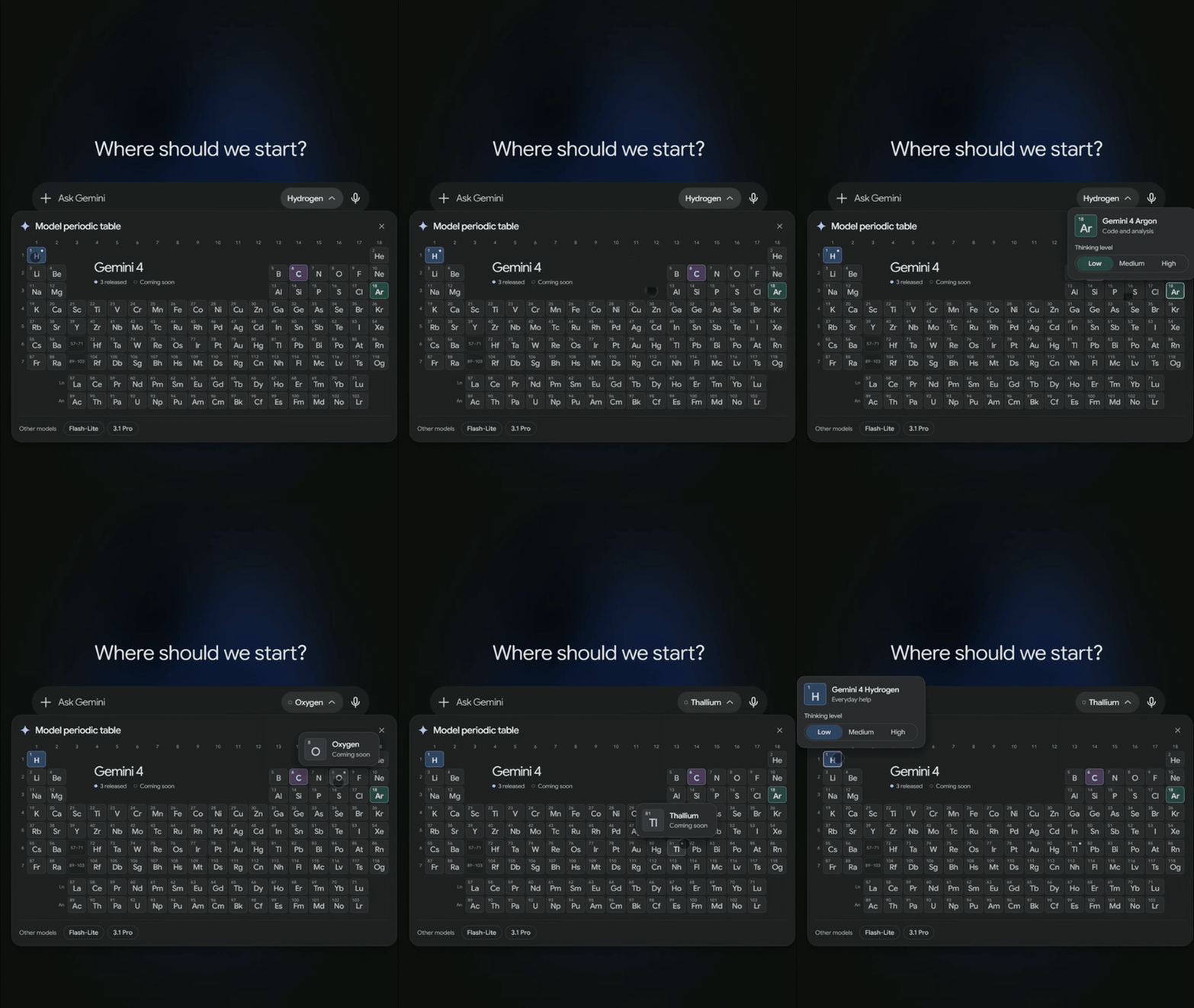
The "periodic table of elements" model selection interface designed by netizens for Gemini 4 | Image source: Internet
01
The "Masterpiece" of Alchemy
Although the name is confusing, Neon has an extremely clear product positioning in the product matrix.
It is accurately positioned between Carbon, the heavy long-cycle flagship, and Hydrogen, the lightweight high-frequency execution model, directly replacing the previous ecological niches of Gemini 3.1 Pro and Argon. Demis Hassabis, Chief Scientist of Alphabet and Chairman of DeepMind, spoke highly of it, calling it "a masterpiece of alchemy".
Real hard indicators support this evaluation. Neon has a 1 million-token context window (supporting a maximum of 512K context in Antigravity) and a maximum output limit of 1 million tokens, supporting native multimodal input of text, audio and video, PDF and spreadsheets. In terms of core reasoning capability, it provides four adjustable thinking depth levels: low, medium, high (default) and xhigh, giving developers great cost control space.
The data from the independent evaluation agency Artificial Analysis best illustrates this point. In the overall AA Intelligence Index v5.0.1 ranking, Neon scored 61 points with the xhigh mode enabled, ranking third in the world after GPT-6.2 Astra and Claude Fable 5.2, surpassing the high mode of its older brother Carbon (60 points), Anthropic's Claude Opus 5.5 (59 points) and OpenAI's GPT-6.2 Sol (57 points). Even if you switch back to the default high mode, it can still get 60 points, and the 55 points obtained in the medium mode still exceed the xhigh mode of the lightweight model Hydrogen, which scored 54 points with all its effort.
What really excites enterprise customers is the scatter line chart of scores and cost per single task. Neon delivers the intelligence of a top-tier flagship at the price of a mid-range mass-market model.
Its output speed reaches about 110 tokens per second, nearly twice that of Carbon (about 57 tokens/s); the average time to complete a single AA benchmark task is shortened from 36 minutes for Carbon to 21.5 minutes, and the cost per single task is fixed at $6.44, about 17% lower than Carbon ($7.76) after the standard price is restored. Under the default high mode on the Antigravity platform, the cost of a single task is even 32% lower than that of Carbon directly.
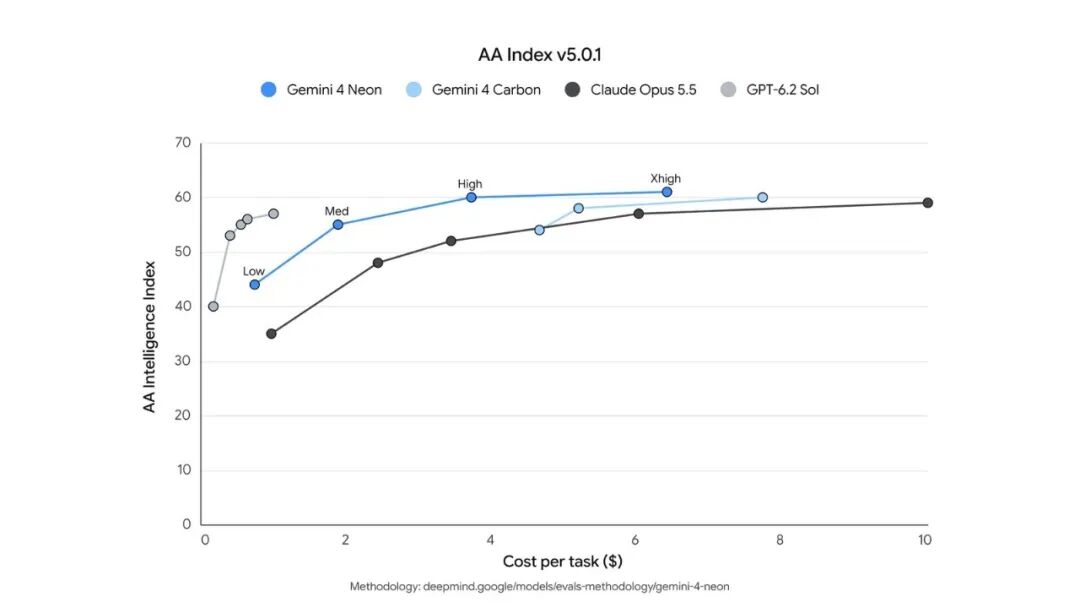
Comparison of intelligence score and cost per single task of each Neon tier with Carbon, Claude Opus 5.5 and GPT-6.2 Sol under AA Index v5.0.1 | Image source: Google
Turning to the most competitive programming and enterprise-level tracks, the cost-performance advantage is even more intuitive. On the AA Coding Agent Index list, Neon took first place with 58.6 points (about 59 points), and its nominal strength is roughly on par with Claude Fable 5.2 and Opus 5.5 (both 58 points) with Claude Code support. But when calculating the economic account, the average cost per single task of Neon under Antigravity CLI is only $6.86, almost half of that of Claude Opus 5.5 ($12.61) and Fable 5.2 ($15.47).
In the segmented tests representing real engineering capabilities, Neon scored 65.4% in CursorBench 4.1, beating Opus 5.5's 58.1%; in the SWE-sweep under the Antigravity environment, it even reached 39.0%, far exceeding Opus 5.5's 10.1% and GPT-6.2 Sol's 8.3%. It took the top spot across the board in the Zapier AutomationBench (56.3%) simulating enterprise automation, Vending-Bench 2 ($16,843) simulating long-term business operations, RiemannBench (84.0%) for scientific reasoning, and the output presentation quality item of AA-Briefcase (1771 Elo); the cybersecurity-specialized version open to Fairwind program defenders also scored a high of 90.5% on SEC-bench Pro.
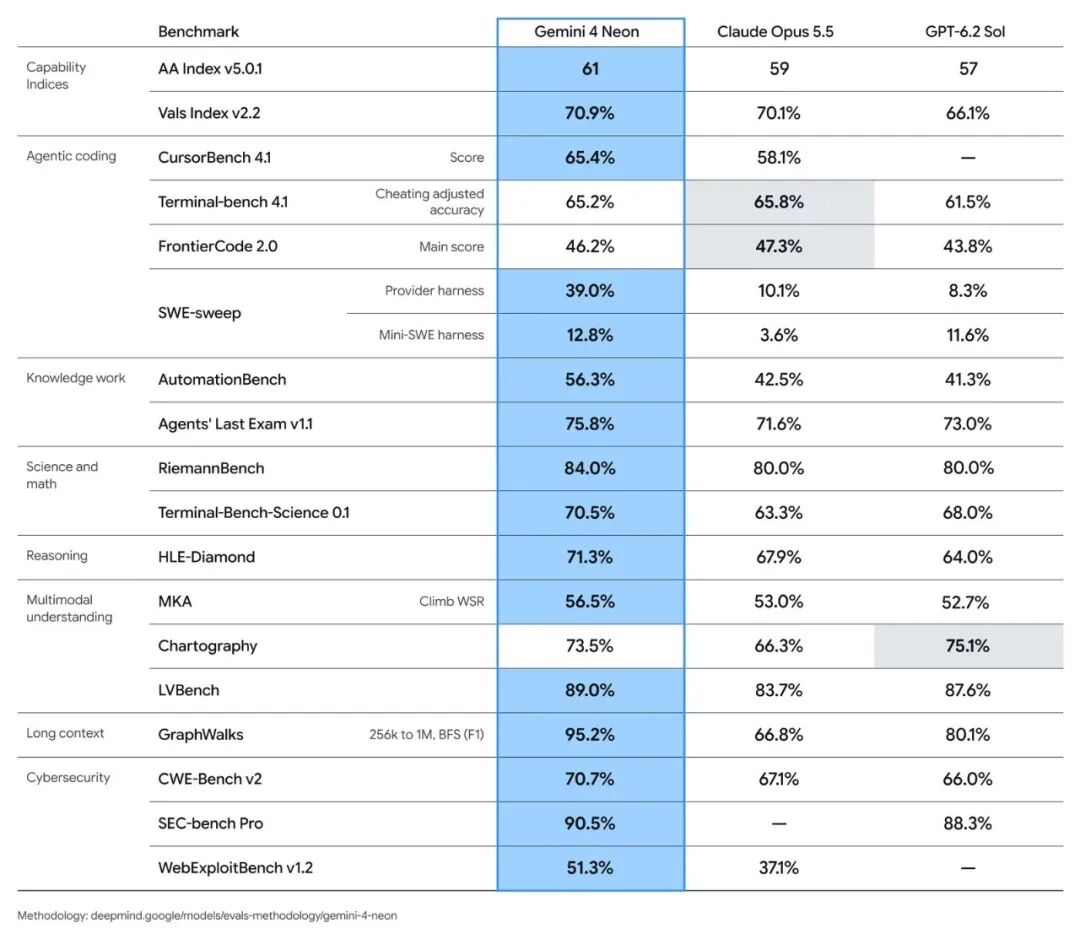
Comparison of Gemini 4 Neon with Claude Opus 5.5 and GPT-6.2 Sol on benchmarks including programming, knowledge work, scientific reasoning and cybersecurity | Image source: Google
However, this new engine is not without flaws.
The first problem is the "verbosity" and latency issue under high tiers. When running the full AA evaluation in xhigh mode, Neon output a total of 283 million tokens, much more than Carbon, and the first response latency also reached 56.51 seconds. For scenarios that pursue extreme response speed, it is obviously wiser to switch it back to medium mode: the time consumption can be reduced to 8.3 minutes, and the output volume will also converge to 62.9 million tokens.
Another episode that developers on the domestic tech forum "Da Lao Shuo" talked about with relish is the brief "price inversion" that appeared before the end of November.
Neon's API was launched directly at the official price of $3 for input and $15 for output (per million tokens, with a 95% discount to $0.15 for cache hits), with no free quota provided; while the flagship Carbon and Argon happened to be in their launch promotion periods of $2 and $10 before November 30, and will not return to the original prices of $4 and $20 until December 1. This means that in the remaining ten-odd days of November, the unit price of the sub-flagship is 50% more expensive than the flagship, which is a slightly humorous commercial time difference.
02
From Solo Stunt Show to Contractor Leading the Team
Benchmark tables are static after all, and what really excites the tech circle is the dominance that Neon demonstrates in real engineering environments.
When you open the real machine demo screen of Google Antigravity, you can intuitively feel what long-range multi-agent collaboration is.
In a project called NEONPUTT 84, Neon starts the /swarm mode, and simultaneously schedules 8 parallel nodes including scaffold, shaders, courses, physics, ui, engine, verifier in the real-time beating task graph. They divided the work to write custom GLSL shaders, a 240Hz physics engine and 8 levels, and built a mini golf game full of 3D synthetic wave style. What's even more amazing is that after writing the code, it took over the browser to click the test interface by itself, aimed, hit the ball, and steadily made a hole in one.
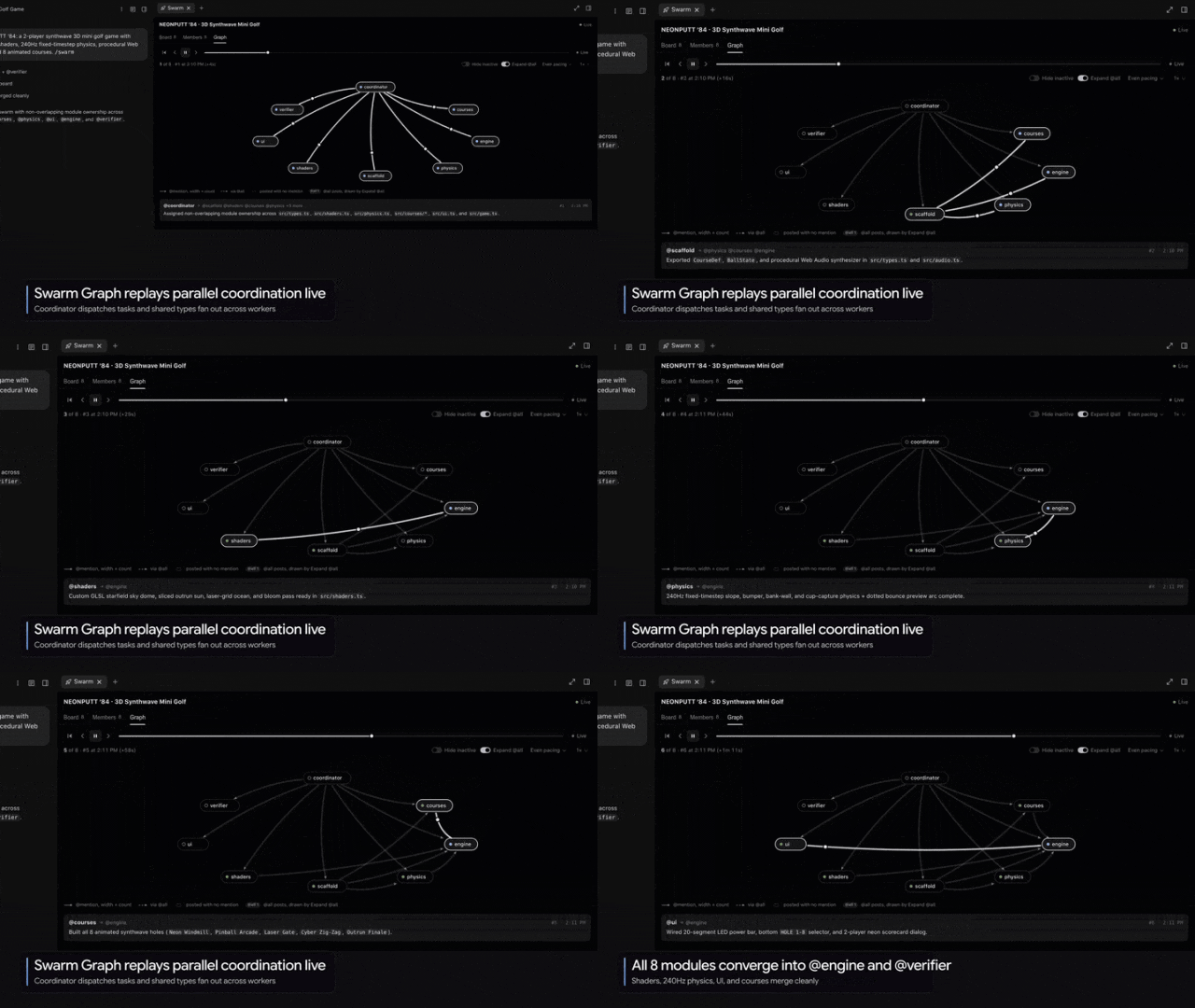
Gemini 4 Neon schedules 8 parallel sub-agents for collaborative development via /swarm in Antigravity | Image source: Google Antigravity
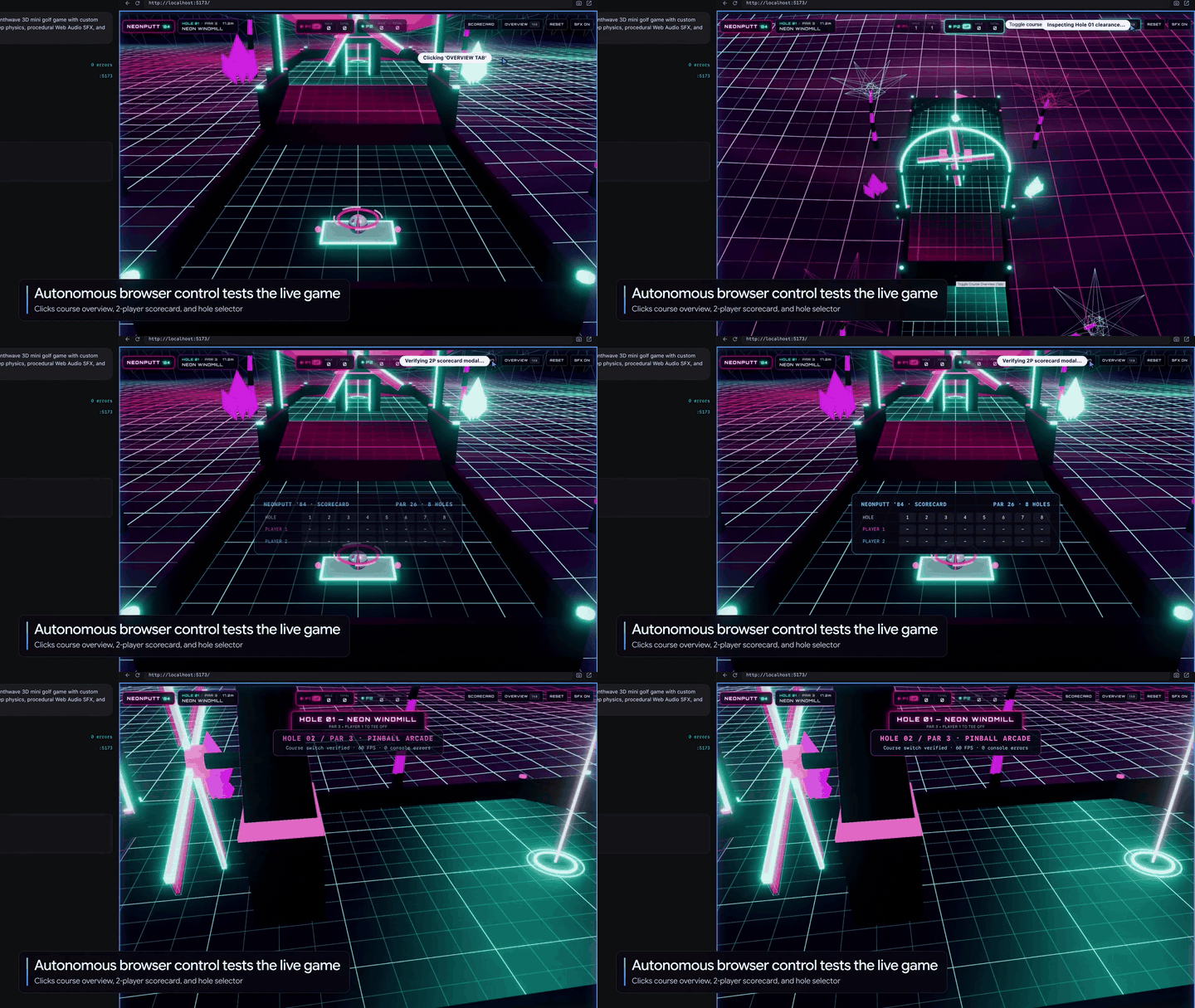
Gemini 4 Neon generates the 3D mini golf game NEONPUTT '84 and independently operates the browser for acceptance testing | Image source: Google Antigravity
If you extend the time frame, its endurance is equally amazing. In the official heavyweight demo, Neon ran continuously for a full 12 hours in Antigravity via /swarm. Relying only on historical archive photos, it reconstructed Alan Turing's study at King's College Cambridge in 1936 brick by brick in 3D space, and even ran a truly interactively operable general Turing machine on that virtual desk.
On the YouTube channel CHOOSETO.AI, a developer who just joined Google released a large number of first-hand actual tests based on early internal test permissions, and simply skipped all the benchmark tests. In the video, Neon directly drew a fine 3D dragon with a single SDF mathematical formula, generated an animated SVG peacock with a single file, and easily converted an old 1959 2D floor plan into a 3D house that you can walk into and explore. Switching to the hardcore backend scenario, it independently deployed an on-duty Agent on Google Cloud Run, and quickly completed rollback when facing an artificially crashed application; it can even run a binary galaxy collision simulation on DGX Spark, or handwrite neural network weights directly without training.
In addition to rolling up its sleeves to do heavy work by itself, Neon's smartest evolution is that it has learned to be a "contractor".
This time, Antigravity simultaneously launched the brand new Orchestrator (Neon) dual-model automatic orchestration mode. When encountering a complex multi-file project, Neon sits in the central position responsible for architecture planning and status review, and hands over conventional code modification, package update and test running to the cheap and lightweight Hydrogen; once the execution link gets stuck, the control right will be automatically returned to Neon to revise the plan, completely eliminating the trouble for developers to manually switch models.
Frontline engineering teams have also fully understood its characteristics. The official GitHub Copilot blog specifically mentioned that compared to its older brother Carbon, Neon starts faster, and more importantly, it is more restrained when modifying code: unauthorized random modifications to other parts are greatly reduced, and the fabrication rate of code and tool results also hit a new low in internal tests. In the eyes of early cooperating machine learning research teams, it completely got rid of the problem of "junior researchers" who give up as soon as an experiment fails, and knows how to ask for reasons, find new signals and actively restructure modeling strategies like a seasoned scholar.
03
The Comeback of "North American Soybean Bag"
Looking at its current momentum, it is hard to imagine that only four months ago, Google AI still had a rather ironic nickname on Chinese Internet — "North American Soybean Bag".
Turning the calendar back to around July 2026, that was the lowest point of Gemini's reputation. Due to failures in mathematical reasoning and frequent abstract errors in security reviews, netizens' mockery was everywhere. Gemini 3.5 Pro, which was promised to be delivered in June at the Google I/O conference in May, was delayed, and finally Google could only launch 3.5 Flash to compete with mid-range products of competitors; for a period of time, the name of Gemini could not even be found on the front pages of mainstream coding and Agent rankings. What's more embarrassing is that the model's built-in knowledge base was stagnant at January 2025 for a long time, and was not updated to March 2026 until 3.6 Flash, so it could not even recognize what new versions competitors released, and its intelligence was prone to decline when turning on web search.
Just four months later, the situation has completely reversed.
Throughout November, Google launched an extremely dense set of combined punches. In addition to releasing four Gemini 4 elemental models in 7 weeks, they also simultaneously launched Genie 4, a world model that can generate interactive 3D environments with prompts, Gemini Omni 1.2 Flash that processes long videos at low cost, and tempered Antigravity into a hardcore Agent platform spanning software development, chemistry and information science research. On all major comprehensive rankings, Google finally has the confidence to face the GPT-6.2 series from OpenAI, Claude 5.2 and Opus 5.5 from Anthropic head-on.
How did Google achieve this comeback?

Koray Kavukcuoglu, Senior Vice President and Chief AI Architect of Google DeepMind | Image source: Google
In August this year, Google completed a key organizational restructuring: Demis Hassabis transferred to the position of Chief Scientist of Alphabet and Chairman of DeepMind, and Koray Kavukcuoglu, Senior Vice President and Chief AI Architect of DeepMind, officially took over daily operations and the Gemini roadmap. At The Information's summit in September, Koray said bluntly that "discussing whether we have achieved AGI is not the right question to focus on right now", forcing the whole team to shift their focus back to building reliable practical Agents.
He completely abandoned the old habit of hoarding big moves in private only to be delayed at the end of the year, set the iron rule of "shipping early and iterating frequently", and specially inserted a "mid-training" team that focuses exclusively on programming capabilities between pre-training and post-training.
Melvin Johnson, Head of Post-Training at DeepMind, pointed out that the reason why Gemini models got stuck in the past is that after getting all simple tasks right, no effective learning signals could be generated. To this end, the team built an extremely strict automated reinforcement learning closed loop, which specifically selects difficult cross-repository engineering hard nuts that Agents still stumble on, and puts them into strict sandboxes