Tencent's AI Costs and Organizational Surgery
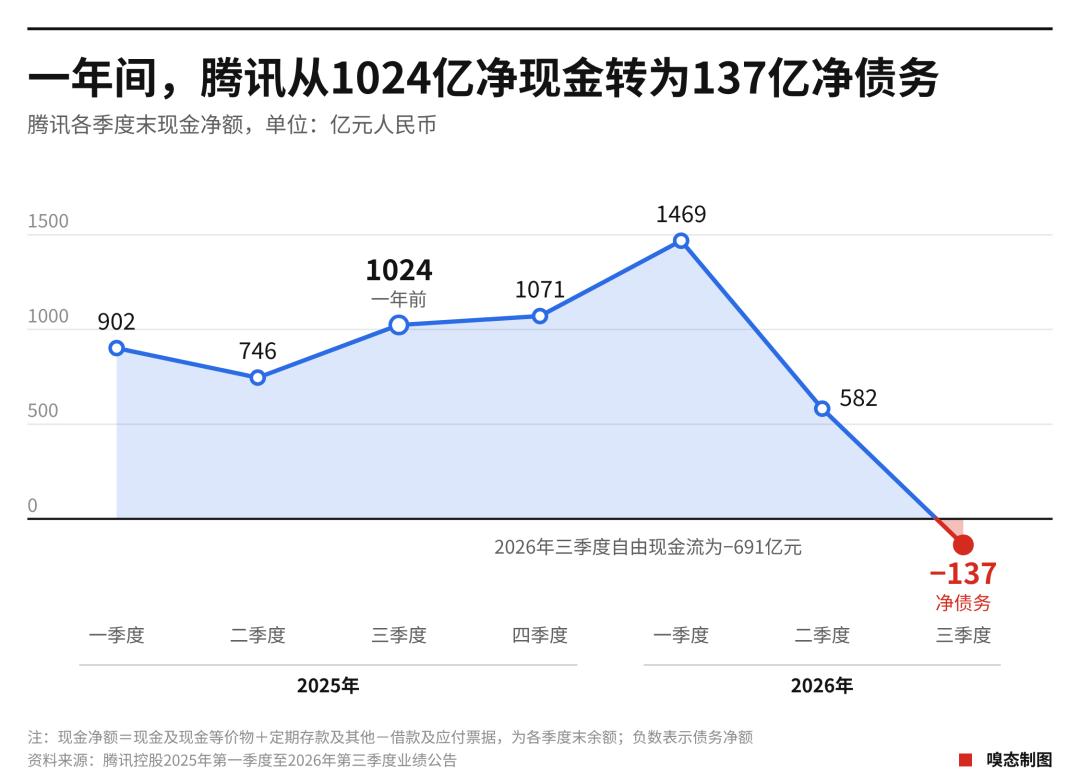
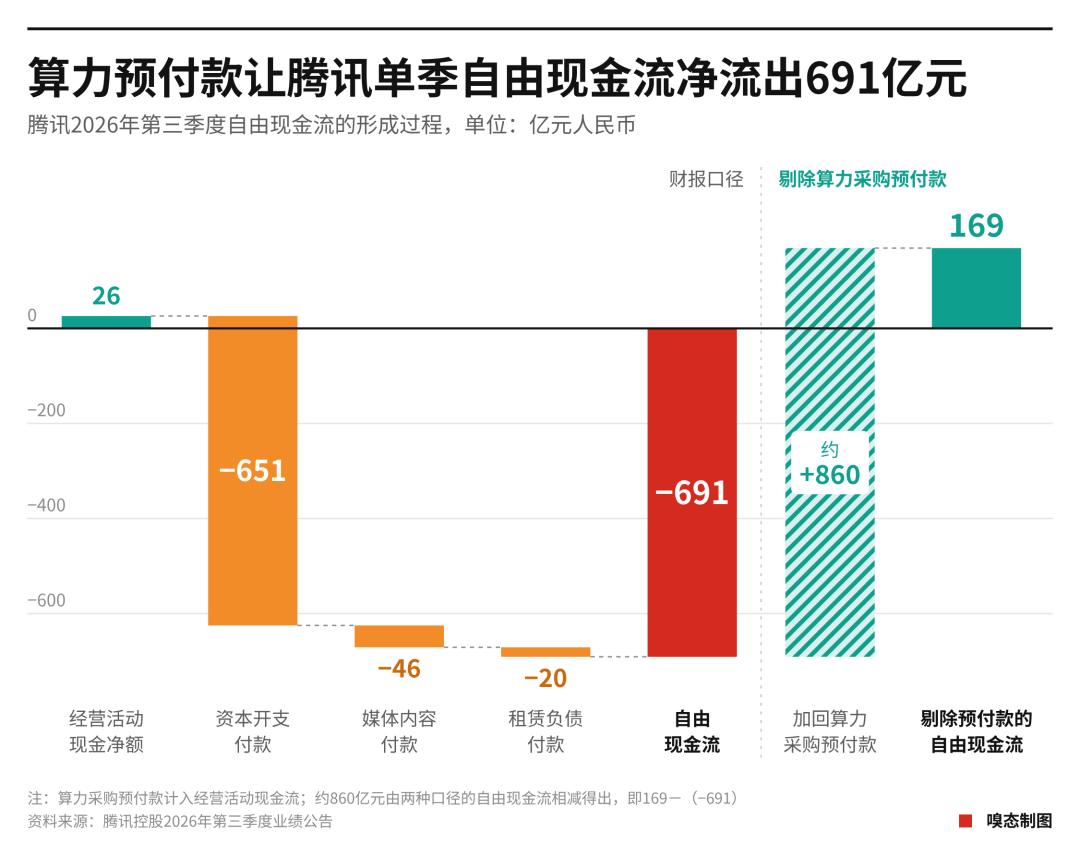
On November 18, Tencent released its financial report for the third quarter of 2026. A year ago, the company held a net cash position of 102.4 billion yuan, but by the end of September this year, it had turned to a net debt of 13.7 billion yuan. Capital expenditure in the third quarter reached 81.4 billion yuan, more than six times the figure of the same period last year. Large advance payments for computing power procurement led to a net outflow of free cash flow of 69.1 billion yuan in the quarter. Excluding these advance payments, the free cash flow posted a positive value of 16.9 billion yuan.
Tencent's main business is still growing. Revenue in the third quarter reached 207.3 billion yuan, up 8% year on year. Excluding new AI products such as Hunyuan, Yuanbao and WorkBuddy, the adjusted operating profit hit 83.3 billion yuan, representing an 8% year-on-year increase. After including new AI products, the operating profit fell to 68.1 billion yuan, with a difference of 15.2 billion yuan between the two statistical calibers.
Massive funds have been heavily invested in computing power, yet employees can no longer be trapped in the old organizational structure. Two days before the financial report was released, Tencent Culture made public the speech notes of Ma Huateng and Martin Lau at the company's 28th anniversary head office LinkTime meeting. The management required core business teams to "reset their mindset", start a new entrepreneurial journey for the AI era, cut down unnecessary management positions, break down departmental barriers, and allow small teams to take on more work.
The financial changes of Tencent and the management's speech focus on the same issue. In the third quarter, the company increased its investment in computing power, models and AI products. At the same time, the management proposed to readjust the division of labor among personnel and the mode of inter-departmental collaboration. Tencent's AI transformation has involved two levels: capital allocation and organizational structure.
Once the financial and personnel authority is put on the table for discussion, it often means that the enterprise has no way to retreat. The current challenge is no longer the speed of business growth, but a fundamental crisis related to survival.
As the management said internally: "In the era of great navigation, you will fall behind if you do not advance; in the industrial revolution, you will be beaten if you lag behind. If we do not invest and embrace the ongoing intelligent revolution, we will be subverted. This is a matter of life and death."
In that case, it is better to take a bold leap forward.
01
The Profit Foundation of Tencent
After 28 years of development, Tencent has accumulated several highly profitable businesses. Looking back at the growth of WeChat, mobile games and Channels, we can all see a similar development strategy: when WeChat was born, QQ value-added services had already taken shape; when mobile games started, the PC game business and social network were at their peak; when Channels was launched, Moments ads had already generated stable cash flow.
Tencent always uses the funds, technology and users of mature businesses to support new products, and after new businesses grow up, they in turn feed the entire group.
Games are the most typical example.
Honor of Kings, which was launched in 2015, has accompanied players for more than ten years and is still an important source of revenue for Tencent. In the game market, it is not unusual for a product to be popular for a year. The difficulty is that ten years later, there are still people willing to open it, purchase in-game items, and continue to play with version updates. Tencent's game team needs to continuously launch new heroes, new gameplay and operation activities to maintain players' interest. The R&D funds invested when the game was launched also continue to generate returns in long-term operation.
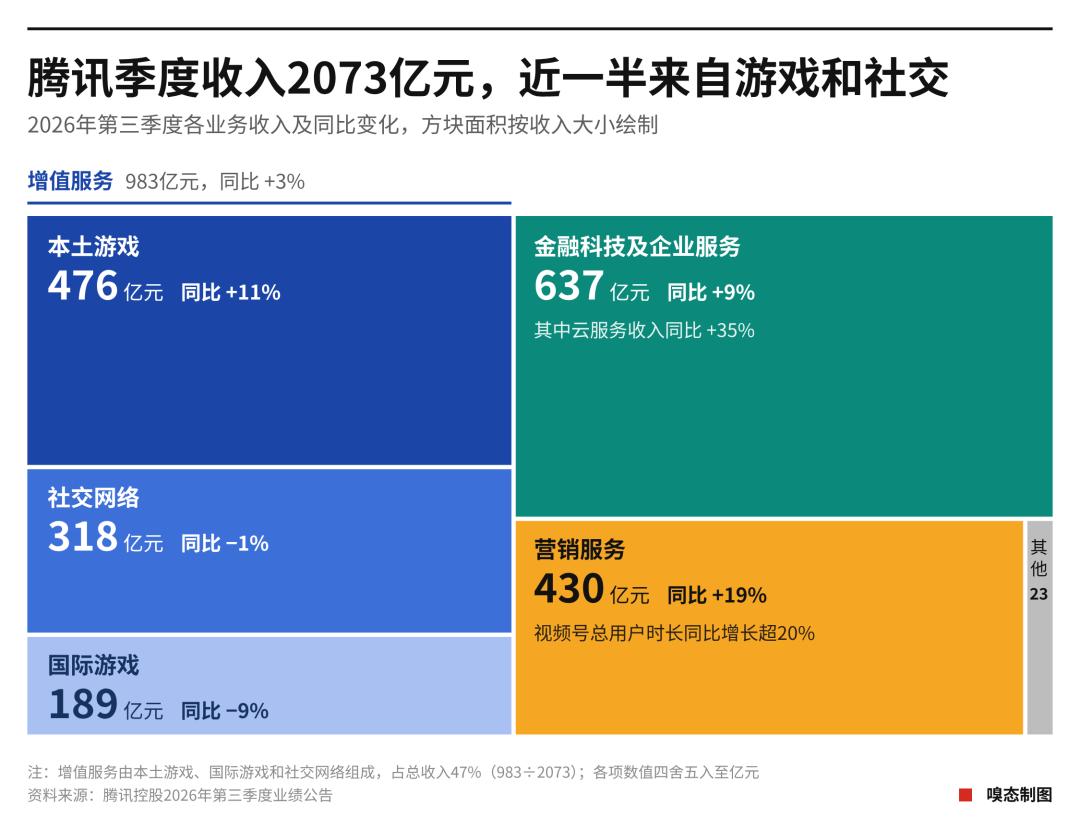
Tencent has successively launched Delta Action and Valorant: Source Energy Operation. The former was launched in 2024, and its daily active users have exceeded 58 million; the latter was launched in 2025, with more than 100 million cumulative registered users. The daily active accounts of both products hit record highs in the third quarter of this year. Together with Honor of Kings, they drove the domestic game revenue to increase by 11% to 47.6 billion yuan.
Interestingly, the profit growth Tencent obtained from these games is faster than the revenue growth. In the third quarter, revenue from value-added services only increased by 3% year on year, but gross profit rose by 7%, and the gross profit margin increased from 61% to 64%. Tencent explained in the financial report that the main reason is the increased revenue contribution of high-margin self-developed games. In contrast, affected by factors such as the outstanding performance of some products under Supercell in the same period last year, the revenue of international games decreased by 9% to 18.9 billion yuan.
Although the performance of domestic and foreign markets varies, Tencent's ability to operate long-term games in China is still generating profits for the company.
WeChat is a different kind of business.
By the end of September this year, the combined monthly active accounts of WeChat and WeChat reached 1.449 billion, up 2% year on year. With a huge user base, Tencent has continuously expanded the range of things people can do on WeChat.
At first, people mainly used WeChat to chat and post on Moments. Later, they could use services through Mini Programs, make purchases with WeChat Pay, and then there came Channels, WeChat Shops and short dramas. Users can watch content, find goods and complete transactions without leaving WeChat.
For advertisers, this change is very practical. A merchant can display products through Channels, receive orders through Mini Programs, and complete transactions via WeChat Pay. Tencent's social network accumulated over many years has gradually connected content, advertising and commodity transactions.
In the third quarter, the total user duration of Channels increased by more than 20% year on year, and Tencent's marketing service revenue reached 43 billion yuan, up 19% year on year. As users spend more time on Channels, the advertising business is also using AI to improve recommendation and delivery efficiency. However, Channels is not the only source of advertising revenue growth. Tencent also generates revenue through Mini Programs, WeChat Shops and other advertising products.
There is a set of figures in the financial report worth pondering. Advertising revenue increased by 19%, but gross profit only increased by 10%, and the gross profit margin dropped from 57% in the same period last year to 52%.
Why did the profit margin decline even as revenue increased? Tencent gave a clear reason: the increase in AI-related operating costs, and the higher content costs generated by short drama services. More accurate ad recommendations consume computing resources; the enriched content supply of short dramas also requires payment. While WeChat can generate more commercial revenue from the same group of users, the cost of operating these new businesses is also rising.
Tencent also leverages its existing customer and technology base in another business. In the third quarter, revenue from fintech and enterprise services reached 63.7 billion yuan, up 9% year on year. Consumer loans and wealth management services drove the growth of fintech revenue, and cloud service revenue increased by 35% year on year. The rising demand from enterprises for AI model services and GPU leasing also brought new revenue to Tencent Cloud.
Looking at games, WeChat and cloud services together, we can see that Tencent's business methods have something in common. After a game acquires users, Tencent continues to generate revenue through long-term operation; after WeChat builds a huge social network, it continuously adds content and transaction services; cloud services use existing technology and enterprise customer relationships to meet new AI demands. The users, technology and operational experience accumulated over the years continue to play a role in different businesses.
In the third quarter, excluding the impact of new AI products, Tencent's adjusted operating profit reached 83.3 billion yuan, up 8% year on year, with an operating profit margin of about 40%. Games, advertising, fintech and enterprise services can still provide a large amount of profits for the company.
But Tencent has already paid high costs for the new round of technological competition. While WeChat, mobile games and Channels can leverage the company's accumulated user and technology base, AI models and applications still need to continuously consume massive amounts of computing power. In the third quarter, Tencent's capital expenditure reached 81.4 billion yuan, more than six times the figure of the same period last year.
02
Computing Power Has Changed Tencent's Business Books
The speed at which Tencent spends money is accelerating significantly.
In the third quarter of 2025, the company's capital expenditure was only 13 billion yuan. It rose to 52.8 billion yuan in the second quarter of 2026, and further increased to 81.4 billion yuan in the third quarter. Within one year, the quarterly capital expenditure expanded by more than six times. The actual capital expenditure paid by Tencent this quarter reached 65.1 billion yuan, up 225% year on year.
An internet company that has long relied on games, social networks and digital content to generate profits is pouring more and more money into computing power infrastructure.
Tencent has not just joined the large model competition recently. In September 2023, the Hunyuan large model was officially released, and then gradually integrated into products such as advertising, cloud services and WeChat. Yuanbao, CodeBuddy and WorkBuddy were also launched one after another.
As model capabilities improve, Tencent needs not only GPUs for training, but also to continuously provide inference services for a large number of users. Every request initiated by a user consumes computing resources in the background. When it comes to tasks such as writing code, processing documents or performing complex operations, the model also requires multiple rounds of calculation and tool invocation. The more users there are and the more complex the tasks are, the greater the computing power required.
WorkBuddy has already made Tencent feel this scale. In the third quarter, this AI office product had more than 10 million daily active users, with an average daily Token consumption of more than 100 trillion. Eight months after its launch, WorkBuddy has achieved considerable usage volume.
But beyond these figures, there is another unpublicized account. Among the more than 10 million daily active users, how many are paying? How much revenue do enterprise customers contribute? How much computing cost does Tencent need to pay to complete a work task?
These figures are related to how much profit WorkBuddy can actually make. The amount of computation behind users opening the software to chat is different from that of letting AI continuously call tools, write code and process files. For Tencent, the expansion of user scale is a good thing, but every model invocation will generate corresponding costs. After the usage of the application grows, whether the revenue can cover the costs of computing, R&D and operation determines its business performance.
The financial report has reflected the cost of new AI products. In the third quarter, excluding businesses such as Hunyuan, Yuanbao, CodeBuddy, WorkBuddy and Xiaowei, Tencent's adjusted operating profit reached 83.3 billion yuan. After including these products, the operating profit fell to 68.1 billion yuan, with a difference of 15.2 billion yuan between the two figures. This is the net impact of the new AI product portfolio on the group's operating profit. Tencent has also invested AI in advertising, games and cloud services, and the related costs and benefits are distributed in other businesses.
Beyond the income statement, Tencent's cash flow has changed even more drastically.
In the third quarter, Tencent's net cash flow from operating activities was only 2.6 billion yuan, and the net outflow of free cash flow was 69.1 billion yuan. Tencent explained in the financial report that large advance payments for computing power procurement affected operating cash flow. If these advance payments are excluded, the free cash flow is positive 16.9 billion yuan.
That is to say, in the face of competition in the entire AI industry, Tencent needs to pay funds in advance to purchase computing resources, and then use these resources through model R&D, application services and cloud business. The money has been paid out, and the related revenue will be gradually generated in subsequent operations.
"The investment is huge because AI development is still in the early stage. All current infrastructure and computing power need to be built independently, and with everyone investing, prices are skyrocketing," mentioned in the Tencent Culture article about the 2026 head office LinkTime meeting.
This has also changed Tencent's financial structure. A year ago, the company still had a net cash of 102.4 billion yuan, but by the end of September this year, it had turned to a net debt of 13.7 billion yuan. Tencent still has a total cash of 525.7 billion yuan and a large number of equity investments on its books, and businesses such as games and advertising continue to make profits, but the scale of funds the company uses for computing power procurement has increased significantly.
I am more concerned about how Tencent plans to use these computing power after purchasing them. GPUs have a service life, servers need to bear depreciation, and chip technology is still being updated continuously. Idle computing resources will increase the unit usage cost; when the usage increases, it is also necessary to consider how much revenue the product can bring. WorkBuddy consumes more than 100 trillion Tokens every day, cloud customers are increasing their demand for AI model services and GPU leasing, and Tencent's internal advertising, WeChat and other products also need computing resources. Different businesses are all using the same type of expensive infrastructure.
Ma Huateng specifically mentioned the input-output ratio of computing power in his internal speech on the company's 28th anniversary. Tencent's financial report also introduced the Hy4 flash model that emphasizes inference efficiency. For Tencent, improving model capabilities can optimize product experience, and reducing inference costs can allow the same computing resources to complete more tasks.
Tencent has invested huge sums of money in building computing power, but which businesses use these resources and what products are prioritized for support is directly related to how much revenue they can generate. Closer coordination of resources is needed between model R&D, cloud services and AI applications. The organizational adjustment proposed by Ma Huateng is also linked to this operational change.
03
Ma Huateng Wants to Change Tencent's Organizational Mode
In Tencent's internal exchange for its 28th anniversary, the core senior management talked about a specific and urgent problem: "Organizational reform needs to be accelerated. In the future, there do not necessarily need to be so many management positions. We must not let cadres who only pass messages, do not want to make progress and occupy resources become obstacles. Mountain-topism and territory awareness must be completely broken. Many grassroots colleagues have the motivation and passion to use AI to give full play to their talents, and they have the opportunity to become very good contributors, but they are constrained by many old structures and organizations. We need to make greater adjustments to this, let more organic small teams do great things, and make the organization change more flexibly."
For a company with many mature businesses, it is not easy to put forward such requirements. WeChat, games, advertising, fintech and cloud computing all have their own product, technical teams and managers, as well as their own business objectives. Such division of labor supports Tencent's huge business system, but when a new product needs to call the technology and resources of other departments, coordination is not so simple. The product team needs interfaces, the technical department needs to arrange manpower, and the business leader also needs to consider their own projects and budgets. When several things come together, multiple rounds of communication are often required.
Tencent once relied on small teams to make important breakthroughs. At the end of 2010, Allen Zhang led a team of about