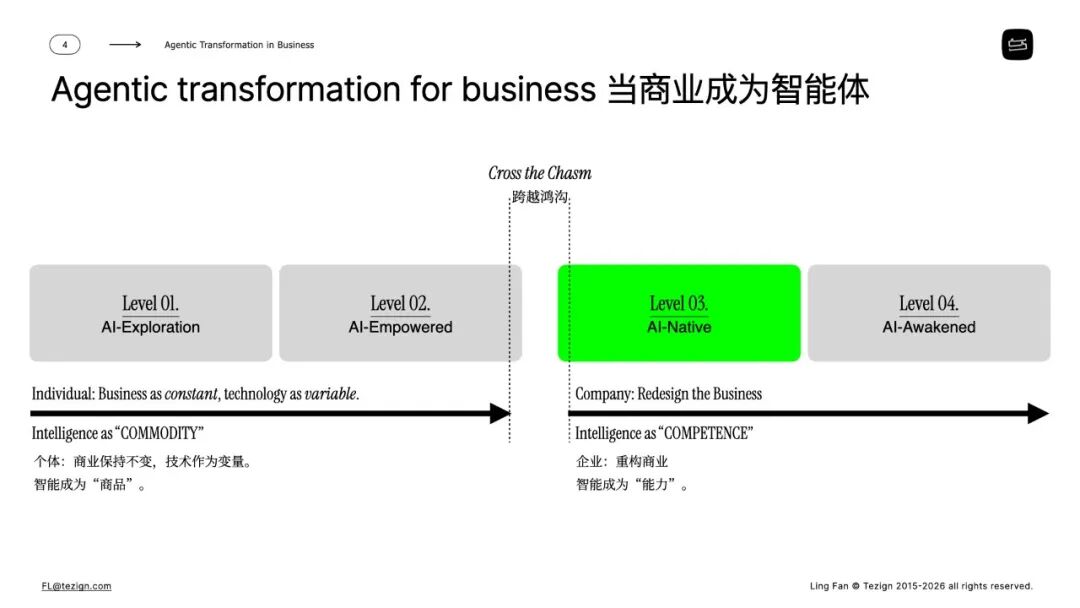
The Agentic Transformation of enterprises needs to go through three leaps.
Over the past year, the speed at which enterprises have deployed AI has far outpaced the speed at which organizations have truly absorbed AI. Models keep iterating, and the invocation volume of agents keeps rising, but the revenue structure, organizational efficiency and decision-making quality of most enterprises have not been rewritten in tandem. The problem does not lie in the lack of technological enthusiasm among enterprises, but in the fact that they often treat AI as an add-on capability rather than a transformation that must be operated and organizationally absorbed.
In this sense, what enterprises are facing today is not a simple technological upgrade, but a management experiment on how the organization rewrites its own operation logic. What truly widens the gap has never been who accesses the model earlier, but who realizes earlier that models can be purchased, computing power can be rented, and even process tools can be outsourced; the only thing that cannot be outsourced is how enterprises understand users, understand themselves, and precipitate this understanding into invocable, correctable, and transferable intelligence.
The Productivity Paradox in the AI Era Has Not Disappeared Automatically
In 1987, economist Robert Solow put forward a famous judgment: traces of the computer age are everywhere, except in the productivity statistics. Today, if we replace "computer" with "AI", this sentence still holds true. Almost all enterprises are discussing AI and almost all are experimenting with AI, but the organizational benefits truly brought by it are still rare.
This is not new. Electrification has also experienced similar twists and turns in industrial history. At the end of the 19th century, a large number of factories had installed electric motors, but the substantial increase in productivity did not really appear until the 1920s. The reason is that most enterprises initially only replaced steam engine drive with electric drive, but did not rewrite the workshop layout, process arrangement and management methods at the same time. What truly released productivity was not "accessing electricity", but reorganizing the factory around electricity.
AI is at a similar moment. If enterprises only embed models into existing positions, what they usually get is only partial speed improvement; but if AI is regarded as the starting point for reconstructing organizational division of labor, judgment mechanism and collaborative relationship, it is possible to give birth to a new kind of organizational intelligence. In other words, what enterprises need to cross is not "whether they can use AI", but "whether they are willing to redesign themselves for AI".
The First Leap: Understand People First, Not Rush to Replace Them
The scarcest resource of an enterprise has never been the output speed of content, but the ability to understand people. Brand managers know which sentence will make users stop, salespeople know at which expression the customer is really hesitant, and the product team knows why a function is liked in testing but not used after launch. These experiences constitute the real judgment assets of the enterprise, but they have long been scattered in individual experiences and organizational inertia, difficult to be reused, and even more difficult to be corrected.
The reason why traditional user research often falls into marginal diminishing returns is that it faces three difficulties at the same time: behavior signals are not equal to real intentions, full-volume data is full of noise, and most researches are often only to verify existing assumptions rather than challenge them. The key change brought by large models is not just to generate text faster, but to make language readable, computable and deducible on a large scale for the first time. Thus, enterprises have the opportunity to move from "collecting feedback" to "understanding why people give such feedback".
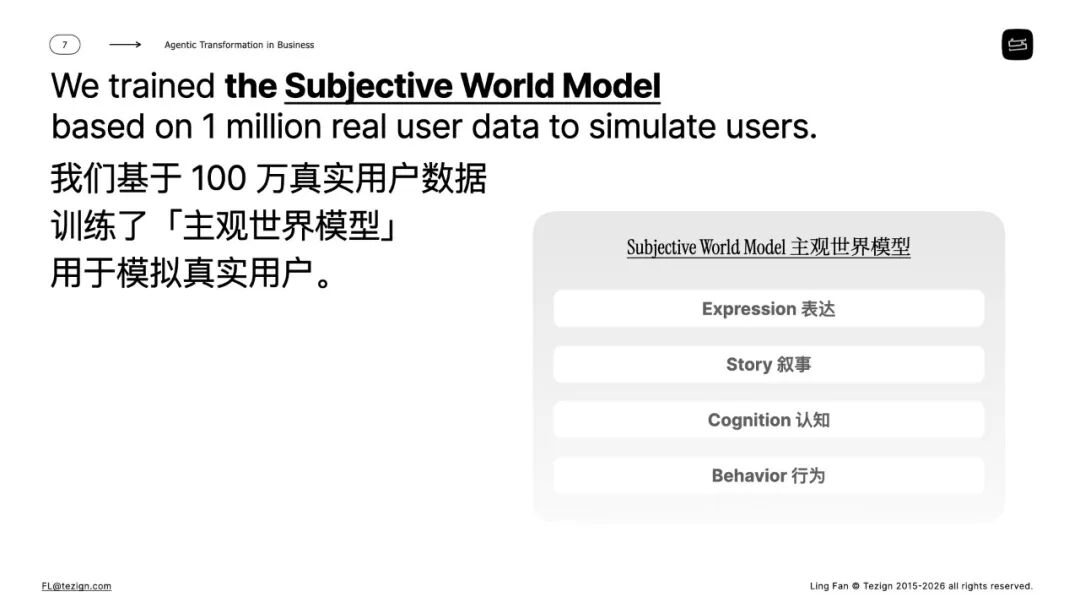
Tezign has trained a Subjective World Model based on data from 1 million real users around the world to model real people. The Subjective World Model's understanding of people includes at least four levels: Expression, that is, what people say; Story, that is, why they express in this way; Cognition, that is, the judgment logic behind it; Behavior, that is, whether these judgments are finally transformed into actions. A consumer may publicly express a preference for high-priced products and give a set of self-consistent reasons, but the actual purchase falls on a lower-priced option. The truly valuable intelligence is not to compress this contradiction into a label, but to accommodate and explain this contradiction.
This is also why enterprises' understanding of people cannot only be built on grabbing data, but must also be built on in-depth interviews, situational observations and real behavior feedback. Once this capability is systematized, user research will no longer be a one-off project, but a mechanism for enterprises to continuously update their own judgments. The first leap in the management sense happens right here: enterprises no longer regard AI as a tool to replace people, but use it as an amplifier to understand people.
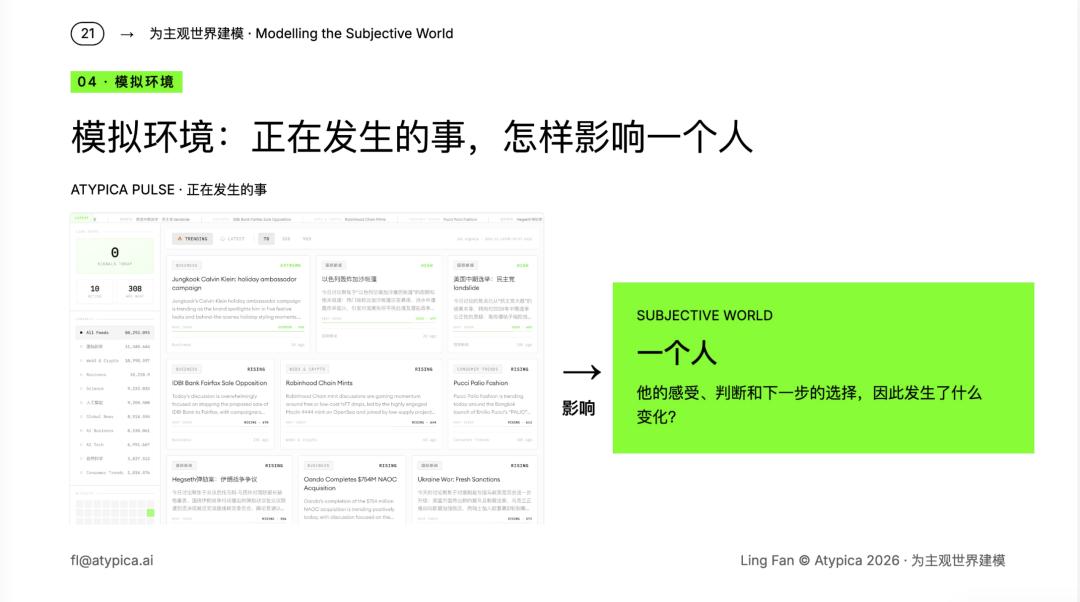
Furthermore, we let this mechanism for understanding people enter the environment where people are. Because to understand a person, you can't just look at the person himself — his current reaction is often determined by the situation he is in.
The Nobel laureate in Economics and Turing Award winner Herbert Simon put forward bounded rationality which gives the reason: People receive limited information, have limited mental power and limited time, so they can't find the optimal solution, and most of the time they only seek "good enough". He compared human rational behavior to a pair of scissors: one blade is human cognitive ability, and the other is the environment he is in. If you only sharpen one blade, you can't cut anything. Therefore, in Tezign's practice, we do two things together: the Subjective World Model simulates how a person thinks specifically, and the Agentic Research Studio simulates the environment he is in, as well as the interaction process between the two — how questions are raised, how situations are set, how ongoing events affect him, and finally go back to real people for verification. Only by putting people back in the right environment can the two blades cut things.
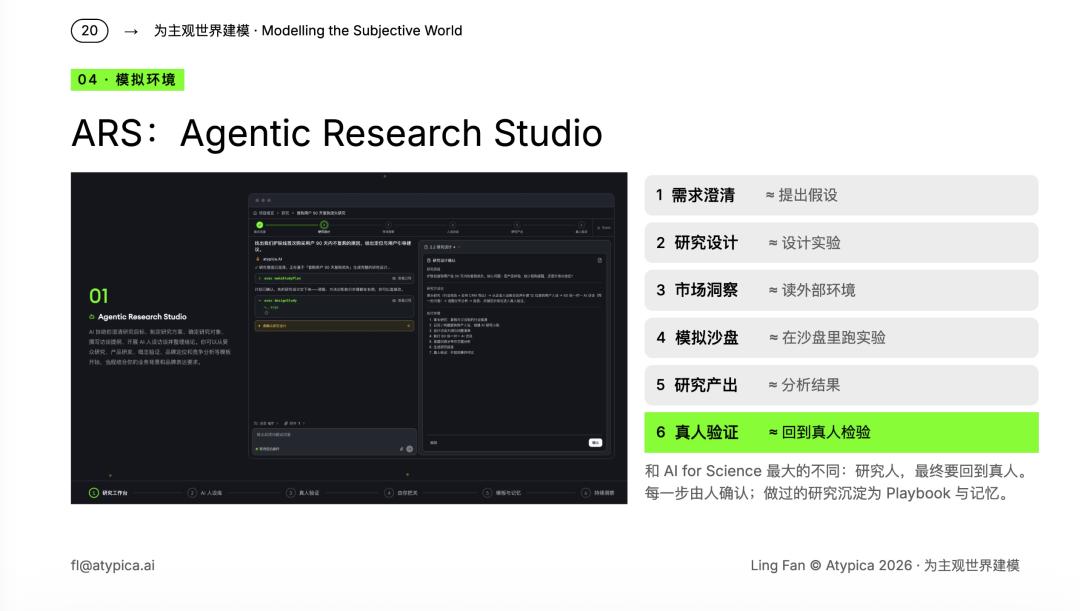
Note: Experience Agentic Research Studio at https://atypica.ai/
The Second Leap: Enterprises Must Understand Themselves First
What is more difficult than "understanding users" is often "understanding the enterprise itself". Many AI projects have been unable to enter the core business for a long time, not because the model capability is insufficient, but because the enterprise's cognition of its own rules, processes and judgment criteria is still vague. The organization is not short of documents, but lacks the knowledge of which facts are important, which rules are prioritized, and which judgments must be retained in a specific task.
This is also the fundamental difference between a knowledge base and a context system. The knowledge base solves the problem of "storing information", while the context system solves the problem of "letting the right information enter in the current task". If enterprises only move documents, minutes and process descriptions into the system, hoping that the model "remembers" everything, they will usually only get a machine that is better at repeating, not a system that is better at judging.
The truly valuable enterprise intelligence must precipitate those tacit knowledge that is difficult to be written into SOP but determines business quality: what counts as "good enough", under what circumstances actions cannot be taken, under what circumstances exceptions can be made, and what signals are worthy of being taken as decision-making basis. Enterprise ontology answers "what are the key concepts of this organization and how are they associated"; enterprise context answers "in this judgment, which concepts and rules should be invoked". The former provides a stable structure, while the latter provides dynamic invocation. Without either end, AI cannot truly become an organizational capability.
Therefore, the second leap is not to "deploy more systems", but to enable enterprises to form a structural understanding of themselves, and turn this understanding into invocable, correctable and transferable assets. What cannot be transferred is not enterprise intelligence, but only the convenience rented from the platform; what cannot be corrected is not enterprise intelligence, but only a coincidentally effective result.
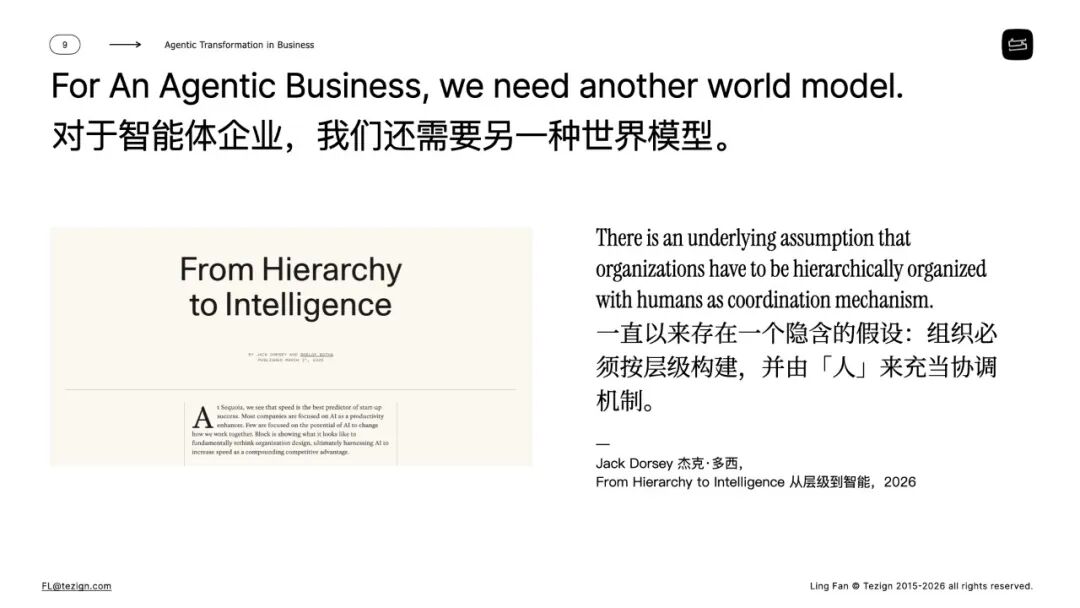
The Third Leap: Let Agents Enter Actions, Not Stay at the Auxiliary Stage
Most enterprises are already familiar with a type of AI today: they exist like assistants, and start working only when they are opened, questioned and invoked. This type of system is certainly valuable, it can improve single-point efficiency, reduce repetitive labor, and help individuals complete higher-density tasks. But they have not really changed the way the organization operates.
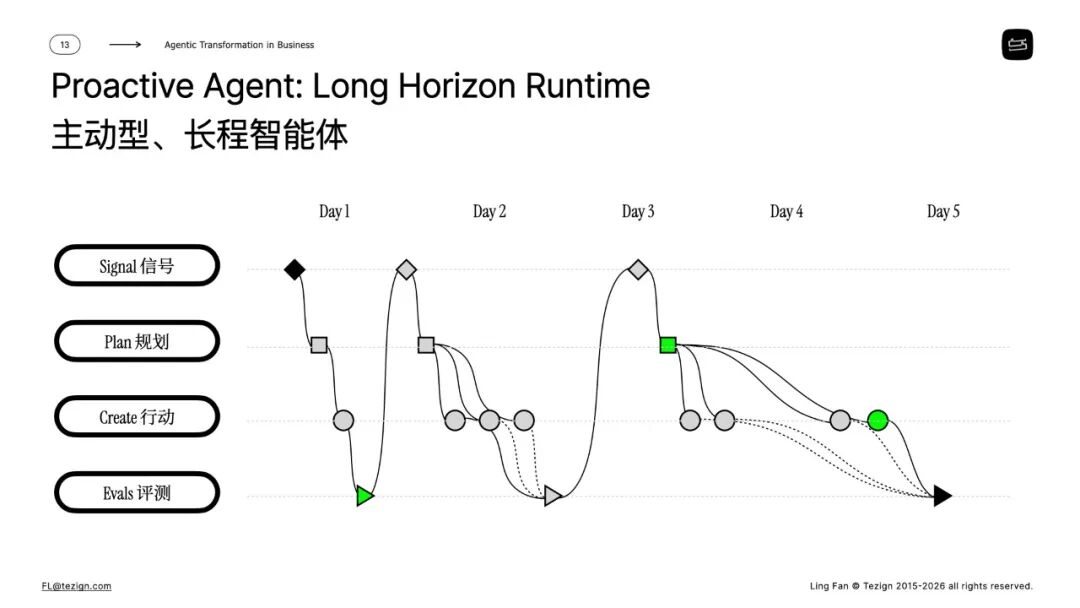
The real leap comes from another type of agent: they do not wait for people to start, but can stay in the background for a long time, operate continuously around time, events and goals, automatically read signals, form preliminary judgments, and promote the next action. The former improves individual productivity, while the latter rewrites the organizational rhythm.
This difference is extremely critical. Because the inefficiency of enterprises often does not come from the slow action of a certain position, but from the waiting, paraphrasing, alignment and repeated confirmation in the cross-departmental link. When agents begin to take over the standard actions in these links — such as information aggregation, preliminary judgment, scheme generation and process promotion — the organization has the opportunity for the first time to compress those friction costs that have long been regarded as "inevitable". People no longer need to spend a lot of time on mechanical connection, but can focus their attention on trade-offs, exceptions and direction correction.
From a management perspective, the value of agents should not be simply measured by "how many tasks have been replaced". If the end point is just to let humans continue to cover for machines and correct errors, the upper limit of the organization is still subject to the lower limit of the machine; but if AI first achieves 70 points for standard actions, humans will have the opportunity to shift their energy to problem definition, standard setting and new value creation. Automation is only the opening, and the real organizational upgrade comes from the redistribution of judgment power and creativity.
The Last Barrier Is Not Technology, But Sovereignty
When enterprises begin to reorganize processes around agents, a deeper problem cannot be avoided: who exactly do these gradually growing intelligences belong to.
This is not an abstract philosophical problem, but an extremely practical business problem. Enterprise-level intelligence involves at least six rights: how to define customers and themselves, how to master data and behavior trajectories, how to decide what agents can read and when to return control to humans, how to define "what counts as good" and "what cannot be done", how to correct outdated conclusions, and whether they can migrate their own memory and capabilities as a whole when the platform changes.
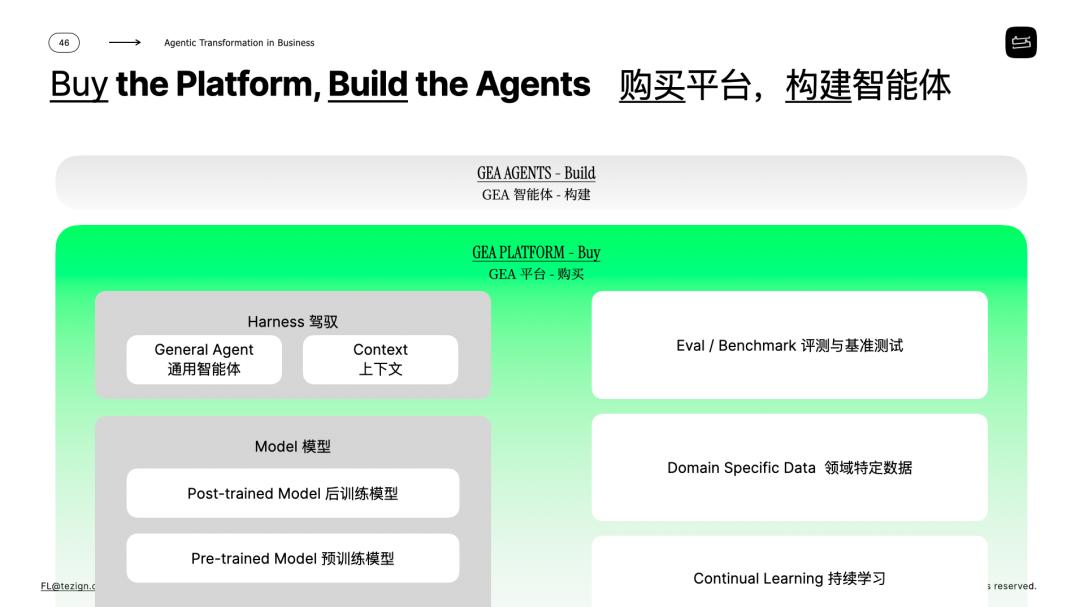
From this perspective, enterprise-level AI is never just connecting a model interface to the business system. What is really important is to build a layer of container belonging to the enterprise itself on top of the model: including scenario-based training and tuning, sustainably maintained context system, governance mechanism that constrains action boundaries, and a learning closed loop that writes experience back into organizational assets. Models may raise prices, change interfaces, or even stop services; but enterprises cannot rent out their own judgment capabilities along with them.
Therefore, sovereignty on the surface is a technical architecture problem, but in essence it is a problem of management right and operation right. Enterprises certainly do not need to develop everything by themselves, but they must clearly distinguish: which capabilities can be purchased, and which capabilities must have property rights. Just like when building a house, you can outsource the construction, but you will not outsource the property right together. The competition of enterprises in the AI era ultimately does not compete on who connects more external capabilities, but on who retains the ownership of their own intelligence.
Five Suggestions for Managers
First, do not start from "where can AI be used", but from "what things that we could not do in the past can AI help us achieve". A good AI project not only makes the existing process faster, but also enables enterprises to serve users that could not be covered in the past, handle complexity that was difficult to bear in the past, or complete tasks that were abandoned in the past due to excessive cost. When setting up a project, managers should first clarify what new business possibilities they hope to create, and then discuss models, tools and budgets. Otherwise, no matter how advanced the technology is, the project will easily stay at the stage of partial efficiency improvement.
Second, before expanding the scale of agents, first establish a common understanding of users and the enterprise itself. For agents to make reliable judgments, they need to understand the external world — who the users are, why they choose, and how they act; they also need to understand the internal world — how the enterprise defines concepts, invokes knowledge, implements rules and handles exceptions. Managers should first precipitate these two types of cognition into invocable and updatable contexts, and then expand the application scope. Without common cognition, the more agents there are, the more often they produce not collaboration, but more conflicting answers.
Third, keep the definition right of "what counts as good" in the hands of the enterprise itself. The model can be provided externally, but the evaluation criteria cannot be handed over along with it. What results can be directly adopted, what situations must be rejected, when manual intervention is required, and how to correct after deviation occurs, all should be clarified by the business leader and continuously updated through real feedback. Managers do not need to review every output, but they must be responsible for the standards, boundaries and upgrade mechanisms, because these are the basis for enterprises to form judgment over the long term.
Fourth, you can start from Copilot, but reconstruct the workflow according to end-to-end results. Single-point assistants are suitable for verifying value and accumulating trust, but they should not be the end point of transformation. Managers need to follow a business result, find out the waiting, paraphrasing, alignment and repeated confirmation in the cross-departmental link, and then decide which standard actions to hand over to agents, and which judgments and exceptions to leave to humans. When measuring effectiveness, we should also observe the overall cycle, result quality and conversion, not just how much time is saved in a certain position.
Fifth, incorporate transferability into daily governance, instead of checking it only when replacing suppliers. Enterprises should regularly conduct a stress test: if the underlying model or platform is replaced tomorrow, can user insights, enterprise context, evaluation criteria, behavior trajectories and workflows be fully migrated, and how long does it take to resume operation. Capabilities that can be exported, explained and