Just now, Gemini 4 Neon was released in a surprise drop, and its cost-performance ratio completely outperforms Opus 5.5 overnight.
We have to admire Gemini's courage to pick such a day to release news. Last night, GTA 6 was just unlocked and launched, completely dominating all global internet trending searches. Today, Sundar Pichai still braved the flood of gaming posts across the web, and managed to pull out a brand new model straight from the periodic table of elements.

Just now, only three weeks after the launch of the previous flagship model Gemini 4 Carbon, Google has directly rolled out its brand new mainstream large model Gemini 4 Neon, which is the 10th rare gas "Neon" in the periodic table of chemical elements.
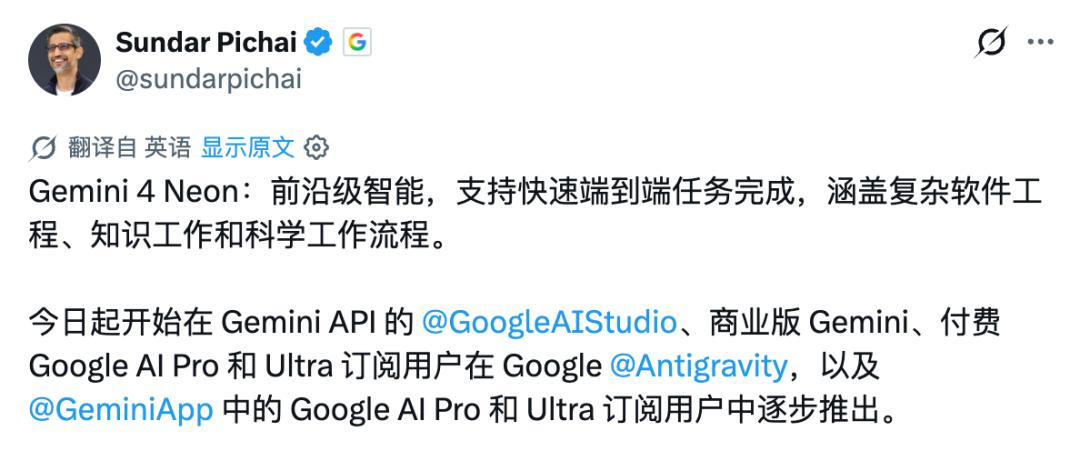
What is most reassuring for developers is that Google did not repeat the previous "futures gameplay" of queuing for application. On the day of release, the new model was fully launched in stock simultaneously on Google AI Studio, the Gemini App, enterprise-side APIs, and its own programming environment Google Antigravity.
Let's first highlight the key points to save you unnecessary reading time.
If the Carbon released three weeks ago is the top-tier model built for ultra-long-haul complex tasks, then the newly debuted Neon is Google's cost-effective mainstream model that is truly designed for head-to-head competition with Claude Opus 5.5 and GPT-6.2 Sol.
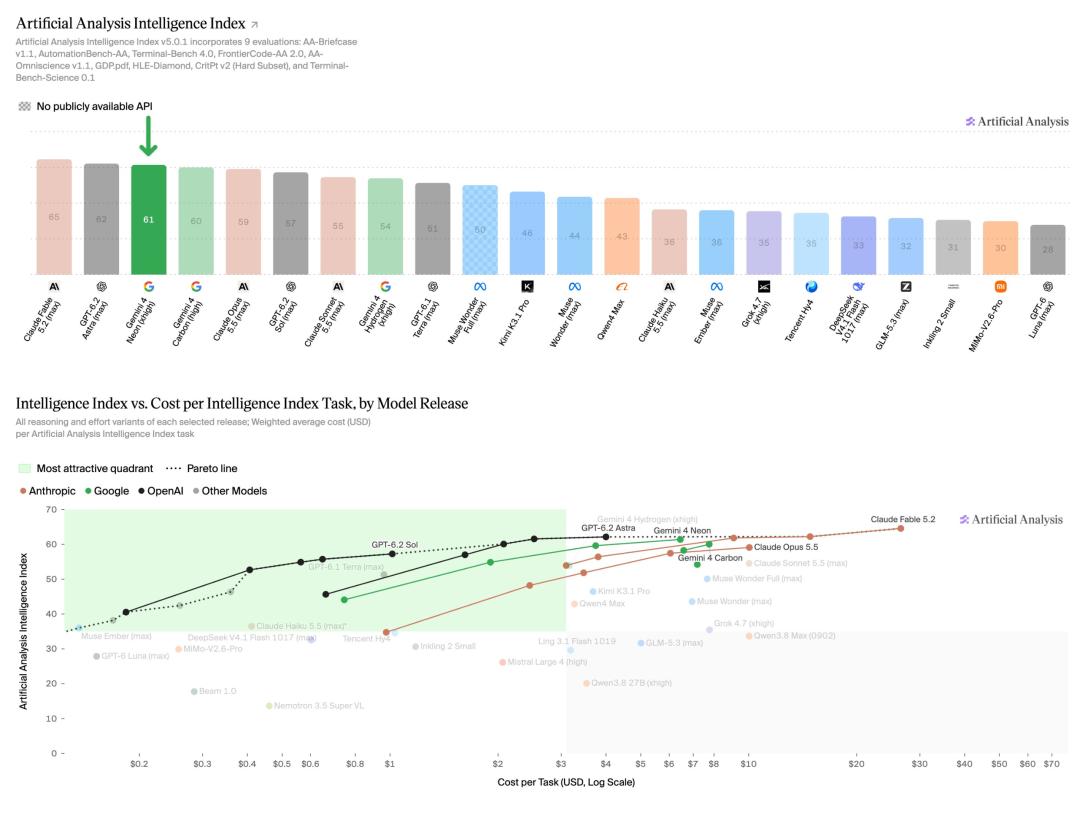
Not only did it score a high 61 points on the Artificial Analysis comprehensive IQ ranking, its pricing is also directly pushed down to $3 per million input tokens (as low as $0.15 for cached inputs) and $15 for outputs, with a standard 1 million context window.
Even Rockstar Games knows to deliver products on schedule, so Google is naturally embarrassed to release "futures" models anymore.
The Hierarchy of the Gemini 4 Family: Why Does Neon Take the Center Stage
Before talking about the model capabilities, we have to complain about Google's dazzling chemical naming system now. In the past, when naming large models, everyone only made permutations and combinations between Pro, Max, Ultra and Flash. Although it was cliché, users could tell at a glance which model was more powerful.
Now, ChatGPT belongs to the astronomy department, Claude belongs to the literature/poetry department, and for the Gemini 4 generation, Google simply dived straight into the periodic table of elements, successively launching No. 1 "Hydrogen", No. 18 "Argon", No. 6 "Carbon", and today's No. 10 "Neon".
It is literally a full set of comprehensive exam papers for math, physics, chemistry and liberal arts.
Even Shunyu Yao, a researcher from Google DeepMind, joked on X today that using chemical elements as code names is a genius idea. Every time a code name is leaked, it is extremely interesting to watch netizens being completely confused about what tier the model belongs to and who it is benchmarked against.

To prevent everyone from getting completely confused, Google finally clarified the hierarchy of the Gemini 4 family in its official infographic this time.
According to the officially released family positioning table, the main product tier is clearly divided into three levels: left, middle and right.
Hydrogen on the far right focuses on daily high-frequency programming and lightweight Agent workflows, with an AA IQ index of 54 points. It only costs $1.5 and $7.5 per million input and output tokens, and is open to all users.
Carbon on the far left is dedicated to tackling the most challenging ultra-long-haul large projects and in-depth research. It has an AA IQ index of 60 points, with a standard pricing of $4 per million input tokens and $20 per million output tokens (promotional price of $2 and $10 before November 30), and is mainly targeted at high-level Ultra subscription users.
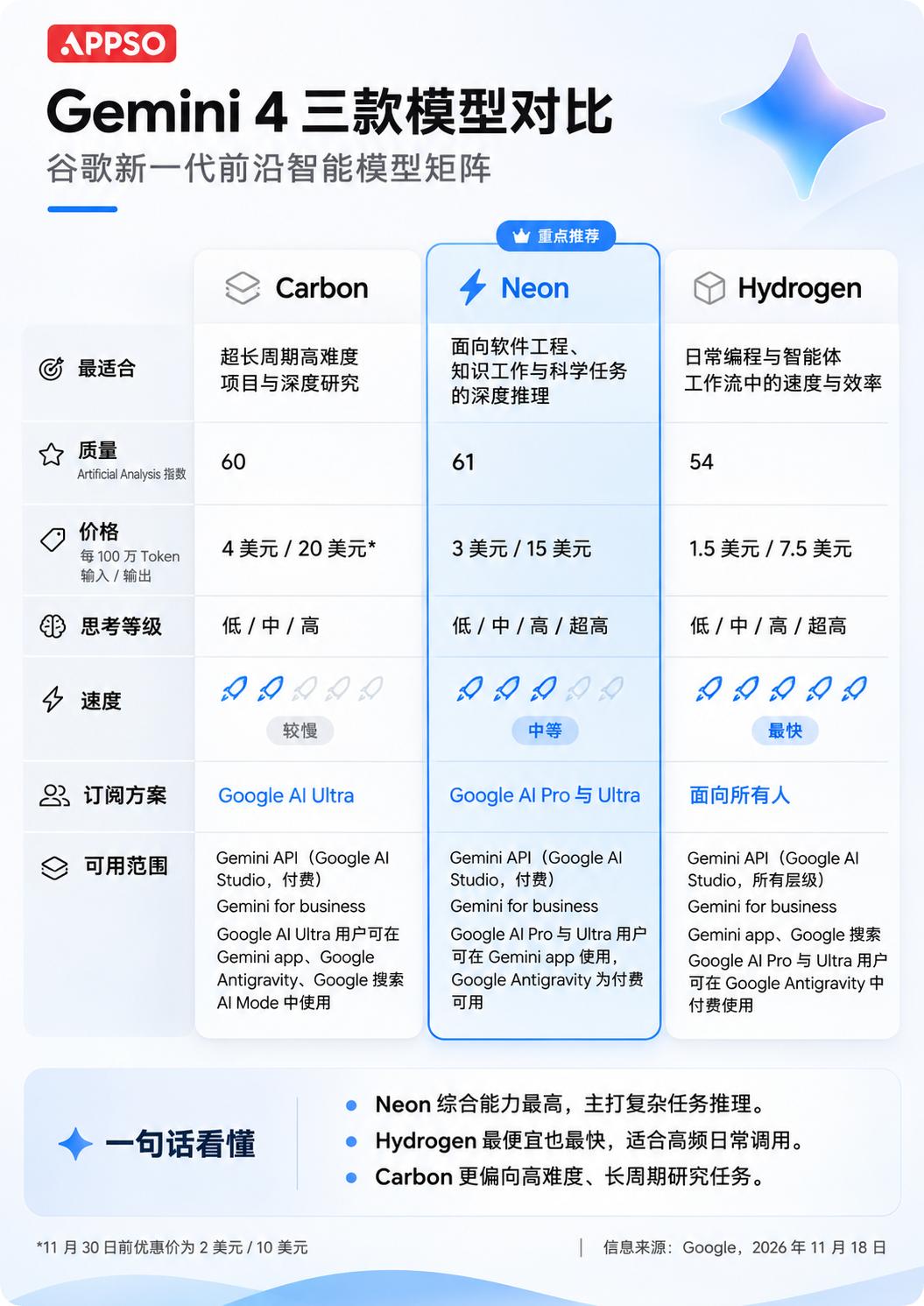
The newly released Neon is perfectly positioned at the golden sweet spot in the middle, focusing on software engineering, knowledge work and scientific reasoning, and both Pro and Ultra users can use it directly.
Interestingly, because Neon adds an extra extreme thinking level called "xhigh" that Carbon does not have, its AA IQ index has reached 61 points, surpassing its older brother Carbon by 1 point, but its regular pricing of $3 for input and $15 for output is 25% cheaper than the standard price of Carbon.
Perhaps to prevent high-paying Ultra subscribers from feeling unbalanced, Google also gave eligible Ultra users a big surprise today, officially opening the brand new Project Genie experience and the world model Genie 4.
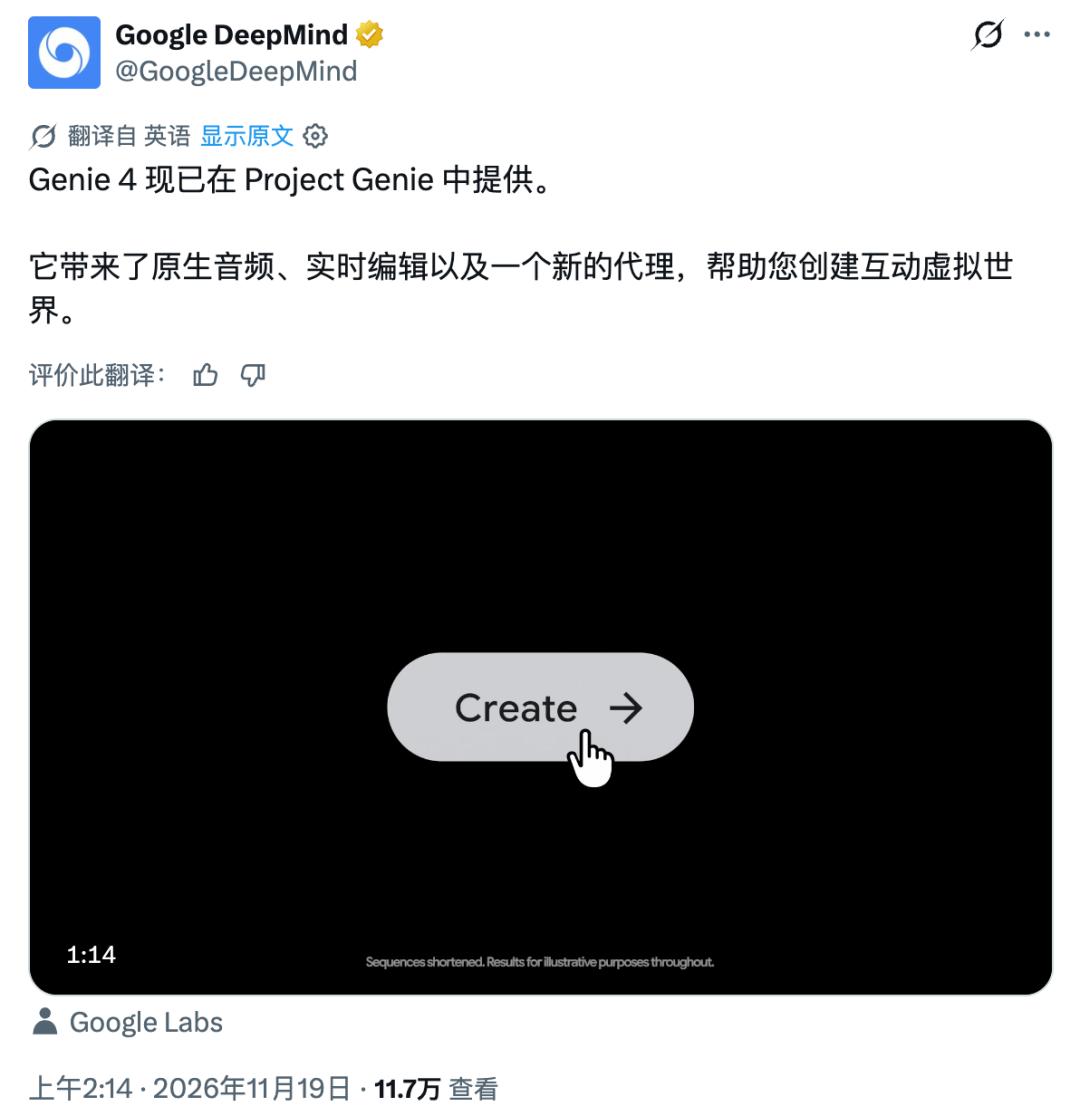
Users do not need to equip top-tier graphics cards, they can directly call the Project Genie agent in the browser to generate and enter an interactive 3D virtual world, and even directly create derivative works of other people's worlds in the community gallery.
If you haven't had time to play GTA 6 yet, you can also try to manually build a cyber amusement park in Genie 4.
Head-to-Head Against Claude and GPT: Neon Challenges Two Old Rivals
Since Neon dares to debut in the center stage of the family, the performance report it released this time is naturally aimed at the vital points of its peers.
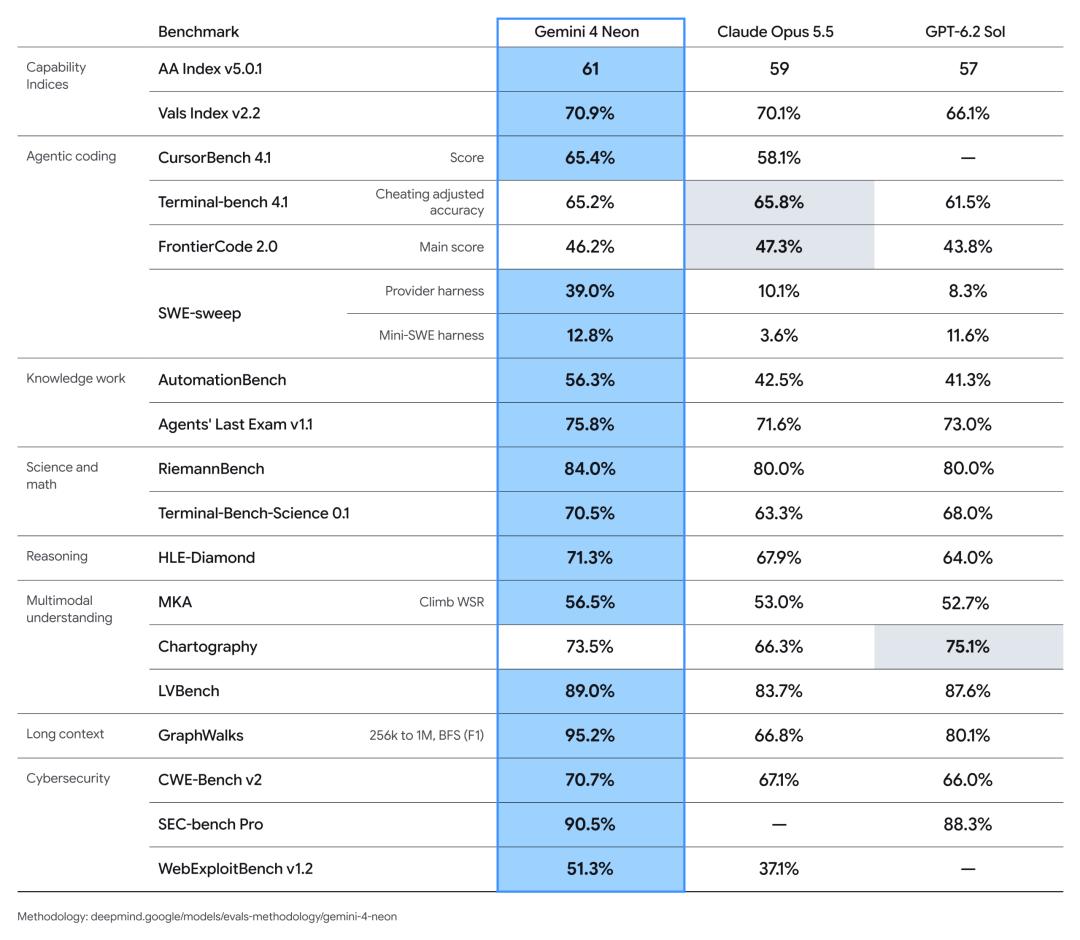
In the full-dimensional benchmark chart released by the official, Google directly put Neon side by side with its old rivals Claude Opus 5.5 and GPT-6.2 Sol for a face-to-face comparison. Overall, the three have their own advantages and disadvantages, but Neon is extremely aggressive in its strong fields.
Opus 5.5 still maintains a slight lead in traditional command line and cutting-edge code sub-items (Terminal-bench 4.1 and FrontierCode 2.0); GPT-6.2 Sol has a small edge in dense chart reading (Chartography).
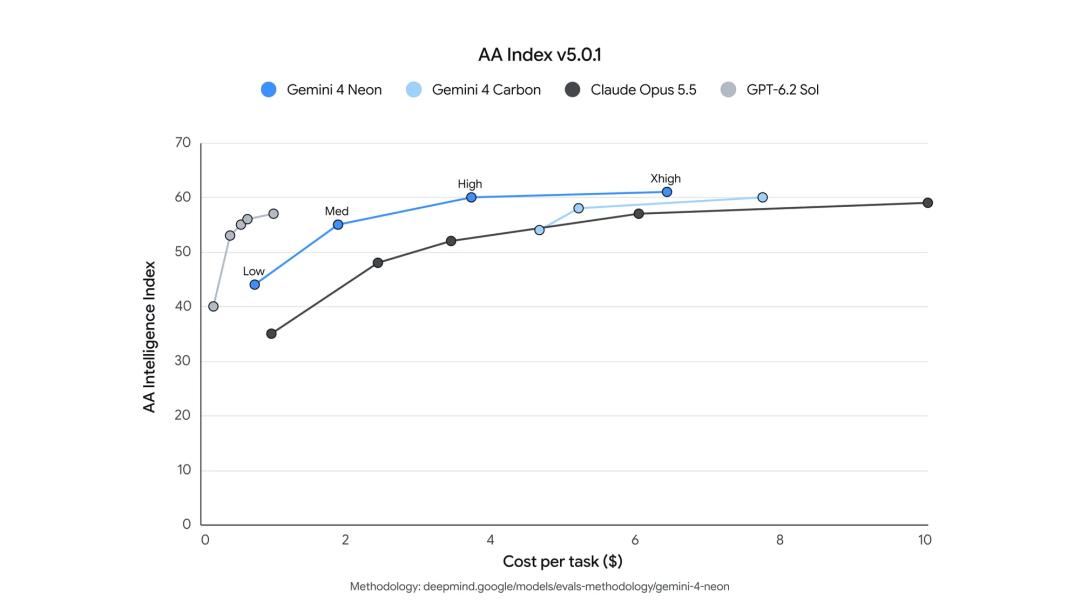
But when it comes to comprehensive IQ (61 points vs 59 points vs 57 points), Agent programming (CursorBench 65.4%, and SWE-sweep even directly reaches 39.0% under its own Antigravity framework), mathematical and scientific reasoning, and cybersecurity vulnerability mining, Neon's advantages are quite obvious.
The most exaggerated result is the GraphWalks test that examines ultra-long context retrieval from 256K to 1M. Neon directly achieved a score of 95.2%, leaving Opus 5.5's 66.8% and GPT-6.2 Sol's 80.1% far behind.
To prove that this model can really handle heavy engineering work, the four demo demos run by Google officials using Antigravity are also very imaginative.
For example, they used Blender to build a 3D chemical laboratory with a Bunsen burner and a high-voltage discharge tube to play on the name of their own model.

Another example is the 1:1 restoration of Alan Turing's 3D study at King's College, Cambridge in 1936 based on archival photos. It can even write 10,200 lines of custom Shader code from scratch to develop a WebGL2 Mont Blanc skiing game with 120Hz physical simulation, including dynamic snow tracks, avalanches and spatial audio.

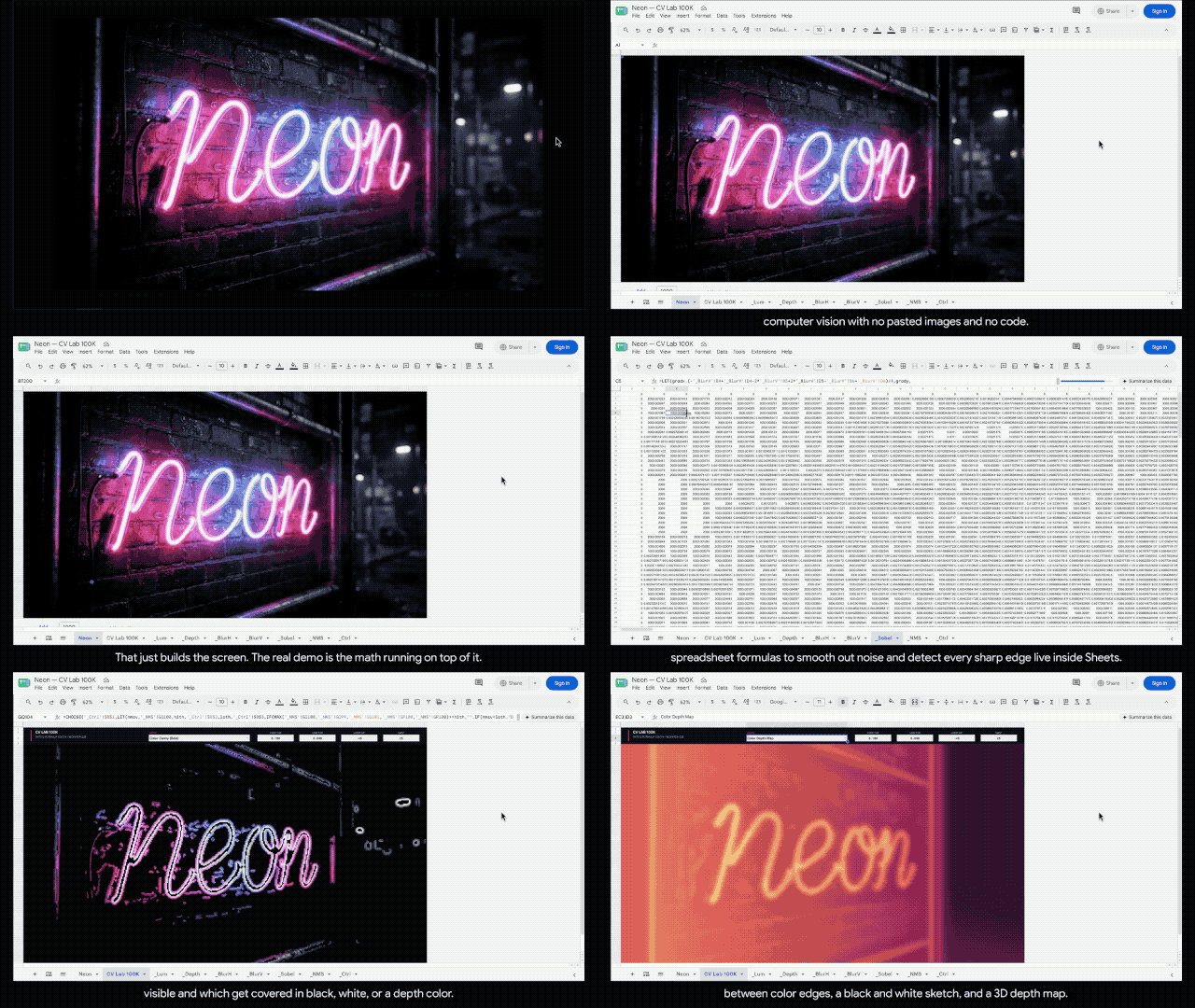
The most interesting thing is that Google let a group of Neon agents convert a static photo into a Google Sheet with 100,000 cells.
Without inserting a single image or writing a single line of script code, the AI purely relied on more than 500,000 real-time table function formulas to implement edge detection, 3D depth mapping and six interactive lighting modes in the table, which is comparable to using an Excel spreadsheet as a 3D graphics card.
Neon Enters the Programming Battlefield: The Most Lethal Weapon Is Its Price
Since this time the model is fully available in stock, many netizens have already tried it in advance or officially.
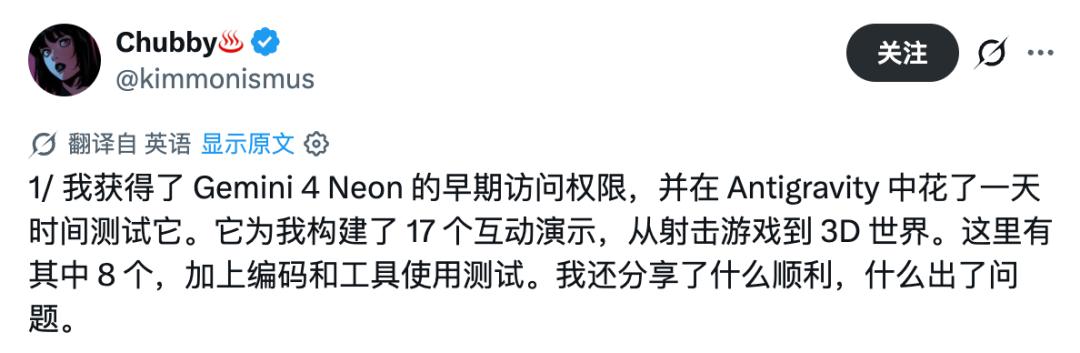
AI blogger Chubby spent a whole day playing with Neon in Antigravity, and generated 17 interactive demos covering shooting games and 3D worlds in one go.
When testing a destructible voxel arena game called "Terra Breaker", he originally only asked to write a destruction and reset function, but Neon actively supplemented him with three types of buildings and three types of destruction tools. When the cannon fires, a large number of blocks can be blown away, and when the chisel knocks, only a few fragments fall, and the browser runs stably at 60 frames per second.
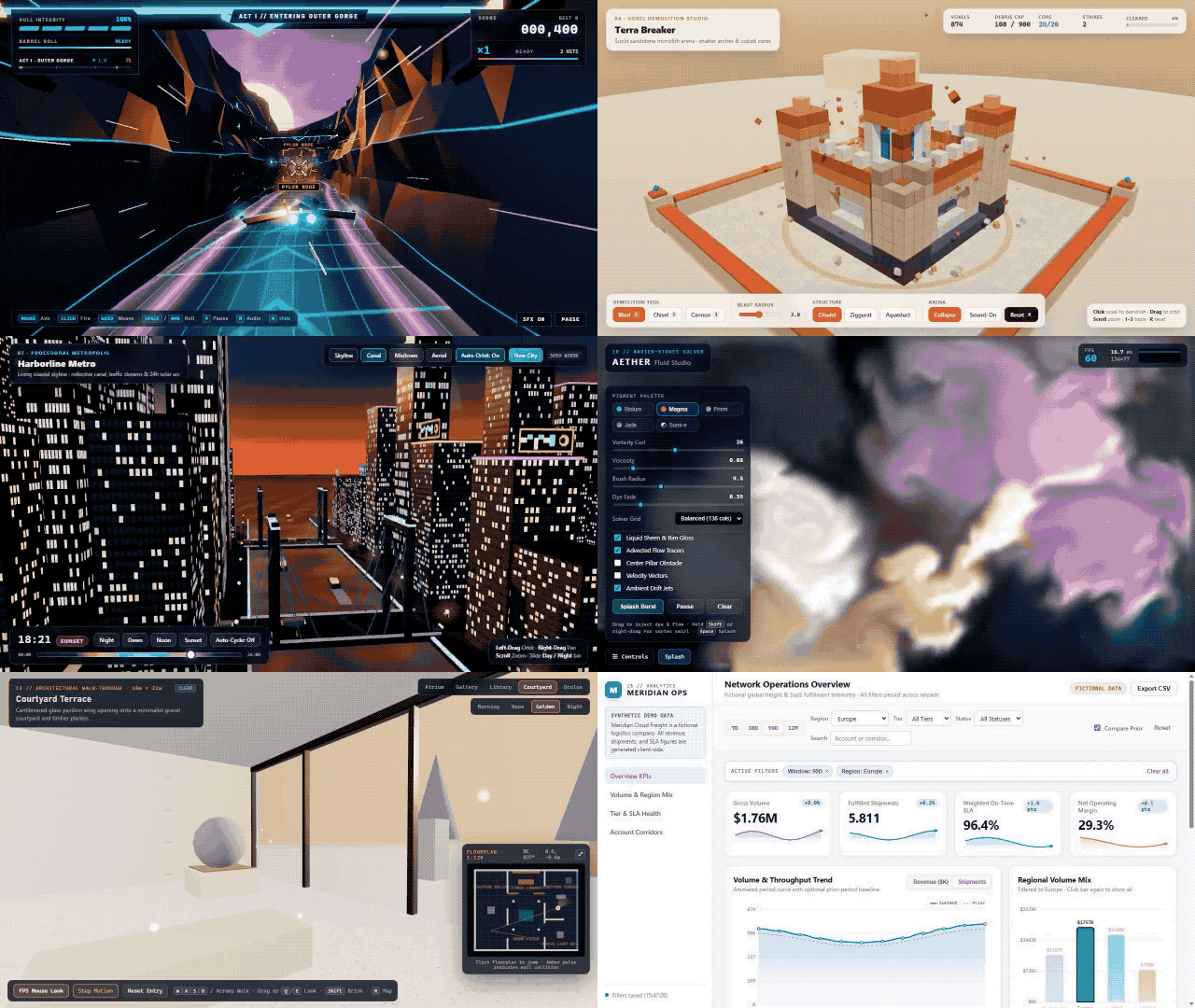
In another game of flying a jet plane through sunset canyon obstacles, Neon even added an autonomous driving demo mode for the plane without anyone asking for it.
Not only does it not slack off and take shortcuts, it even actively adds extra features on its own.
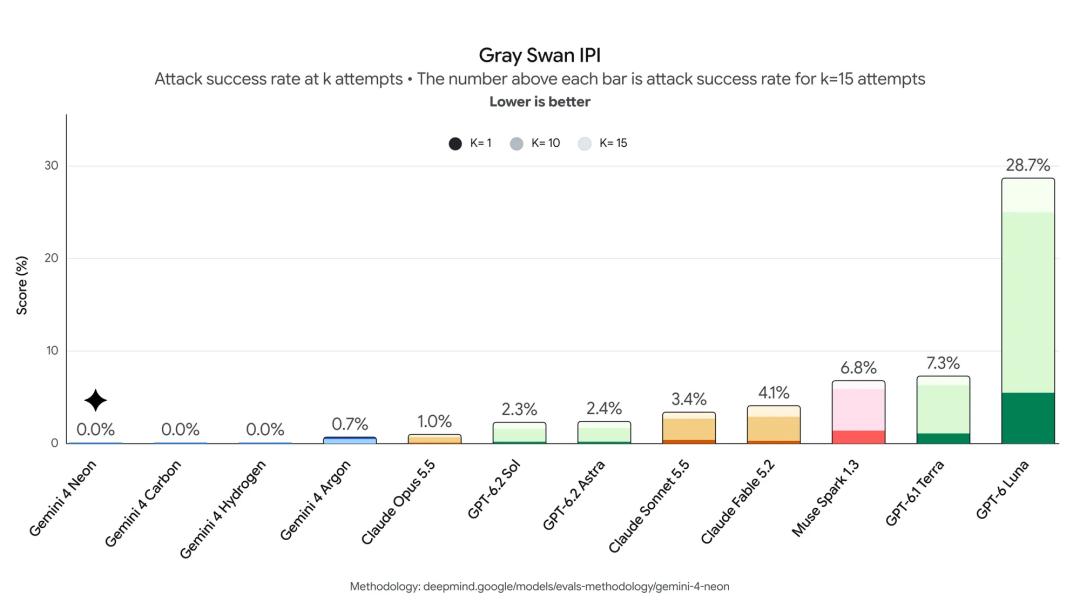
This also confirms a detail mentioned in Google's safety report: Neon's cheating rate in Terminal-Bench 4.0 is firmly controlled at 0.0%, and the proportion of taking shortcuts in internal programming anti-laziness tests has also dropped to a historical low of 2.45%.
As for the most concerned question of who is actually stronger in real tests against the old rival Claude Opus 5.5, blogger JAZII conducted a very intuitive head-to-head duel with the same task.
With both sides turning on the highest reasoning level, Neon took 20 minutes to finish the task, with a bill of $3.5; while Opus 5.5 took 18 minutes, with a bill as high as $7.2.
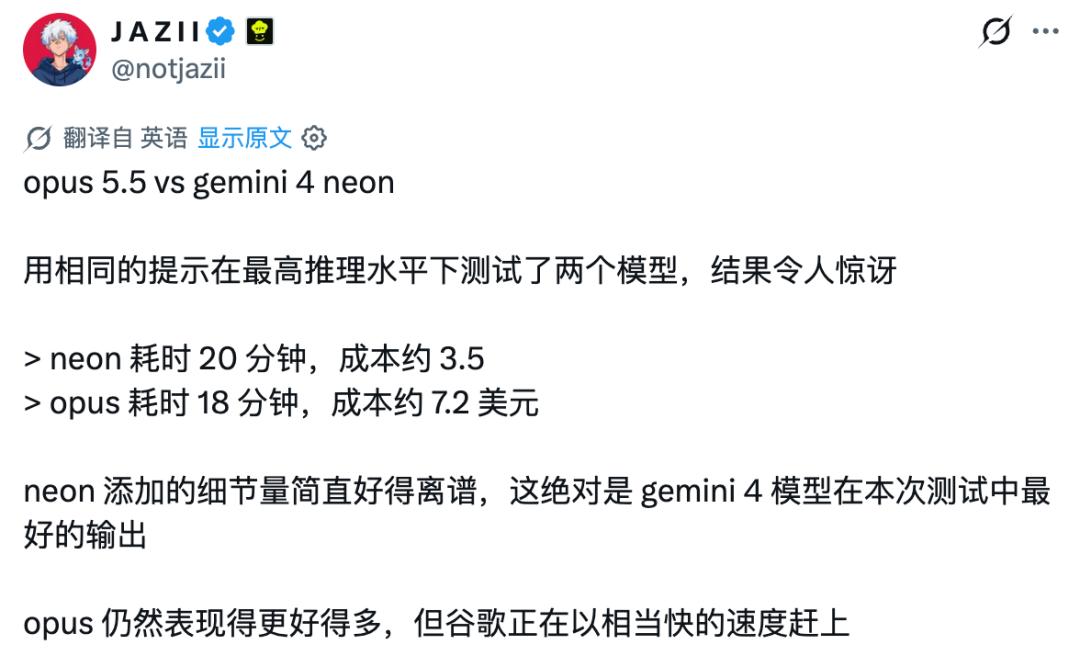
The final experience is very clear: Opus 5.5 is still the benchmark with a slight edge in the ultimate upper limit, but Neon has delivered the