Is the 5-billion-yuan fragrance brand changing hands?
After the merger negotiations with Estée Lauder fell through, Spanish beauty group Puig acquired the remaining 50% stake in dermatology-focused brand ISDIN in October this year for 1.2 billion euros (approximately RMB 8.767 billion), completing full holding and supplementing its efficacy skincare segment beyond perfumes. Now, this Spanish beauty group has taken new actions in the perfume track.
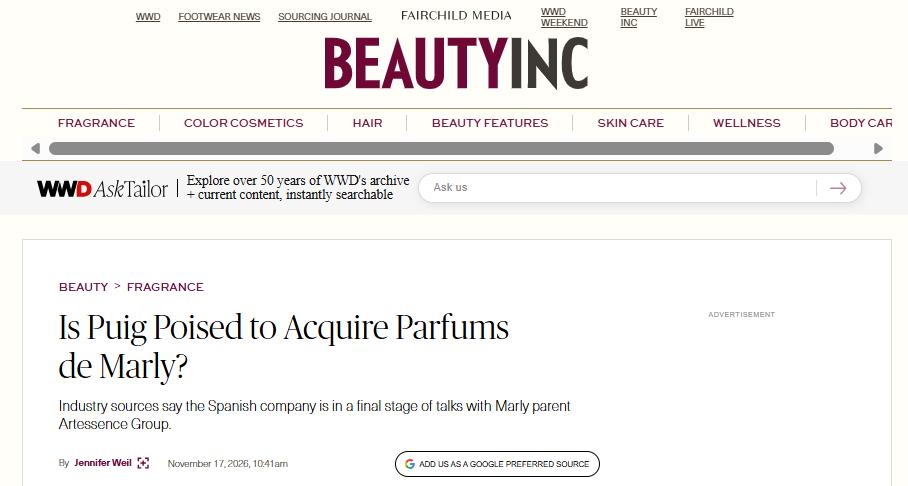
A few days ago (November 17), WWD cited industry insiders saying that Puig has entered the "final negotiation stage" for the acquisition of Parfums de Marly, a niche high-end French perfume brand, whose parent company is Artessence Group. Puig has not commented on this, and a spokesperson for Artessence Group also said it would not respond.
△ Source: WWD
About two weeks before that, reports from media such as Reuters stated that CVC Capital Partners, Cinven and Puig were competing for the acquisition, and Puig was less active in the process than the first two financial investors, with a potential valuation of less than 2 billion euros (approximately RMB 14.6 billion).
Brands with Multiplied Valuation
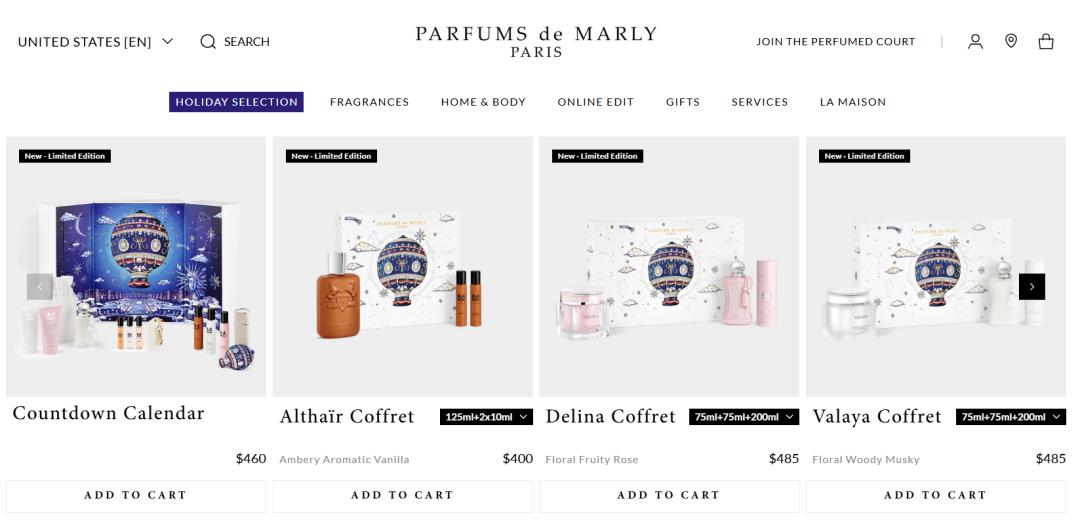
Parfums de Marly was founded by Julien Sprecher in 2009, taking the 18th-century French court equestrian culture as its brand narrative and positioning itself as a luxury niche perfume brand.
In the fiscal year ending in March 2026, Parfums de Marly's sales exceeded 780 million US dollars (approximately RMB 5.199 billion), a year-on-year increase of 42%; it currently has 25 independent boutiques around the world and is present in about 1,500 retail locations. In the Chinese market, Parfums de Marly is operated by Yingtong Group [1]. Since its first store opened in Shanghai in 2021, it has opened dozens of stores and counters in cities including Beijing, Guangzhou and Chengdu.
△ Source: Parfums de Marly official website
In 2023, private equity firm Advent International acquired the majority stake in Artessence Group, the parent company of Parfums de Marly, from the founder. At that time, Parfums de Marly was valued at about 700 million US dollars (approximately RMB 4.7 billion); now the potential valuation in the ongoing sale process is less than 2 billion euros (approximately RMB 14.6 billion). Based on this estimate, the valuation level has increased significantly in the past three years.
From the timeline, the promotion of this sale has been going on for some time. As early as the end of 2025, the holder Advent International began to explore exit options; in October 2026, CVC, Cinven and Puig officially entered the bid list. But it was not until November 17 that Puig was reported to be "in the final negotiation stage".
For Puig, the strategic logic of acquiring Parfums de Marly may be related to the growth changes of its core perfume business.
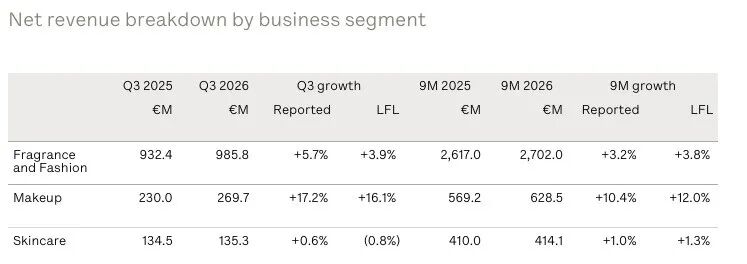
In 2024, Puig's perfume and fashion division grew by 13.6% for the whole year, which was the main growth engine of Puig; in 2025, the growth rate of this division slowed down to 6.4%; by the third quarter of 2026, this growth rate further dropped to 3.8%.
However, according to Puig's management, this slowdown did not come from niche fragrances. In the same period, the niche fragrance portfolio including Byredo and Penhaligon's continued to record high double-digit growth. The real drag was the "normalization" of mass licensed brands Rabanne and Jean Paul Gaultier after five years of rapid expansion [2].
△ Source: Puig Group Financial Report
At the same time, Puig put forward "Vision 2032" at its first Capital Markets Day in October, with the goal of achieving sales exceeding 8 billion euros (approximately RMB 58.446 billion) by 2032, and niche fragrances are listed as one of the four core driving forces.
Puig currently has four niche fragrance brands: Penhaligon's, L'Artisan Parfumeur, Byredo and Dries Van Noten. Financial reports show that in the third quarter of 2026, all these brands recorded high double-digit growth and outperformed the market.
In this context, acquiring Parfums de Marly may be exactly a step for Puig to continue to increase its stakes in the niche fragrance track where growth still exists.
This acquisition may also echo Puig's current position in the industry. In the global beauty market in the first three quarters of 2026, Puig ranked 10th in the TOP list of international listed beauty enterprises with sales of RMB 27.854 billion, and Coty behind it is closely chasing with sales of RMB 27.414 billion. [3] At this "defending" node where it may be squeezed out of the top ten at any time, taking Parfums de Marly, a niche fragrance brand that is still in a period of rapid growth, may help Puig supplement incremental growth and consolidate its ranking on the list.
The Fragrance Competition Is Getting Increasingly Fierce!
Puig's pursuit of Parfums de Marly is not an isolated event. Since 2026, global beauty groups have intensively taken actions to increase their stakes in the perfume field, and a competition centered on fragrance has been fully launched.
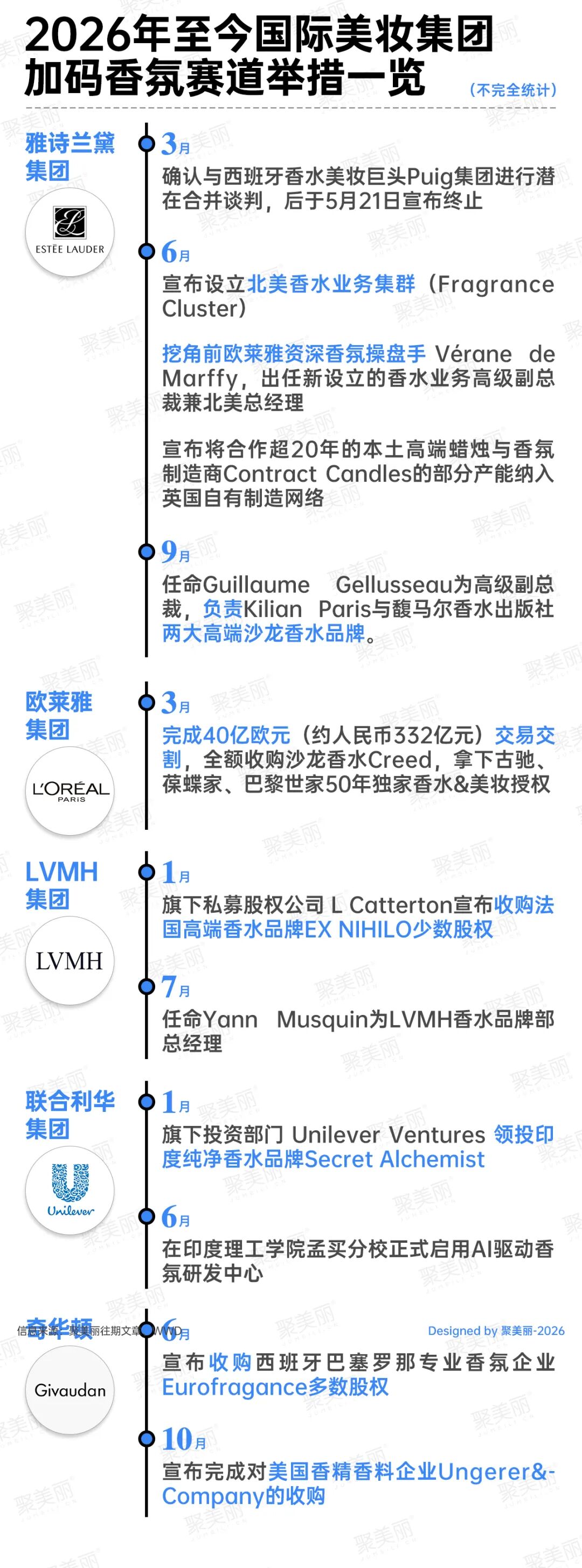
For example, L'Oréal Group has included Creed and multiple high-end fragrance brand licenses in its portfolio, LVMH Group has acquired niche high-end fragrance brands such as BDK Parfums and EX NIHILO on the investment side, and set up LVMH Fragrance Brands to coordinate management on the organizational side. The Estée Lauder Companies has established a perfume business cluster in North America and integrated manufacturing capacity. Unilever has invested heavily in internal fragrance R&D, and flavor and fragrance giant Givaudan has launched the AI fragrance blending tool Carto to empower perfumers.
Chinese domestic brands have also made frequent layouts in the fragrance track. In the second half of 2026, Huaxizi launched its first "West Lake Scenario Series" perfumes in September, with four fragrance types corresponding to the scenery of West Lake; Kans launched the Hongyun fragrance series, which officially landed on major online platforms on October 20; Zheng Que, Chief External Affairs Officer of CHANDO Group, revealed that it will create a perfume line for CHANDO, its main brand with a scale of 5 billion yuan; Yingtong Group invested 97.5 million yuan in the parent company of fragrance brand Fuyu Manpu, holding a 15% stake.
Behind the intensive actions of brands and channels is the continuous expansion of the entire perfume market. According to a report released by Global Market Insights, the global perfume market is expected to grow from 64.1 billion US dollars (approximately RMB 4.337 trillion) in 2026 to 85.5 billion US dollars (approximately RMB 5.784 trillion) in 2035, with a compound annual growth rate of 3.3% [4]. During the same period, the scale of niche fragrances will increase from about 35 billion US dollars (approximately RMB 2.333 trillion) to 68.2 billion US dollars (approximately RMB 4.546 trillion), with a compound annual growth rate of about 7.9%, more than twice that of the overall market.
Facing this rapidly growing market cake, global beauty giants are accelerating their layout with real money. However, it should be noted that the competition in the fragrance field has gradually escalated to a comprehensive competition covering supply chain, channels, brand storytelling and user operation. Against the background of concentrated efforts by leading enterprises, the survival threshold for small and medium-sized fragrance brands will continue to rise, and the competition in this fragrance track is far from decided. In the future, only by building their own unique differentiated barriers can they firmly stabilize the development foundation in the industry wave.
Note: The exchange rate conversion in this article is based on 1 euro ≈ 7.31 RMB and 1 US dollar ≈ 6.67 RMB.
Source of Information:
[1] Prospectus submitted to the Hong Kong Stock Exchange in July 2024
[2] Puig Q3 2026 Earnings Call
[3] Previous articles from Jumeili;
[4] Report released by Global Market Insights
This article is from the WeChat official account "Jumeili" (ID: jumeili-cn), written by Shui Jin, authorized for release by 36Kr.