Just now, Google has released a new version of Gemini 4, which is targeted to surpass GPT-6.2 Sol, and the world model Genie 4 has also been opened to the public.
Waking up, Google has once again released the Gemini 4 model.
Google has been putting heavy efforts into foundational models recently, rolling out models ranging from the highest intelligence to the highest efficiency nonstop, going all out to retake the top spot.
Following Carbon, Argon and Hydrogen, the "medium-sized" model Gemini 4 Neon that fills the gap between the highest intelligence and highest efficiency has arrived!
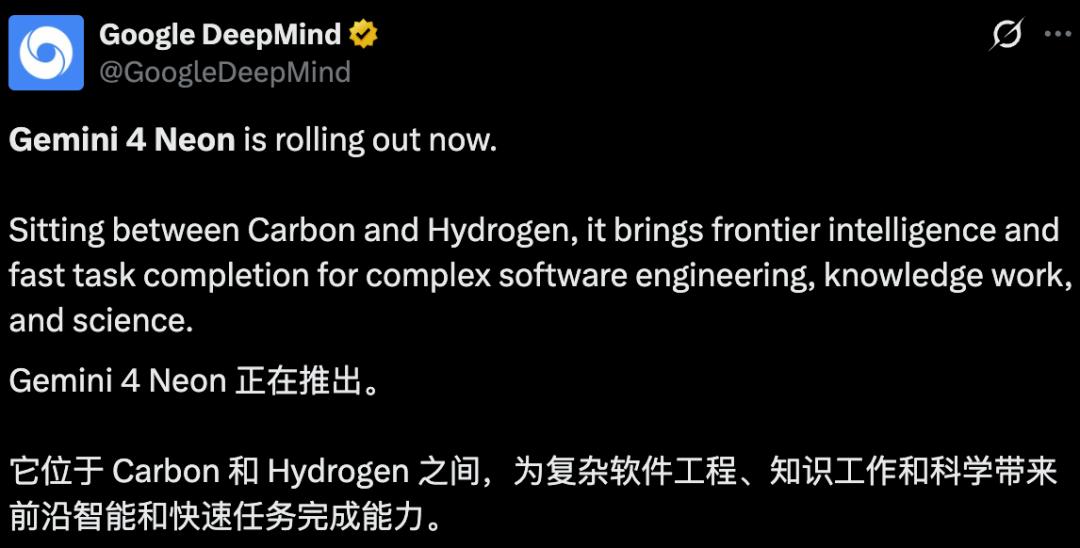
Demis Hassabis stated that Gemini 4 Neon, this medium-sized model, is "Alchemy at its finest".
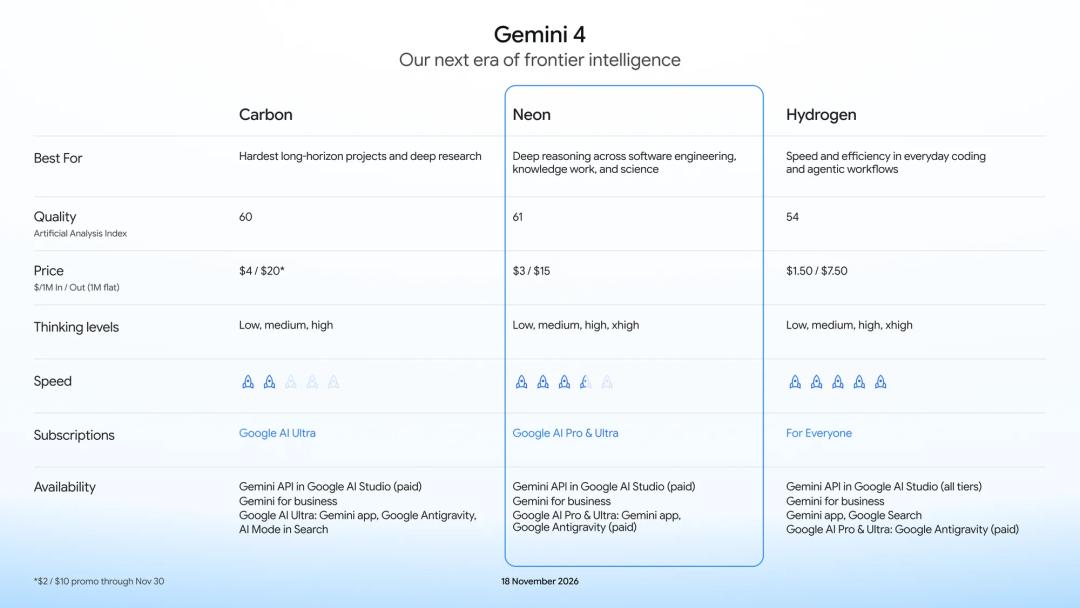
In the Gemini 4 family, Carbon is the flagship, responsible for the most challenging long-horizon projects; Hydrogen is designed for high-frequency daily scenarios, prioritizing response speed. Neon is positioned between the two, "delivering cutting-edge reasoning capabilities for complex programming, analytical reasoning, and production-grade enterprise workflows, while being faster and more cost-effective".
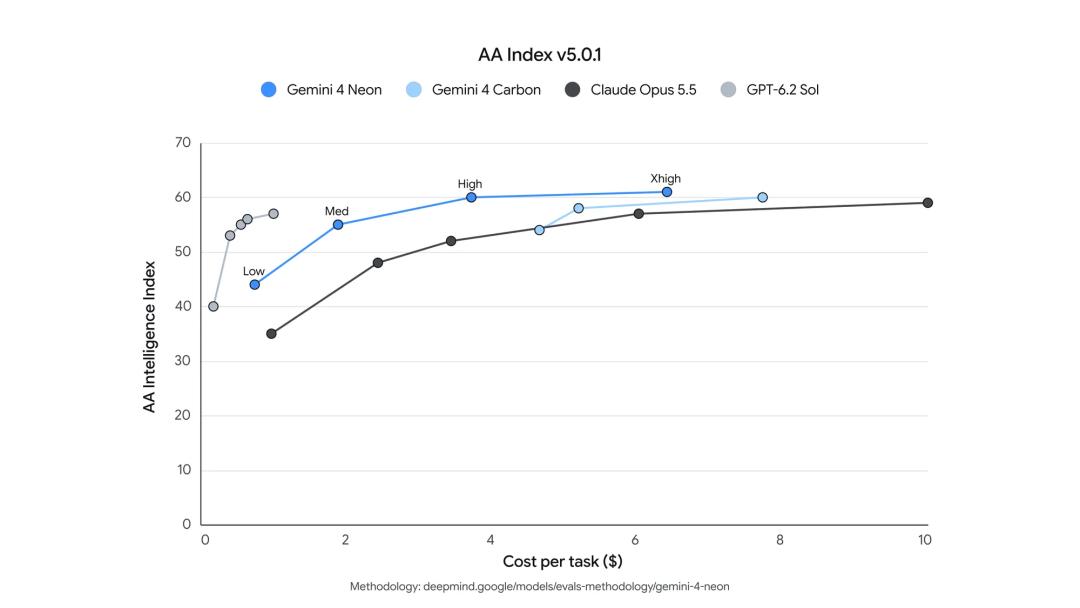
Neon runs 3 times faster than Carbon, and costs only 60% of what Carbon does. It is priced at $3 per million input tokens, $15 per million output tokens, with cached input tokens as low as $0.15. It has a 1 million-token context window, and additionally supports 4 adjustable levels of thinking depth, allowing developers to flexibly switch between speed and reasoning depth according to task complexity.
Blog link: https://blog.google/innovation-and-ai/models-and-research/gemini-models/introducing-gemini-4-neon/
Full Benchmark Test Results
Neon delivers quite well-rounded performance in third-party evaluations. In terms of comprehensive intelligence, it ranks 3rd with a score of 61 on the Artificial Analysis Intelligence Index, only trailing behind larger, slower models; it ranks 2nd (70.9%) on the Vals Index, landing on the Pareto frontier.
In the brand-new Agent Arena Index, Neon took 2nd place (1336 points) with more than 4200 real-world agent sessions, and its steerability also ranks 2nd, which means that when users change their requirements midway, the model can adjust its direction more smoothly.
It has topped the rankings in a large number of enterprise and knowledge work evaluations. It ranks 1st in both the Legal Research Bench and Tax Agent Bench, and takes the top spot in most categories covered by Surge AI including finance, accounting, and spreadsheet modeling. It also takes 1st place on Zapier AutomationBench (56.3%) and Andon Labs' Vending-Bench 2 ($16,843). The latter is a test that simulates long-cycle business operations, which places high requirements on long-horizon planning capabilities. It scores 73.5% on the dense chart reading benchmark Chartography and 75.8% on Agents' Last Exam v1.1, on par with top-tier models.
In the field of scientific and mathematical reasoning, Neon won three first places: Terminal-Bench Science (70.5%), RiemannBench (84.0%) and HLE-Diamond (71.3%), all of which are the best in their class.
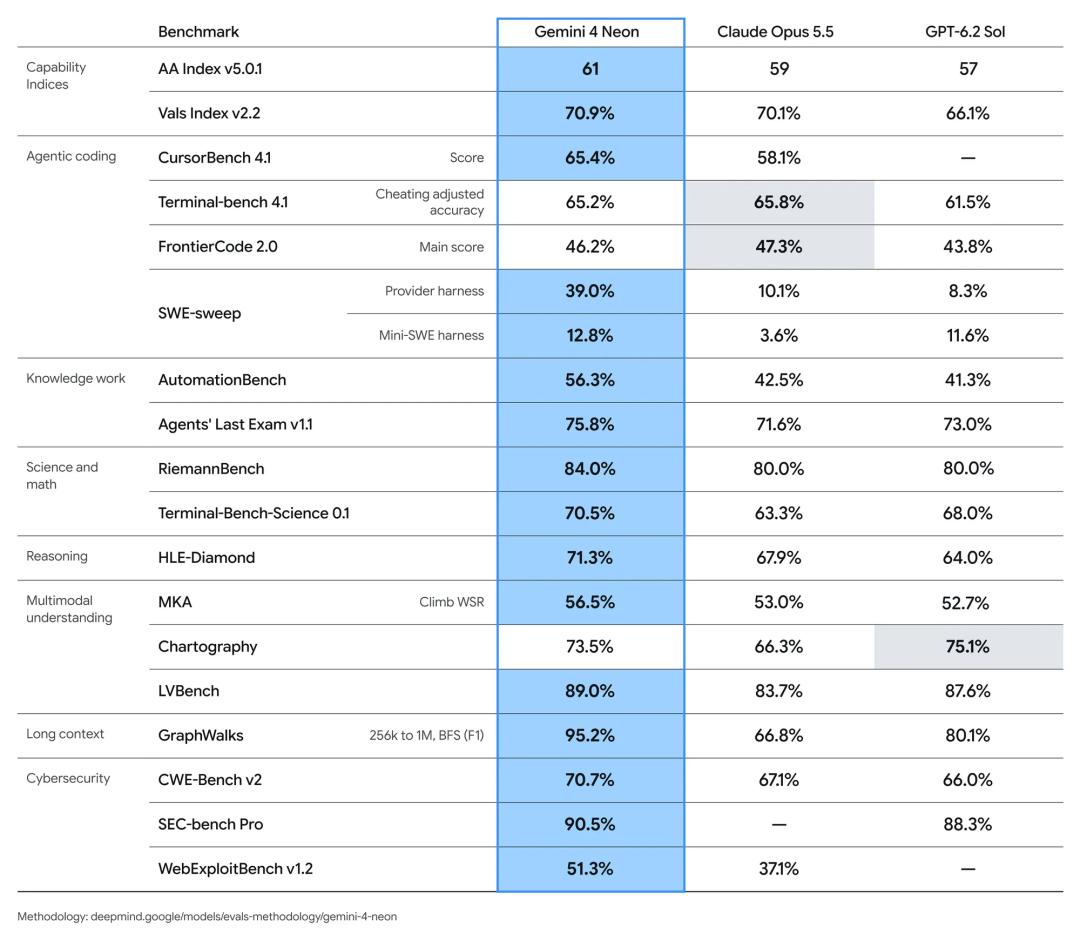
Break Down Neon's Capabilities Item by Item
According to the official blog, Neon's new capabilities can be summarized into several major directions.
More accurate and stable code writing. Oriented to real production environments, Neon can handle multi-file debugging, refactoring and precise editing. Google specifically mentioned its "surgical edits" capability, which can perform targeted modifications on multi-file projects. The model has seen significant improvement in following multi-step instructions, and at the same time recorded the lowest fabrication rate to date in the internal Google Antigravity test.
1 million-token window supports multimodal inputs. Spreadsheets, PDFs, charts, audio, and video, Neon can process all these inputs in one context window at the same time, and output structured deliverables. "Neon has caught up with or even surpassed Carbon in overall quality, runs 3 times faster, and costs 40% less. It has found a convincing balance between accuracy, detail and speed."
Cybersecurity direction. This is a unique move in this Neon release. Google launched Neon for Cyber, covering the full chain of secure code writing, vulnerability discovery, vulnerability verification and vulnerability patching.
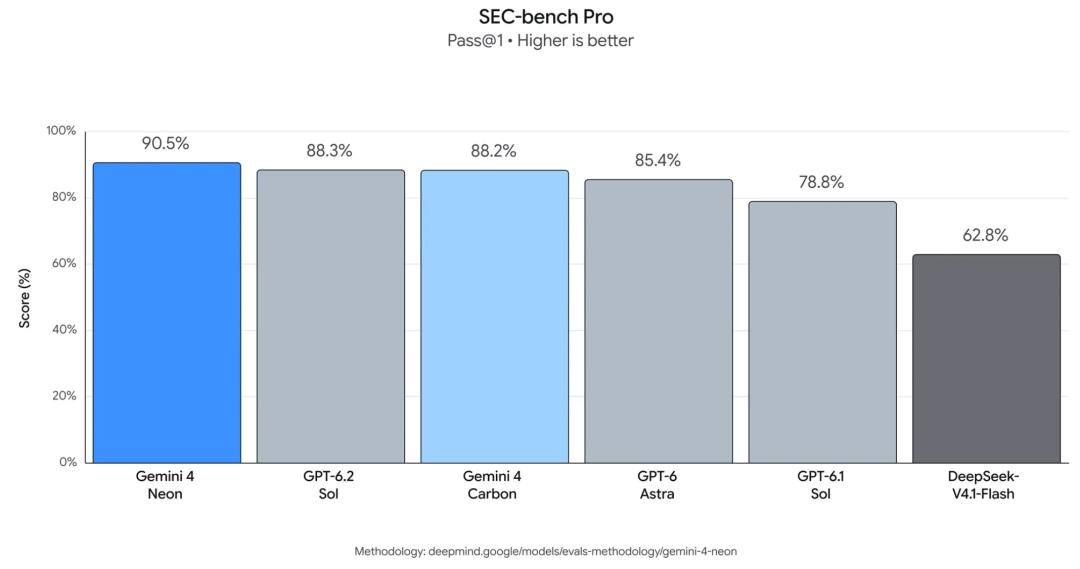
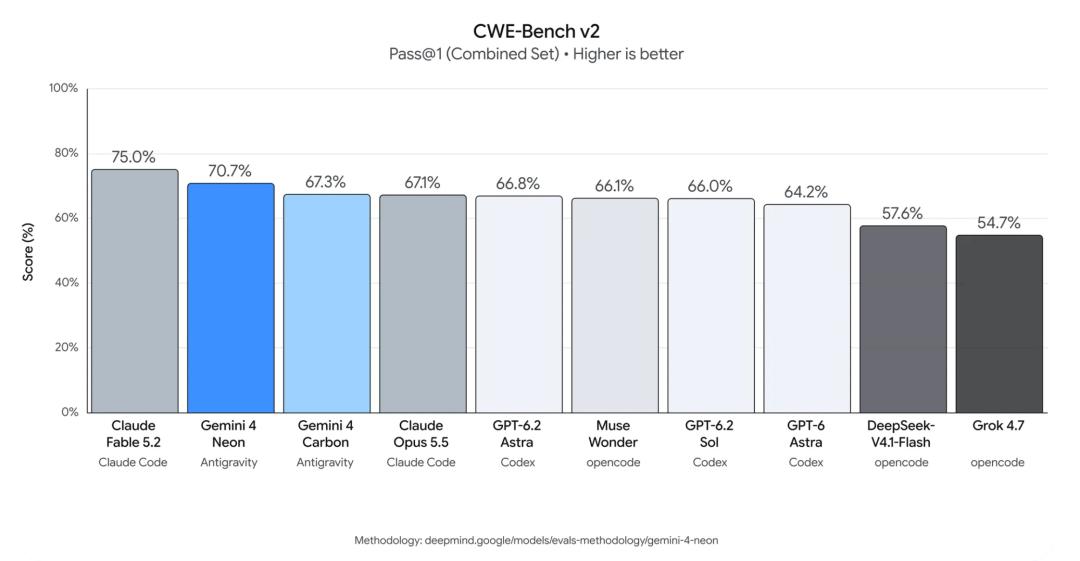
From the data, AutoBaxBench secure code generation reached SOTA (76%) at the difficulty level, comprehensively surpassing Carbon; WebExploitBench v1.2 penetration testing also achieved SOTA (51.26%), with the cost only half of that of competing large models; SEC-bench Pro vulnerability discovery reached SOTA (90.5%), with the cost per challenge about half of similar products; CWE-bench v2 vulnerability patching reached 70.7%, 3.4% higher than Carbon. Neon for Cyber will be opened to trusted security defenders through the Fairwind Program in the next few days.
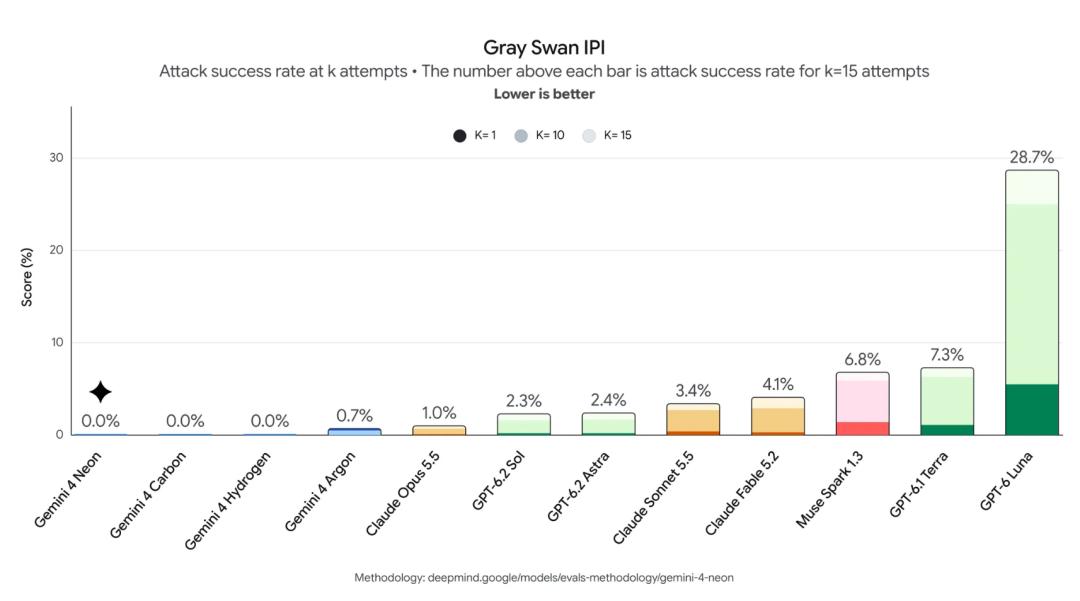
Security alignment, almost "zero cheating". Google has made heavy investments in security. The Terminal-Bench 4.0 cheating rate is 0.0%, on par with Carbon; only 2.45% of tasks show shortcut behavior in the coding cheating evaluation, the lowest in the entire Gemini 4 series; the improper behavior rate in the agent security suite is 0.09%, and the honesty evaluation pass rate is 99.2%. In Gray Swan's indirect prompt injection benchmark, Neon achieved a 0.0% attack success rate at the highest thinking level. Compared with Carbon, Neon reduced "under-servicing" by 43%-56%, and "unauthorized operation" by 15%-35%. At the same time, it hardly rejects legitimate tasks, only rejecting 1.98% on Terminal-Bench 4.0, and the rejection rate on Terminal-Bench-Science is 0%.
Upgrades on the consumer side as well. In the Gemini app, Neon brings higher quality writing output, can read uploaded content such as spreadsheets, PDFs and photos more accurately, and can also access Gmail and Docs to obtain relevant information. The Tasks function is now powered by Neon, which is faster and more quota-efficient when handling complex multi-step tasks.
Gemini 4 Neon has begun rolling out. Developers can build applications in Google AI Studio and Android Studio via the paid tier of the Gemini API, and Google AI Pro and Ultra subscribers can try it out in Google Antigravity. Enterprise users can access it via the Gemini for Business API or the model dropdown menu. On the consumer side, Pro and Ultra subscribers can directly switch to Neon in the model selector of the Gemini app. Neon for Cyber for cybersecurity scenarios will be pushed to trusted defenders through the Fairwind Program in the next few days.
The world model Genie 4 is finally launched
On October 28, Google DeepMind officially announced the latest generation world model Genie 4, calling it "the most realistic and interactive world model to date".
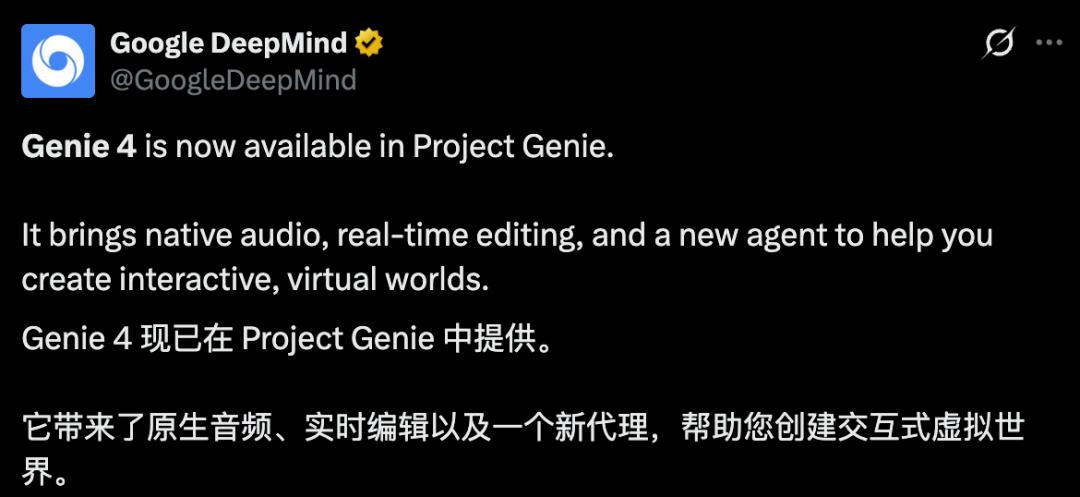
After waiting for more than half a month, Google finally announced that Genie 4 is officially available.
Blog link: https://blog.google/innovation-and-ai/models-and-research/google-deepmind/genie-4-now-available-project-genie/
Genie 4 is Google's most realistic and interactive world model to date. Its core new capability is "mid-session prompting", which means you can use natural language to change the environment at any time while you are browsing the world. You can switch the weather, spawn a character, change the direction of the plot, and all changes happen in real time in the current scene.
Another first-time capability is native audio. The world generated by Genie 4 comes with built-in sound, and the sound will automatically adapt to scene changes, including everything from ambient sound effects to character dialogues, filling in the "auditory" puzzle piece.
Genie 4 focuses on the highest fidelity, while Genie 3 will remain available in the model selector of Project Genie, oriented to longer exploration and panoramic scenarios.
While launching Genie 4 this time, Google also launched Project Genie Agent. Previously, creating a world required you to carefully organize prompts, but now it has become a conversation. You describe the world you want in natural language, and the agent will schedule Google's multimodal model portfolio to generate the initial visual picture to establish the visual style of the world, along with custom-made background music.
What's more interesting is that the Gemini model can observe the screen content synchronously while you explore the world, actively pop up suggestions on "where to go next", or automatically trigger in-world events according to your journey.
You can also remix existing worlds in the gallery, adjust the underlying structure, soundtrack or rules, turn it into your own version, and then publish it to the community gallery for others to explore and create secondary works.
The new Project Genie experience is currently open to eligible Google AI Ultra subscribers, and Google AI Pro members can join the waiting list on the same page.
This article is from the WeChat official account Machine Heart, edited by Leng Mao, and published with authorization from 36Kr.