The average early-2003 founded startup team tackles the pain points in the AI4S industry, solving the scientific hallucination problem through physical deduction.
The AI for Science track continues to gain growing momentum. Amid this wave, a startup team whose members were born on average in 2003 has come into public view, with the youngest member of the team born in 2005.
They have targeted a pervasive pain point that the AI4S industry cannot avoid: while the generative capability of models keeps increasing exponentially, their outputs often violate physical and chemical laws as well as real-world common sense, making it extremely difficult for such models to be truly integrated into physical R&D production lines. Faced with this bottleneck problem, this group of young people did not wait for fully mature industry solutions to emerge, but chose to blaze a trail on their own.
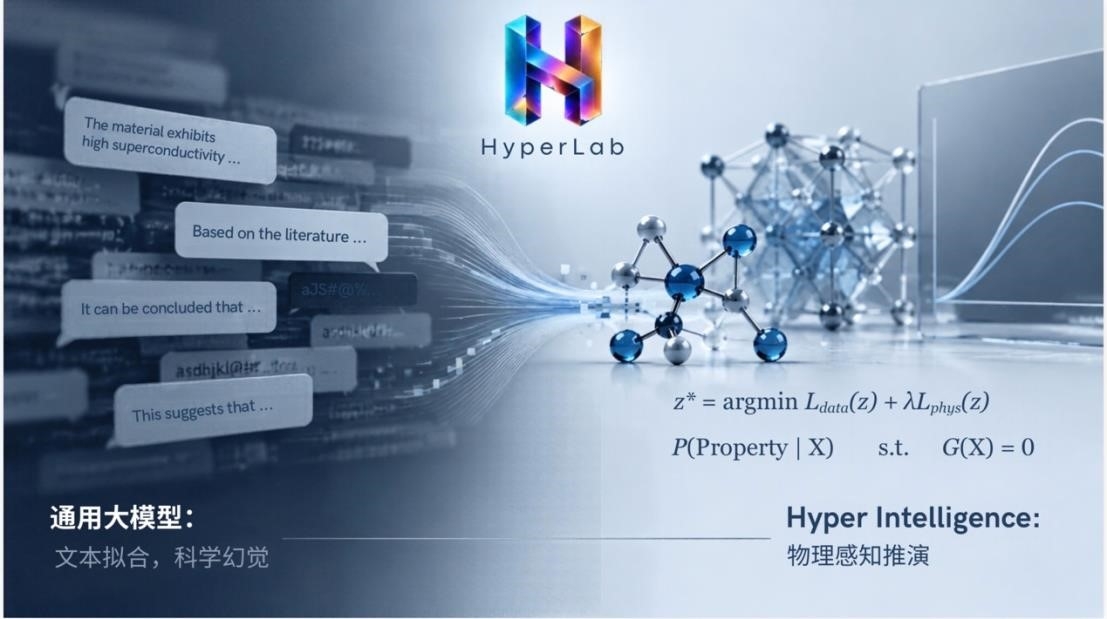
Cross-disciplinary talents in their early 20s jointly build Hyper Intelligence, the superintelligence for the scientific research community
This team is Suzhou HyperLab. They are committed to enabling AI to truly understand the physical world and building an AI Science Factory in collaboration with autonomous laboratories, so as to realize Hyper Intelligence — the superintelligence for the scientific research community.
The founder was born in 2002, completed his undergraduate study in Materials Science and Engineering at Harbin Institute of Technology, and pursued his master's degree in Materials Science at the University of Hong Kong. The core members of the team come from Harbin Institute of Technology, the University of Hong Kong, the Hong Kong University of Science and Technology, Fudan University, Northeastern University and other universities, covering four fields: materials science, artificial intelligence, physical algorithms and automation engineering. The Hyperteam has set a clear goal: to build Hyper Intelligence, the exclusive superintelligence tailored for scientific research scenarios. The word "Hyper" means "super" and "transcend", which is the expectation of these post-2000s members for themselves, and further implies breaking through the limitations of existing general intelligence to establish cognitive capabilities that belong to science itself.
They find the universal limitation of the AI4S industry: AI "scientific hallucination" restricts the implementation of hardcore scientific research
Current general large models generally have cognitive defects in physical laws. They often output content that violates objective laws with extremely high confidence, appearing confident but full of hallucinations, making it difficult to be truly embedded in hardcore R&D processes of materials, chemistry, biomedicine and other fields. The traditional scientific research chain is lengthy, highly dependent on manpower from scheme design, simulation calculation, synthetic characterization to iterative optimization, which leads to long trial-and-error cycles and high costs.
In the fields of advanced materials, fine chemicals and new energy materials, traditional R&D also faces deeper industrial practical bottlenecks. The industry has long relied on the "trial-and-error by cooking-style" iteration of scientific researchers, and it often takes months or even years for a single formula from development to mass production. Experimental data are stored dispersedly in various instruments and paper records, forming a large number of data silos, which will significantly reduce the prediction accuracy of AI models under the condition of small samples.
In addition, many current AI4S projects remain at the pure simulation calculation level, facing the implementation dilemma that "the simulation results are ideal but the actual products are difficult to prepare". At the same time, the track also has underlying architecture problems: there is a lack of standardized adaptation middleware between different material AI models and scientific research experimental equipment, and the models are deeply bound to the hardware. Replacing the model or instrument requires reconstructing the entire pipeline, resulting in consistently high transformation costs. The mutual separation of capabilities in materials science, algorithm R&D and hardware engineering also makes it difficult for most solutions to truly achieve 7×24-hour high-throughput uninterrupted closed-loop R&D.
Against the backdrop of multiple industry pain points, HyperLab is trying to find a new solution different from the pure simulation route.
Concept derived from scientific research laboratories: a unique physical perception deduction route
It is understood that the concept of Hyper Intelligence sprouted during the team's process of studying and conducting scientific research exploration in university laboratories. In daily scientific research, industry surveys and countless brainstorming sessions, they personally felt the pain points of existing AI tools: general models only fit the literature texts, do not understand the real physical rules, and output conclusions with a sense of certainty, but hide errors that cannot be implemented.
As the top-level decision-making hub, the HyperMind intelligent engine can complete model deviation correction and multi-dimensional information fusion, and realize forward prediction of material properties and reverse innovation of formulas and processes. The system relies on virtual deduction to quickly traverse massive experimental combinations; then anchors real experimental conditions and environments through physical perception deduction, reduces AI hallucinations, enhances confidence, generates the optimal experimental scheme that can be directly executed, and supports both manual review and autonomous distribution by agents.
At present, landing verification has been completed in multiple material R&D scenarios, which can reduce redundant experiments and shorten the R&D cycle with the help of intelligent deduction capability, and the closed-loop verification has been completed in the consumer materials sector. At this stage, the team continues to polish the entire system, connect with partners from the industry and scientific research end, and promote the iteration of the physical AI autonomous experimental system.
At the execution layer, the HyperLab Platform, an intelligent laboratory scheduling platform realizes non-inductive adaptation of existing instruments, cross-device collaboration and automated high-throughput experimental operations for samples. Real-time backflow of experimental measured data precipitates high-quality scientific research data assets, continuously feeds back to model accuracy iteration, and builds a real scientific research flywheel of "virtual deduction pre-screening — physical perception real verification — automated experiment implementation — data closed-loop iteration". At present, the platform has completed development and iteration, accessed more than 300 experimental equipment of different systems and more than 150 material R&D tools, and built a safe operation mechanism including double task review and full-process log audit.
Different from the shallow solutions that the industry generally focuses on hardware automation transformation, this system takes AI scientific deduction and data intelligence as its core barriers, and hardware automation only serves as the implementation base for superintelligence, truly realizing the paradigm upgrade of material R&D from "empirical trial and error" to "mathematical and physical deduction + intelligent empirical verification".
The core of Hyper Intelligence: focusing on understanding the essence of science
The core of Hyper Intelligence is to rely on the physical perception deduction architecture, integrate heterogeneous scientific experimental data, establish the model's cognition of the objective laws of materials and chemical systems at the bottom, and carry out physical perception deduction to understand the experimental environment, changes and processes in the real physical world, so as to fundamentally weaken this "confident hallucination". Different from the mainstream laboratory automation transformation idea in the industry, the core breakthrough of HyperLab is not limited to equipment scheduling. Its main goal is to enable the model to truly understand the physical world and grasp the essence of science, so as to realize that design equals implementation.
From scientific research ideas and industry surveys to the industry: verification completed for advanced materials and cosmetic formulas
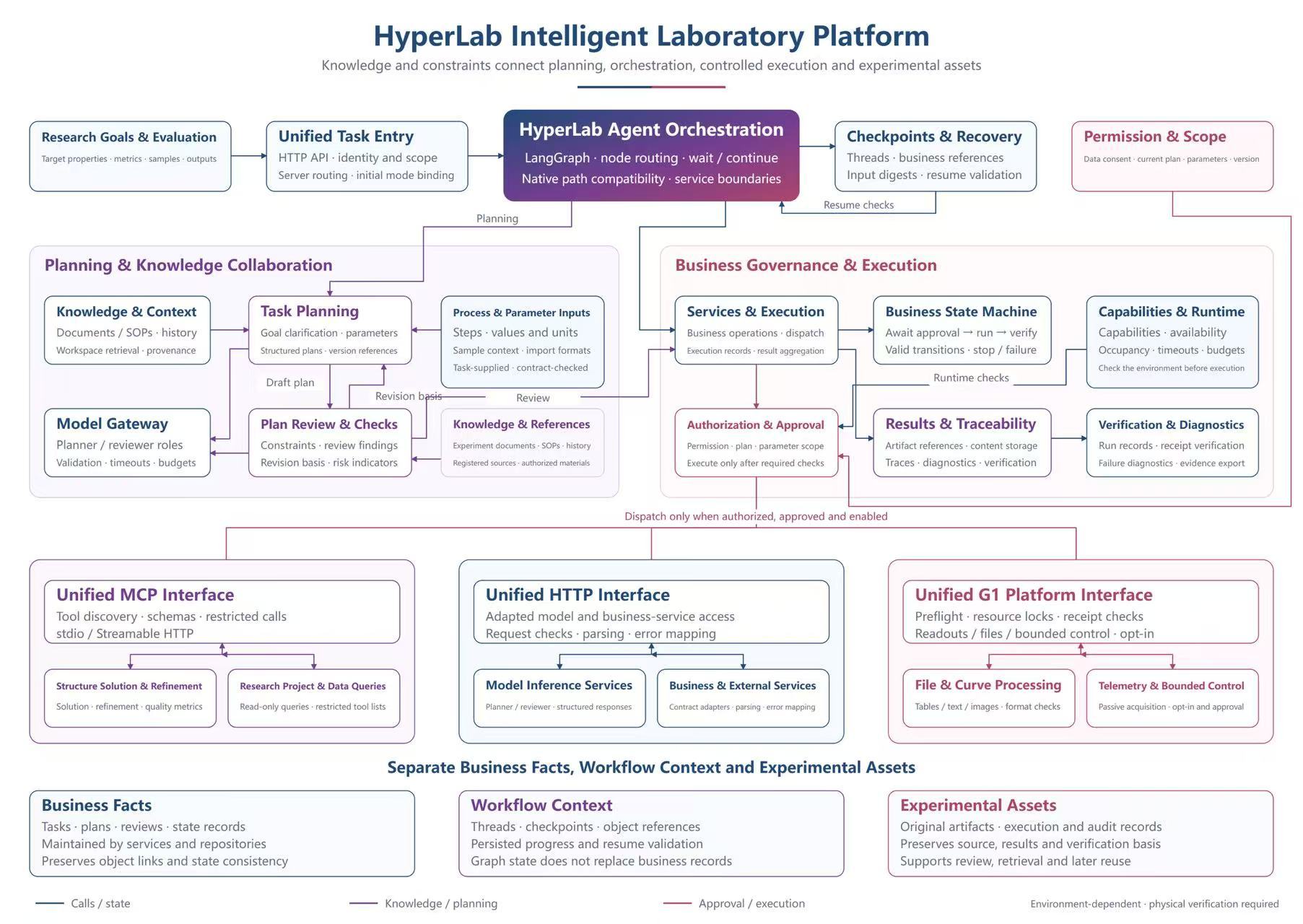
Commercialization adopts step-by-step capability delivery: providing intelligent reconstruction of experimental links for existing scientific research carriers to bridge the cognitive gap between virtual deduction and physical characterization; at the same time, building joint R&D pipelines with industrial partners to targeted tackle the development problems of materials and formula systems. HyperLab prioritizes the scenarios of advanced materials and fine cosmetic formulas, and continuously calibrates the physical consistency of the model relying on scenario closed-loop data. On the technical route, it first completes the endogenous self-iteration of the model and experimental links, then moves to design-to-manufacture, and jointly carries out new material R&D exploration with industrial partners in the form of joint projects, and outputs complete R&D capabilities with the scientific research factory as the final form. In the track, HyperLab focuses on the implementation of advanced materials, fine chemical formulas and other directions, continues to iterate and optimize, and has completed the production line closed-loop verification of some scenarios, pushing the ideas that collided in the campus in the past to industrial implementation.
Young forces build AI Science Factory: looking forward to further progress of domestic scientific research
Youth and daring to think and act are the most distinctive labels of this team, which is also their advantage to break the inertia of traditional scientific research. Rooted in the thinking of university scientific research scenarios and not bound by inherent paradigms, the team hopes to use super scientific intelligence with physical comprehension to reconstruct the basic scientific research paradigm and shorten the R&D cycle of new materials and new molecules.
At the stage when AI4S moves from concept to industrial implementation, more and more young forces are stepping into the field to tackle the underlying scientific intelligent infrastructure. From pain point insight and brainstorming in campus learning to industrial scenario implementation verification, Hyper
Intelligence is worthy of the industry's continuous attention on whether it can truly solve the pain points of scientific research implementation.