The AI business in Tencent's perspective
On November 18, Tencent released its Q3 financial report. I finished reading the report and listened to the earnings call for over an hour.
One figure stands out sharply: 81.4 billion.
Well, Tencent's quarterly capital expenditure is more than five times higher than the same period last year; meanwhile, its revenue rose by 8%, but the adjusted operating profit dropped by 6%.
With money being spent so fast, how will Tencent earn it back in the future?
In this earnings call, Martin Lau shared a lot of insights, some of which are quite interesting. For example, Tencent used to be relatively cautious about the enterprise software business in China. Why did it change its view now?
Another example: why was the AI assistant built in WeChat not designed to be overly powerful from the very beginning?
Putting these things together, it becomes much easier to understand the whole logic.
......
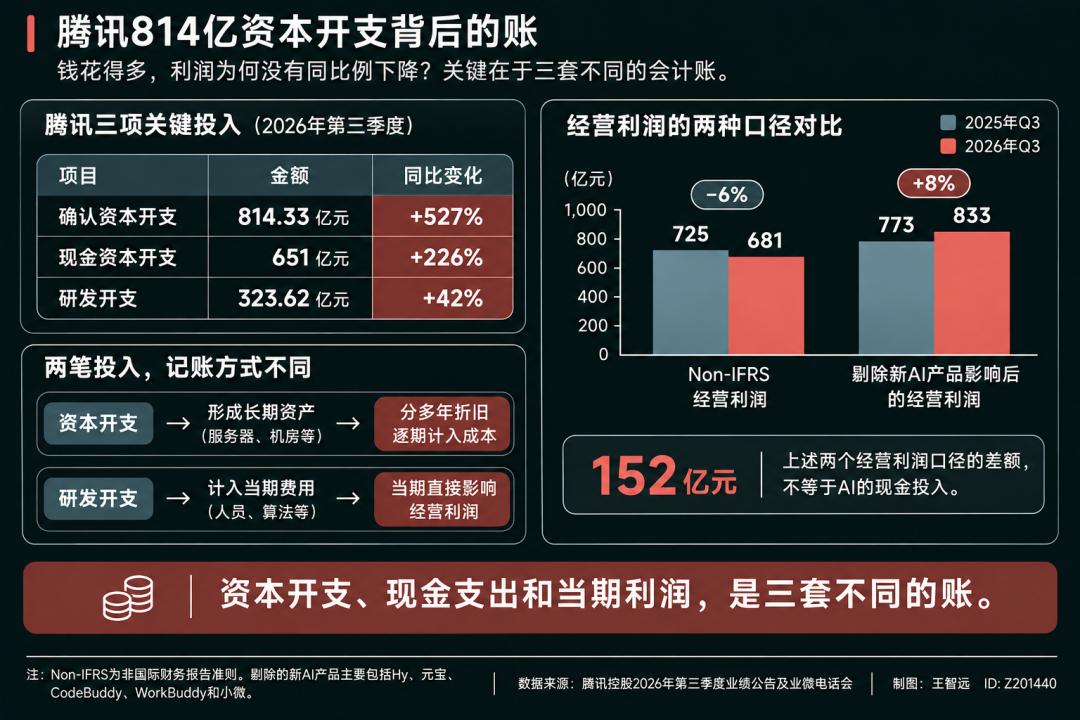
Let's start with this 81.4 billion figure. I checked the financial statements, and Tencent's recognized capital expenditure this quarter reached 81.433 billion yuan, up 527% year on year. The market originally expected it to spend 55.4 billion, but the actual figure was 26 billion higher than the forecast.
However, the actual cash paid out was 65.1 billion, up 226% year on year. There is a 16.3 billion gap between the two figures, and the financial report does not specify where the difference comes from.
There is another sum of money worth noting:
Under the item "Prepayments, deposits and other assets" on Tencent's books, the balance was only 24.54 billion yuan at the beginning of the year, and it had risen to 162.9 billion by the end of September. It was stated in the earnings call that a large part of this amount is the prepayment for computing power procurement.
Looking at Tencent's assets, the value of properties, equipment and fixtures rose from 149.9 billion yuan at the start of the year to 242.5 billion, and construction in progress also increased from 9.67 billion to 23 billion.
You can roughly picture the scene: a large number of servers have been moved into the data centers, and more supporting facilities are still under construction.
What is the difference between purchasing servers and paying employee salaries?
When you buy a server that can be used for several years, you can spread the cost over multiple years in accounting terms, and deduct a small portion from the profit statement each quarter. This is called depreciation.
Therefore, the 81.4 billion capital expenditure will not be deducted from the profit of this quarter all at once.
The R&D expense is different. Tencent's R&D expenditure this quarter was 32.362 billion yuan, 42% higher than the same period last year, and this entire sum is counted as current-period expense.
Martin Lau used an analogy in the earnings call, saying that this is a bit like building a factory. The factory building can be used for many consecutive years, instead of only producing products for one quarter.
Once you understand this logic, it will not be difficult to interpret Tencent's profit. In this financial report, three figures can be viewed together:
Calculated in accordance with the International Financial Reporting Standards, the operating profit was 59.1 billion yuan, down 7% year on year
Calculated on a non-International Financial Reporting Standards basis, the operating profit was 68.1 billion yuan, down 6% year on year
Based on the second figure, excluding the impact of five new AI products, the operating profit reached 83.3 billion yuan, up 8% year on year
The five products are Hy, Yuanbao, CodeBuddy, WorkBuddy and Xiaowei, and the official statement says that these five are the core of the new AI product portfolio.
Tencent specifically released the third figure to let the public see the profitability of its original business when these new businesses are temporarily excluded.
You can see that after exclusion, the operating profit margin still stands at 40%, which is basically the same as last year.
But profit is profit, the cash has actually been paid out. Tencent's free cash flow this quarter was negative 69.1 billion yuan. If the computing power prepayment is excluded, the figure will be positive 16.9 billion.
So how much more will Tencent spend in the future?
James Mitchell, Chief Strategy Officer of Tencent, said: In terms of actual cash paid out, capital expenditure has reached its peak level. For the rest of this year and next year, the spending will probably fluctuate around this level before declining afterwards.
He also mentioned that the situation will become better when 2028 comes.
Why? The facilities built in the past two years can continue to be used for a long time. The price of equipment is quite high at present, and the price of the same equipment is expected to drop when purchased later.
Besides, the computing power efficiency is still improving, so the same batch of equipment can handle more workload in the future. Of course, these are the management's judgment on the future, and the money has already been spent.
......
Then what businesses do these devices help Tencent run?
The revenue of Tencent Cloud services this quarter increased by 35% year on year, compared with 21% in the second quarter, and only a dozen percentage points for the whole of last year.
Interestingly, Tencent is still cutting the price of its large models. According to Tencent's own statement, the pricing of Hy4 flash is only 1/20 of that of Hy4, which is 95% lower.
Well, the selling price is getting lower and lower, but the business scale is getting larger and larger. What is the secret behind this?
First of all, let's talk about why the model can be so cheap.
Hy4 flash has a total of 224 billion parameters, but only 12 billion are activated each time. To make an analogy: you have 224 people under your management, and when a task comes, you only need to select 12 people who are good at this task to finish it, there is no need to make all 224 people work.
In this way, the computing power consumed for each task is greatly reduced.
Just imagine, a machine that originally can process 100 user requests a day can now process 200 requests a day. With other conditions unchanged, the equipment cost allocated to each user is cut by half.
The management said that the computing power efficiency is doubling every year.
Of course, high efficiency alone is not enough, there must be customers willing to buy. I noticed that the management mentioned three sources of cloud revenue growth:
GPU leasing, which means leasing computing power to other users, saw its revenue rise by more than 30% both year on year and quarter on quarter this quarter
MaaS, namely Model as a Service, allows customers to use models without building their own, and pay according to actual usage. Its revenue this quarter increased by more than 300% quarter on quarter
WorkBuddy, which turns models into software that can help people complete work, its revenue this quarter is more than 5 times that of the previous quarter
You see, some customers buy computing power directly, some buy model usage volume, and others buy ready-made AI tools. These three purchase modes consume the same batch of servers behind the scene.
There is another question here: as the United States further tightens chip controls, will Tencent's computing power reserve still be sufficient?
James Mitchell's judgment in the earnings call is: The cloud business will not be materially and negatively affected. To understand this statement, we need to distinguish between model training and inference.
This is a bit like training a chef. When learning to cook, the chef needs to know all kinds of ingredients, practice knife skills, learn to control heat, and try making dishes over and over again. After he masters the skills, when a customer orders Kung Pao Chicken, he only needs to make that specific dish.
Model training is equivalent to learning skills, and inference is to use the learned skills to complete work.
Chip restrictions will indeed slow down the training progress. Martin Lau said very directly in the earnings call that the next generation of Hunyuan model will take longer to launch.
But for inference, models with high efficiency can also run on domestic chips. Cloud services mainly run inference tasks, which is what James Mitchell refers to when he says there will be no negative impact.
Mitchell also sighed that the change in inference efficiency in the past 12 months is so fast that it was completely unimaginable a year ago.
No one can predict how chip control policies will change in the future.
However, Tencent is already trying to develop this model into a new type of business. Martin Lau was not that optimistic about this business in the past.
......
His exact words are: Tencent used to be relatively cautious about the development speed of China's enterprise software market; now he believes that with the support of AI, enterprises will be willing to spend more on office software, and this change will come very quickly.
Why did he change his mind? There are three reasons.
The first reason is piracy.
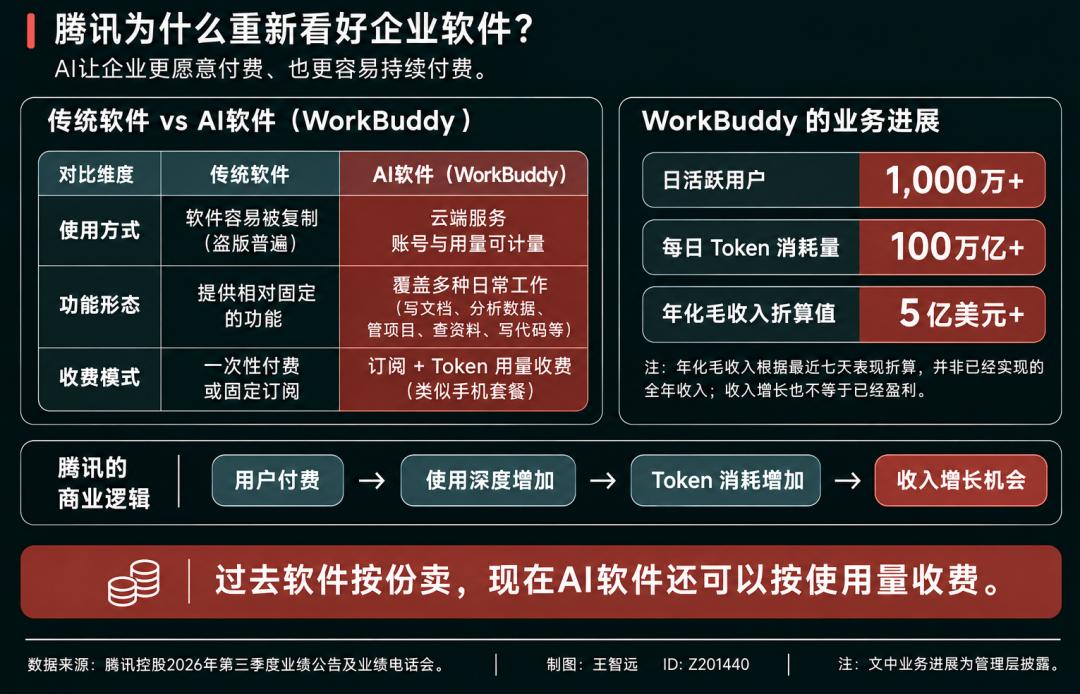
This is a decades-old problem in China's software industry: after buying a set of software, people will copy it to the whole company for use, and the company even thinks it is saving money. But AI services cannot be copied easily, the background system can see which account you use and how much you consume.
In the past, it took a lot of effort to convince enterprises to pay for software, and explain to them the value of the product.
WorkBuddy is quite different: it can do a lot of work including document writing, data analysis, project management, information query and coding.
One single function may not be worth much money, but if all these functions are integrated together and employees have to use them every day at work, enterprises' willingness to pay will be completely different.
There is another interesting change: the payment model has changed.
In the past, when buying software, enterprises either paid a one-time fee, or paid a fixed annual fee. WorkBuddy adopts a subscription plus token usage billing model, which is a bit like a mobile phone plan: you pay a basic monthly fee, and pay extra if you use more resources.
Do not underestimate this "extra payment". The more dependent customers are on this tool and the more they use it, the more revenue Tencent can get, without even needing to raise prices deliberately.
Therefore, Tencent now sends engineers to customer sites to teach them how to use the tool in their daily work. According to the management, after some customers fully understand what WorkBuddy can do, their spending on the product will increase significantly.
How large is this business now?
Martin Lau said in the earnings call that WorkBuddy's daily active users have exceeded 10 million, and the daily token consumption has exceeded 100 trillion. Converted into annualized gross revenue based on the performance of the latest seven days, the figure has exceeded 500 million US dollars, which is more than twice the current revenue of Tencent Meeting, a product launched seven years ago.
The enterprise version of WorkBuddy was only launched in June this year. Up to now, 60% of China's top 100 enterprises and half of China's top 500 enterprises, covering more than 50 industries, have become its customers.
There is also an interesting example: one user spent 40,000 yuan only on token purchase in a single month.
When talking about this, he used online games as an analogy.
In the early days, game developers in China also went through a similar development path. Later, people found that games can be sold by in-game items instead of selling the whole game copy.
In the past, you could only charge once for selling a game copy. But for selling in-game items? Users who are willing to pay can keep spending money. Martin Lau believes that today's enterprise software business is very similar to the online game industry in those days.
Of course, it cannot be said that this business has already made profit. Tencent is still spending money to attract users, and some user groups, such as school teachers, can use the product for free for the time being.
How will this business develop in the future?
Tencent will guide more free users to become paying users, encourage existing paying users to use the product more frequently, and find ways to reduce the cost of tokens. These are the three development directions mentioned by Martin Lau.
However, not every scenario requires such heavy usage. When it comes to WeChat, the business logic is different.
......
The AI assistant in WeChat is called Xiaowei. It has been in gray-scale testing for several months, and now its daily active users have reached 30 million.
Martin Lau used two words to distinguish WorkBuddy and Xiaowei. He said that WorkBuddy provides depth of AI usage, while Xiaowei provides breadth of AI popularization.
How to understand this?
A person who cannot work without WorkBuddy every day represents the depth of AI usage; a person who rarely uses AI before casually asks Xiaowei a question when browsing Moments represents the breadth of AI popularization.
Therefore, you can find Xiaowei in more than 30 places in WeChat, including Moments, Official Accounts and Channels. Tencent is also trying to connect Xiaowei with Mini Programs and WeChat Shops.
According to his statement, the more places Xiaowei appears, the more users will use it, and the usage frequency of users will gradually increase.
However, some users who have tried Xiaowei find that it is not as smart as Yuanbao.
Martin Lau also talked about this problem, and his answer is quite interesting: this is originally part of the product design. Yuanbao has also shifted its focus from pursuing user scale to improving product capability.
Why? We need to calculate the cost.
WeChat and WeChat International have a total of 1.449 billion monthly active users. Even if each user only chats with AI for a few words every day, it will be a huge expense under such a large user base.
Therefore, Xiaowei uses a specially customized model. At this stage, it does not pursue overly powerful capabilities, but first develops functions that are sufficient for daily use, and reduces the cost of each call.
He gave a very intuitive figure: according to his estimation, even if Xiaowei is open to all 1.4 billion WeChat users, the cost of one quarter will be lower than the cost of Yuanbao in one quarter earlier this year.
Moreover, part of the inference tasks can be run directly on the user's mobile phone in the future, which will further reduce the cost.
Then how does Xiaowei make profit?
Martin Lau used a term called "multiplier". His point is that Xiaowei can help Tencent's existing WeChat businesses generate more revenue.
How much revenue does WeChat generate every year? He did not give an exact figure, but said that the total revenue of all related businesses reaches hundreds of billions of yuan.
His calculation logic is: if Xiaowei can increase this total revenue by 10% to 20%, it will be enough to cover its own cost and achieve profitability.