When AI office tools are all powered by the same model, the competition has come back down to the old issue.
This is a rare sight. Spurred by the emergence of AI, several major Chinese companies have successively adjusted the organizational structure of their AI office business recently.
At the end of July, ByteDance launched an organizational adjustment to integrate the strengths of Doubao, Feishu and Volcano Engine. In September, Liang Rubo, CEO of ByteDance, systematically explained this arrangement for the first time at the Feishu Conference. Tencent's WorkBuddy has Ma Huateng personally participating in its product meetings, and the QClaw related business and team have also been incorporated into this line. Alibaba merged three products into Tongyi Office, which is under the charge of the DingTalk team. Baidu integrated its internal products into Baidu Dazi, while Kingsoft Office shifted its main focus to AI.
These adjustments show that all parties have ended the previous stage of separate attempts, and started to concentrate resources to develop this business with their existing advantages in organization, ecosystem and channels.
This is not quite the same as the expectations when large models first emerged.
At that time, many people thought that new AI products would replace the original industry leaders, and small companies could also rise by relying on a new technology. Several years later, models are accessible to all, and the big companies that have channels, customer relationships and complete product systems still occupy a favorable position.
One detail can illustrate this point. None of these products are connected to a single model. In addition to its own Hunyuan, Tencent's WorkBuddy is connected to DeepSeek, Zhipu GLM, Kimi and MiniMax. In addition to the two Doubao models, Doubao Work also accesses Kimi, GLM and DeepSeek. Tongyi Office is more straightforward: ten models were launched at one go in mid-November, including self-developed Tongyi, DeepSeek, Kimi and MiniMax — it briefly accessed external models in August and then quietly withdrew, and only completely opened up after several swings. Microsoft Copilot does not only use one model either, with OpenAI and Claude both adopted.
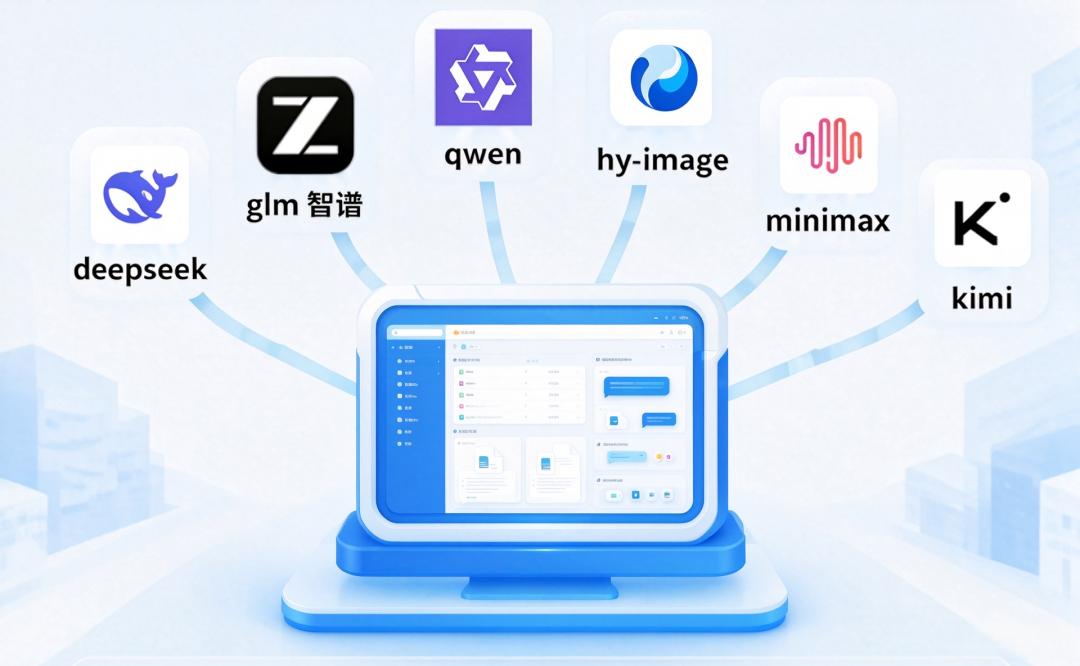
This seems to be different choices made by each party, but the results point to the same direction. When mainstream models are all connected to the same product, the models become replaceable parts at any time, and no one can widen the gap in underlying capabilities. The more complete models you access, the more similar the products will be to each other.
This situation is not uncommon in commercial history. However, the three sentences that large enterprises often mention now all have points that need to be scrutinized.
1. More data does not mean better utilization
The first sentence that large enterprises love to talk about most is that enterprises hold massive data, which can be put into use once connected with AI, and the data itself is a competitive advantage.
People who truly understand enterprises know that things are not that simple.
In the same company, the sales, finance and warehouse teams keep their own accounts, and the same number does not match across different departments, which is rooted in their different responsibilities and authorities. The data mid-platform that was popular in previous years encountered exactly this problem. This concept was popularized by Alibaba around 2015, and many enterprises followed up with investment. Around 2020, Alibaba itself was weakening the mid-platform, and many projects found that the data was still not easy to use even after the system was built.
The difficulty lies not mainly in technology, but in the organization — getting various departments to hand over data and re-coordinate interests is far more difficult than deploying a system.
This can also explain a phenomenon. Alibaba's Tongyi Office open-sourced a set of tools this year, which is used to organize data scattered in different systems and in different formats into content that agents can directly use.
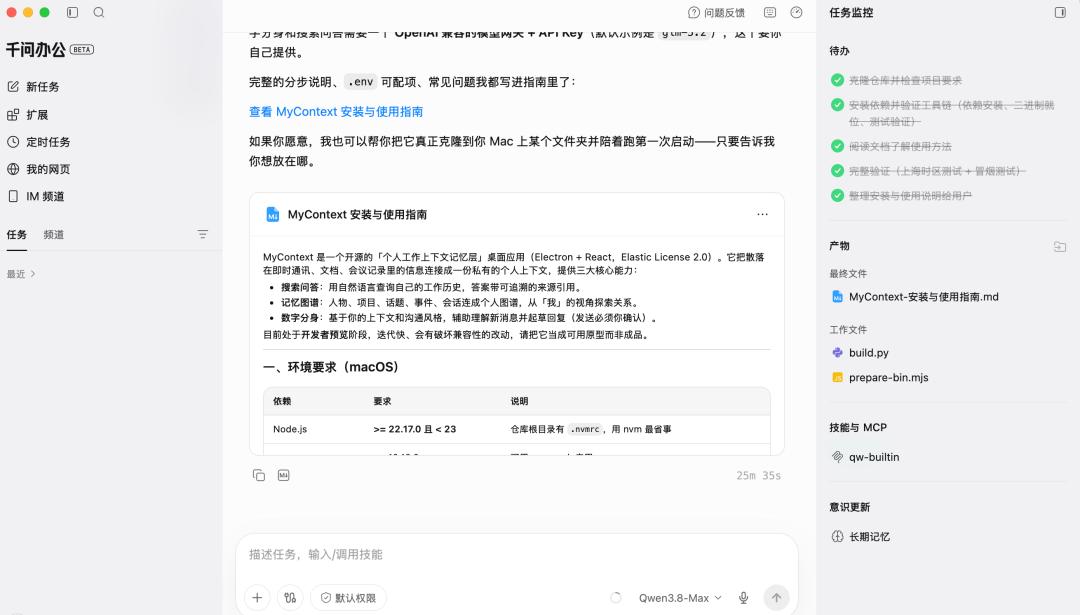
If the original data can be used directly, this kind of tool will not be necessary. The reason why it has attracted attention is that sorting out messy data into usable information requires long-term accumulation, which is exactly the capability that large companies have after years of serving enterprise customers, and cannot be solved by simply switching to a new model.
Now that models are mastering more and more knowledge, the value of old data simply stored by enterprises needs to be re-evaluated. What really matters is the mechanism that allows data to flow smoothly within the company, as well as the experience accumulated by agents in practical work.
Holding data in hand is not the same as being able to make good use of it.
2. Deeper customization brings higher modification difficulty
The second sentence that large enterprises often mention is to connect the system to the core processes of enterprises, make customization according to customer needs, so that customers will rely more on it the longer they use it, and the position will be stable.
This practice is very common in the software industry, but it also has obvious costs.
In the past, many large enterprise software were tightly integrated with the specific processes of customers. In the short term, it was difficult for customers to replace them; but once the technical direction changes, these software companies have to take care of old customers, so their product modification is very slow, and it is difficult to fully embrace new trends.
A more recent example is the previous generation of automation software RPA: its operation rules are set for specific processes. Once the business process changes, the original rules need to be remade, and the subsequent maintenance workload is huge. Some practitioners reported that the labor cost saved in some projects is not even enough to maintain the normal operation of the software.
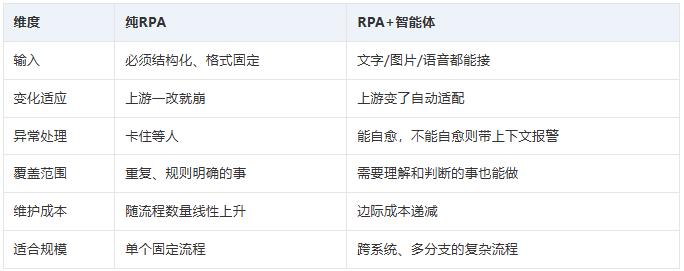
Current AI office products have already shown different choices.
Tencent first develops the assistant on personal desktops, and then gradually expands from individual users to enterprises; Alibaba pays more attention to enterprise customers, and goes deep into business relying on DingTalk; ByteDance directly integrates AI functions into Feishu.
Different choices are related to their respective strengths and burdens, and the risks are also different: a lightweight approach brings fast promotion but easy to be replaced; a heavyweight approach ensures stable customers but may fail to keep up with changes.
Models are updated roughly every half a year. At this pace, solid customer relationships and inflexible products often come from the same reason. The tighter you tie your customers, the more your own hands and feet are restricted.
Whether a balance can be struck between stability and flexibility is more important than simply competing for deeper integration.
3. Nominal innovation, but still following old practices
Connecting the previous two points, you will find a somewhat ironic fact: this competition known as subversive uses tactics that are not very different from those of the traditional software industry.
Microsoft is the clearest example.
Satya Nadella did not make AI an independent product, but gradually integrated OpenAI's capabilities into its own software system: the standalone Copilot Pro was discontinued, AI functions were merged into the Office suite, and then packaged together with security and management tools into the E7 plan at $99 per user per month.
Even Microsoft connects both OpenAI and Claude models in Copilot instead of using only one. On the surface, new technologies are driving the progress, but what actually works is the customer base accumulated by Windows and Office for many years. AI only makes these old products more attractive.

Several domestic companies are also following similar ideas.
Tencent relies on the traffic from WeChat and WeCom, Alibaba relies on the enterprise customers on DingTalk, Kingsoft relies on government and enterprise channels and compatibility in document formats, and Baidu relies on its own systems such as search, cloud disk and intelligent cloud.
None of these advantages are brought by AI, but are the results of years of operation by each party. It is nominally a new business, but the old resources are still being mobilized.
The user growth figures also need to be viewed separately.
The rapid development of WorkBuddy is partly driven by point subsidies and free traffic diversion from WeChat. Some users are only attracted by the subsidies and use it as an entry to call other models. The bustle at the time of release does not necessarily translate into long-term usage.
Looking at it over a longer time horizon, the changes brought by technology rarely simply replace old companies. When a new technology goes from scarcity to popularity, what usually happens first is that old companies use it to complete their own upgrades and incorporate new changes into their original systems. AI office is now at this stage.

But this does not mean that the pattern has been settled.
In commercial history, companies that truly re-divide the market often emerge outside the attention of leading enterprises. They do not copy ready-made practices, nor rush to imitate large companies.
Now the five major companies are staring at each other, and their products are becoming more and more similar. The truly different forces may be developing in places they do not notice.
Technological changes are real, but the realization process is more tortuous than initially expected. It is still too early to tell the winner among these companies at the moment, and what is more worthy of attention is the new player that has not yet entered this competition.
This article is from the WeChat Official Account "Silicon-based Research Lab", written by Zhou Quan, and published with authorization from 36Kr.