Tencent's AI closed loop is embodied in the next WorkBuddy.
On November 18, Tencent released its new quarterly financial report.
In Q3 2026, Tencent recorded a revenue of 2073.36 billion yuan, a year-on-year increase of 8%; under the Non-International Financial Reporting Standards, the profit attributable to equity holders of the company was 665.19 billion yuan, a year-on-year decrease of 6%; the three main business lines of games, advertising, fintech and enterprise services still maintained steady growth.
While its core home base remains solid, Tencent has fallen into unprecedented disorientation.
At Tencent's general meeting of shareholders this May, when asked whether Tencent was lagging behind in AI, Pony Ma said: "A year ago we thought we had already boarded the ship, but later found the ship was leaking. Now we feel we have stood firm on it, but we are not yet able to sit down properly, and we still hope the ship can sail faster."
On November 11, at Tencent's internal total office meeting LinkTime, Pony Ma discussed AI again.
"The wave is already crashing in. Some core businesses seem to hold solid positions, but AI is advancing at a tremendous speed. The surging tide in the distance is swallowing hills one after another, and you can no longer sit still and enjoy the view. Land warfare has turned into naval warfare, the army has become the navy. Everyone needs to move supplies, upgrade their skills, and get on board quickly to meet the battle."
For Tencent, the key issue is not whether it has AI, but whether AI can form a new closed loop.
For a long time, Tencent has been born with C-end attributes in its genes, and its AI path naturally carries the imprint of "C to B", that is, leveraging the product habits and entry potential of the C-end to pry open B-end scenarios and revenue.
According to data from Nomura Securities, in April 2026, among the top 50 apps that cover about 93% of the usage duration of China's mobile internet, the duration share of ByteDance's product ecosystem rose from 32.3% in the same period of the previous year to 38.3%, while Tencent's ecosystem accounted for 30.8%. A year ago, the figures for ByteDance and Tencent were 32.3% and 32.4% respectively, which were almost at the same level.
After leveraging the massive user base of WeChat and investing 1 billion yuan in red envelope campaigns to drive 114 million monthly active users, Yuanbao saw its MAU drop to 37.33 million in September this year, which is no longer in the same order of magnitude as Doubao's 419 million MAU.
In the AI era, the situation Tencent is facing seems more severe than ever. When the growth of its C-end business starts to slow down, where can Tencent find the closed loop for the AI era?
The "Thickness" and "Thinness" of the C-end Matrix
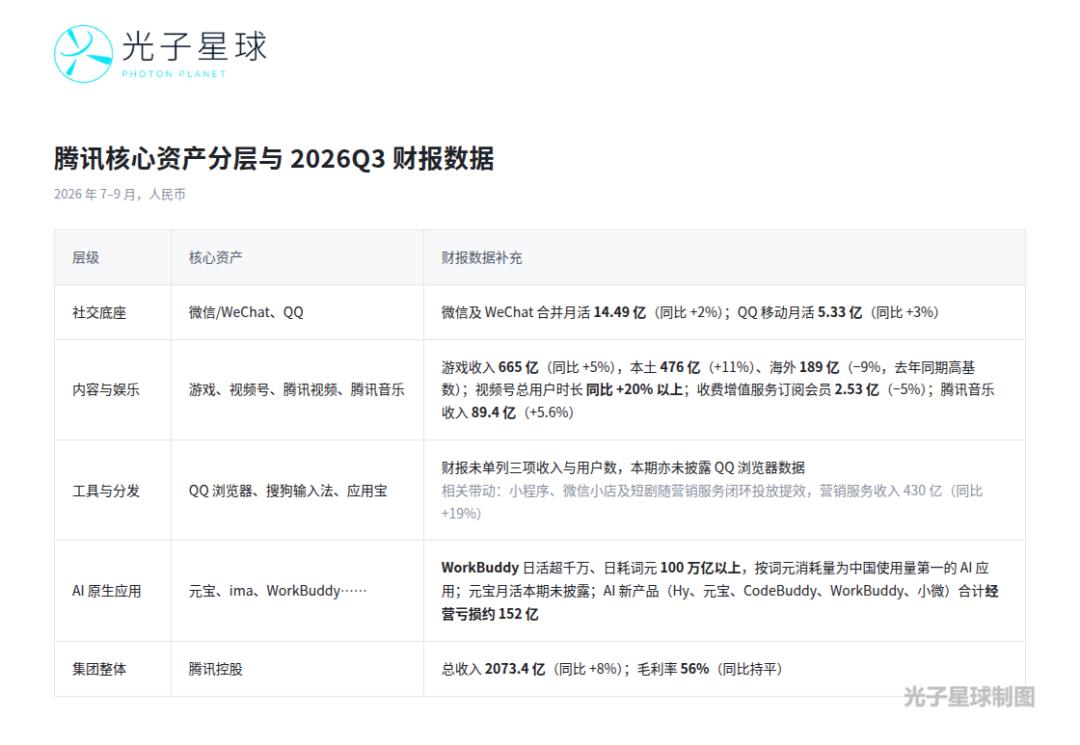
Multiple financial report data show that the moat of Tencent's C-end business is still very "thick". Its core basic market has not been impacted at all, and has even achieved profit growth after products are empowered by AI.
On the revenue side, Tencent's latest financial report shows three major growth highlights.
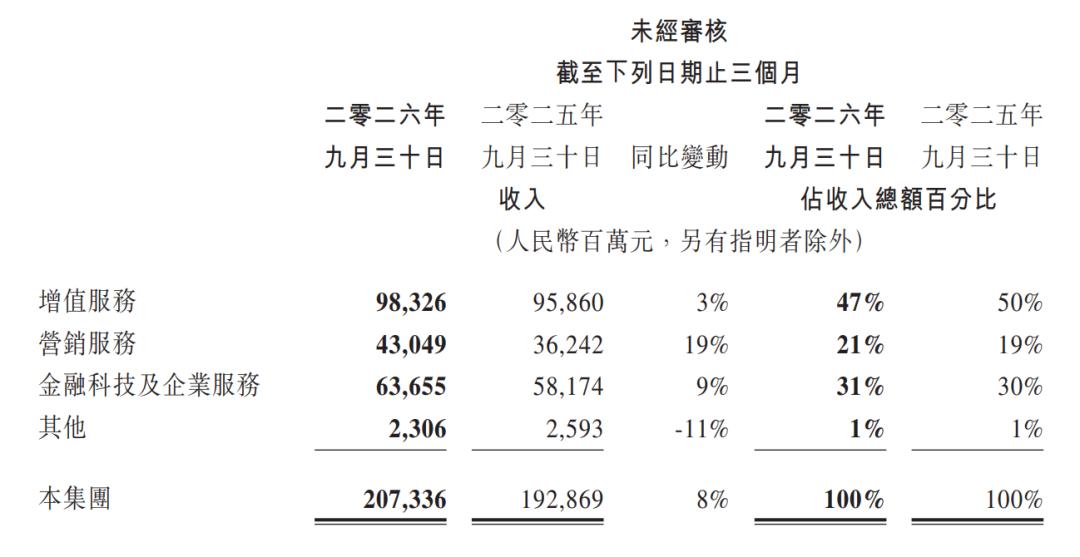
The financial report shows that Tencent's value-added service revenue increased by 3% year-on-year to 983 billion yuan. The revenue from local market games reached 476 billion yuan, up 11% year-on-year, driven by the revenue growth of games such as *Delta Action*, *Valorant: Source Energy Operation* and *Honor of Kings*.
Marketing service revenue increased by 19% year-on-year to 430 billion yuan. By integrating the closed-loop marketing capabilities within the WeChat ecosystem, Tencent empowers short dramas, WeChat Mini Shops and other WeChat integrated services, and places ads on WeChat and other Tencent-managed advertising resources.
In terms of fintech and enterprise services, the revenue in 2026Q3 increased by 9% year-on-year to 637 billion yuan. The growth of fintech service revenue came from the increased income of consumer loans and wealth management services. The growth of enterprise service revenue was mainly driven by a 35% year-on-year increase in cloud service revenue.
However, it can be seen from the financial report data that the development of AI-native applications shows a relatively weak performance. The essence is that Tencent's C-end advantage is a distribution advantage, not an AI-native advantage.
With the help of technologies such as AI advertising recommendation model and AIM+ upgrade, Tencent's advertising business has realized end-to-end delivery capabilities from targeting, bidding, creative production to landing. In the game business, the integration of AI and gameplay is also continuously advancing. For example, in the game *Game for Peace*, the player experience is improved through AI NPCs.
Judging from the AI transformation process of Tencent's two core businesses, advertising and games, Tencent's AI implementation has crossed the technical pilot stage and entered the business verification stage. But this path still belongs to the logic of AI enhancement for existing businesses, rather than building new entrances and new increments for AI-native applications.
For this very reason, Tencent's traditional C-end traffic moat, on which it has long relied for survival, is being continuously eroded under the wave of AI-native applications, and its original distribution advantage is no longer the amulet for winning.
In the AI-native application list released by QuestMobile in September, the top three AI applications by monthly active users are: Doubao with 419 million, Qwen with 158 million, and DeepSeek with 123 million. None of Tencent's AI-native products have entered the first echelon.
The "thinness" of the AI-native segment has kept Tencent in a catching-up position all the time.
Before the birth of WorkBuddy, Tencent had long lacked a benchmark product that could hold a firm position in the C-end AI track. Therefore, Tencent not only continuously supplies resources for AI development with revenue from sectors such as games and entertainment, but also uses its C-end ecological advantages to provide entry scenarios for its own AI-native applications.
But overall, the landing results are not satisfactory. In the past two years, a number of Tencent's AI products including QClaw, Tencent Meta-Element, Tencent Translator and Zhiying have successively announced service shutdown and integration, and some of their capabilities have been migrated to mainline products such as Yuanbao and WorkBuddy, and are no longer operated as independent C-end AI applications.
Facts have proved that it is very difficult for Tencent's familiar C-end diversion strategy to incubate AI-native applications with self-growth capabilities. The social relationship chain, which is the first layer of value of its C-end genes, cannot guarantee the long-term stickiness of products either.
On the contrary, WorkBuddy, which also belongs to the CSIG business group, has run through the closed loop in the free exploration of edge projects, and has gradually grown into Tencent's AI strategic product.
Tencent's Q3 financial report data shows that calculated by the consumption of large language model tokens, WorkBuddy has become the AI product with the highest usage volume in China, with over 10 million daily active users, and more than 10 million users consume a total of over 100 trillion tokens every day.
The second layer of value of C-end genes does not lie in the C-end traffic entry, but in how to coordinate the users and products that have been precipitated for many years, and extend the implementation to B-end productivity scenarios.
This is exactly the reason why WorkBuddy is pushed to the front stage to carry Tencent's expectation of breaking through in the AI field.
WorkBuddy: The Only Verified Sample in the "C to B" Closed Loop
"We believe WorkBuddy has developed into the largest AI application in China. Driven by WorkBuddy, and as we allocate more computing power for Model-as-a-Service and GPU leasing, the growth rate of cloud service revenue has further increased," Tencent stated.
In the AI era, Tencent has once again realized the C to B closed loop, and this time the sample is WorkBuddy.
The predecessor of WorkBuddy is CodeBuddy, an internal efficiency tool for developers. In the early days, AI Coding was not a popular track. In order to verify the value of the product, the CodeBuddy team went directly to the site of enterprise customers to work on site, participating in meetings, deploying products, collecting feedback and iterating the product.
This means that what the early CodeBuddy team accumulated is not only the model calling capability, but also the working capability of the model to enter real scenarios.
After WorkBuddy lowered the usage threshold and turned to the office scenarios for non-technical users, it has become everyone's work partner, which can independently understand and decompose goals, run codes, call tools, and finally generate deliverables.
At the same time, in Tencent's internal ecosystem, WorkBuddy has connected C-end products such as Tencent Docs, QQ Mail and Tencent News, and aggregated the application potential under Tencent's ecosystem. According to QuestMobile data, WorkBuddy ranks first in the AI office ranking, with a monthly active user of 32.35 million in September, more than three times that of the second place.
In October this year, WorkBuddy was deeply integrated with WeCom to realize unified account interconnection, further connecting Tencent's office ecosystem.
In this process, WorkBuddy undertakes the task execution layer, uses WeCom as the customer acquisition entry to directly reach 14 million enterprises, and successfully transplants C-end products to B-end scenarios. The conversational interaction habits precipitated by employees on the C-end can be directly migrated to the enterprise workflow. And enterprises can also pay directly for the delivery results, not just for the model and computing power.
In the second half of this year, WorkBuddy has received more and more enterprise orders, covering transaction orders in multiple fields such as insurance, banking, hospitals, FMCG, construction, and media.
Official data of WorkBuddy shows that its enterprise version has been implemented in more than 50 industries, covering 50% of China's top 500 enterprises, and the number of developers and collaborators has reached more than 50,000.
From C-end user habits to B-end scenario payment, WorkBuddy has become Tencent's only closed-loop empirical evidence in the field of AI-native applications.
However, Tencent's positioning for WorkBuddy is not to replace the original tools and software, but to build a platform that can carry all tools, and even an operating system for the Agent era.
Buddy One, the cross-application AI collaboration system launched on October 29, is taking WorkBuddy as the workbench, connecting Tencent Docs, Tencent Meeting, Tencent Cloud Drive and IMA internally, and connecting the existing enterprise systems and third-party Agents externally.
Under such a strategic system, Tencent has initially realized an AI closed loop on the B-end, and has a fulcrum that does not depend on the scale of C-end traffic.
Where is the Next WorkBuddy?
The AI time window waits for no one, and the gap in the AI office field is narrowing.
According to the statistics of Analysys, in September 2026, among China's desktop AI-native office agent platforms, the monthly visits of Qwen Office reached 46.55 million, and the monthly visits of Doubao Work reached 30.39 million. Alibaba and ByteDance are also catching up vigorously through organizational structure integration.
At the same time, Tencent's proud C-end home base is being eroded by ByteDance. There are two paths here: the first is time substitution, Douyin and Hongguo Short Drama are continuously taking up users' leisure time.
QuestMobile data shows that in May 2026, the monthly active users of Hongguo reached 356 million; in July, the daily active users reached 168 million, exceeding the sum of the daily active users of four long video platforms: Tencent Video, iQiyi, Youku and Mango TV.
The other path is habit migration, AI applications such as Doubao are establishing new interaction inertia. In the statistics of QuestMobile in September 2026, the average monthly usage times per capita of Doubao is as high as 72.0 times, and the average monthly usage duration per capita reaches 132.5 minutes.
The above two paths point to the same result. Although Tencent's C-end entry still exists, the user mindset of opening Tencent's products to complete a task is being diverted by opening ByteDance's products to kill time or by AI services.
The lever fulcrum of C to B is exactly this mindset. Once the fulcrum begins to loosen, the effectiveness of the lever will decline accordingly.
When talking about the transformation, Pony Ma said that some people are like the "Army", guarding core businesses such as games and social networking, and improving efficiency through AI; the other part of people are like the "Navy", exploring AI Native businesses and new growth spaces.
This metaphor itself has explained the problem. If the C-end basic market is solid enough, there is no need to transform half of the people from "Army" to "Navy". The premise of the transformation from "land warfare" to "naval warfare" is that the advantages on land are being bypassed by the surging tide in the distance. The sense of urgency of organizational adjustment comes exactly from the vulnerability of C-end genes under the impact of AI.
It is not that WeChat will disappear, but the value weight of the "relationship chain entry" represented by WeChat in the AI era may no longer be sufficient to support Tencent to continue to pry open the B-end business in the next decade in the C to B way.
Tencent, which used to be used to making money easily, has begun to "slash" its organization. Tencent said: "The last time we carried out passive cost reduction, this time we are taking the initiative to improve efficiency." At this moment, what Tencent lacks most is the AI transmission mechanism that completes the transition from C to B at the organizational level.
Tencent believes that the development of AI at the application level has just begun, "just like in the early days of industrialization, electricity was just invented to light up, and various electrical appliances and the use of electricity in production have not yet emerged"; larger intelligent applications in the future will occur in production, combine with thousands of industries, and there are many opportunities worth investing in.
Following this logic, Tencent has begun to replicate the Agent engineering capabilities precipitated by WorkBuddy, WeCom's reach capabilities and Tencent's industry data into vertical scenarios.
The official stated that since the "Buddy One" open platform was launched two months ago, Buddy applications have covered 55 professional scenarios and more than 30 vertical fields, including finance, law, medical care, education, public welfare, design, SaaS, etc.
The next "WorkBuddy" may not be called "WorkBuddy", but it must carry the same genes. Starting from an existing entry or habit on the C-end, it will grow into an Agent that B-end users are willing to pay for.
WorkBuddy is the first answer, but Tencent still needs a series of answers.
This article is from the WeChat official account "guangzi0088" (ID: TMTweb), written by Hao Xin and Huang Mengyu, authorized for release