"The First Trendy Toy Scalper Case": Pop Mart reported scalpers to the police, and the scalper was sentenced.
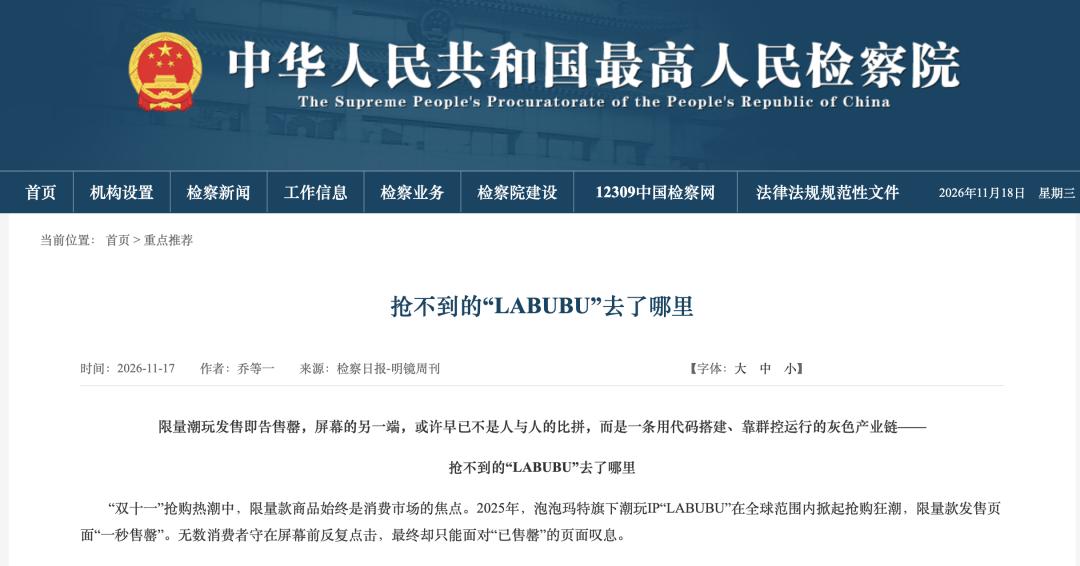
On November 17, the official website of the Supreme People's Procuratorate published an article disclosing the first case of "trendy toy scalpers being held criminally liable".
The article shows that on June 17, 2025, a clerk at a Pop Mart store in Jing'an District reported to the police that sellers on second-hand platforms were selling rush-snatching plug-ins, and the public security organ immediately opened a case for investigation. In the same month, the public security organ first arrested the Wang gang in the intermediate link (handled in a separate case), which broke through the entire gray industrial chain, and finally locked the source technicians Wu and Xia, who were arrested one after another in September 2025.
On November 5 this year, the court pronounced a verdict on the two "technical scalpers" of Pop Mart: for the crime of illegally obtaining computer information system data, the source technician Wu was sentenced to fixed-term imprisonment of 3 years with a 4-year probation, and a fine of 50,000 yuan; Xia, who was responsible for downstream expansion, was sentenced to fixed-term imprisonment of 3 years with a 3-year probation, and a fine of 30,000 yuan.
This is also the first case in which scalpers in the trendy toy sector have been sentenced. Although the sentences are probations, they are enough to deter a large number of scalper players in the trendy toy industry.
The article released by the Supreme People's Procuratorate discloses that Wu and Xia have experienced multiple speculative tracks including digital collectibles and virtual currencies since 2021, and finally set their sights on the globally viral Labubu in 2025. Through "technology", they could control more than 3,000 mobile phones in groups at the peak, with a request frequency of once every 2 seconds and 30 requests per minute, successfully snatching more than 28,000 orders in total from June to August 2025. In addition, Wu illegally obtained more than 100,000 yuan by selling plug-in programs and taking commissions from downstream resales, and Xia illegally obtained more than 50,000 yuan by taking commissions from downstream resales.
To a certain extent, they just ran into Pop Mart's crackdown on scalpers.
The Pop Mart clerk reported the case on June 17 last year, and the next day was the "Black 618" in the history of Pop Mart scalpers: on the 18th, Pop Mart launched a "surprise restock", and for the first time put the Labubu 3.0, which was then speculated to a sky-high price, on shelves across multiple platforms in the form of pre-sale.

Although the mental state of the two "technical scalpers" in the case at that time cannot be verified, the subsequent events are familiar to all: the Pop Mart secondary market experienced a flash crash, the listing price of a whole set of Labubu 3.0, which took the brunt of the impact, plunged from the high of 2800 yuan to about 700 yuan quoted in the group, and kept falling as the pre-sale delivery date approached.
This restock triggered the large-scale retreat of scalpers, before Wu and Xia were arrested by the public security organ, the huge change in market supply and demand had already completed the reshuffling of scalpers one step earlier.
The game between Pop Mart and scalpers has a long history. Last year, stores began to prohibit queuing on behalf of others and picking up goods on behalf of others. The compliance high-voltage line for internal employees is also tightening. A source close to Pop Mart told Spicy that "now everyone is generally more cautious" to avoid being "sunshined" — there is a subscription account named "Sunshine Bubble" inside the company. As for the "employee internal purchase lucky bags" that can be intuitively observed externally, the premium space is not high. A lucky bag with an internal price of 299 yuan usually has a market quotation of only about 340-350 yuan.

With the large-scale retreat of scalpers, Pop Mart's performance is also experiencing the pain and sharp drop after de-foaming; and the conclusion of the case of "technical scalpers" being sentenced seems to mean that the era of big scalpers in Pop Mart and even the entire trendy toy industry has completely ended on the surface.
But the story has not come to a full stop.
The court ruled this time with the "crime of illegally obtaining computer information system data", targeting the "technology" that directly attacks the enterprise's protection system; the Wang gang in the intermediate link that the public security organ first arrested — the "traditional big scalpers" that are more in line with the cognition of ordinary consumers, who organize supply and resell goods, are currently being handled in a separate case with no final conclusion yet.
Scalpers in offline stores have not completely disappeared, they just changed their way of survival. As the "era of big scalpers" turns the page, the game between Pop Mart, scarcity and speculators seems to continue for a period of time.
Criminal penalty for technical scalpers, resale still in gray zone
Before this case, the judicial accountability in the trendy toy industry mainly focused on "anti-counterfeiting" at the production end, with the main charge being "crime of infringing on copyright".
The Chaoyang District People's Court of Beijing once sentenced Zhu, who commissioned a factory to produce counterfeit "Temperature" series and "City of Night" series products, to the crime of infringing on copyright, sentenced to 4 years of fixed-term imprisonment and a fine of 600,000 yuan. The Pudong New Area People's Court of Shanghai also filed a public prosecution against 9 defendants involved in counterfeiting Pop Mart and FARMER BOB products on suspicion of copyright infringement.

Infringing figure products seized by Shanghai public security organs
At the end of July this year, Pop Mart's official WeChat account "Pop Mart Fan'er" published two consecutive articles, one thanking the customs for intercepting counterfeit Labubu, and the other focusing on the complete counterfeiting industrial chain of trendy toys exposed by CCTV, both pointing to the unauthorized counterfeit industrial chain that reproduces products, mainly emphasizing "intellectual property rights", and has not directly touched the rush purchase and resale behavior in the secondary market.


In fields such as concert ticketing, the judicial entry point for dealing with scalpers is the same as this case, focusing on "technical scalpers".
In October this year, the procuratorial organs disclosed another case of a "technical scalper" team, which was mainly involved in "professional software proxy snatching" for popular concert tickets. The clue of this case originated in April 2024, in Zhenjiang, Jiangsu Province, the two involved persons Chen and Sun were also convicted of "crime of illegally obtaining computer information system data", sentenced to probation and fined. The verdict was delivered in July 2026.
Apparently, the Pop Mart case follows a similar judicial logic.
For ordinary players, what is more intuitive and more troublesome is actually the "resale-type scalpers" who monopolize offline supply. Under the current legal framework, if someone is convicted of the crime of illegal business operation only for reselling trendy toys, the threshold for conviction is relatively high, and the judicial organs remain prudent.
This also partly explains why in this case, the Wang gang in the intermediate link, which is more in line with the public's perception of the concept of "scalpers", was arrested first but handled in a separate case, and the characterization is still pending.
"Technical proxy snatching tools" are still on sale on platforms such as Xianyu
On the surface, the conviction of "technical scalpers" does not seem to have caused much repercussion among scalpers.
As of press time, there are still a large number of "Pop Mart technology" links for sale on various platforms, the listing price on one platform is usually 10-40 yuan, the top-ranked link shows that more than 400 units have been sold, most of which are positive reviews.
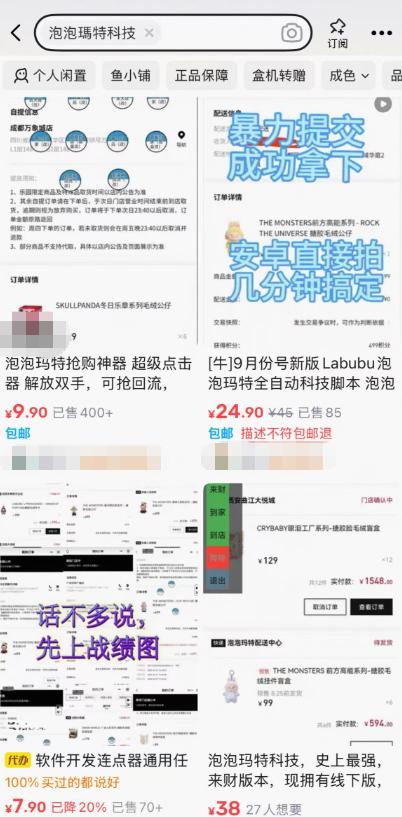

This reflects that most ordinary buyers and retail investors may not realize that using rush-snatching "technology" may touch legal issues.
Most of the proxy snatching "technologies" are explained as simulating manual continuous clicks, many people understand it similar to the "daily task clearing script" in games. Although it wanders on the edge of the rules, there are still large-scale manufacturers entering the market, and it is regarded as a mature neutral technology.
In fact, during the court hearing of the Jing'an District case, the defender also put forward a not-guilty defense based on this logic: the interaction between the plug-in program and the platform server follows the basic communication rule of "request-response", which essentially only simulates manual clicks and has no intrusion function.
The procuratorial organ entrusted multiple parties to appraise the involved plug-in program, confirming that the involved plug-in program bypassed the risk control to automatically rush to purchase, and finally determined that the involved plug-in program was unauthorized, evaded the platform's security protection by technical means, invaded the computer information system to obtain transaction data, and was suspected of the crime of illegally obtaining computer information system data.
This may mean that there is a certain difference between the "technology" that ordinary players can search for with the brand name and the technology used inside the "scalper groups". Under those "technology" links that are still on sale, some buyers left bad reviews: "It's basically useless, it can't be used on the blind box vending machine, there is no stock in the store for now, you still need to keep refreshing by yourself."
The risk aversion actions of gray industry practitioners may have started even earlier.
Spicy learned that a store that previously sold automated scripts including Pop Mart scripts no longer accepts new external customers since last year, only allowing repeat purchases from old customers in the group and referrals from acquaintances, and the "battle record" photo album in the group has also been emptied.
But it is obviously not objective to completely attribute the large-scale retreat of Pop Mart scalpers since this year to the deterrence of the law. To a certain extent, it is the market supply and demand itself that educates scalpers faster than the law.
Since the official large-scale release of goods on "Black 618" last year pierced the scarcity bubble, Pop Mart's "hard currency" magic in the secondary market has failed. This year, many new Pop Mart products fell into the situation of "breaking the issue price as soon as they are launched". Even the former top stream Labubu's "Vintage Barbershop" series, except for the hidden version, the transaction price of all ordinary versions on platforms such as Qiandao has fallen below the store selling price of 159 yuan, and the unpopular versions even fell to a low of 68 yuan; the only hidden version that retains premium has its premium space compressed to less than double.

When opening a blind box is basically equivalent to a loss, scalpers' profit opportunities are gradually compressed to a level close to that of ordinary players. In the past, the main complaint against scalpers on the platform was that they colluded with store employees to obtain sold-out spot goods and resold them at high prices. But this year, their main activity has become "snatching restocked boxes": by shaking the boxes to confirm the styles on the counter, waiting for passersby to enter the store to buy unpopular styles, and immediately testing whether the clerk's restocked box is a popular style. This activity still has the risk of losing money, and the profit opportunities are also gradually compressed to a level close to that of ordinary players.

Pop Mart's Q3 2026 financial report shows that after squeezing out the speculative bubble significantly, the overall revenue was halved, the domestic market shrank by 25% to 30%, of which the online channel plummeted by 45% to 50%, while the offline store decline was only 5% to 10%, and the consumer base seems to be "as expected" returning to being dominated by ordinary consumers.
With the mass supply capacity of "technical scalpers" being