Li Xiang stated that the Mach M100 will gradually be opened up for external supply. Inquiries have already been received from a number of robotics enterprises, and the chip business of Li Auto is seeking new markets.
On November 17, Li Xiang, Chairman and CEO of Li Auto, posted on social platforms that many robotics enterprises have inquired whether Li Auto can supply the Mach M100 chip, and Li Auto will gradually open the external supply of this self-developed chip.
This statement continues the recent commercialization moves of Li Auto's chip business. In October, Shanghai MachXin Technology Co., Ltd., the entity under Li Auto that oversees the chip and domain controller business, signed the first round of equity financing agreement with a total subscription amount of 1.625 billion yuan, and the funds will be used to support chip R&D and commercialization.
From internal vehicle installation to the introduction of external capital, and then to the clear gradual opening of external supply, Li Auto aims to expand the application scope of its self-developed chips. Of course, the inquiries from robotics enterprises are not equivalent to actual orders. Whether the automotive-grade chips can be converted into products that external customers are willing to purchase still requires adaptation and delivery verification.
Self-developed Chips Expand From Complete Vehicles to Robotics Field
According to the information previously released by Li Auto, the Mach M100 chip adopts 5nm automotive-grade process, with a single-chip computing power of 1280 TOPS, and has been installed on mass-produced Li Auto models. It is understood that this chip first serves Li Auto's own intelligent vehicle business. Li Xiang also mentioned in this post that the Mach M100 has been applied to many new cars launched this year to support perception and assisted driving functions.
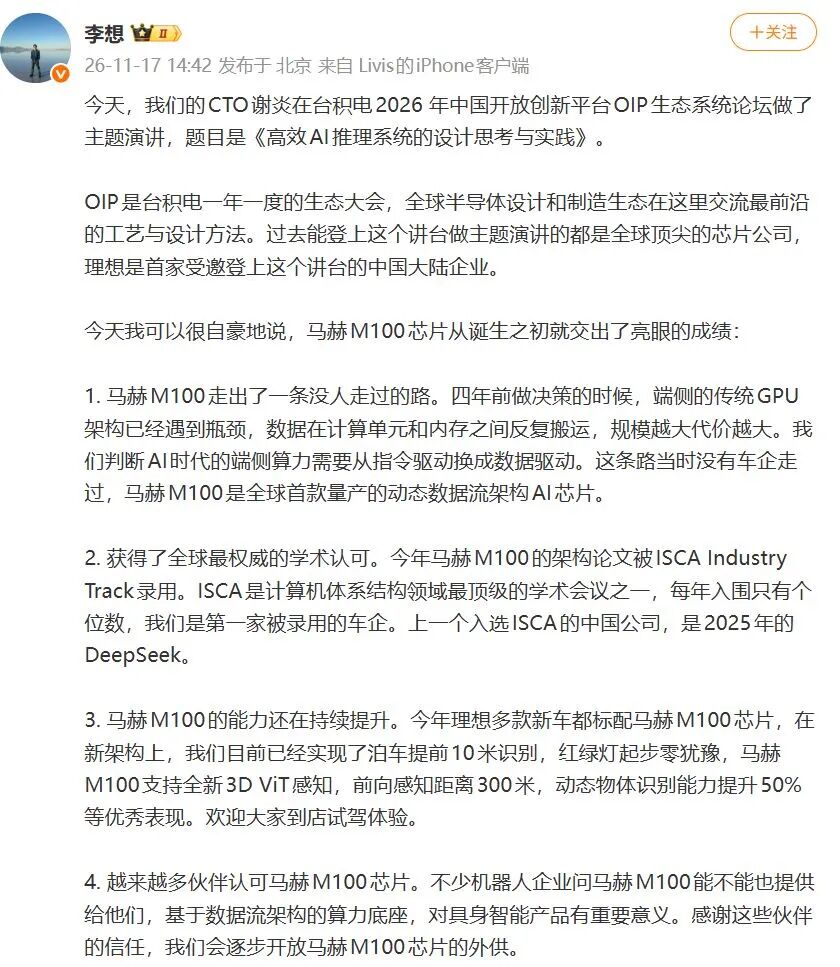
Image source: Sina Weibo (@Li Xiang)
For automobile manufacturers, the significance of self-developed chips is to arrange computing resources around their own models and complete vehicle requirements, and promote the collaborative development of chips, software and vehicle systems. After the application scope is expanded, the chip business needs to face another set of requirements: in addition to running its own models, it also needs to enable different customers to complete development, deployment and subsequent maintenance.
Inquiries from robotics enterprises have provided new application directions for the Mach M100. It is understood that although the application scenarios and specific tasks are different, both intelligent vehicles and robots need to perceive and reason about environmental information and respond in a timely manner, which share certain common requirements for the computing efficiency, power consumption and real-time processing capability of chips, making it possible for automotive-grade chips to expand to the robotics field.
It is worth mentioning that Li Auto has repeatedly released signals of external supply before. Xie Yan, CTO (Chief Technology Officer) of Li Auto, said in June this year that the possibility of supplying self-developed chips externally is not ruled out, and mentioned that some robotics enterprises have shown interest; Ma Donghui, President of Li Auto, later also said that standardized components such as chips and silicon carbide modules can be exported externally, and other manufacturers can complete the adaptation work.
Li Xiang's further clarification of "gradual opening" this time indicates that non-automotive fields such as robotics have become one of the directions for Li Auto to explore the commercialization of chips. However, as of now, he has not announced the specific customer list, supply scale and delivery time in this statement.
From a business perspective, external supply provides opportunities for chip R&D investment to obtain more application carriers. According to industry insiders, internal demand mainly depends on the sales volume and installation ratio of Li Auto's models, while external customers may expand the shipment scale and provide new demand feedback for subsequent technology iterations. At the same time, this process will also increase service investment. Selling chips externally requires providing development tools, technical documents, adaptation support and continuous supply capability. Whether the internal R&D capability can be transformed into products available for different customers will affect the scale that external chip supply can achieve.
Introduce External Capital to Promote Market-oriented Operation
Behind the external supply plan, Li Auto has built a financing and independent governance platform for its chip business.
According to the announcement on October 16 this year, the first round of financing of MachXin Technology is led by Hangzhou Jingtao, BlueRun Ventures and Huaye Tiancheng, with participation from MiraclePlus. Of the total subscription amount of 1.625 billion yuan, external investors contributed a total of 625 million yuan, and the remaining 1 billion yuan was invested by Li Auto through its wholly-owned subsidiary.
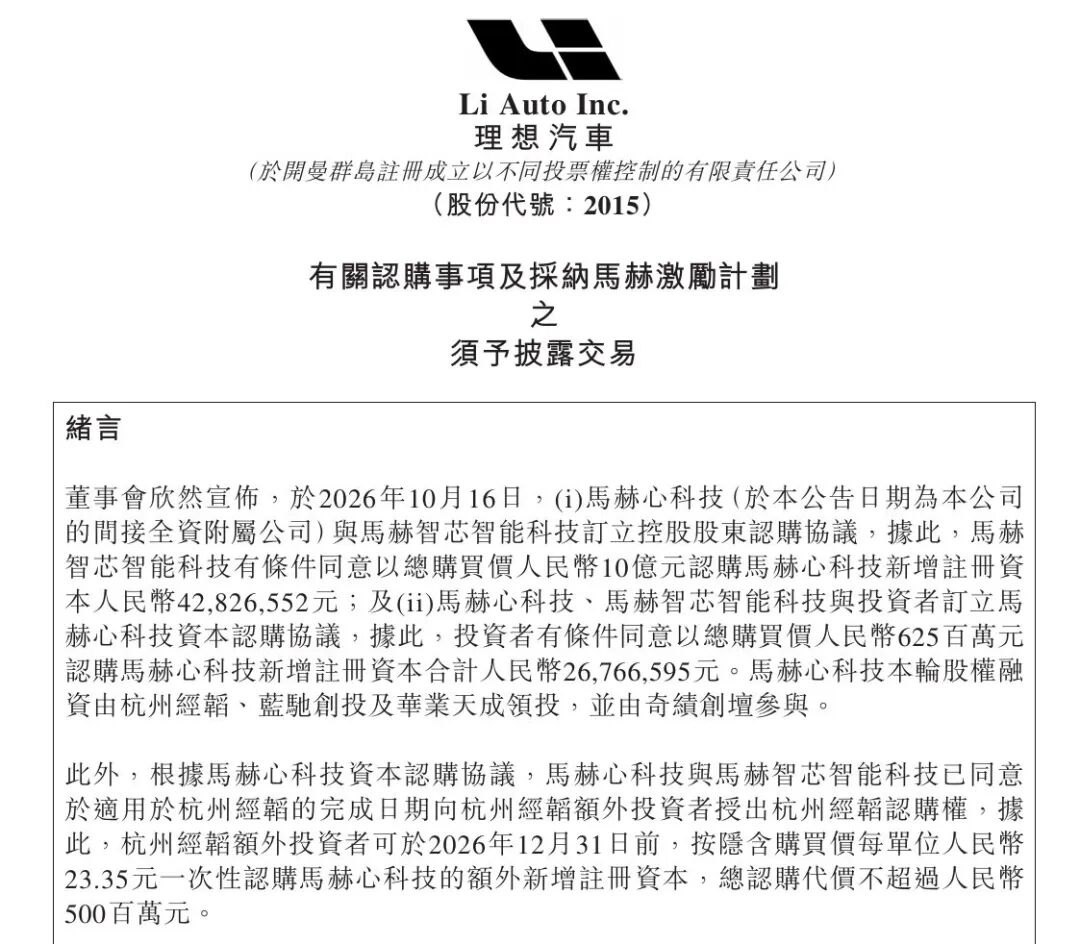
Image source: Li Auto Announcement
In the announcement, Li Auto positioned the chip and domain controller business as the group's second growth curve, hoping to allocate capital and carry out independent governance through a dedicated platform to seize broader industrial opportunities, especially in non-automotive fields. After the transaction is completed, Li Auto will still control MachXin Technology and include its financial results in the consolidated statements.
This means that the introduction of external investors does not mean that the chip business is disconnected from the complete vehicle business. Li Auto can still retain the R&D collaboration between chips and complete vehicles, while allowing the chip business to have a financing and operation mechanism oriented to the external market. Ji Xuehong, Director of the Automotive Industry Innovation Research Center of North China University of Technology, believes that chip investment is large in scale, long in return cycle and full of uncertainties, and the introduction of external investors can share the capital pressure; investors may also use their own ecology to help promote the business and expand the application scale.
In fact, there are other cases of automobile manufacturers introducing external capital for their chip business. NIO disclosed in February this year that its subsidiary Shenji has signed an agreement with investors, under which the investors intend to subscribe for newly issued shares with 2.257 billion yuan. Shenji is mainly responsible for business related to intelligent driving chips, and is also expanding application directions such as embodied robots. These moves reflect that the business objectives of self-developed chips of automobile manufacturers are extending: they not only need to support complete vehicle products, but also hope to share investment through a wider range of customers and scenarios.
For Li Auto, Li Xiang's statement this time makes the external supply direction clearer. What needs to be observed next is whether the inquiries can be converted into actual purchases, whether the chips can complete adaptation in different scenarios, and whether the new revenue can cover the continuous investment in R&D and customer services. The transformation of self-developed chips from "usable by ourselves" to "willing to be purchased by customers" still needs to be verified through market-oriented delivery.
This article is from the WeChat official account "NBD Auto", author: Sun Lei, published with authorization from 36Kr.