Alibaba can't wait for Pupu any longer, so it lets Taoxianda step in to fill the gap first.
The battle for instant retail among industry giants has intensified once again.
Over the past month or more, the news that Alibaba has relaunched Taoxiada has caused quite a stir in the retail sector. It is reported that Taoxiada is positioned as an affordable fast-delivery supermarket, featuring 24-hour operation and delivery within 30 minutes at the fastest. Since September, Taoxiada has intensively opened warehouses in East China, with its entry embedded in Taobao Flash Purchase.
From the perspective of the industry landscape, the orientation of this move is very clear.
The scale of instant retail is approaching one trillion yuan, and the focus of competition has shifted from subsidies and traffic to warehouse density, single-warehouse order volume, and the supply chain's penetration in high-frequency grocery categories.
Meituan Xiaoxia Supermarket operates more than 2,000 front warehouses, and has consolidated the depth of its warehouse network through the acquisition of Dingdong Maicai, raising the threshold of the core competition battlefield.
Alibaba is not short of underlying capabilities, as it holds Hema's fresh food supply chain, the hard-discount product selection verified by Superbox NB, and the traffic entry of Taobao Flash Purchase. However, Alibaba needs a widely covered self-operated affordable front warehouse network, which is exactly the gap Taoxiada is designed to fill.
For Alibaba, relaunching Taoxiada is not just a renovation of an old brand, but an active move to fill a key puzzle in the trillion-yuan instant retail race. Instead of waiting to acquire Pupu Supermarket and then pushing for its expansion, it is more efficient to seize time through self-construction. More importantly, as the timeline for Alibaba's instant retail business to achieve profitability in fiscal year 2029 is getting closer, Alibaba needs this second growth curve.
Ultimately, how dense and deep this network can be deployed will determine Alibaba's position in the next stage of the instant retail landscape, and further affect the operating quality of the Alibaba Group.
60-day network deployment in East China: Alibaba relaunches Taoxiada
The expansion pace of Taoxiada in this round is rare in the instant retail industry.
On September 12, six sites opened simultaneously in Hefei, followed by successive launches in Nanjing, Suzhou and Hangzhou, with Ningbo, Changzhou and Wuxi added to the preparation list, covering seven cities within 60 days. According to Tech Planet, Taoxiada will next enter Ningbo, Changzhou and Wuxi, and it has more than 33 warehouses across the country at present.
Generally speaking, a brand-new front warehouse brand needs to go through multiple links including site selection, warehouse construction, supply chain building, user acquisition and operation running-in to verify the single-city model from 0 to 1, which requires at least 3-6 months of trial and error period.
Taoxiada almost skipped the stage of polishing the model from scratch, and directly entered large-scale replication after the launch of the first city, which demonstrates its remarkable warehouse opening efficiency.
Behind the near-lightning speed is the strategic priority tilt at the group level.
In August this year, Jiang Fan, CEO of Alibaba E-Commerce Business Group, clearly stated on the earnings call: "Next, we will accelerate the integration of relevant sectors such as Hema and Tmall Supermarket, develop instant retail for non-catering categories, especially accelerate the development of front warehouses."
In fact, Alibaba has allocated considerable resources and manpower for this relaunch of Taoxiada.
According to Tech Planet, Taoxiada is classified as an innovative project within Hema, operated by teams from Hema's front warehouse division and Superbox NB.
The most direct support comes from the transfer of organizational capabilities. In June this year, Wang Zhiqiang, former vice president of Kuaishou, joined Hema and reports to Yan Xiaolei, CEO of Hema. He previously served as the head of the grocery department at Meituan Maicai; Zhang Dongzheng, former procurement head of Hema's hard-discount format Superbox NB, later transferred to serve as the head of Taoxiada's product department.
One is the key figure recruited by the group to benchmark against Xiaoxia Supermarket, and the other is the procurement head who is good at managing affordable products. This means that the relaunch of Taoxiada is not building a new system from scratch, but re-outputting the verified capabilities of Hema with a new positioning.
According to the observation of Lianxian Insight, the homepage of Taoxiada's Taobao Flash Mini Program clearly marks three core attributes: under Hema, 24-hour operation, and 30-minute delivery. In addition, Taoxiada's page layout and membership system are similar to those of Hema, and membership benefits include free vegetables and free delivery fees.
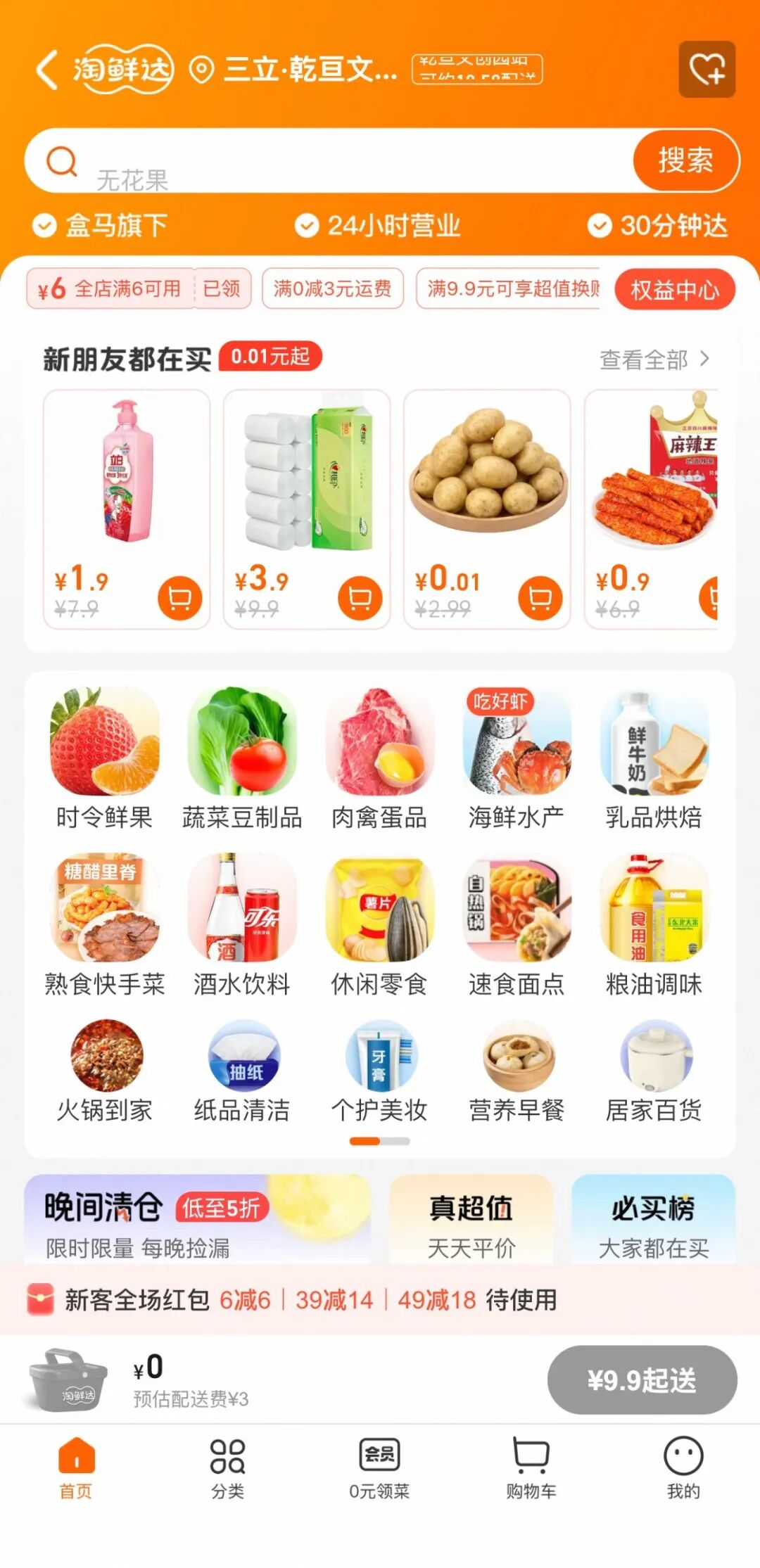
Source: Taoxiada Taobao Flash Mini Program
According to Tech Planet, a supplier of Taoxiada said that some of the products at the initial stage of Taoxiada's launch are shared with Hema.
The current product selection logic is to migrate Hema's product selection to Taoxiada, retain the best-selling products, replace the poor-performing ones with new items.
The reuse of core supply chain is the key to supporting Taoxiada's lightning expansion at this stage, which significantly reduces the fixed asset investment and operation running-in period at least in the initial stage.
In addition, the traffic support from Alibaba's ecosystem has also accelerated the launch of Taoxiada.
The relaunched Taoxiada adopts a dual-traffic model of independent APP + Taobao Flash Purchase entry. At present, in cities where it has launched services, Taoxiada will appear on the homepage of Taobao Flash Purchase. On the one hand, it directly accesses the core traffic pool of Taobao Flash Purchase, backed by the exposure resources of hundreds of millions of users in the Taobao ecosystem; on the other hand, it precipitates its own users in the form of an independent APP.
For the front warehouse business, the order density in the cold start stage directly determines the operation efficiency. Alibaba's traffic support allows Taoxiada to obtain basic order volume immediately after opening the warehouse, quickly verify the single-warehouse operation model, and shorten the user accumulation period.
The alignment of organizational hierarchy, operation team, warehouse distribution assets and traffic entry in the same time window essentially means that Alibaba reuses Hema's underlying capabilities on a lighter front warehouse network that focuses on affordable standard products. This set of capabilities verified within the Hema system will help Alibaba find a new solution for instant retail in the mass price range.
Differentiated from Hema: Taoxiada fills three gaps for Alibaba's instant retail business
Speed is only the appearance, and positioning is the core to understand the value of Taoxiada's relaunch.
The newly relaunched Taoxiada is no longer the light platform that provided online operation agency services for traditional supermarkets back in 2017. After organizational restructuring, in Alibaba's instant retail system, it is redefined as an affordable fast-delivery supermarket under Hema, specifically targeting the "market that Hema has not covered".
Over the years, Hema has formed a diversified business format matrix. Hema Fresh focuses on mid-to-high-end quality fresh products and integrated store-warehouse experience with a relatively high customer unit price; Superbox NB focuses on offline hard-discount community retail, with streamlined SKUs and a focus on in-store consumption.
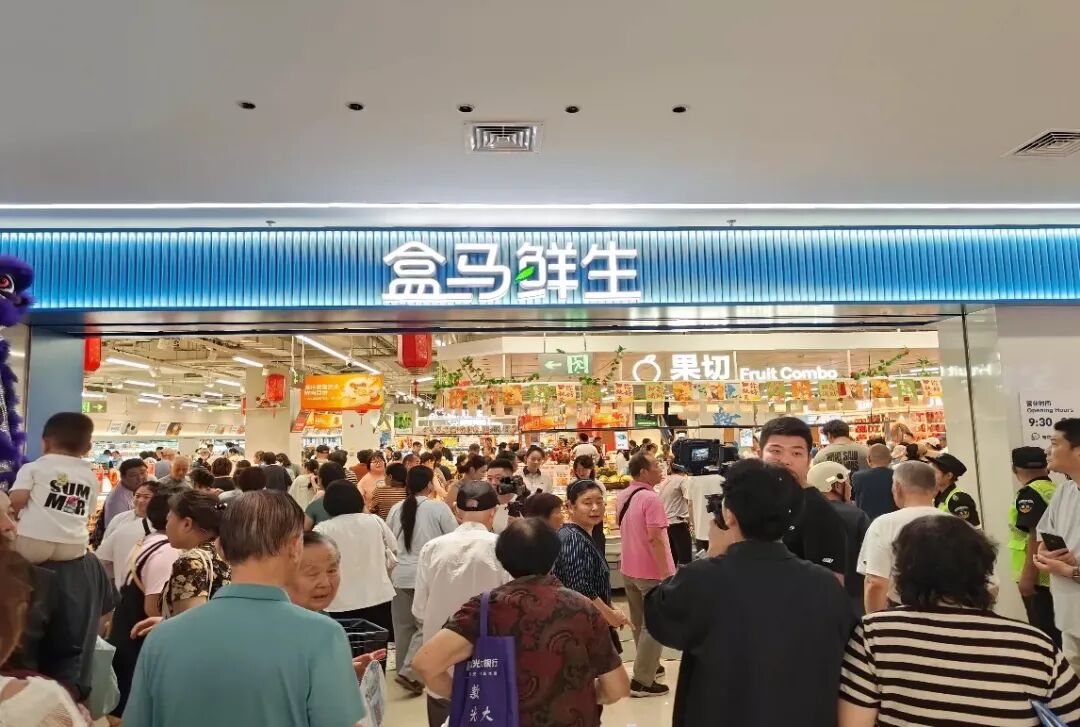
Source: Hema official website
In the pure online mass-affordable front warehouse track, Hema has adopted the "store-to-warehouse" model since August 2024, transforming many offline stores directly into front warehouses. Up to now, the number of front warehouses across the country has exceeded 500.
Hema's front warehouses shorten the delivery radius of Hema Fresh, but in terms of product structure and quantity, they cannot yet meet consumer demand. Hema's front warehouses adopt the "1+N" model, that is, one Hema Fresh store is equipped with several front warehouses, relying on Hema Fresh's stores, product portfolio, supply chain and brand, and distributing part of the online demand to closer warehouses.
This also determines that the products of Hema's front warehouses are basically consistent with Hema Fresh, or even fewer, taking the mid-to-high-end route, leaving a blank in the high-frequency affordable daily consumer market. The relaunch of Taoxiada just fills this business format gap.
In the profile of the official account of "Taoxiada Supermarket", Taoxiada has a clear positioning: an affordable fast-delivery supermarket under Hema.
It is not difficult to find that on the product side, it has an intentional differentiation from Hema Fresh: Hema Fresh and Superbox have a high proportion of private labels, while Taoxiada hardly operates self-owned brands and mainly sells third-party brands. The difference in performance threshold is also more straightforward: Taoxiada's basic delivery fee is 3 yuan, and the basic delivery fee is waived when the order amount reaches 29 yuan; Hema Fresh's free delivery threshold is above 49 yuan, with a basic delivery fee of 6 yuan.
This is a cost structure designed for the scenarios of "high frequency, low customer unit price, and daily household restocking", which exactly falls in the middle zone between Hema Fresh and Superbox NB.
From the perspective outside the Hema system, Taoxiada fills the gap for Alibaba to directly compete with rivals in the mass front warehouse track.
Judging from the current industry competition pattern, front warehouse is a track that all giants are competing for. Meituan's Xiaoxia Supermarket takes the lead with a scale of more than 2000 front warehouses. Alibaba has long lacked a product that can compete head-on with Xiaoxia Supermarket on this track.
Neither the number of warehouses nor the number of products of Hema's front warehouses can directly compete with Xiaoxia Supermarket in the mass affordable market. The addition of Taoxiada means that Alibaba has a full-coverage product matrix from high-end to mass market in the core track of instant retail, which can not only use Hema to hold the high ground of quality, but also use Taoxiada to compete for the mass user base.
Looking at Alibaba's larger instant retail landscape, Taoxiada fills the gap of non-catering self-operated supply for Taobao Flash Purchase.
Since 2025, Alibaba has unifiedly integrated its instant retail business under the Taobao Flash Purchase entry, forming a pattern of "one entry, multi-terminal supply", with the goal of expanding the overall transaction scale of instant retail. After the end of the food delivery war, the public awareness of Taobao Flash Purchase has been cultivated, and the competition of instant retail has shifted from simple catering orders to non-catering orders with richer product portfolios and stricter performance requirements.
For Taobao Flash Purchase, to achieve the goal of trillion-yuan transaction scale, relying solely on catering categories is far from enough. The growth of non-catering retail, especially supermarket categories, is the core driving force.
The access of Taoxiada just supplements high-quality affordable self-operated supply for Taobao Flash Purchase. On the one hand, its mass positioning can cover a wider user group, improving the platform's user penetration and usage frequency; on the other hand, the self-operated model guarantees the standardization of performance timeliness and product quality, which can optimize the order structure of Taobao Flash Purchase and increase the proportion of high-frequency rigid demand orders.
The competition of instant retail has long gone beyond the stage of competing on subsidies and traffic. What Taoxiada fills is not just a business segment, but also Alibaba's core competitiveness on the supply side.
Cannot wait for Pupu: Alibaba needs to move faster
In the race of the front warehouse track, mergers and acquisitions were once regarded as a shortcut for Alibaba to quickly make up for its shortcomings, and Pupu Supermarket is the most suitable target in the eyes of the market.
In June this year, the market spread the news that Alibaba planned to invest 1.5 billion US dollars to acquire Pupu Supermarket. Earlier, there was also news that Alibaba, Meituan and JD.com competed for the target at the same time, and the valuation of the target was once pushed to the range of 2 billion to 5 billion US dollars.
Pupu Supermarket has deployed more than 400 front warehouses in 9 cities including Fuzhou, Xiamen, Guangzhou and Shenzhen, with revenue of about 30 billion yuan in 2024 and achieved full-year profitability. Huachuang Securities pointed out in the research report that thanks to the strategy of large warehouses and high-density warehouse deployment, Pupu Supermarket's performance expense ratio in 2024 was only 17.5%.
This is a front warehouse network with a verified regional profit model. Pupu Supermarket has been deeply cultivating the core markets of Fujian and Guangdong for many years. If the transaction is completed, Alibaba can directly obtain its mature warehouse network and professional operation team in Fujian and Guangdong.
From the perspective of capability complementarity, it is indeed the most convenient puzzle to supplement the density of front warehouses. However, the fact that the acquisition has not been closed, coupled with the accelerated evolution of the industry pattern, Alibaba has made a more pragmatic choice — while promoting the acquisition of Pupu, it speeds up the self-construction of Taoxiada.
This is a race against time, and Alibaba wants to firmly grasp the strategic initiative in its own hands.
Jiang Fan has clearly drawn the growth timetable on Alibaba's fiscal 2026 earnings call: Alibaba maintains the goal of the overall instant retail transaction scale exceeding one trillion yuan in fiscal 2028, and expects the sector to achieve overall profitability in fiscal 2029, and the transaction value of non-catering instant retail will exceed the catering category in the next fiscal year.
To support the trillion-yuan scale and profitability goals, the network density of front warehouses and the order volume of single warehouses must climb rapidly within a limited time to achieve scale effects. On the other hand, Meituan is still accelerating its expansion after integrating Dingdong, and the industry window period is narrowing rapidly. Once the scale barrier of leading players is fully formed, Alibaba's catch-up cost will inevitably increase.
Relying on Hema's eight years of accumulated underlying capabilities, Taoxiada's self-construction speed is not slow. The transfer of the operation team, reuse of warehouse distribution assets, sharing of the supply chain system, plus the traffic support from Alibaba's ecosystem, allow Taoxiada to skip the stage of trial and error from scratch, landing in 7 cities in East China within 60 days, achieving a warehouse opening efficiency far exceeding the industry average.
Of course, accelerating self-construction does not mean there are no challenges. The profitability problem of front warehouses is a common proposition in the industry. Even with Hema's underlying support, Taoxiada cannot avoid the core test of single-warehouse order density.
Whether Taoxiada's affordable standard product portfolio, low free delivery threshold and 24-hour delivery can generate a sufficiently high single-warehouse order volume on Hema's supply chain has not been fully verified yet.
24-hour operation extends the order period, and affordable standard products reduce the customer unit price. After the superposition of the two, a single warehouse needs more orders than mid-to-high-end front warehouses to cross the same break-even line. In addition, although 24-hour operation can cover night emergency scenarios and improve user stickiness, it also correspondingly increases night operation costs, which in turn puts higher requirements on the order volume of a single warehouse.
Just two or three years ago, front warehouses were synonymous with burning money and difficulty in making profits in the eyes of the industry, and the exit of Missfresh made the market full of doubts about this path. In the past two years, the cognition of the whole industry has reversed. Giants have unanimously raised front warehouses to the core strategic position, and the track has officially entered a new round of racing era.
From integrating Taobao Flash Purchase to unify the traffic entry, to using Hema to hold the mid-to-high-end quality position, and then relaunching Taoxiada to storm the mass affordable market, Alibaba is building an instant retail system with clear layers and coordinated capabilities.
The 7-city deployment in 60 days is just the beginning. What really determines the weight of this move is