Tencent's WorkBuddy has surpassed 10 million daily active users. What kind of signal does this convey?
Just now, Tencent announced that the daily active users of its AI Agent product WorkBuddy has exceeded 10 million, with the average daily Token consumption exceeding 10 billion, making it the AI product with the highest Token consumption of large language models in China.
WorkBuddy is not a traditional AI chatbot, nor is it just an AI office software. Its more accurate definition is a general-purpose AI Agent work platform for knowledge workers. It can plan tasks, call tools, perform multi-step work and deliver results, with extremely high usability.
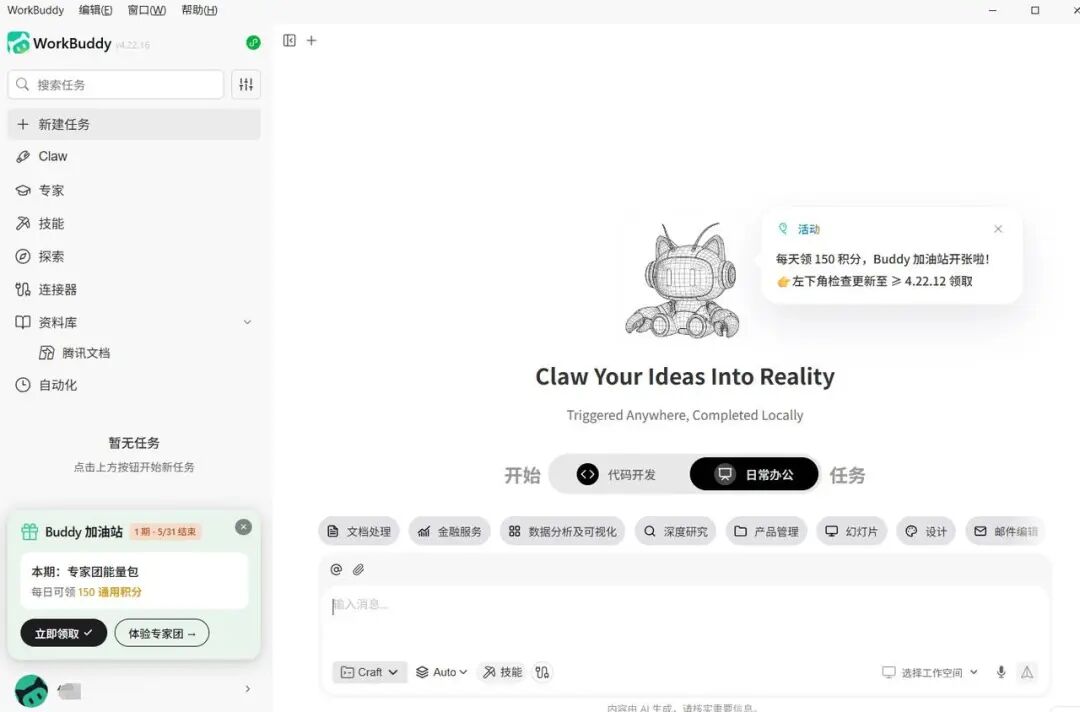
At the beginning of this year, the open-source project OpenClaw, also known as Lobster, was briefly popular in a small circle, but it was quickly replaced by mature AI Agent products represented by WorkBuddy.
Compared with Lobster, a key advantage of Tencent's WorkBuddy is that it packages the Agent capabilities that originally required technical configuration into products that ordinary users can use directly, which means that every user can hire a digital assistant or digital employee to help them work at a very low threshold. In short, the threshold for WorkBuddy has been greatly reduced, and its ease of use has been greatly improved.
The reason why Tencent's WorkBuddy can grow rapidly in the fiercely competitive AI Agent market, a very important factor that is easily underestimated by the outside world is that Tencent is probably one of the Chinese Internet companies that are best at distributing software on the PC side. QQ Games, QQ Music, Tencent PC Manager, CrossFire, and League of Legends in the past all reflected this capability to varying degrees.
Entering the era of AI office, the PC desktop that has been silent for a long time has once again become the main battlefield, and Tencent's traditional advantages are highlighted at this time.
In addition, the rise of WorkBuddy is also closely related to the WeChat and WeCom ecosystems that Tencent owns.
At present, the combined monthly active users of WeChat and WeChat outside China have reached 1.449 billion, and the monthly active users of Tencent's QQ mobile app still stand at 533 million.
More importantly, a large number of work tasks for knowledge workers in China are originally initiated through WeChat. For example, customers often put forward demands on WeChat, bosses assign tasks in WeChat groups, and partners send files through WeChat.
This means that WeChat is not only a traffic entry, but also the place where work tasks are generated.
If WorkBuddy can read necessary task information with the user's authorization, understand the context, call tools and deliver results at the same time, it may form a new work link. The commercial value and imagination space here are extremely huge.
At present, WorkBuddy has carried out close collaboration with WeCom. On October 14 this year, WeCom and WorkBuddy jointly launched a new version. After the enterprise activates and allocates seats, employees can call WorkBuddy through the sidebar of the WeCom address book, or log in to the client with their WeCom account to process work messages, documents, meetings and to-do information within the authorized scope.
According to data from QuestMobile, the monthly active users of WeCom on the PC side reached 20.3 million in September 2026, higher than DingTalk's 12.57 million and Feishu's 1.94 million in the same period. WeCom can directly deliver WorkBuddy to existing enterprise employees, which greatly accelerates the promotion of WorkBuddy.

At present, personal WeChat, which has a huge number of users, has not yet carried out in-depth collaboration with WorkBuddy, but this is precisely the biggest imagination space for WorkBuddy in the follow-up.
From past experience, Tencent's WeChat team is usually cautious when facing new things, and the speed of follow-up is often much slower than that of its peers, which is understandable from the perspective of Tencent and WeChat.
Because WeChat is a huge social network with more than a billion monthly active users, any mistake it makes will have a huge impact; conversely, it is much easier for WeChat to promote anything than other platforms, which can be seen from the rapid rise of WeChat Channels.
At present, users can send tasks from WeChat on their mobile phones to WorkBuddy on their computers, let it process files, check codes, etc., and then return the results to personal WeChat. This is one of the few integrations between personal WeChat and WorkBuddy.
In the future, as WeChat may open more permissions to WorkBuddy, WeChat will most likely directly evolve from a communication tool to an operating system for AI tasks.
Tencent currently has multiple AI product lines, and WorkBuddy is not the only one among them.
In June 2026, WeChat's native AI assistant "Xiaowei" was launched and began grayscale testing. It is promoted by the WeChat team, uses model capabilities adapted to WeChat scenarios, and gradually explores entries such as Moments, Official Accounts, and Channels.
In the future, an architecture like this is very likely to emerge: WeChat is responsible for the entry, and WorkBuddy is responsible for complex execution, with both sides giving full play to their respective advantages.
In other words, users may not even need to know the name WorkBuddy in the future, they can directly tell Xiaowei in WeChat, for example: "Help me make a PPT from this document", or "Make a PPT from the chat records of this group". WeChat is responsible for understanding user intentions and obtaining necessary authorization at the front end, while complex tasks are executed by the Agent behind WorkBuddy at the back end.
The future possible integration with WeChat also brings huge commercial imagination space to WorkBuddy. If WorkBuddy is viewed in isolation, it may only be an AI office product with an annual revenue of tens of billions of yuan. But if WorkBuddy is deeply integrated with the WeChat ecosystem, it may have an imagination space of hundreds of billions of yuan in the future.
The future AI competition will largely be a competition for context understanding, and WeChat is the largest context carrier in the Chinese-speaking world. Once WorkBuddy is fully connected to WeChat's context environment, it will be difficult for any other similar products to match it.
However, the rapid development of WorkBuddy has also brought a "happy trouble" to Tencent. In the past few years, compared with other large Internet manufacturers, Tencent is considered to be relatively conservative in investment in AI infrastructure.
According to media reports, Tencent has launched a huge computing power leasing cooperation with Oracle. Tencent plans to obtain the right to use a large number of advanced AI chips by leasing Oracle's data centers in Southeast Asia.
However, recently, the prospects for Chinese Internet giants to lease data centers in Southeast Asia have become bleak, and the topic of tight computing power has become one of the most important topics in China's Internet and AI circles in the past two days.
Other domestic Internet giants have made more forward-looking deployments in computing power earlier. For example, Alibaba's self-developed AI chip T-Head has been developing for many years, Baidu's self-developed AI chip Kunlunxin has also made considerable progress, and ByteDance, another major Internet giant, has been more aggressive in computing power expenditure.
At an internal Tencent conference last week, Tencent founder Ma Huateng defined AI as a "life-and-death level transformation".
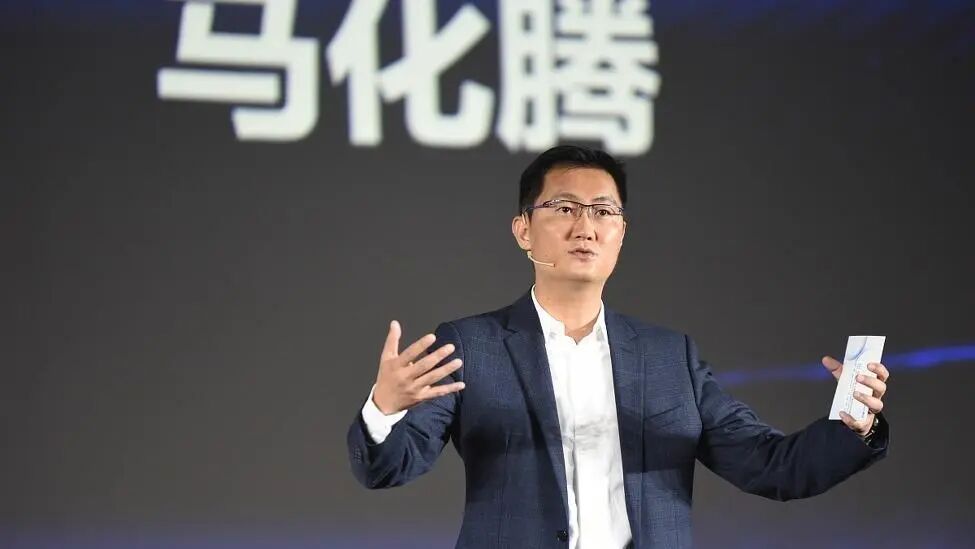
Ma Huateng's exact words are: "The wave is already coming, the AI tide is swallowing hills one after another, we cannot sit back and watch. When the battlefield changes from land warfare to naval warfare, all personnel need to change their skills and get on board to fight." At this meeting, he specifically named WorkBuddy as Tencent's first AI native benchmark product that has been fully verified, and believes that AI applications have just started, and greater opportunities lie in the production and industrial end.
This article is from the WeChat Official Account "Xinghai Intelligence Agency" (ID: junwu2333), the author is Xinghai Laoju, and 36Kr is authorized to release it.