Hefei replicates the "Changxin Model"
CXMT, whose market value once exceeded 4 trillion yuan, is a miracle in the history of China's venture capital. We once wrote in *The History of China's Venture Capital* that the success of CATL marked the maturity of RMB-denominated funds. If an additional chapter were to be added, CXMT would represent the peak of RMB-denominated funds.
For Hefei, the success of CXMT also means the success of Hefei's "organizer-led" model. In the two previous investments in BOE and NIO, Hefei's state-owned capital acted as a shareholder that contributed both capital and land, while in the case of CXMT, it became the real organizer of the whole project.
We have observed several typical moves:
For instance, Hefei took the lead in incubating the enterprise following the logic of the industrial chain, proactively entered the storage chip track, and became one of the initiators of the enterprise. Another example is the arrangement where major shareholders do not hold controlling stakes and the market-oriented professional team takes charge of operation. Before CXMT went public, entities related to Hefei's state-owned capital held a total of about 35% of the shares, forming the largest group of shareholders, but the company had no controlling shareholder nor actual controller; the operation was mainly handed over to Zhu Yiming, a representative from the industrial sector. This arrangement not only maintains the strategic attributes of CXMT, but also preserves its market orientation and professionalism. Another example is that with CXMT as the core, Hefei has organized a storage chip and semiconductor industry alliance through forms such as hundred-billion-level funds.
From a micro perspective, these moves somewhat resemble the "venture producer" model that prevails in Silicon Valley, where investors take the lead in starting businesses, come up with ideas, allocate capital, find CEOs, and produce startups in batches. But obviously Hefei's model is more ambitious: it has transformed the investment capacity of state-owned capital into the capacity to organize and operate urban industries.
In the past two years, this set of strategies has been applied to future industries, and it seems to be executed with great proficiency. What we are going to talk about today is how Hefei replicates this "CXMT Model". The latest clues can start with two companies.
01.
The first company comes from the commercial aerospace sector.
On November 9th, Zhongke Nebula was officially established at the 2026 Space Cloud Industrial Ecology Conference. It is a company focused on space computing power. Space computing power sounds far-fetched, but Hefei has already started its layout in this field.
The company's technology comes from the "Space Cloud" special project of the Aerospace Information Research Institute, Chinese Academy of Sciences. In May this year, the Aerospace Information Research Institute, together with more than 100 organizations, released the *Initiative for Co-building the "Space Cloud" Ecology*, putting forward the specific implementation plan for space computing power: the first step is the integration of sensing and computing; the second step is the integration of communication and computing; the third step is the synergy of supercomputing.
For laymen, this technical solution is undoubtedly a stack of abstract terms. But our focus is not on the technology, but on the organizational structure of Zhongke Nebula.
The company has a registered capital of 1.5 billion yuan, and is jointly established by a total of 16 initiators, including 6 industrial entities (5 of which are listed companies): Zhongke Spatial Digital, Sugon, Hygon Information, Starway Measurement & Control, Sugon Digital Innovation, and Zhongke Satellite, together with Sinovation Development under the Chinese Academy of Sciences, central enterprise Chengtong Venture Capital, provincial-level Anhui Energy Capital, Huaan Jiaye, the parent fund led and supervised by the Provincial Department of Science and Technology, as well as municipal and district-level investment platforms such as Hefei Industrial Investment and Hefei High-Tech Venture Capital.
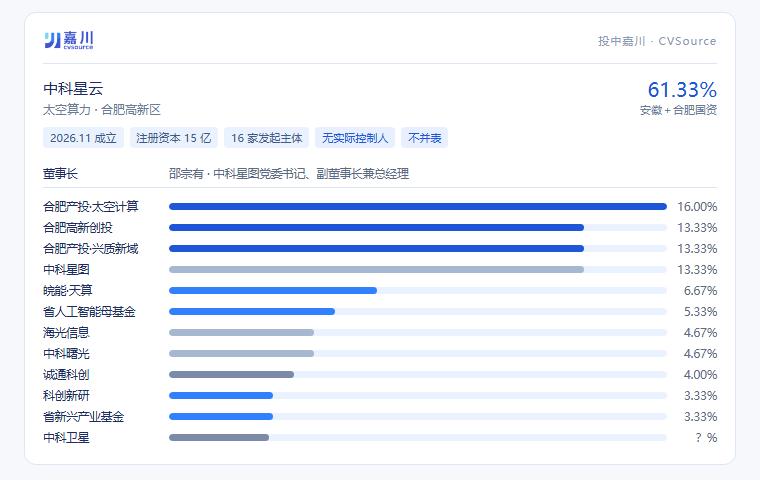
Among them, the three platforms under Hefei Industrial Investment and Hefei High-Tech Venture Capital hold 16%, 13.33% and 13.33% of the shares respectively, and the total shareholding of state-owned capital at the municipal and district levels reaches 42.66%, making it the largest capital contributor. If Anhui Energy Capital, Huaan Jiaye and the parent fund led and supervised by the Provincial Department of Science and Technology are included, the total shareholding of Anhui provincial and Hefei municipal state-owned capital is as high as 61%.
Although Zhongke Nebula publicly discloses that it has no actual controller, the leading role of Hefei/Anhui state-owned capital in it is self-evident.
Just like CXMT, Zhongke Nebula also invites people from the industrial sector to operate and manage the company. The chairman Shao Zongyou is the Party Secretary, Vice Chairman and General Manager of Zhongke Spatial Digital. He has rich experience in the fields of computing power and commercial aerospace.
Shao Zongyou was born in 1976, and holds a doctorate degree from University of Science and Technology Beijing. He joined Sugon in 2001, starting from cluster monitoring software, and successively served as General Manager of the Product Center and General Manager of the R&D Center, and was promoted to Vice President in 2007. During his tenure at Sugon, he managed multiple business lines including servers, storage and overall solutions.
In December 2016, Shao Zongyou joined Zhongke Spatial Digital. Founded in 2006, formerly known as Aerospace Spatial Digital, the company is engaged in R&D of digital earth technology. In 2012, the founding shareholders sold the company's equity to Zhongke Jiudu under the Aerospace Information Research Institute of the Chinese Academy of Sciences. Later, the company introduced Sugon as a strategic shareholder and was renamed Zhongke Spatial Digital.
After Sugon took shares, the former senior executives of Sugon were dispatched to manage the company, and Shao Zongyou became the director and general manager.
Under Shao's leadership, on July 8, 2020, Zhongke Spatial Digital was listed on the Sci-Tech Innovation Board. Its business has been split into multiple subsidiaries, among which Starway Measurement & Control was listed on the Beijing Stock Exchange, Starway V-Tianxin was listed on the New Third Board, and Starway Earth, Starway Capital, Starway Low-Altitude Cloud, Starway Smart, Starway Defense and other subsidiaries have been established one after another, expanding the business from satellite TT&C and digital earth platform to low-altitude economy and commercial aerospace.
For Hefei, Shao Zongyou is a key figure. First, he has senior working experience in the fields of computing power and commercial application of satellites; second, he has overseen the whole process of a company from startup to listing; third, he has a close relationship with Hefei, as the global headquarters of Zhongke Spatial Digital's digital earth business is located in Hefei.
Thus, the combination of Hefei state-owned capital and the veteran from the industrial sector was formed.
In this portfolio assembled by Hefei, there are also 6 industrial parties including Sugon, Hygon Information and Zhongke Spatial Digital, which further integrate computing power and aerospace resources.
02.
This set of organizer-led strategy is not only replicated in the space computing power sector, but also in the nuclear fusion field.
In May 2023, Fusion New Energy was established in Hefei with an initial registered capital of 5 billion yuan, which was increased to 14.5 billion yuan one year later. Among the shareholders, Hefei Industrial Investment holds 20.5%, Anhui Energy 20.5%, PetroChina Kunlun Capital 20%, Hefei Science Island Holdings contributes 20% with intellectual property rights, Anhui Science and Technology Innovation Investment 14%, and Weiju Technology (NIO Capital) 5%.
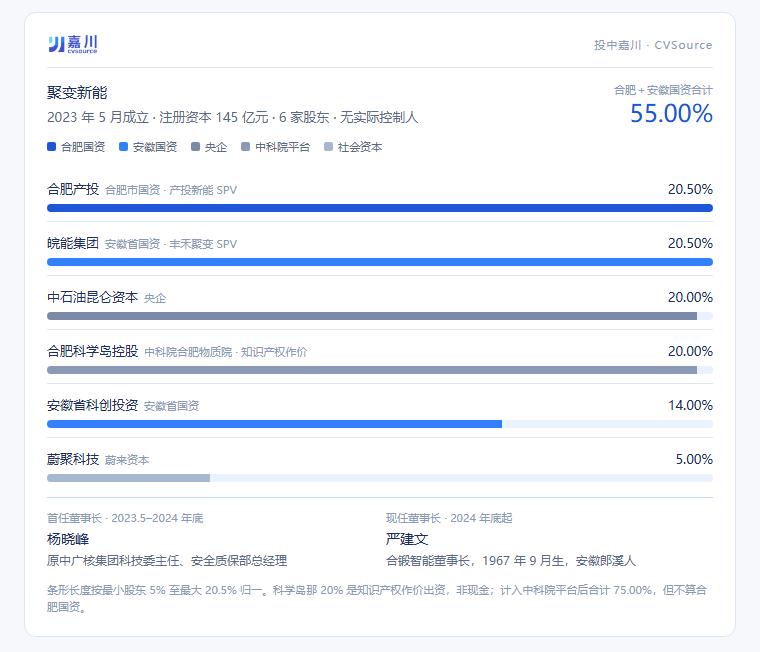
The equity arrangements of the six shareholders are neatly arranged, with only four tiers of 20.5%, 20%, 14% and 5%, and the two largest shareholders are tied. This is obviously a deliberate arrangement to prevent any party from holding controlling stake.
The operator it invited also comes from the industrial sector. The first chairman Yang Xiaofeng once served as Director of the Science and Technology Committee and General Manager of the Safety and Quality Assurance Department of China General Nuclear Power Group. At the end of 2024, Yan Jianwen, a local entrepreneur from Hefei, succeeded Yang Xiaofeng and became the second chairman.
Yan Jianwen is a native of Langxi, Xuancheng, Anhui Province. In 1984, he was admitted to the Mining Machinery Major of Huainan Mining Institute (the predecessor of Anhui University of Science and Technology). Later, he taught at Hefei University of Technology. In 1990, at the age of 23, he resigned and went into business. In 2003, taking advantage of the restructuring of state-owned enterprises, he took over Hefei Forging Machine Tool General Factory, which was on the verge of bankruptcy. He restructured the factory into Hefei Metalforming Intelligent, which was listed on the main board of Shanghai Stock Exchange in November 2014. It took about 11 years from the takeover to the listing.
Hefei Metalforming Intelligent manufactures high-end forming machine tools, whose products are used in automobiles, aircraft, Shenzhou spacecraft, Tiangong rockets, nuclear power, high-speed railways and ships. As early as 2021, it started the R&D of the vacuum chamber for fusion reactors. The 2024 interim report shows that "breakthrough progress has been made in the manufacturing of core components of fusion reactors", and the manufacturing of the BEST vacuum chamber has been smoothly launched, with phased achievements made in forming, welding and testing processes.
The vacuum chamber is the core component most difficult to manufacture in fusion devices. It undertakes four tasks at the same time: vacuum boundary, structural skeleton, safety barrier and precision reference, and directly determines whether the device can be assembled in engineering.
And the person who led the team to make this breakthrough is naturally Yan Jianwen. The project "Research on Key Technologies of Precision Forming and High-Performance Welding for Fusion Reactor Vacuum Chamber" led by him and for which he served as the chief scientist was selected into the national key R&D plan, receiving 43.67 million yuan of special funds from the central government, and the Energy Research Institute provided another 20 million yuan as supporting funds.
Therefore, Hefei invited Yan Jianwen to serve as the chairman, which means letting the person who masters the core component process of fusion reactors manage the company. The key to moving fusion energy forward is precisely solving engineering problems.
03.
From CXMT, to Zhongke Nebula, to Fusion New Energy, the strategy of Hefei's state-owned capital has been completely different from that when it introduced BOE and NIO.
When Hefei introduced BOE, BOE was expanding the next-generation production line of an existing enterprise, and many cities including Shenzhen, Wuhan and Chengdu were competing for the project at that time. Hefei finally won the project with huge investment and efficient policy response
and other supporting measures, which tested the courage of the Hefei government at that time.
The investment in NIO in 2020 was a white-knight-style investment. When the enterprise was on the verge of running out of funds, Hefei exchanged investment for the relocation of the headquarters to Hefei, which tested Hefei's ability to price and provide underwriting support.
However, CXMT, Fusion New Energy and Zhongke Nebula are all enterprises built from scratch. Hefei has clear proactive strategic intentions: it not only contributes capital, but also finds professional talents, gathers industrial resources, and takes the lead in designing the governance structure, which tests its strategic vision and organizational design capabilities.
Moreover, from the tracks of these three companies from CXMT to Zhongke Nebula, we can see that Hefei's strategic vision has moved forward. The environment for space computing power is obviously different from that of storage chips. Around 2016, storage was a problem that had to be solved as soon as possible. This market was dominated by three South Korean and American manufacturers: Samsung, SK Hynix and Micron. Once the supply was restricted, it would not only be an industrial problem, but also a social and people's livelihood problem.
Space computing power is not a definite concept, but it points to the competition of future industries. Whoever occupies the orbits and spectrum first will seize the leading position. From this perspective, the previous bet on storage was to grab market share in a market that had already been divided up by the three giants; now the bet on space computing power is to seize seats in a new market.
The organizational and design capabilities are related to the state-owned capital structure and industrial introduction.
State-owned capital does not hold controlling stakes and does not merge financial statements in CXMT, Zhongke Nebula and Fusion New Energy. CXMT has 60 shareholders and no actual controller; Fusion New Energy has 6 shareholders, and the two largest shareholders hold 20.5% of shares in parallel; Zhongke Nebula has 16 shareholders and no actual controller. The equity tables of the latter two companies clearly show traces of artificial design, which is to prevent any party from merging the company into its own financial statements.
This design, on the one hand, maintains the leading position of state-owned capital, on the other hand, reduces the interference of non-market factors and gives the enterprise maximum flexibility. At the same time, state-owned capital also reduces its own risk and compliance pressure.
The management right of the company is entirely handed over to people from the industrial sector. Zhu Yiming founded GigaDevice first, and GigaDevice is the upstream link of CXMT; Shao Zongyou is a group-level operator, who is connected to leading computing power enterprises such as Sugon on the one hand, and the commercial aerospace territory of Zhongke Spatial Digital on the other hand; Yan Jianwen is an experienced veteran in high-end equipment, who solves engineering problems.
Beyond individual enterprises, there are naturally more elements. For example, talents: the number of various investment professionals in Hefei's state-owned capital system has reached about 1,000, according to the data from our survey at the end of 2025.
Another example is the industrial fund ecosystem. Hefei CXMT Industrial Investment manages the Anhui New Generation Information Technology Fund, including a 12.5 billion yuan parent fund and a 1.3 billion yuan direct investment fund. From the perspective of GPs funded by the parent fund, they also have distinct industrial orientation. They prefer three types of funds: the first type, which accounts for the largest proportion, are CVCs of upstream and downstream enterprises of CXMT, such as Skyworth Capital, Midea Capital and so on, accounting for more than 50%. Such GPs not only have strong investment attraction capabilities, but also interact well with direct investment business. The second type are market-oriented managers from Beijing, Shanghai and Shenzhen, accounting for 30-35%; the third type are local state-owned and financial institutions familiar with the local situation.
This industrial investment model focusing on CVCs may also be replicated in Fusion New Energy and Zhongke Nebula.
For Fusion New Energy, Hefei Industrial Investment released the "Hefei Future Fusion Energy Venture Capital Fund" in January 2026, with the first phase of 1 billion yuan and a duration of 15 years, which is specially invested around the upstream and downstream of the nuclear fusion industry.
On the day of the establishment of Zhongke Nebula, the Nebula Space Intelligent Industry Fund was also launched simultaneously, with a total scale of 5 billion yuan and the first phase of 2 billion yuan, which invests in technology transformation and industrial chain companies of the Space Cloud.
According to public data, these two funds have not yet landed any substantial projects so far. But in their respective investment tracks, Hefei has gathered a group of enterprises. According to official data from Hefei, in the nuclear fusion track, Hefei has gathered more than 70 upstream and downstream enterprises in the industrial chain, and more than 190 commercial aerospace-related enterprises and institutions.
