Do people who know how to use AI have an easier time finding jobs?
AI has been widely integrated into multiple links of game development, and this trend has also changed game developers' demand for talents. A 2026 intern recruitment document from Tencent IEG shows that the demand for game AI-related positions has increased significantly, and some positions have set up AI interviews or AI Coding assessments.
This trend is also common across the world. Statistics released by GDC in November 2026 show that 40% of surveyed game practitioners use generative AI at work, and 57% of them use it every day.
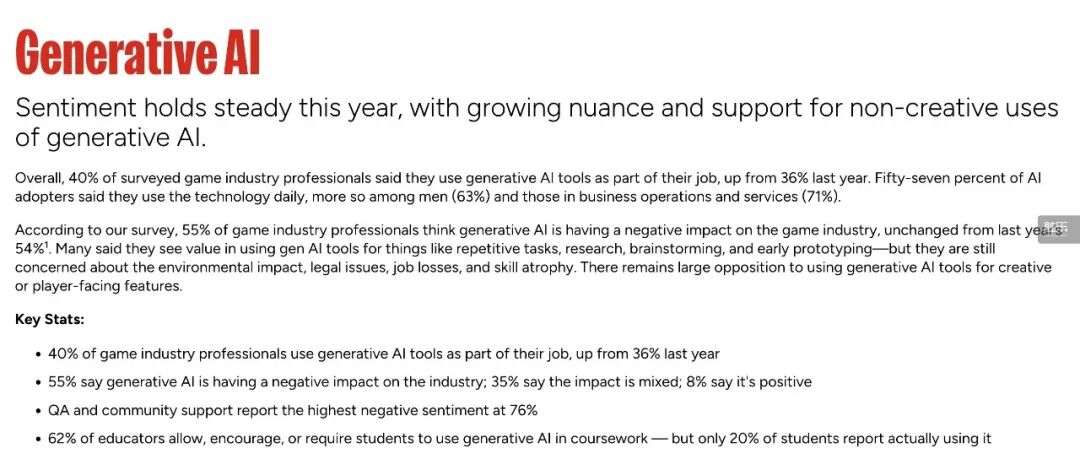
GDC's statistics also show that 62% of educators allow, encourage or require students to use generative AI in their assignments, but only 20% of students have actually used it.
This year, Lin, a senior graduating student, set his main application target at business analysis and strategic positions in game companies. A question he is frequently asked in interviews is "How do you combine AI to improve efficiency in your daily work?". On another occasion, his interviewer directly asked him: "Nowadays many junior jobs in user research can be replaced by AI, so why should we hire you?"
To demonstrate his AI capabilities, Lin followed tutorials online and spent time installing the AI plugin Claudian for the note-taking software Obsidian, building a personal knowledge base that can be read and updated by AI. When answering questions related to AI skills, he will show the whole process: collecting information, screening materials, and asking AI to help modify the wording after finishing the first draft; if he plans to focus on a certain field for a long time, he will set scheduled tasks for AI; for strategic positions, he will also ask AI to generate a research framework for him.
For both game developers and job seekers, AI is increasingly becoming a general skill. Some people compare it to the office software Office, while Lin thinks it is like English: "When you interview for some emerging, cutting-edge internet positions, how well you use AI is just like how well you master English."
However, even if people all agree that "they need to use AI tools proficiently", they are facing different problems. Job seekers want to know what advantages AI skills can bring them and whether they can get more opportunities. For HR and project team members, apart from confirming whether a person "can use AI", there are many other things that require more time to verify.
More opportunities for people who know how to use AI?
In 2025, the Game Working Committee of China Audio-Video and Digital Publishing Association released the AI Technology Application Survey Report for Game Enterprises, which surveyed 22 domestic game enterprises, most of which are medium and large-sized companies. The results show that the AI application rate of enterprises in the R&D link reaches 86.36%, and 77.3% in the distribution and operation link, but it still presents the characteristics of giving priority to breadth while lacking depth. The industry's application of AI is still dominated by tool-based and shallow use cases.
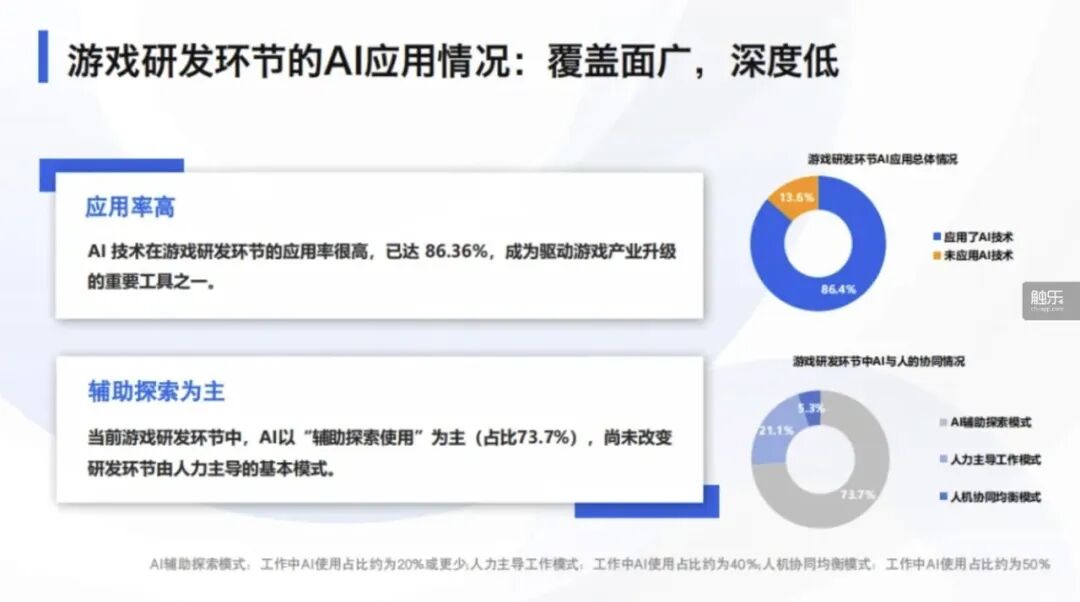
Statistics on AI application and collaboration in the AI Technology Application Survey Report for Game Enterprises
In the public job descriptions of game companies, the position of AI is also significantly different. An overseas-oriented game developer listed AIGC together with PS, AE and Spine as tools that UI special effects artists should master in its 2026 campus recruitment, while AI application engineers need to develop functional modules for businesses such as customer service and operation under the guidance of mentors, from understanding requirements to testing and launch. The AI development tools that need to be mastered and corresponding use experience are clearly specified in job responsibilities and job requirements.
An HR of a listed game company who is mainly responsible for recruiting R&D positions told Chuapp that the "using AI" mentioned in the industry can be roughly divided into two categories: one is using AI as a tool to reduce costs and increase efficiency, and the other is taking AI as the core gameplay. The company he works for mainly belongs to the former category. "For example, value planners used to fill in forms with Excel, but now they can let AI models test several sets of values," in this process, AI plays an auxiliary role, "we used to work in other forms, now we just change to a new tool, and the effect is faster and better."
In addition to individual employees, the company also tries to promote efficiency improvement in terms of workflow. A planner working in a medium-sized game company recalled that from 2025 to 2026, the company has been trying to connect the work of planners, programmers and artists with AI, but so far "it has not been fully put into operation".
Therefore, at least for now, most game developers' assessment of job seekers still focuses on the position itself. The HR estimated that in the initial interviews he handled, the content related to AI tools "may only account for about 5%, no more than 10%", and the focus is still on the professional ability and experience for the position. Only when the professional basic skills meet the requirements, AI ability will be a plus.
"The core is still the same as the traditional situation, we need to see the applicant's understanding of our position and our project," the HR said. "From the interview perspective, there is actually not much difference from before. There may be adjustments in employment tendency according to the company's strategic direction, but in terms of AI use and popularization, it is still more about the basic part." He also said that the company has now accessed the mainstream AI models on the market, and all regular employees have a certain quota authorization, so they will not over-examine job seekers' proficiency in a certain AI coding tool.
In the view of other practitioners, this similar trend is further intensifying involution. An artist cited the plot of the American drama Hacks to criticize the view that "you will be eliminated by the times if you don't accept AI" — what makes AI "inevitable" is the large-scale promotion behavior of internet companies and technology companies, and ordinary people thus lose their right to choose. Specifically in the game industry, this will aggravate people's anxiety, "in the past, costs were calculated by man-days, and everyone's workload was already at the limit. Now many companies will include the workload brought by AI, so people's pressure is even greater. If everyone else uses AI but you don't, and you can't finish the work, you will be the one who suffers losses."

In the American drama Hacks, the protagonist Ava calls the promotion of AI by technology companies "forced inevitability"
Another practitioner who has participated in recruitment said he does not deny this statement, but "anxiety is useless, this thing is inevitable". He believes that we are no longer in an economic rising period, and the game market is also a stock market. Under this premise, more intense competition and involution are unavoidable. For ordinary job seekers, AI can at least make their resumes more attractive. Lin's statement is more straightforward: "Everyone should be more utilitarian when facing AI. In this era, you can be not interested in it, but you can't not know how to use it; you can dislike it, but you can't be unfamiliar with it."
Humans need to do more than AI
Many game developers and job seekers feel at the same time that after AI is widely used, "what humans can do" has become more important.
The HR of the listed company said that if a job seeker says he is very good at using AI, he will ask the candidate to reproduce the process based on a specific scenario during the interview. In this process, he will observe whether the candidate's ability is sufficient and whether he can really get things done thoroughly.
He gave a counterexample: once when recruiting for a user research and track research position, the applicant submitted a seemingly very detailed research report, but after reading it, the HR thought that the applicant might just simply use AI to generate some content, without going through adjustment and iteration, and even the applicant himself did not know enough about the generated content. So the HR asked the applicant to reproduce the content. "As a result, the prompt he used was very simple, similar to 'help me summarize the reviews and understandings of a certain game from media across the market, and output a version for interview'. I was thinking at that time, if this is the case, I can do it myself, why do we need to hire a special person for this position?"
"Some people may think that after they input the prompt and AI gives the answer, the work is theirs, which means they understand it. But it is not the case. AI can help you collect information, but the premise is that you have to understand it yourself," the HR said.
Even for fresh graduates, he values more how applicants derive a clear conclusion from their own game experience and the materials they find, "the conclusion does not have to be correct, but they need to have such thinking". Accordingly, for social recruitment, the requirements will be higher. Applicants need to explain clearly the reason behind a certain design, the purpose to be achieved, or the indicators they hope to improve, "they need to think clearly enough, and their reasoning must be tenable".

The 2026 intern recruitment document of Tencent IEG clearly states that "some positions will set up AI interviews or AI Coding assessments"
After participating in many interviews for business analysis and strategic positions, Lin found that AI is often closely linked to specific business problems. "Many positions have relatively vertical demands," Lin said. For example, when researching a company that develops models or applications, you must first figure out its model architecture, whether it has independent computing power, and what its business model is like; some positions need to understand how to integrate AI into the creation process, or how AI is used in advertising and commercialization.
When facing relatively open questions like "many junior jobs in user research can be replaced by AI, so why should we hire you", Lin's answer is: user research itself is a job that requires people to interact with people, and there are many interview links in it, which cannot be handed over to a single senior employee. "The JD will mention that people with psychology knowledge are needed, which means that people are still needed to understand other people. AI can never replace the work of researchers," Lin said.
Overall, game developers' demands for applicants are more pragmatic. In the 2027 Campus Recruitment AI Talent Market Insight released by 51job in August 2026, in terms of the skills required for AI talents, in addition to professional abilities such as mathematics, statistics, machine learning and programming, the proportions of "understanding and application ability of cutting-edge technologies such as large models" and "problem decomposition and business understanding ability" are very high, reaching 39.3% and 25.9% respectively.
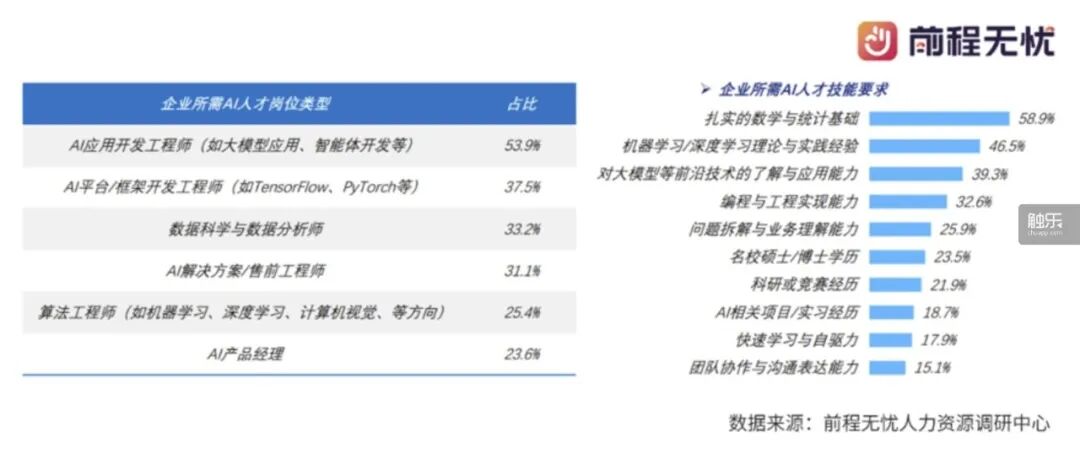
Statistics on AI talent skills in the 2027 Campus Recruitment AI Talent Market Insight shows that the proportion of "problem decomposition and business understanding ability" is higher than that of academic background and internship experience
Overseas, a survey released by the National Association of Colleges and Employers (NACE) in the spring of 2026 shows that 65.9% of the 44 surveyed companies regard "analyzing and modifying AI output on demand" as one of the most important abilities.
However, the HR of the listed game company also said that all these demands are based on the premise of taking AI as a tool to reduce costs and increase efficiency, but some views believe that the productivity explosion brought by AI will eventually affect production relations. "The traditional position division in the game industry is planner, artist, programmer, distribution and so on. As AI develops further in the future, job types may change. At that time, traditional planners will no longer be just planners," he said.
When planners start to submit code
Producer Xinjie is trying to make AI bring more changes to the game production process. He led the team to develop the Xianxia RPG Ask No Mortal Affairs. Xinjie introduced that this product started R&D at the beginning of the year, and launched early access on Steam in September, achieving good results. Its production speed is significantly higher than that of similar products.
"We are more like an AI team making games," Xinjie said. "There are two logics for using AI: one is Human in the loop, which means people follow the current workflow and use AI to help improve efficiency; the other is Human on the loop, where AI does the real work, and people integrate the workflow. Ask No Mortal Affairs is the latter."
Xinjie told Chuapp that in his team, AI first changed the art workflow. A series of work from original painting, fine polishing, scene integration to video driving are all completely handed over to AI, while people need to put forward a large number of demands, give opinions, and review the work results of AI. In May and June this year, Claude 4.8 brought a significant improvement in Coding capabilities, so he required all planners to write HTML gameplay prototypes, and let other positions cooperate across pipelines. Now the project team has reached the third stage: "as the demander, the planner needs to be able to complete the implementation of requirements by himself". In the team, planners have begun to submit code in batches.
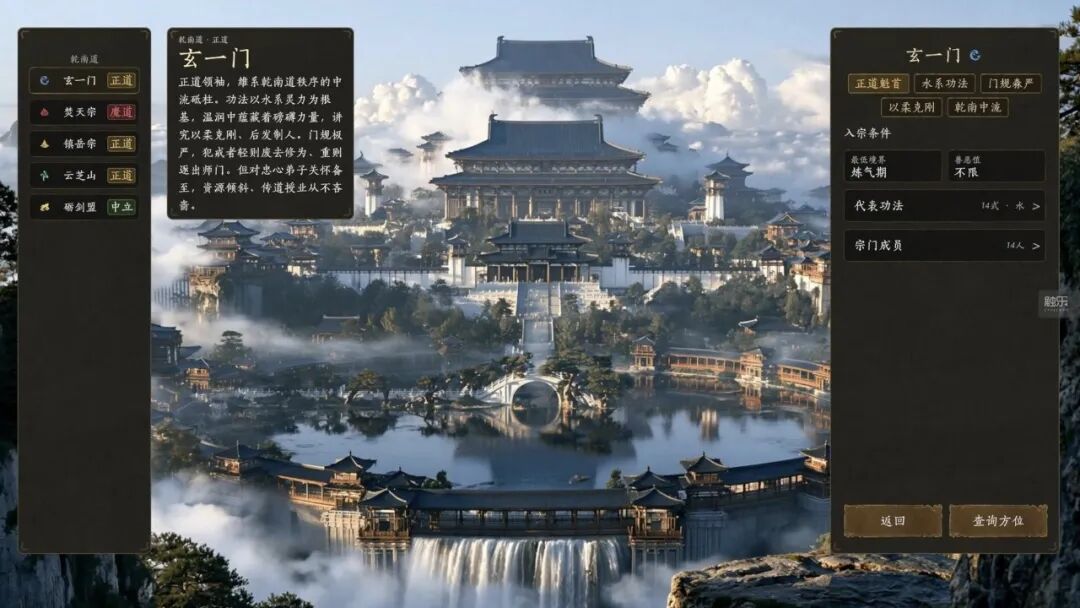
Game screenshot of Ask No Mortal Affairs
However, after the arrival of AI, people's work has not become easier. Xinjie said that traditional game development is a complex large project. Without AI, each position requires different abilities, such as planner, artist, programmer and so on, and each ability will be further subdivided. Commercial games have requirements for version cycle, so increasing production capacity depends on adding more manpower. At present, AI can break the boundaries of capabilities such as programming, art, video and audio, but the demands people need to handle have also increased greatly, and everyone is in an "overloaded" state — this may be one of the important factors for AI to change the logic of game production. In addition, since AI iterates very fast, the workflow also needs to be adjusted accordingly. Inside the Ask No Mortal Affairs project team, the workflow is adjusted approximately every two months.
Accordingly, this new logic has very high requirements for people. "It is extremely difficult to recruit such people," Xinjie said. "On the one hand, this person needs to have the ability to face multiple demands, just like GPU thinking, which can handle problems in multi-threading; on the other hand, he needs to have professional judgment, such as whether the program can run, whether the gameplay is appropriate, and how planners and artists can cooperate on the demand side. In addition, he needs to be willing to do this, which is also very important."