Against the backdrop of a 27% store closure rate, leading braised snack giants are collectively setting their sights on the hot braised food segment.
The braised food industry is undergoing a round of adjustment. Juewei Food recorded its first annual loss since listing in 2025, and its revenue and net profit continued to decline in the first three quarters of 2026; Zhou Hei Ya saw its net profit and gross profit margin drop simultaneously in the first half of 2026. Faced with pressure, several leading braised food giants have responded in the same direction: ramping up investment in hot braised products.
The era of easy growth is over, and the braised food industry is facing tough times
NCBD (Food Dictionary) "White Paper on Restaurant Closure Rate in China's Catering Industry 2025-2026" shows that the average restaurant closure rate of the catering industry from 2025 to 2026 is 23.7%, and the overall closure rate of the braised food category is 27.9%, higher than the industry average; the closure rate of the duck neck category is 27.1%, up 5.8 percentage points year on year, ranking the third fastest rising closure rate among 80 categories. The closure rate of braised food stores varies significantly across provinces, ranging from 10.5% to 46.9%. Heilongjiang takes the lead at 46.9%, followed by Jilin at 42.8% and Liaoning at 42.5%, with all three northeastern provinces recording a closure rate above 42%. Guangdong (36.1%) and Hainan (35.6%) rank right after them.
Store contraction is more directly reflected in leading enterprises. According to data from Zhaimen Canyan, the number of Juewei stores was close to 16,000 at the end of 2023, dropped to 10,624 at the end of 2025, and stood at 8,804 as of November 11, 2026, a net decrease of about 7,000 stores compared with the end of 2023. The company stated at its performance briefing in June 2026 that it would no longer simply pursue scale expansion. The store adjustment of Zhou Hei Ya is relatively gentle: the total number of stores was 3,019 at the end of 2025, and 2,972 as of June 30, 2026, with the scale basically maintained at around 3,000.
In terms of performance, several leading enterprises have shown differentiation. The 2026 Q3 financial report of Juewei Food shows that its operating revenue in the first three quarters reached 3.857 billion yuan, down 9.46% year on year; the attributable net profit to shareholders was 168 million yuan, down 39.95% year on year, of which the net profit in the single third quarter was 33.53 million yuan, down 68.03% year on year. The 2026 interim performance of Zhou Hei Ya shows that its revenue in the first half of the year was 1.461 billion yuan, up 19.5% year on year; the net profit was 91.496 million yuan, down 15.2% year on year; the gross profit margin dropped from 58.6% to 54.7%, presenting a situation of revenue growth without profit growth. In addition, Huangshanghuang recorded revenue of 1.632 billion yuan and attributable net profit of 103 million yuan in the first three quarters of 2026, up 18.36% and 2.21% year on year respectively. However, the incremental revenue mainly came from the consolidated freeze-dried food business, while the original braised sauce business is still contracting.
Hot braised food has become a common transformation breakthrough point
Hot braised food refers to the form of braised products that are freshly braised and mixed on site, with soup and sauce, which can be paired with rice, noodles to make simple meals, covering lunch and dinner scenarios. Since last year, leading braised food brands have all set their sights on hot braised food.
Juewei has taken the most frequent moves by testing water with parallel multi-store formats and superposed multi-product lines. In July 2025, the first "Juewei Plus" store opened in Changsha, with nearly 30 SKUs covering fried braised products, grilled food, staple food, desserts and drinks; in October 2025, it launched the fast food brand "Juewei Clay Pot" in Shenzhen, entering the full meal scenario by converting cold braised products into hot clay pot dishes; in November 2025, it launched "Hot Braised Cup" in multiple stores across the country, directly entering the lunch scenario with the combination of "braised food + staple food". In addition, Juewei also promotes set meals such as braised pork rice and cold dishes in its stores to cover lunch and dinner scenarios.
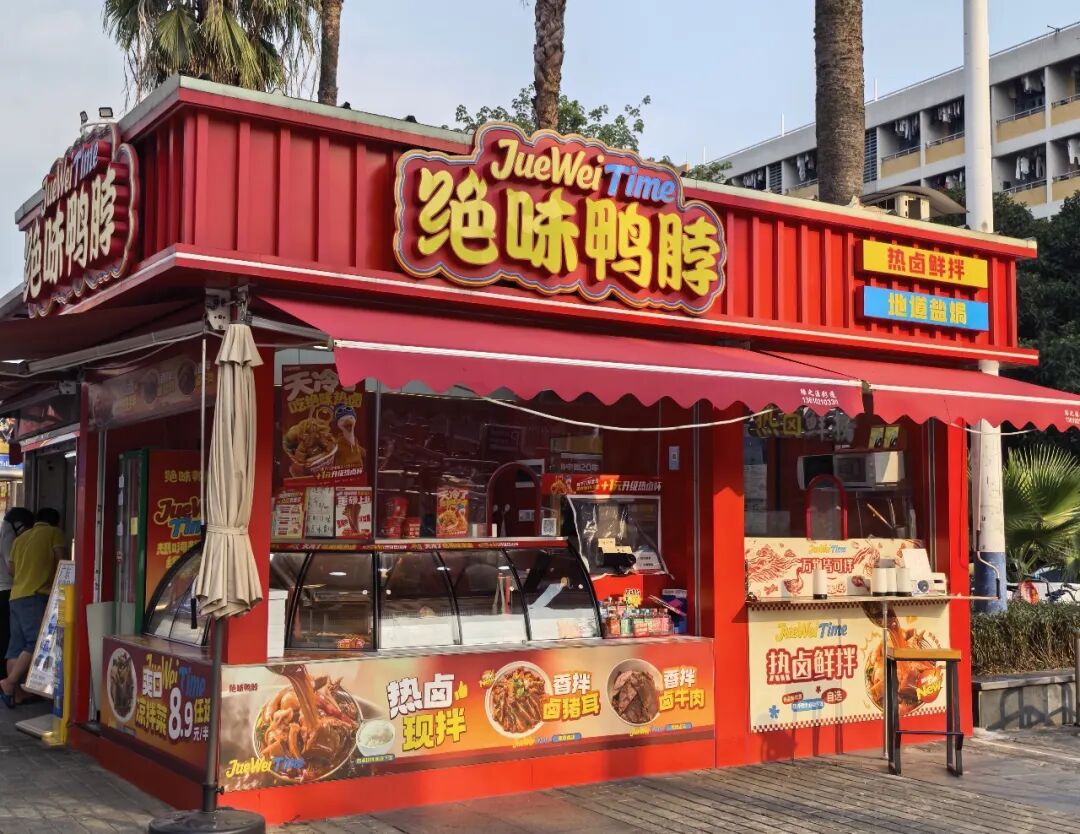
△ Photo from Food Dictionary
Jiujiuya has taken another path: instead of changing the store format, it adjusts the sales method. Since 2025, the brand has upgraded a large number of existing stores to "Jiujiuya · Fresh Hot Pot Braised Food", abandoning the past mode of placing pre-made cold braised products in cabinets and weighing and packing them. It boils hot pot base into braised soup, and puts semi-finished products such as duck necks, duck wings and duck palms into the pot in batches for braising before placing them in the display cabinet; after customers place orders, the products will be put into the corresponding braised soup to cook for about 1 minute according to the spicy or non-spicy taste before serving. This process is equivalent to integrating the more mature hot pot category into braised food, which not only heats the products, but also allows secondary flavor penetration. The spicy, fragrant and delicious taste is more in line with the preference of young consumer groups.
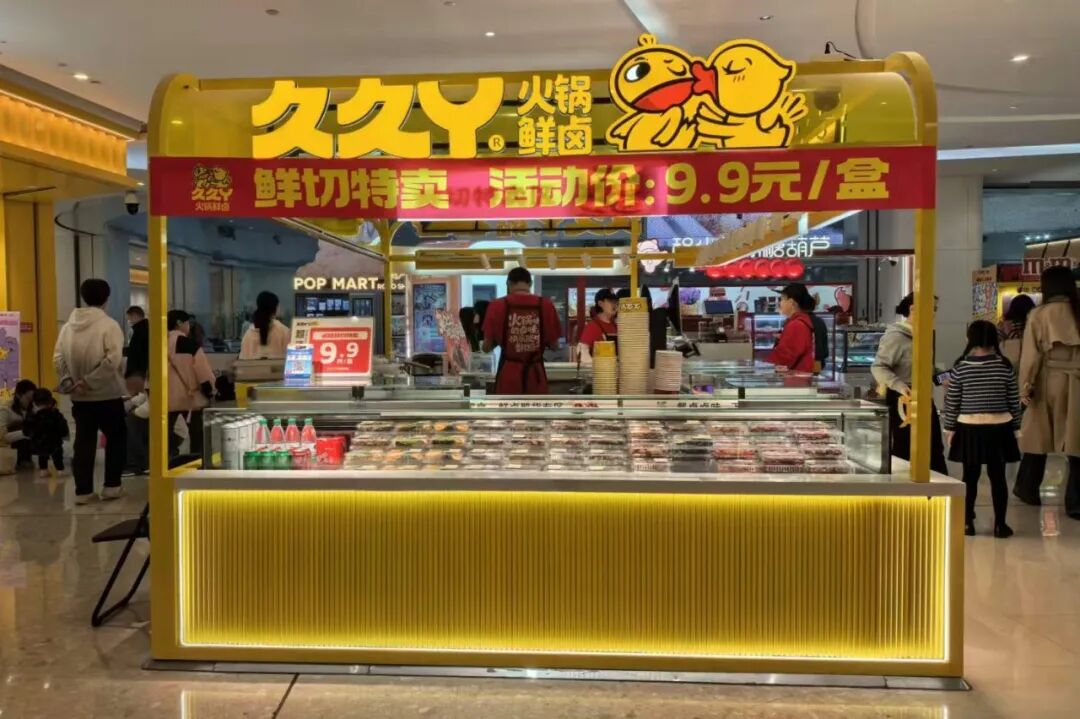
△ Photo from Food Dictionary
The two enterprises have different transformation ideas. Juewei adopts "parallel multi-store formats", using new store formats and new brands to carry out decentralized trial and error, which brings controllable risks but also leads to scattered investment, and none of the lines have achieved large-scale operation yet. Jiujiuya adopts "unified transformation with a single mode", which converts existing stores into the same fresh hot pot braised food process in batches, with the advantages of unified standards and fast replication, but it needs to re-establish manpower efficiency, food safety, loss control and product consistency at the store end. The common point of the two is that they no longer rely on the increase of store numbers, but seek growth from the time slot, category and customer unit price structure of existing outlets.
Zhou Hei Ya's moves are relatively restrained. It basically keeps the main brand store system unchanged, and chooses to extend at both the single product and channel ends. In June 2025, it piloted the hot braised sub-brand "3 Jin Ban · Small Pot Fresh Braised Food" in Wuhan, with an open kitchen in the store, adopting the combination of per-piece pricing and bulk weighing, and matching with staple foods such as rice, mixed noodles and mixed rice noodles; in 2026, it cooperated with Micun Banfan to launch "Gudu Duck Clay Pot", which entered all stores of Micun Banfan across the country as a formal meal dish. In addition, in 2025, Huangshanghuang opened its first "Huangshanghuang Hot Braised Food" specialty store in Nanchang, with supporting products such as braised rice noodles, fried rice, cold dishes and drinks.
Why hot braised food?
Juewei, Zhou Hei Ya, Huangshanghuang and Jiujiuya made similar choices in the same time window and collectively targeted hot braised food. What is the reason behind this?
"Cold braised food is not selling well" is one of the main reasons, and in addition, there are the following reasons:
First, hot braised food has the "wok qi" (freshly cooked aroma). The core of cold braised food is standardization: products are pre-cooked in central factories, distributed via cold chain, and unpacked and repackaged in stores. What consumers get is industrial finished products. For hot braised food, the braised soup is boiled on site in the store, with open kitchen operation, and the products are served steaming hot. The aroma, temperature and taste are all presented in front of customers. In an environment where consumption is becoming more rational, consumers are more willing to pay for visible freshly made products rather than brand premium, and the "wok qi" is exactly what the cold cabinet cannot provide.
Second, hot braised food can serve as a full meal. Leisure braised food belongs to optional consumption, with low customer unit price, unstable consumption frequency, and consumption scenarios concentrated in the evening and late-night snacks. It is the first category to be cut when the weather gets cold or the budget tightens. With the addition of staple food, set meals and soup, hot braised food directly enters the lunch and dinner scenarios, improving the effective business hours of stores and repurchase frequency.
Third, the category extensibility of hot braised food is far better than that of cold braised food. The SKUs of cold braised food are closed, limited to duck by-products, vegetarian dishes, seafood and a few other categories, with limited space for addition or subtraction. Hot braised food naturally comes with a cooking pot, which can be added with staple food, vegetarian dishes, drinks, and even connected to hot pot like Jiujiuya. Once the category boundary is opened, there is room for adjustment in product structure, customer unit price and store model, which determines that hot braised food is not just a new selling method, but a whole new set of store format.
Fourth, the industry supply chain is mature, and the store transformation threshold is low. The upstream pre-braising, compound seasoning and cold chain systems have been developed for many years. All that the store end needs to add is a braising barrel, an induction cooker and an operation counter. The transformation cost is far lower than re-selecting sites, redecorating and rebuilding the supply chain, which is also more acceptable for franchisees. This is not only the reason why hot braised food can spread rapidly within two years, but also the reason why it is easy to be replicated and difficult to form competitive barriers.
Fifth, the market has been pre-educated, leading to low customer acquisition cost. Community fresh braised stores, braised food hot pot and rotary small hot pot have been operating for several years before leading brands enter the market. Consumers are no stranger to freshly braised, hot served and portioned boiled products, so brands do not need to re-educate the market. In addition, the open hot pot itself has a drainage effect, and eating strategies and matching gameplay on social platforms can also bring organic traffic, so the cold start cost of new store formats is significantly lower than that of new categories built from scratch.
Risks and challenges
Braised food giants ramp up investment in hot braised food and launch staple food set meals to enter the lunch and dinner scenarios, which essentially means the transformation from braised food retail to light catering. While opening up incremental space, they are also facing multiple challenges.
First, there is a mismatch between business model and capabilities. Traditional braised food relies on pre-production in central factories and cold chain distribution to stores, with stores mainly focusing on display and sales, featuring simple operation and high standardization. However, hot braised food as formal meal requires on-site boiling and order control in stores, which follows the catering operation logic, and the two systems have obvious differences. At the same time, the increase of on-site operations in stores makes it more difficult to control taste stability, which may easily damage the brand image. It is also difficult for consumers to quickly change their original perception, as the public are used to regarding Juewei and Jiujiuya as braised cooked food stores.
Second, the rising cost and higher loss pressure. Store transformation requires investment, and the daily expenses of water, electricity and cleaning supplies also increase simultaneously. Traditional cold braised stores can be operated by a single staff, while hot braised food stores need special personnel to operate during peak hours, leading to rising labor costs. Hot braised food, staple food and soup products have short shelf life, and it is difficult to predict passenger flow. Excessive stock is easy to go bad, while insufficient stock will lead to customer loss, so the loss rate is significantly higher than that of cold braised food retail. To adapt to the fast food market, the set meal pricing needs to be affordable, and the overall gross profit margin is lower than that of single braised food products. Stores can only make profits by relying on stable table turnover rate and associated consumption.
Third, the difficulty of supply chain and site adaptation for enterprises. The original supply chain of enterprises is adapted to pre-made cold braised food, while hot braised food requires high-frequency, small-batch distribution of fresh products. Newly added SKUs such as staple food and soup materials will increase the complexity of warehousing and distribution, and it is difficult to form scale advantages in a short time. In addition, store sites are highly differentiated: stores in office buildings and commercial districts are suitable for formal meal scenarios, while a large number of small community stores have insufficient area and supporting facilities, so it is difficult to achieve good performance after transformation.
Finally, the risks of food safety and track involution. The regulatory standards for on-site hot food are stricter than those for pre-packaged retail, and there are more control nodes such as brine storage, heat preservation and disinfection. With a large base of franchise stores, the risk of food safety public opinion is higher. In addition, the threshold of hot braised food model is not high, which leads to extremely high homogeneity, and low-price group buying for drainage will compress profits. The tilt of brand resources to new projects may also distract energy from the main business, leading to hidden dangers that the new business fails to operate well while the original cold braised food basic market declines.
Hot braised food is not a new incremental blue ocean, as emerging brands and cross-border players have entered this track for many years, and the model replication threshold is not high. The real difference lies in who can run a sustainable single-store model and steadily promote it on the premise of profitability and replicability. For several braised food giants, the focus of subsequent moves is not on the number of new store formats, but on whether the single-store revenue, gross profit margin and cash flow can be improved simultaneously.
This article is from the WeChat official account "Food Dictionary", written by the Editorial Department of Food Dictionary, and authorized for release by 36Kr.