Abandoning search services and refusing to embrace AI, Chicago Public Schools pushes back hard against Google: Bundled AI is worse than no AI at all
Google's newly introduced rule recently has infuriated multiple public school districts across the United States.
The core of the rule is that starting from early 2027, education accounts for K-12 schools will no longer be allowed to turn off the AI feature in Google Search separately.
If you want to use the search service, you have to accept the built-in AI Overview. Want to completely avoid using AI? Then you cannot use the entire search service at all.
According to media reports, the core implication of this policy is that rejecting AI means directly giving up Google Search. News outlets have also confirmed that schools can independently toggle on and off standalone AI applications such as Gemini and Gemini Notebook, but the embedded AI Overview feature in search cannot be disabled separately. To retain access to the search service, you have to accept the AI feature along with it.
Faced with Google's bundling operation, Chicago Public Schools made a clear statement directly: they would rather give up Google Search than let students passively accept generative AI.

Source: Generated by Doubao AI
In fact, Chicago has long been exercising strict control over AI tools on student terminals. At present, the school district has fully blocked ChatGPT, Claude and Gemini applications on all student accounts and school-issued devices, mainly due to privacy risks and student safety concerns.
According to reports from the Chicago Tribune, the school district is currently testing various technical means to separately block the AI mode and AI Overview features in Google Search.
However, if Google insists on not separating search from AI, Chicago has a backup plan. The school district stated that if Google never provides an option to separate the two, they will directly switch to other search engines.
It is worth mentioning that the Chicago school district previously considered opening access to Gemini for high school students.
The plan was strongly opposed by parents and the community after it was made public, and was finally put on hold. Now Google's mandatory bundled push directly crosses the bottom line of the school district.
Faced with the collective boycott of school districts, Google's attitude is also very clear: search and AI have been deeply integrated and cannot be separated.
Chris Phillips, Vice President and General Manager of Google for Education, said in an interview that search and AI are deeply integrated and inseparable.
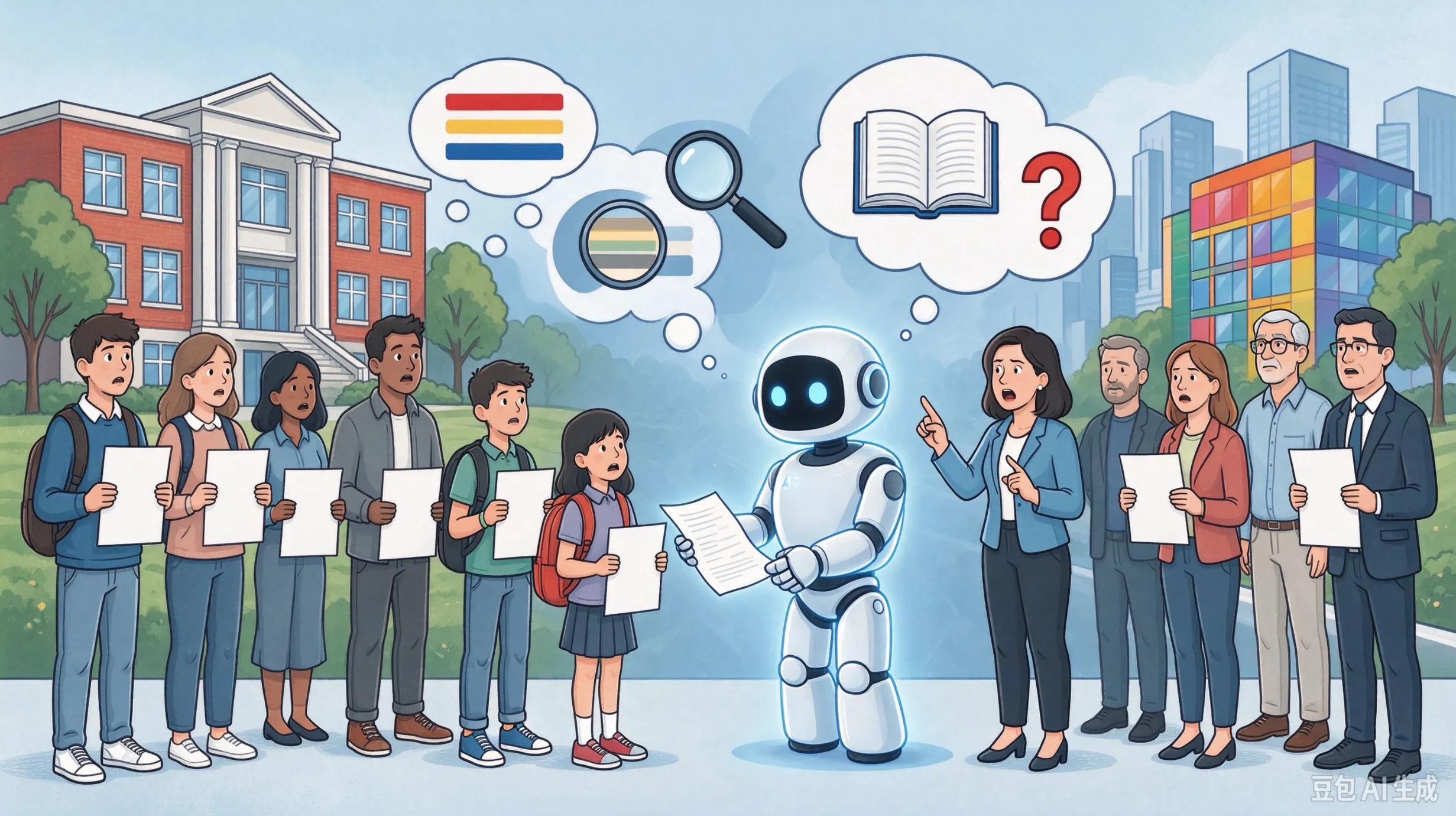
Source: Generated by Doubao AI
Reports from the Associated Press also confirm this rule: schools that completely reject AI tools will not be able to use Google Search normally later, and students will only see the prompt information set by the school after opening the page.
Of course, Google has also offered a compromise solution, launching a guided learning feature for classroom scenarios. Google claims that this feature will not directly give students ready-made answers, but guide students to sort out problem-solving ideas step by step, hoping to ease schools' concerns about AI giving away answers directly.
However, Google has made no concessions on the core rule that search and AI cannot be separated.
Google's new rule has not only annoyed school administrators, many parents, teachers and students have also come forward to oppose it. Many protesters gathered downstairs at Google's Chicago office to publicly resist this policy.
Local Chicago media has also reported on the core concerns of the public: AI generating answers directly will replace teachers' feedback and guidance, weaken students' deep thinking ability and reduce learning effectiveness. At the same time, the information output by AI is not necessarily accurate and reliable, and may mislead students instead.
Quite a few schools share the same attitude as Chicago's schools. Restricting students' access to generative AI has become a common choice for many schools.
Frederick County has voted to pass a district-wide K-12 AI ban, with exceptions only for AI teaching courses and adaptive scenarios for students with disabilities.
Los Angeles has taken more direct measures, temporarily blocking all generative AI tools on student devices across all grades.

Source: Generated by Doubao AI
Technology website TechSpot summarized the common demands of these education authorities: What people are dissatisfied with is not just the AI feature itself, but also that Google did not give schools sufficient advance notice before launching the feature, nor did it provide a stable and reliable way to turn it off, so students can easily be exposed to AI content without any preparation.
On the surface, this is a debate about whether AI can enter campuses. At a deeper level, it is a test of the discourse power of platforms.
The core of the controversy is that when a monopolistic platform forcibly bundles basic tools that are in rigid demand by the public with new features, can public schools still retain the right to independently formulate technology policies?
Google's rule does not force students to use AI. Schools can choose to opt out, but the price of opting out is giving up Google Search, and additional manpower and material resources need to be invested to find alternative solutions.
Not all school districts can easily afford these administrative costs and tool gaps. The Chicago school district has a very firm attitude: as long as Google does not come up with a solution to separate search from AI, they will continue to promote alternative solutions and stick to their stance to the end.
This article is compiled by Lei Technology from gadgetreview
Original link: Chicago Public Schools push back against Google, stating they would rather give up search services than accept AI features.