Major upheaval has swept the AI companion industry: 5 out of the top 10 highest-grossing offerings have been removed from shelves. Who is the winner in this round of iOS rectification?
Nowadays, the AI companion app track on the mobile end has almost become the home turf of Chinese and South Korean teams. Combined with data from SensorTower, the top 10 apps on the revenue list are mostly developed by Chinese/Chinese-origin teams or teams with South Korean backgrounds, and it remains to be seen who will have the last laugh.
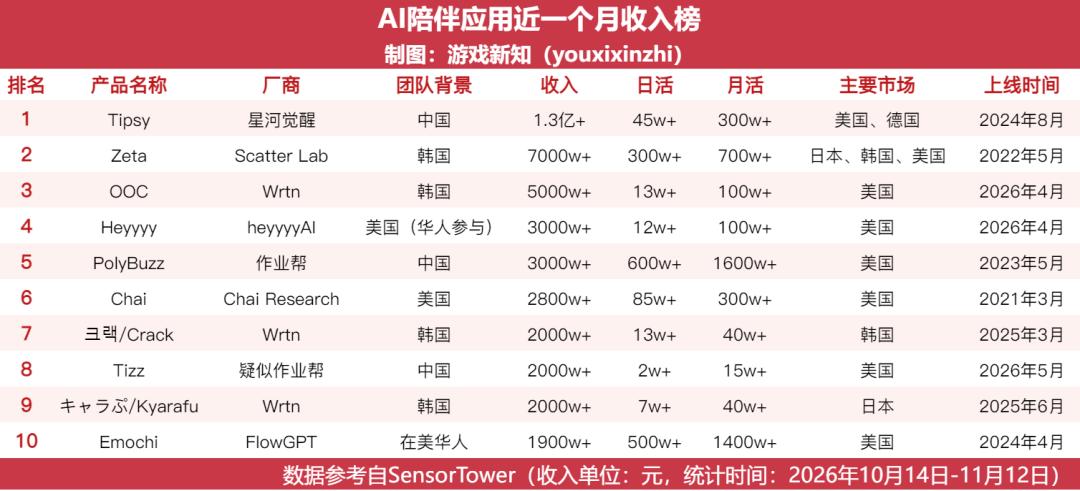
Only IAP revenue is counted in the statistics
At present, Chinese teams are still leading with a considerable advantage. The top-ranked Tipsy stands out at a higher tier, with a monthly revenue of 130 million yuan, nearly twice that of the second-ranked Zeta. There are also two dark horses: the newly listed Tizz is suspected to be developed by Zuoyebang; the other app Heyyyy has a team that transitioned from the gaming industry, with core members of Chinese origin.
South Korean teams are also keeping up closely. Wrtn has 3 products in the top tier, which are localized for the US, South Korean and Japanese markets respectively, with a combined monthly revenue exceeding 90 million yuan.
However, it is still too early to say that the landscape of the AI companion app sector has been finalized. For one thing, the market is far from saturated: currently, most players are competing for users in the US, Japan and South Korea, while a large number of other markets remain untapped. For another, the real major test has probably just begun — with Apple's new rules for AI apps implemented in October, apps that touch the red line may be removed from shelves and their accounts banned. What kind of impact will this bring? All teams are likely waiting and seeing, and they must be feeling both anxious and worried.
5 out of the top 10 apps on the revenue list have been removed from shelves!
This wave of shocks seems to be more fierce than expected. Previously, multiple media have reported that two leading apps, Tipsy and PolyBuzz, have been removed from the iOS App Store, but the actual affected scope is wider — Zeta, Chai and Tizz have also quietly disappeared from iOS. That means, 5 out of the top 10 AI companion apps by revenue have been removed from iOS in one go! (Note: This batch of apps has basically been removed from the iOS App Store in their main markets, and can only be downloaded in a few regions.)
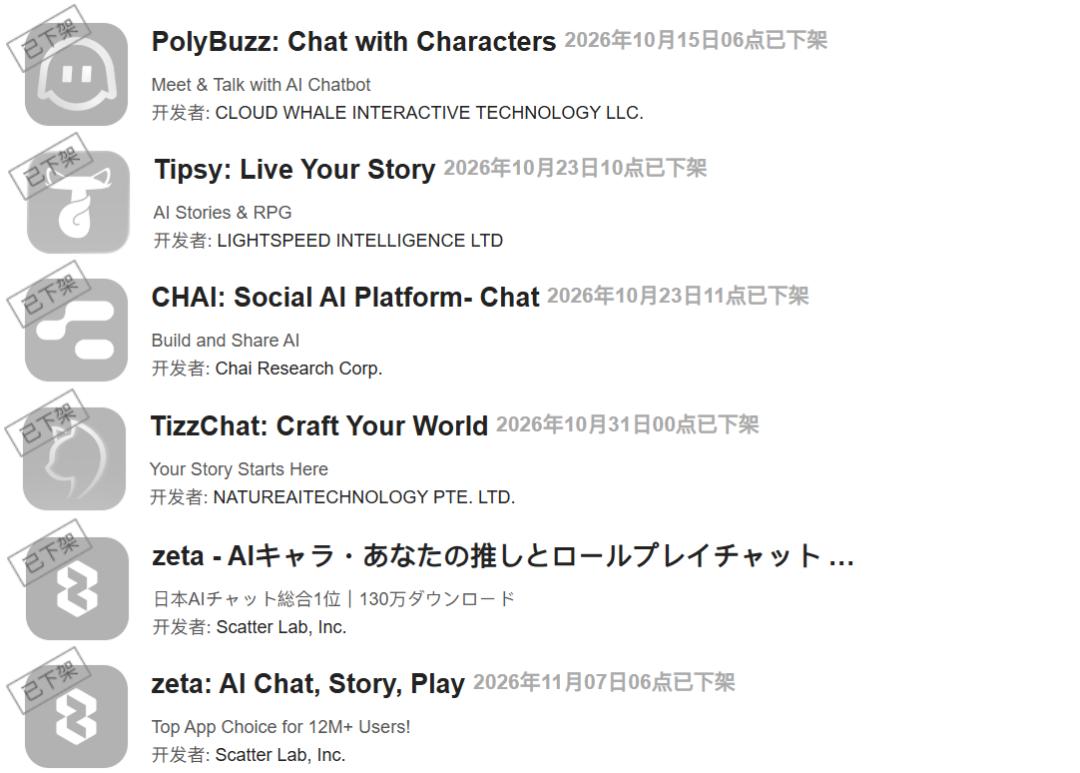
There has been no official statement on this round of removals so far, but the general speculation points to the recent new iOS rules.
The story dates back to January this year. At that time, a non-profit organization TTP released a report exposing a large number of AI nudification apps on Apple and Google's app stores, such as apps that generate explicit images of real people without the consent of the parties involved. According to statistics, there are 47 such apps on Google Play and 55 on the Apple App Store (38 of which are available on both platforms), this batch of products has generated a total revenue of 117 million US dollars (data from AppMagic), and the platforms have indirectly benefited from the revenue cut.
In April, TTP followed up with a report stating that although both platforms explicitly ban apps with "nudification" functions, the search and ad links on the app stores still lead users to such content. In July, officials in San Francisco, the United States, asked Apple to delete 8 products that can generate non-consensual intimate images. Later, controversial incidents such as the Grok case also occurred...
Under public opinion and regulatory pressure, Apple updated its review rules on October 16, drawing two red lines: first, apps are prohibited from generating "non-consensual intimate imagery" (including AI-generated images); second, apps containing hidden or unrecorded functions are prohibited from being released (including apps that make false statements about their purposes during the review process and expose harmful functions such as "nudification" after being approved). Once verified, not only the app will be removed, but the corresponding account will also be banned — it is expected that more developers will use shell apps to avoid risks in the follow-up period.
There are indeed cases in the AI companion track that leverage NSFW (Not Safe For Work, generally referring to content unsuitable for public browsing, including explicit sexual hints, sexualized images, suggestive interactions and adult content) to drive commercialization. This path is opportunistic and easier to get through. That's why some non-NSFW apps, which have a larger scale of downloads and active users, have lower in-app purchase revenue than NSFW/romance simulation apps.
The premise for this is that the platform turns a blind eye, which is obviously impossible. Judging from the timeline, PolyBuzz was the first to disappear from iOS, and it was removed from shelves on October 15. Looking back now, that was more like a signal, and in the following two or three weeks, several other competing apps were removed one after another.
Reactions from all parties are also somewhat subtle.
So far, only Chai has responded on public platforms, but it only mentioned in a perfunctory manner that the iOS version is being optimized, cannot be downloaded from the iOS App Store, and existing installed users are not affected in their usage.
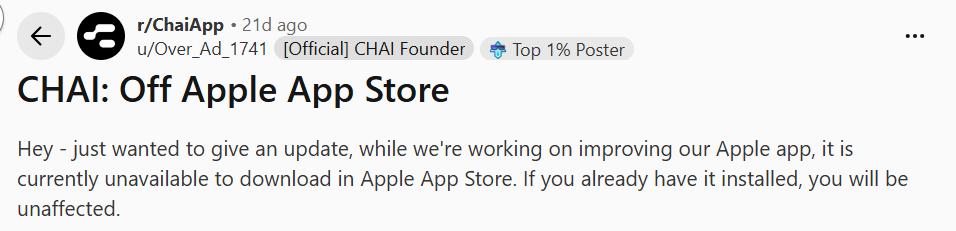
The app can still run normally, but updates have become a problem. Some users reported that they received update reminders, but there is no corresponding store page when they click in; moreover, every iOS system update increases the probability of failures for old versions of apps that are no longer maintained.
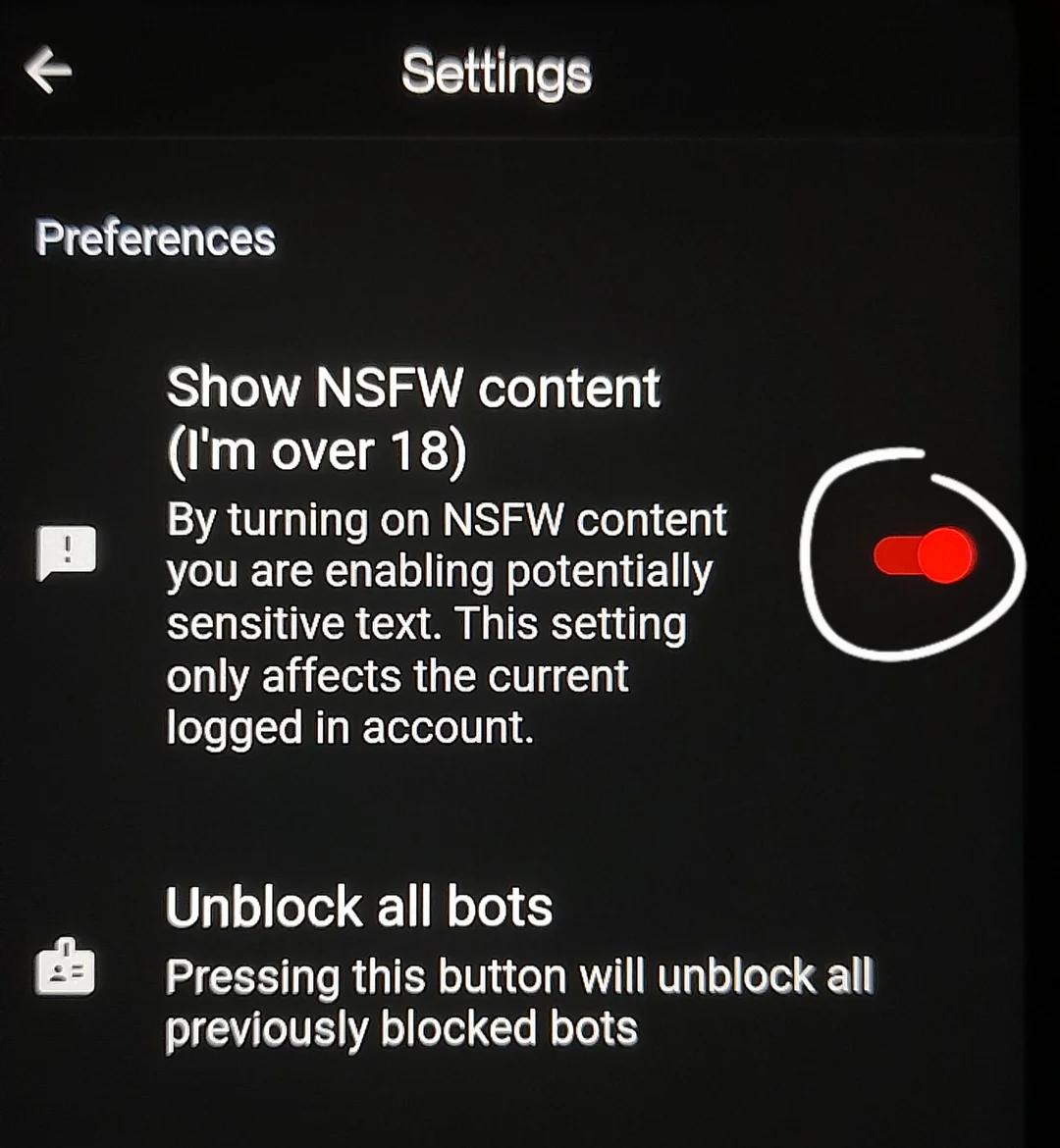
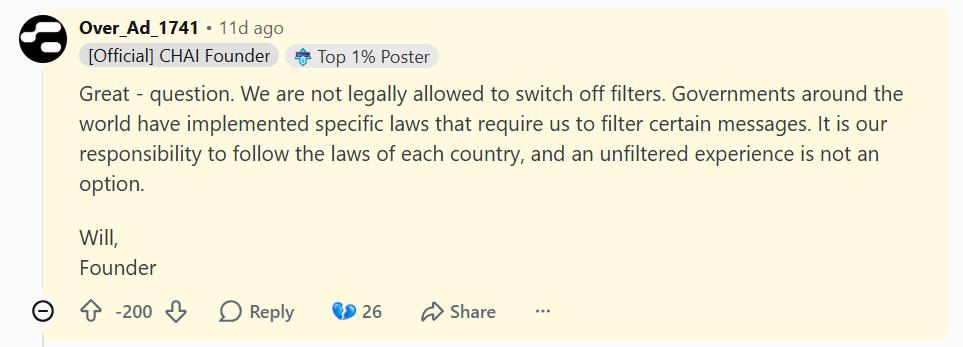
What also sparked controversy is the mandatory content filtering mechanism (mandatory NSFW filtering) recently launched by Chai. Some users complained that the review is too strict and one-size-fits-all, which damages the experience, and hope to get a switch button for independent selection. The official attitude is very tough, stating that it will never provide "unrestricted AI chatbots", regulators around the world have introduced regulations requiring AI apps to be equipped with content filtering mechanisms, Apple also has clear restrictions on UGC, and versions without information filtering are not optional. This reply was downvoted hundreds of times in the community — people may not be unaware of the logic, but it is obvious that their resentment is quite strong.
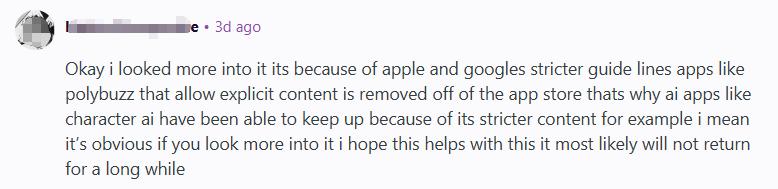
On the other hand, PolyBuzz has remained silent the whole time. Users have been asking on its official Instagram account why the app can no longer be searched on iOS. There are also discussion posts on Reddit, and many people in the comment section are confused. Some users simply attributed the removal to Apple cracking down on AI apps. Only a few users pointed out that it may involve suggestive content, and some even cited Character.AI, believing that it "can continue to operate thanks to strict censorship", but they may not know that Character.AI recently filed for bankruptcy protection — according to Reuters, Character.AI still has about 12 million active users, but loses 8 million to 9 million US dollars per month due to costs of computing power and personnel.
As for the most profitable Tipsy, its revenue has not fluctuated much for the time being, but it faces considerable pressure in the long run. Its daily active users are not high in the first place, and its revenue is mainly driven by high-paying users. Once NSFW content is strictly regulated, its existing commercialization model will face great difficulties.
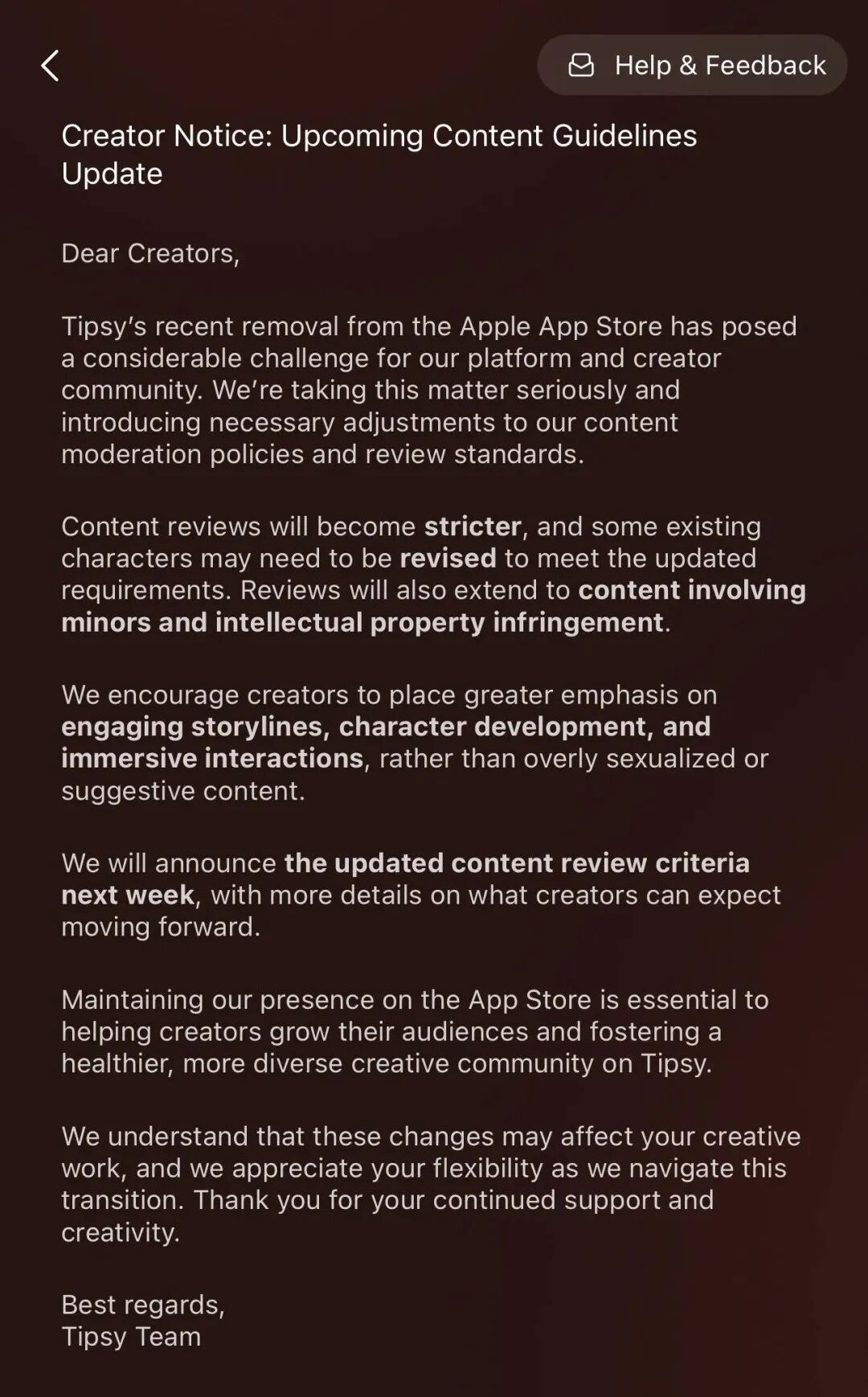
The team must be very troubled. It has issued an internal announcement acknowledging that this round of removals has had a huge impact, and in the follow-up it will tighten content review, modify some existing character images to comply with the new rules, and expand the review scope to cover content involving minors and copyright infringement. The official hopes that creators will focus on plot, character building and immersive interaction, and avoid over-sexualized and sexually suggestive creations.
It is predictable that the adjusted Tipsy will most likely face user churn and revenue decline.
This series of unexpected events has also brought some issues to the forefront: can AI companion apps make money without relying on suggestive content? (The answer is no, but it may not be as fast and easy as the gray-area monetization approach.) Apple has already taken action, will Google follow up later? Can AI apps strengthen censorship without damaging the UGC experience?
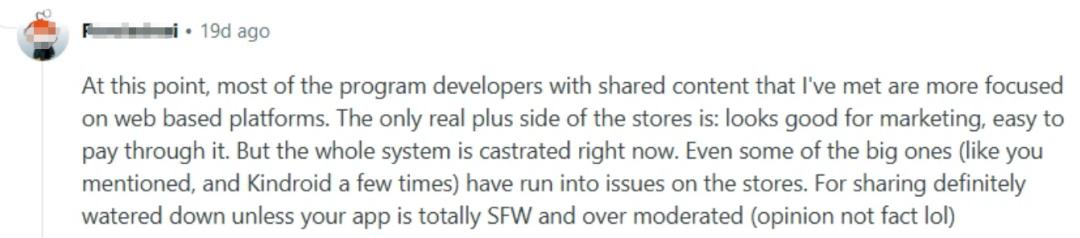
These problems are difficult to solve in a short period of time. But one thing is clear to all: the shortcut of fast monetization relying on NSFW content in the past is probably gone. Some netizens also believe that this impact is limited to the mobile end. The netizen said that according to what he has seen, the vast majority of developers of content-sharing apps prefer the web end. The real advantages of app stores lie in better public promotion and ready-made smooth payment links. But this ecosystem is now restricted everywhere, and the content sharing sector has been greatly affected, unless your app is completely SFW (Safe For Work, referring to age-appropriate safe non-sensitive content) with full censorship and control.
Who has reaped the dividends from this round of app removals?
While this wave of removals has sounded the alarm for peers, it has also triggered a series of chain reactions.
For competitors, the period when leading apps "disappear" is undoubtedly a good opportunity to seize users, which cannot be missed. Observations show that several competing apps have indeed reaped dividends.
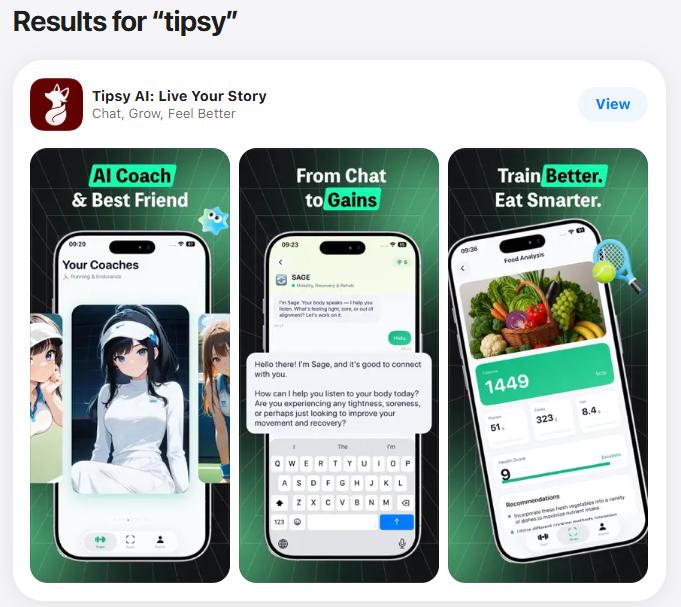
A rather special case is a new product called Tipsy AI, which took the opportunity to be launched on iOS, and is suspected of riding on the popularity of Tipsy with a similar name and logo. Some users searched and thought it was the same app and clicked to download, so it got more than 7000 downloads and tens of thousands of yuan in revenue in a short period of time.
Tizz is much less fortunate. It was removed from iOS shortly after its momentum picked up, and now it has dropped out of the top 10 of the monthly revenue list (the statistics cover the period from October 18 to November 16). Its position has been taken by Popia developed by Beijing Yuanshi Technology.

Emochi and Heyyyy have also clearly absorbed this wave of traffic. Recently, the iOS download volume of both apps has risen, and their revenue has also increased simultaneously.
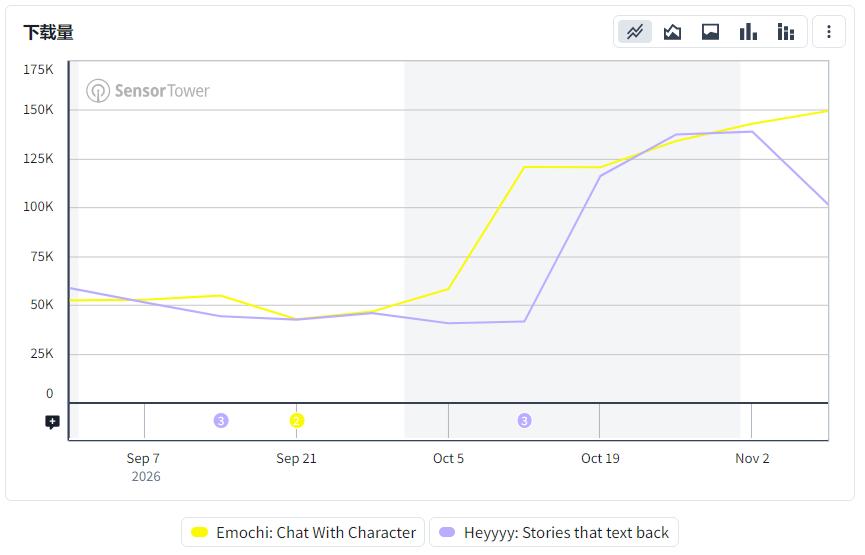
iOS download trend (Source: SensorTower)
Among them, Heyyyy has climbed all the way to No.34 on the US iOS Entertainment Top Grossing list. Its team is quite special, as it transitioned from the gaming industry. Public information shows that the company has three co-founders and directors, two of whom are the founders of the mobile game company A Thinking Ape, and the third is Yao Zhenwang, who graduated from University of Science and Technology of China, has worked at iFlytek and Motorola, joined A Thinking Ape in 2010, and successively served as software engineer, team lead, and Vice President of Growth.

A Thinking Ape