Focusing on the field of personal knowledge and growth, "Akasi" is committed to building a more vertical Personal Agent | Early-stage Project
Undoubtedly, PA (Personal Agent) has already been the most booming AI product direction at the current stage.
In September 2026, Meta released Muse, hoping it can proactively handle emails, arrange trips and push forward long-term goals for users; in October, domestic Today AI announced its total accumulated financing has exceeded 200 million US dollars. AI that can remember an individual and continuously run errands for them has attracted both large companies and entrepreneurs to enter the market at the same time.
Yet PA is far from converging into a fixed product form. The personal assistant that books tickets, makes purchases and manages schedules for users is the most easily visible form at present. Broader explorations also cover how to help people learn, create, understand themselves, and provide companionship in long-term interactions. "Personal" means AI starts to work continuously around one person's experiences, preferences and goals, and there are still many possibilities for how this relationship will exist in the end.
What "Akasi" selects is the part of knowledge and growth. It expects people to accumulate what they have read and thought about here, and then derive new ideas from the accumulated content. This PA product focused on knowledge management was developed by the "Qianzhen Digital" team based in Hangzhou starting from April this year, when the term PA had not yet come into being. The team believes that AI will evolve from universal tools to more personalized fields.
From the perspective of the Qianzhen Digital team, when the capabilities of personal agents get increasingly close to each other, the texture of interaction will become the key factor that determines whether users are willing to use a product for a long time. When users resume a topic after a few days, they hope the other end is still that familiar partner. It remembers where the last conversation left off, has its own opinions, and sometimes raises different views. After a long period of interaction, shared experiences will also influence how it responds next time. Akasi hopes to bring such experience into daily learning and thinking through AI personalization technology.
Akasi can take notes, manage knowledge, chat with users, and turn notes into podcasts. Its desktop pet has selectable personalities, supports costume changing, and will write down its observations of users. The Qianzhen Digital team calls it "the Personal Agent in the field of personal knowledge", hoping it will become a partner that accompanies people to learn and think.
On November 18, "Akasi" was officially launched. According to data provided by the team, the 2nd-day retention rate of Akasi's first round of internal test is 42%, and the 3rd-day retention rate is 33%.
Over the past year, we have had multiple communications with Wang Jinpeng, the founder of Qianzhen Digital. During this period, Qianzhen has expanded from a team of more than 20 people to over 80 people at present; focusing on the "AI personality algorithm", the team's product focus has extended from Wutuo, a multi-role co-creation UGC world game, to Akasi today. What remains unchanged in repeated conversations is one wish of Wang Jinpeng — to make AI change in the process of interacting with humans.
01 A Personal Inspiration Jar
When demonstrating Akasi to us, Wang Jinpeng first opened a knowledge graph — which contains materials of psychology, artificial intelligence, as well as Buddhism and philosophy. Each note is a node, and the content is displayed on the right after clicking it, while the lines between nodes represent the association of knowledge. One of the lines connects the Diamond Sutra with Jungian personality.
These are the materials he accumulated in Akasi himself. Wang Jinpeng conducts research on AI personality algorithms, which requires him to read across several disciplines, hoping to understand human psychology and convert some of the mechanisms into systems that AI can run. As the materials keep piling up, how to retrieve them when needed has also become a problem in his daily research.
This connection reminds Wang Jinpeng of a question he cares about in personality research: how do people change their minds after they have already confirmed a certain thing? When he re-reads the concept of "breaking attachment" in the Diamond Sutra, he believes there are points worth further exploration between the two.
At the bottom right corner of Akasi's main page, there is an "Inspiration Jar" used to collect these inspirations that pop up at any time. The content accumulated in the knowledge base can be re-associated by AI to form inspirations for users to view and discuss. It tries to find out things that users have not noticed before from the materials they already own.
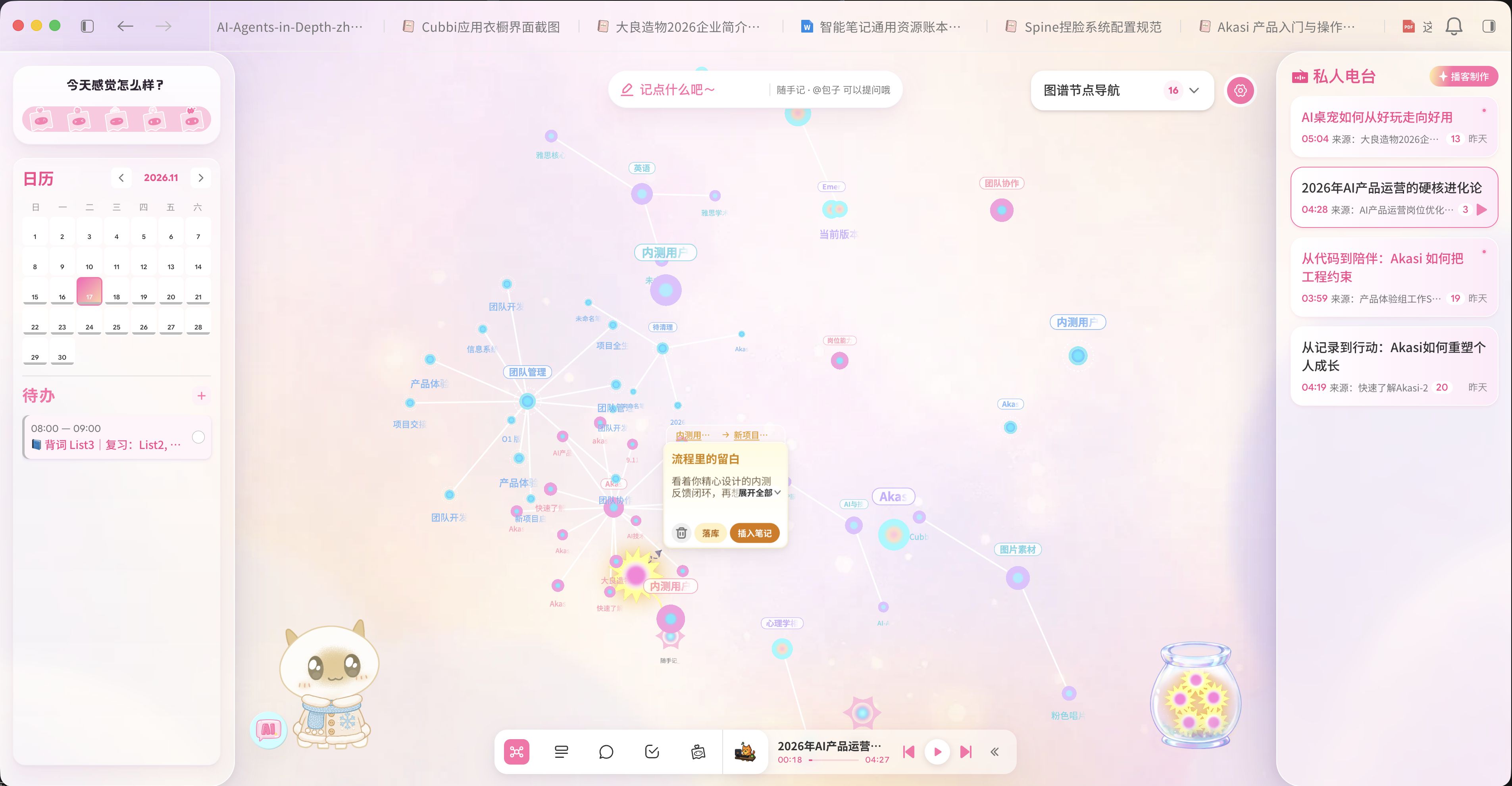
The main interface of Akasi, with the Inspiration Jar at the bottom right corner
For a period of time, Wang Jinpeng intensively studied world models. Based on the materials he browsed, Akasi sorted out directions for further exploration from seven dimensions including cognitive science and psychology. Wang Jinpeng said that the clues about predictive coding and free energy also provided inspiration for his subsequent research.
Compared with getting a complete article, he values these unwritten ideas more. "Nowadays, to get a really good idea, you need to spend a huge amount of time." he said.
At present, it is already very easy to make AI write an article or a piece of material, and the things before writing have become more challenging. What you have read before, which idea is worth following up, whether two seemingly unrelated materials can help you understand the same problem, and how personal accumulation participates in generation after the generation speed is accelerated, have all become problems that need to be re-processed.
Note-taking tools such as Obsidian allow users to add links to notes to form a knowledge network. Wang Jinpeng hopes that in Akasi, AI can take on more work of finding and organizing connections.
One internal test user also mentioned the problem of how to reuse content after accumulation. In the past, this user would copy content obtained from search and AI Q&A into documents and organize them manually, but the documents are rarely opened again after being created. When using Akasi, AI will automatically generate notes from discussion content, and the user will flip through the notes during work breaks to check the associations between ideas and knowledge points. From the perspective of this user, the generated notes not only save the answers, but also help him sort out his thoughts.
Talking about the goal Akasi expects to achieve at the current stage, Wang Jinpeng told 36Kr, "We hope people will think of our product once they think of inspirations, emergent knowledge and creativity."
02 A Knowledge Partner With Its Own Perspective
In the early internal test of Akasi, the appearance of students preparing for exams made part of the value of this tool concrete.
Preparing for postgraduate entrance exams does not necessarily require a lot of interdisciplinary associations, but requires long hours of reading, sorting and memorizing. Wang Jinpeng found that some invited test users are very fond of the desktop pet online co-use feature, which allows them to use the product together with friends, just like entering a small online study room.

The desktop pet online co-use feature of Akasi
In the demonstration, Wang Jinpeng opened the desktop pet diary and read out its observation of him: "Today my master dived headfirst into the logical labyrinth of Buddhism."
Akasi's desktop pet will respond to the recent concerns of users based on the content left by them. The materials users have read and the ideas they have noted down, apart from becoming nodes and connections in the knowledge graph, also become clues for this partner to understand the user.
In terms of desktop pet settings, Akasi provides different images and 16 optional personalities.
For a partner that accompanies people to read, personality is also reflected in where it focuses its attention. For example, as Wang Jinpeng cited, some personalities care more about why a person does things in this way, while some care more about what to do next. The team hopes that after a long period of interaction, users can recognize the way this partner views issues, and feel that the content they have read and discussed together in the past will influence the next communication.
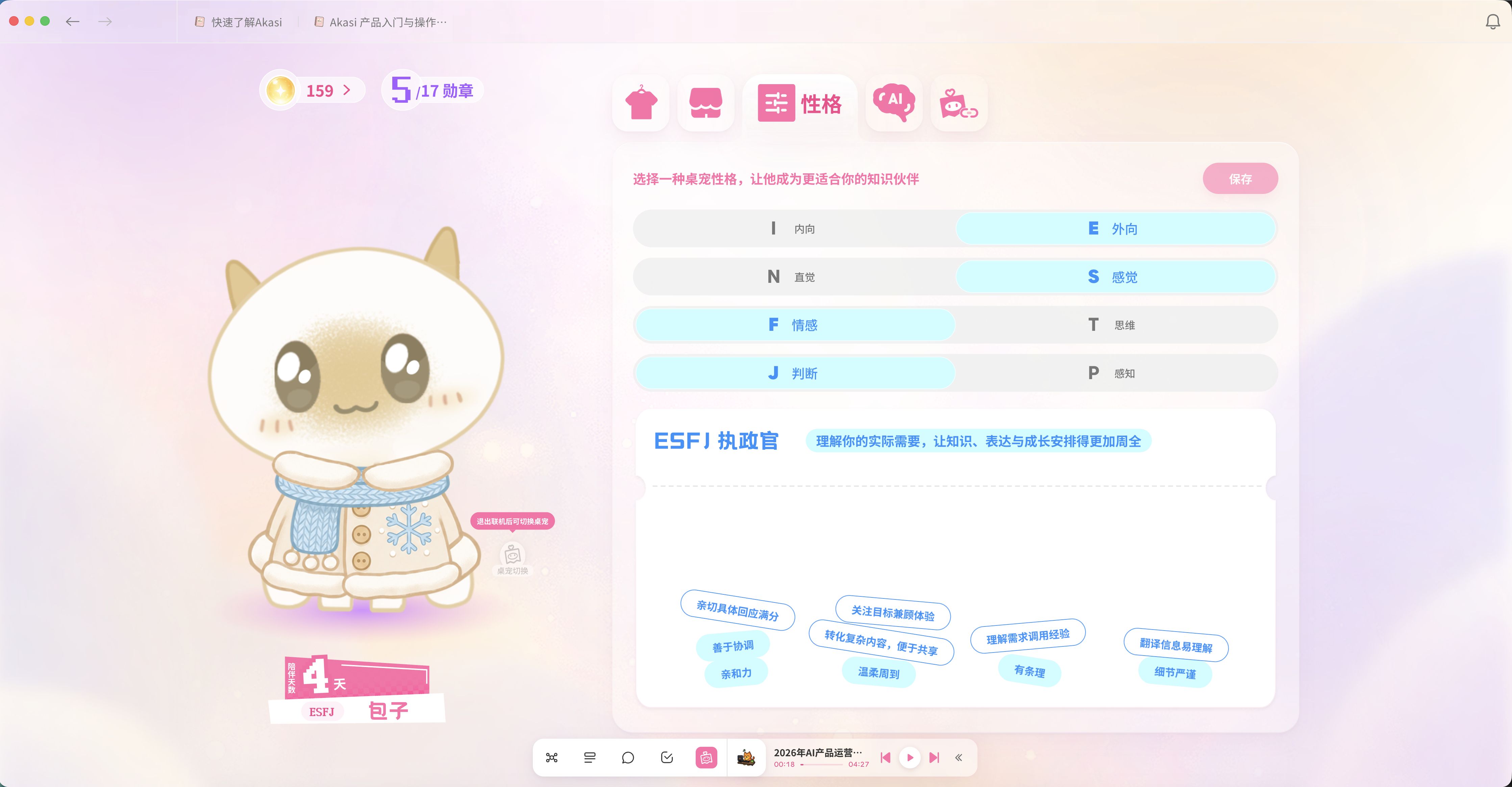
The personalities of Akasi's desktop pet
To provide personalized support that fits individual needs, users need to continuously leave materials and ideas. But every record requires effort, and users need to feel the value of these accumulations first before they are willing to keep using the product.
The desktop pet diary, online co-use and nurturing mechanisms are attempts made by Akasi around continuous use. Users can earn points that can be used for rewards such as costume changing by recording and thinking. The team hopes these daily feedbacks can make recording and learning easier to stick to; as accumulation increases, the connections between knowledge will bring more long-term returns.
In Akasi, users can import existing notes, documents and links, and also discuss with AI around the materials. Wang Jinpeng calls it "knowledge compound interest" — it takes time, and requires users to have some accumulation first, "It cannot immediately produce these outputs for you as soon as you start using it."
One internal test user who works as a program developer and has used multiple note-taking tools divides the value of Akasi into use value and emotional value: the knowledge graph and podcast have practical value, while the desktop pet brings emotional feedback. He likes the interaction mode of dragging files to the desktop pet for processing, and is particularly interested in the desktop pet online co-use feature. His memory of QQ Pet makes him expect this kind of companionship and interaction can continue in new products.
Bring Personality Research Into Products
How to make an AI have a stable and distinguishable personality, and also change because of interactions with humans? This is a specific problem that Emergi Lab, the AI Mind Lab under Qianzhen Digital, faces when studying interaction texture. One single discussion may only affect its current response. Which experiences are worth recording, and what kind of evidence is sufficient to make it adjust future judgments, need to be studied respectively.
In the early stage, the team developed JPAF, a personality adaptation framework based on Jungian psychological types, to study how different psychological types participate in judgment and adapt to situations; the subsequent Emergi-PersonaOS distinguishes relatively stable personality beliefs from current states, and sets evidence, review and version records for long-term changes. With the deepening of research on memory, emotion, relationship and personality evolution, the team has also organized relevant mechanisms into a mind system called "Emergi-MentalOS".
For Akasi, these studies provide mechanisms and methods for product design. The discussion perspectives brought by different personalities, the retrieval of historical materials, and the desktop pet's response to users' concerns are all experiences that the team hopes to continuously improve. Whether the methods proposed by the research are effective in real use still needs to be tested back in specific scenarios.
Self-developed products give this research a chance to continuously face users. How users organize materials, along which clues they expand discussions, and how they evaluate the feedback of the desktop pet, all help the team find new problems. The team hopes to bring these problems back to research, and then apply improvements to products, so as to form continuous feedback between technology accumulation and daily experience.
Wang Jinpeng himself has also become a user. He says he barely needs companion AI products, but now he uses Akasi to organize reading and research, and find clues worth following up. From his own knowledge graph to a note or a piece of discussion left by users daily, Akasi provides the team with specific scenarios to observe personal knowledge demands.
From the first product Wutuo to Akasi today, the user retention and continuous use performance of both products during the test period are far better than their respective similar products. The team found in surveys that users care about what uniqueness the AI that interacts with them has: it remembers previous communications and has its own opinions. The team believes that personalization has significantly improved the interaction texture of the product, which is exactly the reason why users are willing to come back again and again.
From the perspective of Qianzhen Digital, when the capabilities of AI get increasingly close, the texture of interaction will become the reason for users to choose and stick to a certain product. This will also be the real watershed for AI products in the future.