JD.com is set to burn cash in a new business segment once again.
JD released its Q3 financial report.
This time last year, it was still busy taking the leading position by distributing red envelopes to users ordering food delivery. This year, the number of red envelopes has decreased, but profits have rebounded.
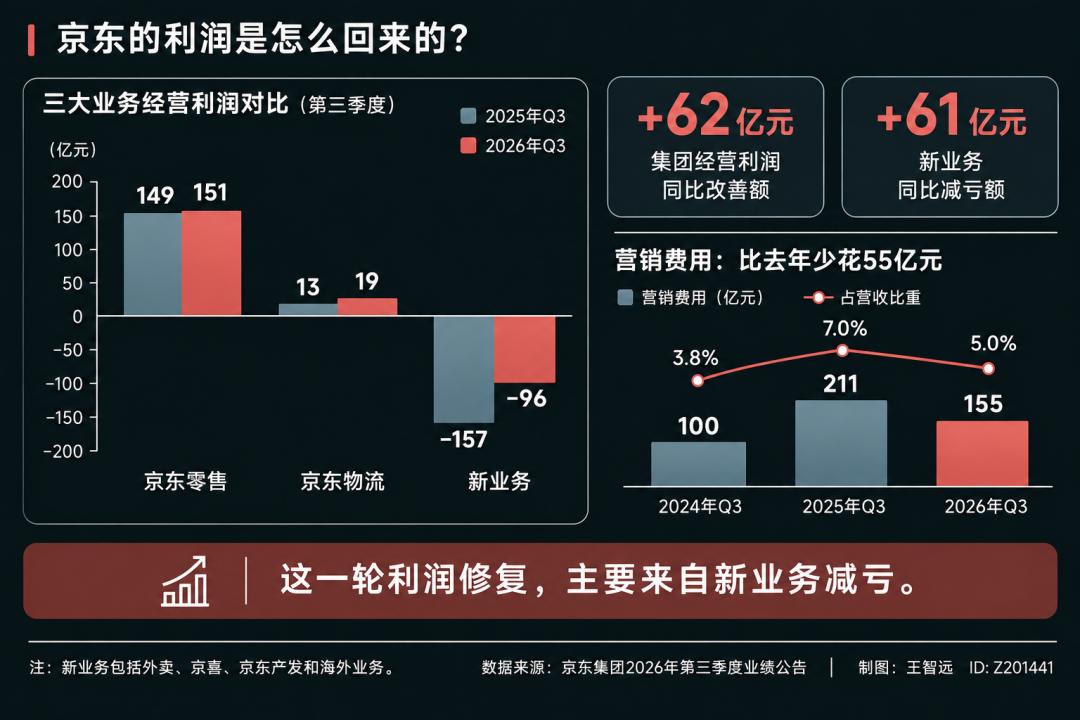
I went through the financial report. In the third quarter of this year, JD's operating profit reached 5.2 billion yuan. It was still in the loss in the same period last year, a year-on-year increase of 6.2 billion yuan, of which 6.1 billion yuan came from narrowed losses of new businesses. You can see that revenue only rose by 3.5%, but the profit changed so drastically.
The new businesses in JD's financial statements cover food delivery, Jingxi, JD Industrial Development and overseas operations. In the third quarter of last year, these businesses lost 15.7 billion yuan, while the loss narrowed to 9.6 billion yuan this year.
Well, that still sounds pretty staggering. There are roughly 90 days in a quarter, with an average daily loss of just over 100 million yuan, while last year the average daily loss hit 170 million yuan.
……
It becomes clearer when we put the operating profits of JD's three business segments side by side:
- The retail segment earned 15.1 billion yuan, up 1.6% year on year with little change
- The logistics segment earned 1.9 billion yuan, up nearly 50% year on year
- The new business segment lost 9.6 billion yuan, with 6.1 billion yuan less loss than last year
The logistics segment performed well: its revenue rose by 16%, and costs increased by a similar margin, but expenses only rose by 10%. After offsetting the changes, its operating margin rose from 2.3% to 3.0%, and its profit increased by nearly 50%.
The sum of profits of the three segments is 7.4 billion yuan, which is higher than the group's total 5.2 billion yuan. The extra 2 billion yuan or so refers to headquarters expenses, equity incentives and other items that are not allocated to individual segments.
One expense of the group dropped particularly significantly: marketing expenses fell from 21.1 billion yuan in the same period last year to 15.5 billion yuan, saving 5.5 billion yuan in just one quarter. JD explained in its financial report that it optimized the promotion expenditure for new businesses.
The coupons we usually receive, subsidies for user acquisition on the platform, as well as brand advertisements and channel promotions, are all related to this expense. When the food delivery war broke out last year, this item saw the most dramatic increase.
I pulled out the marketing expenses of the same period in the past three years:
- 2024: 10 billion yuan, accounting for 3.8% of revenue
- 2025: 21.1 billion yuan, accounting for 7% of revenue
- 2026: 15.5 billion yuan, accounting for 5% of revenue
Last year, users could get red envelopes almost everywhere when opening JD. Now there are fewer red envelopes, but the marketing expenses are still 55% higher than that before the food delivery war.
Interestingly, even with less spending, the number of users is still growing. JD's quarterly active users have maintained double-digit year-on-year growth for 12 consecutive quarters. More than one third of new users in this quarter come from Jingxi, which has also passed its peak investment period.
Food delivery and Jingxi help JD reach groups that barely shopped on JD before.
Now JD does not need to maintain the huge marketing expenditure as it did last year, while its user base is still growing. As for how many users who came for red envelopes have stayed and how much revenue new users can contribute, we need to wait and see.
The cost saving is also related to the external environment.
At the beginning of this year, regulatory authorities launched investigation and assessment on food delivery platforms, explicitly opposing excessive subsidies and price competition. All players are cooling down their investment, so JD also followed the trend to cut its spending.
Xu Ran said on the earnings call: The decline in marketing expenses benefits from "marketing efficiency optimization and disciplined investment in new businesses". At the height of the fierce competition last year, such remarks would not have been so easy to make.
However, the operating profit increased by 6.2 billion yuan, but why did the pre-tax profit only rise by 2.3 billion yuan? We need to look further down the income statement for the answer:
- Other net income dropped from 5.674 billion yuan to 2.306 billion yuan, down nearly 3.4 billion yuan
- The investment income recognized through equity method decreased by 570 million yuan
- Interest expenses saved 60 million yuan instead
The sum of the three items exactly explains the nearly 3.9 billion yuan gap. Other net income is a miscellaneous item in the financial report, and we need to refer to more detailed disclosures to find out which part of the income decreased.
At least, it is a separate account from the earnings of the retail, logistics and food delivery businesses we talked about earlier.
Looking further down, JD's net profit attributable to shareholders in this quarter was 6.5 billion yuan, 1.2 billion yuan more than the 5.3 billion yuan in the same period last year. Its original core business remains stable, and new businesses have also narrowed losses significantly. JD's profit has finally recovered.
However, marketing expenses decreased by 5.5 billion yuan, but is this sum really saved?
……
I also went through several other expenses in the financial report, and found that R&D, fulfillment and administrative expenses are all rising. Putting the four items together:
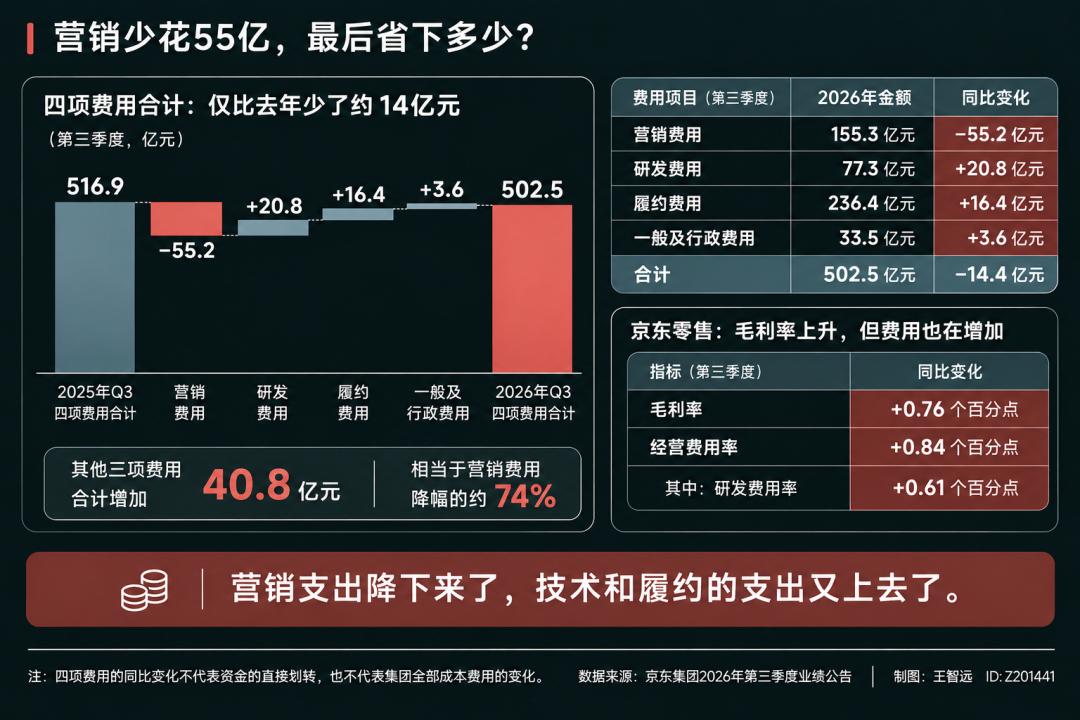
- Marketing: 15.53 billion yuan, 5.52 billion yuan less than last year
- R&D: 7.73 billion yuan, 2.08 billion yuan more than last year
- Fulfillment: 23.64 billion yuan, 1.64 billion yuan more than last year
- General and administrative expenses: 3.35 billion yuan, 360 million yuan more than last year
The sum of the four items reached 51.69 billion yuan last year and 50.25 billion yuan this year. After offsetting the changes, the actual total decrease is only over 1.4 billion yuan.
What are the extra 4.1 billion yuan spent on?
R&D funds are mainly invested in technology and talents; the increase in fulfillment expenses is related to the growth of order volume and warehouse & distribution investment for new businesses; the administrative part is mainly equity incentives.
Among these items, the R&D expenditure is worth more discussion.
As mentioned earlier, the profit of JD Retail did not rise much this quarter, but its gross margin stood above 20% for the first time, reaching 20.1%, 0.76 percentage points higher than the same period last year, and it has improved year on year for 18 consecutive quarters.
The gross profit of JD's product sales is improving, and the proportion of high-margin businesses such as advertising and commission is also rising.
Do not underestimate this 0.76 percentage point. Calculated based on the 258 billion yuan revenue this quarter, it is equivalent to an extra 2 billion yuan of gross profit. However, looking further down, the operating margin of the retail segment is only 5.8%, compared with 5.9% in the same period last year.
The gross margin has risen, but why did the operating margin drop?
In this quarter, the operating expense ratio of JD Retail was 0.84 percentage points higher than that of last year. The management said on the earnings call that R&D alone contributed 0.61 percentage points of the increase. In other words, the rise in R&D expense ratio alone offset 80% of the gross margin improvement.
From the group's perspective, R&D expenses increased by 36.9% year on year, and its proportion in revenue rose from 1.9% to 2.5%.
The management mentioned the application of AI in retail and logistics: how customer service responds to user inquiries, how purchasing and sales teams select products, and what products users can see when opening JD, all these links are being optimized.
Take the purchasing and sales business as an example:
JD operates self-run business, so it needs to judge by itself what products to purchase and how many to stock. If the stock is insufficient, there will be no goods available when users want to buy; if the stock is overstocked, unsold products may have to be sold at a discount after a period of time.
If AI can help the purchasing and sales team make more accurate forecasts, reduce the stock of unsold goods, it can also free up more working capital.
For a company with annual revenue exceeding one trillion yuan, there are countless small accounts like this in its daily operations.
Individually, the money saved in each link may not be huge, but when calculated across warehouses and orders nationwide, it is worthwhile to invest specially in optimization. As for how much benefit can be realized, it depends on the actual effect.
The retail segment is increasing R&D investment, and new businesses are also seeing some changes. Year on year, the loss narrowing is quite impressive, but when we look at the performance of the three quarters of this year as a whole, it tells a different story:
- Q1: loss of 10.352 billion yuan
- Q2: loss of 9.854 billion yuan
- Q3: loss of 9.642 billion yuan
From Q1 to Q2, the loss narrowed by nearly 500 million yuan; from Q2 to Q3, the loss only narrowed by just over 200 million yuan. The loss narrowing trend continues, but the pace has slowed down significantly.
The loss rate dropped quite rapidly, standing at 164.9%, 135.7% and 123.1% for the three quarters respectively.
The revenue of new businesses rose from 6.279 billion yuan in Q1 to 7.831 billion yuan in Q3. As the business expands and the total loss gradually decreases, the loss per 100 yuan of business naturally shrinks.
By the way, there is a financial reporting caliber issue here.
The revenue of new businesses decreased by 49.8% year on year, mainly because starting from Q1 this year, instant delivery revenue has been classified into the logistics business. Directly comparing the loss rate of this year with that of last year may lead to misjudgment.
Let's take a look at the specific businesses under new businesses:
The loss of food delivery business in this quarter has narrowed by more than half compared with the same period last year, and also decreased compared with the previous quarter; Jingxi has passed its peak investment period; Joybuy in Europe is still increasing investment. JD has not separately disclosed how much each business spent and how much it saved.
In the past year, JD's spending priorities have indeed changed. In the past, a large amount of money was used to acquire users and grab orders, and now R&D and overseas markets also require capital investment.
The accounts for the last round of investment have not been fully settled, and the next round of investment has already started.
……
So how much room does JD have for spending in the future? In the short term, JD's capital reserve is relatively sufficient, but there are also many areas that require capital expenditure in the future.
The free cash flow in this quarter was negative 23.861 billion yuan, with 12.6 billion yuan more outflow than the same period last year.
This number looks a bit staggering when viewed alone; but if we extend the time horizon, JD's free cash flow in the first three quarters of this year still reached 1.493 billion yuan, compared with negative 10.834 billion yuan in the same period last year; in other words, JD retained 12.3 billion yuan more in the first nine months of this year than in the same period last year.
Didn't we mention earlier that JD's profit has recovered? Then why is there still so much cash outflow?
For example: you run a store, you made profits from selling goods in September, but in order to prepare for the business in November, you spent a large sum of money to stock up at the end of the month.
The profit earned in September is still recorded in the income statement, but the cash available on hand has decreased. If you purchase more equipment, the cash may be even less.
The third quarter is the stocking season for e-commerce platforms, and goods for Double 11 need to be prepared in advance. By the end of September this year, JD's inventory reached 116.166 billion yuan, up 20% from the end of last year and 15% from the same period last year.
Looking at operating cash flow alone, the performance in the same period of the past three years is as follows:
- Q3 2024: net outflow of 6.2 billion yuan
- Q3 2025: net outflow of 8 billion yuan
- Q3 2026: net outflow of 18.7 billion yuan
In the first half of this year, JD's operating cash flow was still positive 38.3 billion yuan, and nearly half of it flowed out in the third quarter.
JD also had 5.5 billion yuan of capital expenditure in this quarter, more than double that of last year. Purchasing land, building warehouses and adding equipment are all real cash outlays.
Of course, cash also inflows from other sources. In this quarter, net cash inflow from investment activities was 4.8 billion yuan, and net cash inflow from financing activities was 5.3 billion yuan. After taking into account factors such as exchange rate fluctuations, JD's cash and related balances on account decreased by 9.6 billion yuan in net terms.
As for why the operating cash flow this year is so much less than in previous years, the announcement has not given a more detailed breakdown. The change in inventory alone cannot explain the whole picture.
By the end of September, JD's cash, restricted cash and short-term investments totaled 214.7 billion yuan, about 10 billion yuan less than at the end of last year.
Among them, short-term investments rose from 75.7 billion yuan to 121.9 billion yuan, an increase of 46.1 billion yuan, which means that part of the cash has been converted into wealth management products and has not been spent.
Part of this sum cannot be used at any time, but from this scale, JD's current capital reserve is still relatively sufficient.
The business environment in the future may not be so easy.
JD's revenue from selling electronic products and home appliances in this quarter reached 127.7 billion yuan, accounting for more than half of its total commodity revenue.
The management mentioned on the earnings call that the price of electronic products has risen, and the previous national subsidies have led some consumers to replace their mobile phones and buy home appliances in advance, so this business will be affected in the fourth quarter and next year.
It is easy to understand: people who have already replaced their refrigerators and washing machines with subsidies last year probably will