NVIDIA has just released what is likely the most important financial report for its medical business.
On the morning of November 18 Beijing time, NVIDIA released its latest quarterly report. This quarterly report has drawn tremendous attention due to widely known events.
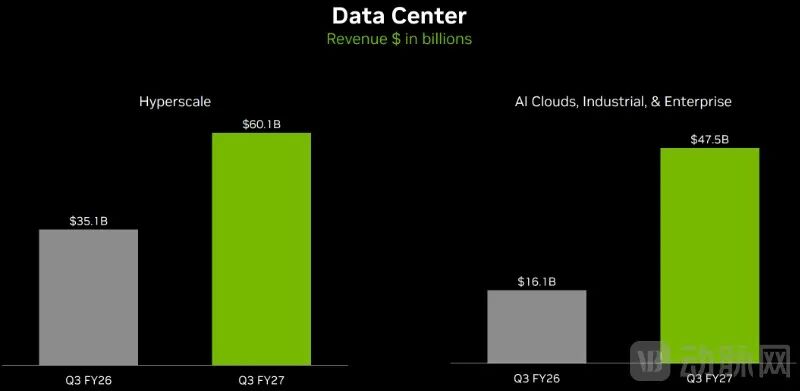
Purely from a numerical perspective, this is a successful quarterly report. Revenue in the single quarter reached 115.8 billion US dollars, up 103% year on year and 20% quarter on quarter; among which, data center revenue hit 107.6 billion US dollars, accounting for 92.9% of the total revenue. The management's guidance for the next quarter is 130 billion US dollars, representing a further 12% quarter-on-quarter increase. Meanwhile, the new-generation Vera Rubin platform started shipping this quarter, adding nearly 20 billion US dollars quarter on quarter, marking the fastest product ramp-up in NVIDIA's history.
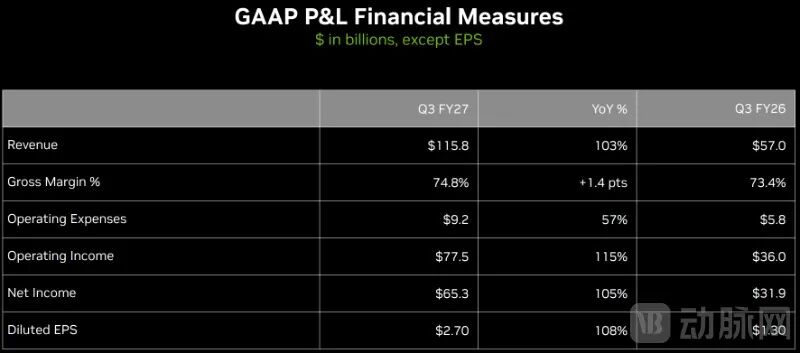
Most critically, the financial report has also reversed the recent downward trend of NVIDIA's stock price, which is expected to gradually recover.
Although there is no direct numerical reflection, there is no doubt that this quarterly report is also the most important quarterly report release for NVIDIA's healthcare business so far. At the recent several GTC conferences, the exposure and weight of the healthcare sector have been increasing. Whether this momentum will be diluted and weakened is also the focus of the industry's attention.
01. Current Status of NVIDIA's Healthcare Business and Investment
Looking only at the income statement, the healthcare business is barely noticeable. But the real development trend of healthcare is hidden in the company's four-tier structure.
The bottom layer is the computing power base. The data center contributes 92.9% of the revenue, with a gross margin of 74.9%. The supply chain is committed to expanding from 119 billion US dollars to 279 billion US dollars within one quarter, mainly focusing on storage and production capacity.
Pharmaceutical companies have voted with real money: Roche has deployed more than 3,500 Blackwell GPUs globally, covering multiple sites in the US and Europe, which is the largest publicly announced GPU deployment in the pharmaceutical industry. Moreover, it is not limited to pilots, and is turning AI into the core operational capability running through the whole chain of pharmaceutical R&D, diagnosis and manufacturing.
The middle layer is domain-specific software. BioNeMo (pharmaceutical R&D), MONAI (medical imaging), Parabricks (genomics) and Holoscan (surgical end) correspond to four segments respectively, and have been deeply embedded in the healthcare ecosystem.
At the GTC conference this March, NVIDIA launched Isaac for Healthcare, the first physical AI platform for medical robots. The platform includes the Open-H dataset with more than 700 hours of real surgical videos, Cosmos-H that can generate surgical simulation videos, GR00T-H that can understand surgical instructions, and Rheo, the digital twin blueprint for hospitals. At present, both CMR Surgical and Johnson & Johnson MedTech have adopted this platform.
At the GTC conference in October, this segment saw new developments. First, Siemens Healthineers announced a cooperation with NVIDIA to run the next-generation adaptive radiotherapy on NVIDIA's full stack; second, AI pharmaceutical company Lila Sciences also announced a laboratory agent that uses BioNeMo combined with CUDA-X to connect target identification to laboratory operation into a streamlined pipeline.
In the latest quarterly report, NVIDIA also announced the launch of Nemotron for Science, to cooperate with global healthcare and life science organizations to advance protein design, accelerate drug discovery and expand precision patient care.
More notably, with the expansion of AI capabilities, domain-specific software is no longer just a model library, but is evolving into agents that can independently work in laboratories.
The upper layer is data and autonomous laboratories, with Thermo Fisher, IQVIA and Mayo Clinic all being partners at this layer. Meanwhile, open data assets are also located at this layer.
NVIDIA has cooperated with Google DeepMind and EMBL to add 1.7 million high-confidence protein complex structures to the AlphaFold database, and led the mapping of the trillion-gene atlas with Basecamp Research, which is 10 times faster through Parabricks, completing more than 20 years of analysis within two years; Tahoe has expanded the single-cell dataset to 100 million cells.
The top layer is ecological certification. The number of CUDA developers has increased from 3 million in 2021 to 11 million, and the number of GPU-accelerated applications has risen from 9,000 to 50,000. According to the company's official statement, as of 2025, there are more than 650 healthcare-related models and over 250 datasets released on GTC. As more and more medical AI companies build their models on it, CUDA has become the default environment for medical AI.
This penetration depth is well-documented. Nearly 90% of eligible lead compound projects under Roche's Genentech have integrated AI, which has helped speed up the design of an oncology degrader molecule by 25%, and compressed the delivery time of candidate alternative molecules from more than two years to seven months. On the digital health side, Heidi Health uses Nemotron to process clinical documents, reducing latency by 75% and operating expenses by 64%; Hippocratic AI and OpenEvidence are not only included in NVentures' portfolio, but also run on Nemotron, realizing dual binding of investment and ecology.
In the financial report, healthcare is listed among six scenarios: automotive, healthcare, manufacturing, smart spaces, telecommunications and robotics; Roche and Eli Lilly also appear in the list of pharmaceutical customers of AI factories; at the same time, there are healthcare targets in the investment portfolio.
This shows that healthcare is not a revenue item for NVIDIA, but an ecological item for it.
The investment portfolio is particularly worth mentioning. In the financial report, the valuation narratives of well-known names such as Recursion, Hippocratic AI and OpenEvidence are all branded with the NVIDIA ecosystem logo.
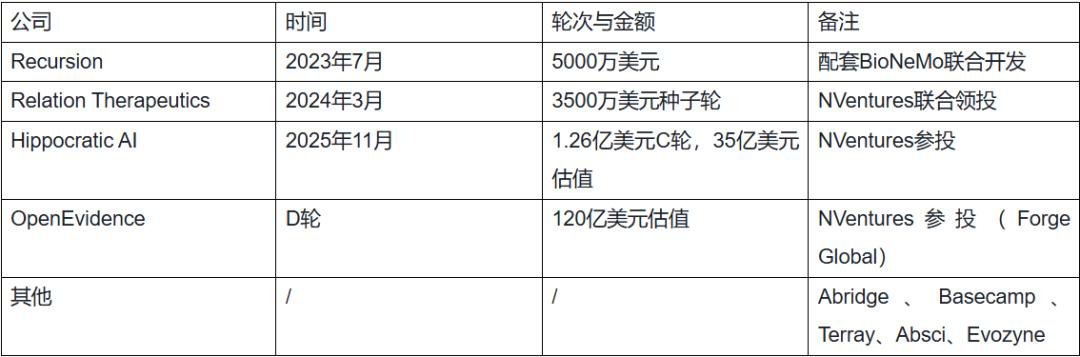
Representative projects in NVIDIA's healthcare investment portfolio (data from NVIDIA's financial reports and announcements, official announcements of previous rounds, Forge Global)
This profound layout has also built a high barrier for NVIDIA's healthcare business, but it is far from the time to sit back and relax, and testers at the edge of the barrier are also eyeing covetously.
02. NVIDIA's Old Rivals Are Also Making Efforts in the Healthcare Circle
Frankly speaking, the 11 million developers and 50,000 applications, the software assets accumulated over more than 30 years, cannot be surpassed by competitors in a short period of time. However, it is an indisputable fact that the healthcare semiconductor track continues to gain popularity. According to Global Market Insights' calculation, the global healthcare semiconductor market will be about 66.5 billion US dollars in 2026, and will exceed 160 billion US dollars in 2035. This has also attracted NVIDIA's old rivals to make moves in the healthcare sector.
At the data center layer, AMD invited the AI pharmaceutical company MindWalk to the main stage at the Advancing AI 2026 conference in July, and publicly demonstrated for the first time that its AI drug discovery platform ReefIQ runs on AMD Instinct GPUs and EPYC CPUs. According to official information, the discovery cycle can be shortened from several months to several hours.
Combined with the open-source ROCm, AMD provides an opportunity for ecosystems that do not want to be tied to CUDA. Although the migration cost from CUDA is relatively high, AMD has actually proved in many previous competitions that it has the ability to reduce such migration costs.
At the clinical site layer, Intel targets edge AI at clinics and operating rooms. This March, it cooperated with medical-grade hardware provider MedYoung Technology to promote AI platforms to emergency treatment, mobile care and smart wards.
At the device and wearable layer, Qualcomm took the lead in establishing the Personal AI Health Alliance at the Snapdragon Summit in September. More than 30 institutions including Optum, Scripps and Merck KGaA joined, with the goal of shifting healthcare from "ex-post recording" to "ex-ante warning", and hoping to keep health data on the local computing power of portable devices. Official cases confirm that open-source models with 120 billion parameters can be compressed to 20 billion, and AI laptops can run offline on a single device.
In China, the situation is more straightforward. Due to policy restrictions, NVIDIA's data center revenue in China has dropped sharply. Domestic players are re-evaluating suppliers against the backdrop of information technology application innovation, and the localization budget for hospital information systems is gradually tilting towards domestic computing power.
Interestingly, at the previous Computex 2026, medical IT vendor MedYoung Technology appeared on stage as an ecological medical partner of NVIDIA, Intel and Qualcomm at the same time. This also shows that more and more medical IT enterprises are considering multi-supplier strategies to reduce dependence on a single supplier.
However, compared with NVIDIA's penetration in the entire medical AI ecosystem, although every step of expansion by followers is real, it can only play a complementary role in the short term.
AMD complements a demonstration of pharmaceutical computing power, Intel complements a corner of the clinical edge, and Qualcomm complements a scenario of wearables. In the short term, no one can replace the NVIDIA ecosystem. What they have to face is a sophisticated machine that integrates computing power, software, data and capital operation.
03. Followers Have No Say for the Time Being
Since its registration and establishment in 1993, NVIDIA has gone through many ups and downs. Finally, it took 33 years to turn a graphics card into the default terminal for pharmaceutical companies and medical AI, deeply embedded in the medical ecosystem, with full-chain engagement from models, data to capital. This quarterly report once again confirms the same fact. Although healthcare does not exist in its financial statements on paper, it is ubiquitous in its overall layout.
Any competitor, without the courage to go all-in, will probably find it difficult to shake its competitive advantage in the short term.
This article is from the WeChat official account Arterial Network (ID: vcbeat), written by Chen Peng, and authorized for release by 36Kr.