Some of the first batch of humanoid robots that joined the workforce have already lost their jobs.
Are humanoid robots born to be destined for nonstop work?

Even humanoid robots can get fired from their jobs.
Not long ago, during a trial live stream of Agibot robots working at a convenience store, 2 out of 6 participating robot "candidates" were eliminated. Audiences who expected a happy ending witnessed a "bad ending" moment right in front of their eyes.
On the other hand, embodied intelligence manufacturers including Galaxy Universal and Unitree Robotics are also sending their products to work in convenience stores, replacing human store clerks to perform daily store tasks.
Embodied intelligence manufacturers are lining up to deploy their robots to work in convenience stores, as this scenario features moderate technical difficulty, appropriate data collection conditions, and considerable traffic and publicity effects.
Beyond convenience stores, Agibot, which proposed the Worken theory, has also deployed its robots to scenarios such as factories and amusement parks, and has achieved performance growth driven by this work-oriented concept.
Perhaps for clients like convenience stores and factories, humanoid robots are not only expected to satisfy people's curiosity, but also to complete specific practical tasks. If such basic requirements cannot be met, not only the robots themselves may be eliminated, but also the embodied intelligence manufacturers behind them.
Will robots also lose their jobs?
Recently, Agibot hosted a 24-hour live stream, deploying 6 of its G2 Elf robots to work at a convenience store, to test whether they are qualified for the store's daily operations.
Generally, when manufacturers launch live streams showing their robots at work, the goal is to demonstrate their technical strength, and the story usually ends with a happy ending: the robots successfully show off their capabilities, the audience is amazed, and the manufacturer's popularity is boosted.
However, during this trial, the 6 Agibot robots not only made multiple work mistakes, but 2 of them were even directly eliminated by the convenience store after the probation period.
The reason why these two robots were eliminated from their convenience store jobs is that they could hardly handle the in-store work requirements.
But all 6 robots are from Agibot, so why did some pass the probation while others were directly rejected?
This is not caused by uneven product quality control of Agibot's robots, but because they were assigned to different positions, and robots in certain positions are more prone to errors than their counterparts in other posts.
Among them, the robot named "Juanwang" was responsible for patrol and restocking. But when there were gaps on the shelves, it would not take the initiative to fill the gaps on the shelves like a real human clerk, and would only start working after receiving explicit instructions.
"Juanwang" lacked initiative and failed the probation assessment. Some other robots showed full enthusiasm, but their capabilities were not enough for the work.
In the convenience store, the cleaning post robot named "Lengjie" made three mistakes in one day: it mistook the wood grain on the table for coffee stains and wiped the table repeatedly; after the trash can was full, it left the convenience store on its own to look for another trash can; it also almost misjudged the food placed on the counter by customers as garbage and threw it away.
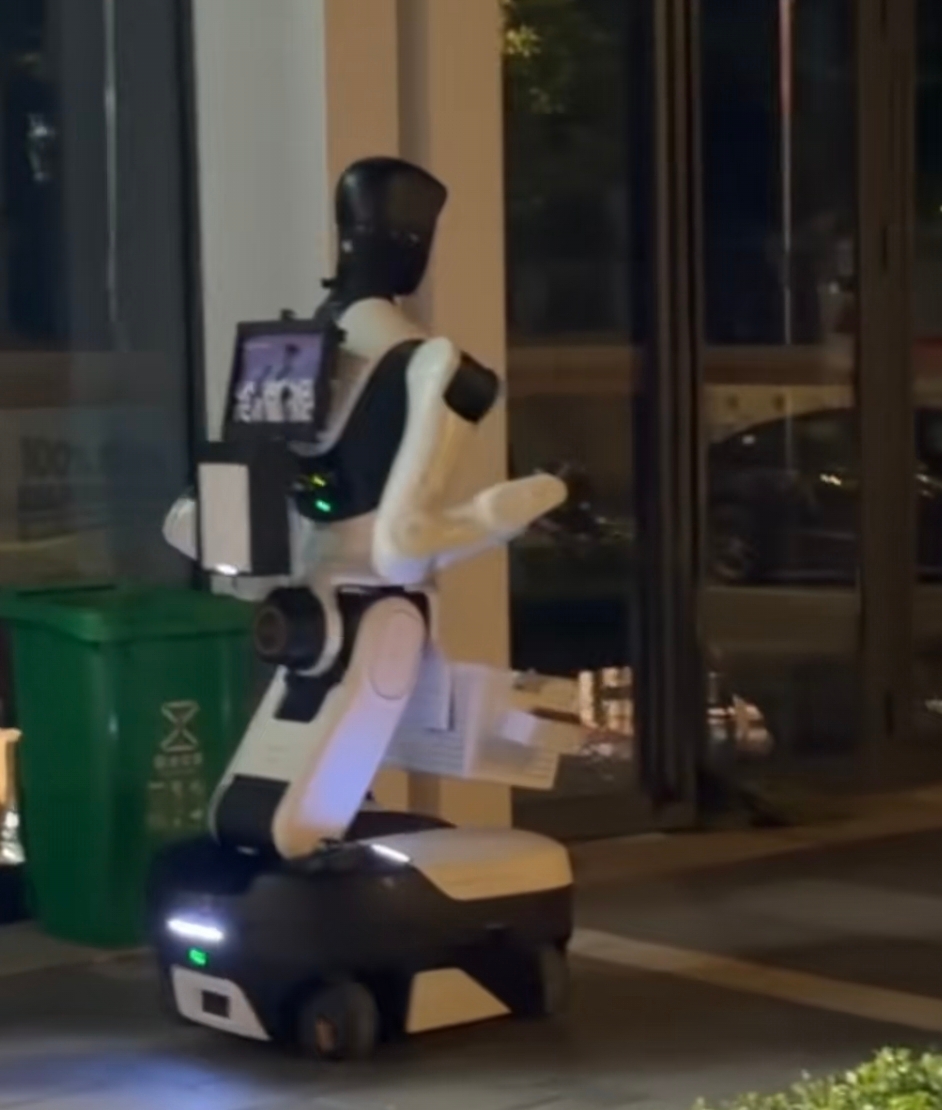
Since "Juanwang" and "Lengjie" failed the probation, did the other robots perform perfectly? Of course not, but their problems were relatively minor.
For example, "Dingjiang", which was responsible for hot food preparation and cashier work, broke the bun skin when picking up steamed buns, and dropped a corn on the ground when handling it. The barista robot "Kashao" failed to write back the order status correctly during the peak dining hours.
Among the 6 Agibot robots, the greeter robot "Ahao" seemed to perform the best, and the pick & pack robot "Huobao" ranked second.
Why choose convenience stores as the test scenario?
The 24-hour live stream of Agibot exposed many problems of humanoid robots. At the same time, many other manufacturers in the industry are also sending their products to work in convenience stores for practical training.
For example, the Galbot G1 robot from Galaxy Universal has started working at a FamilyMart convenience store in Zhongguancun, Beijing, taking charge of greeting customers, guiding customers to find items, picking up cooked food, and processing checkout payments all on its own.
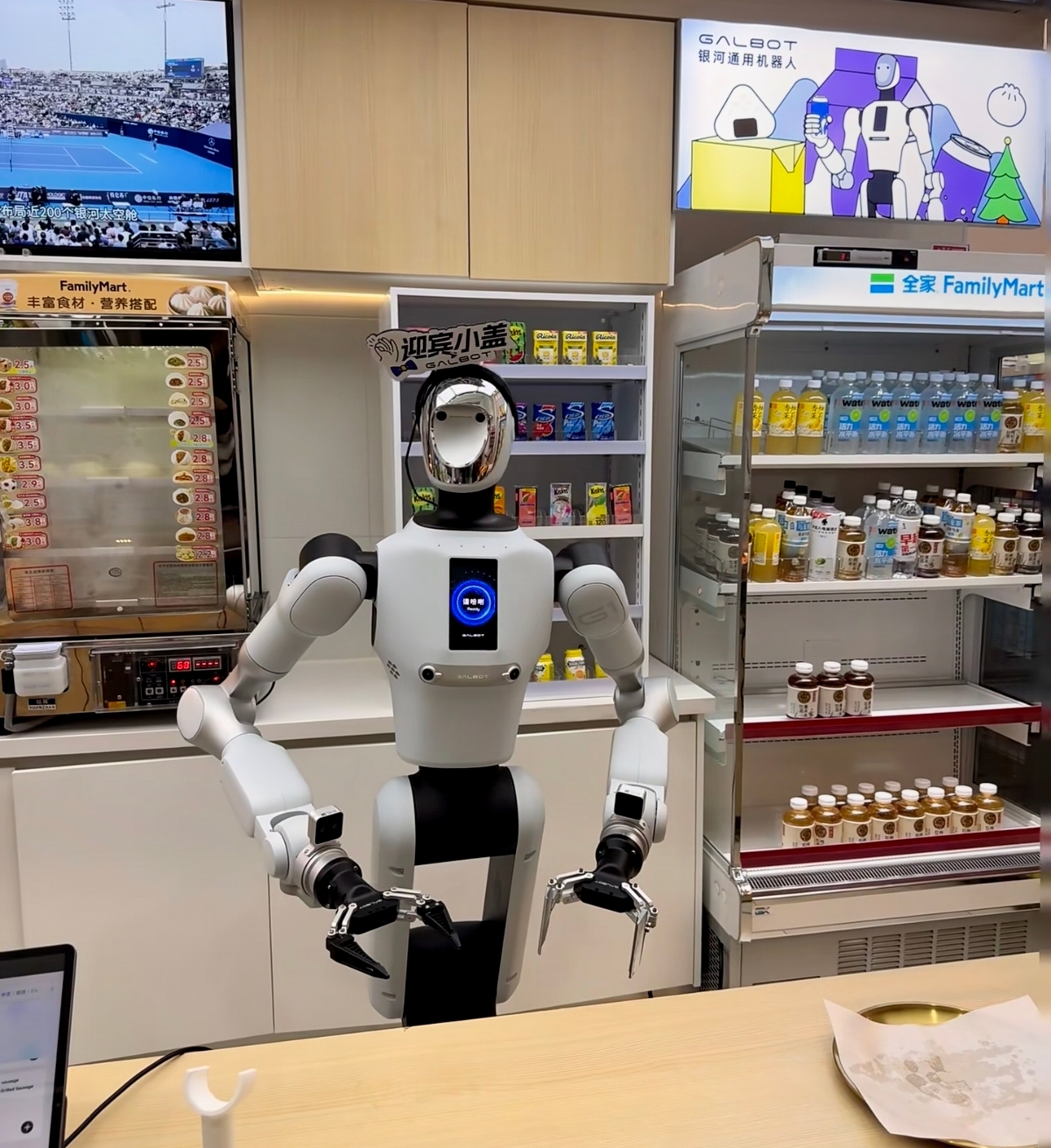
At the same time, Galaxy Universal has also combined its robots with unmanned vending space capsules to launch the Galaxy Space Capsule, which has now landed at more than 200 sites in over 50 cities across China.
On the other hand, Unitree's humanoid robots have been deployed overseas where labor costs are higher. The Unitree G1 humanoid robot works at supermarkets under Danish retail giant Salling Group, responsible for restocking the shelves at night.
Will humanoid robots working in convenience stores pose a threat to real human employees? For now, the impact seems to be quite limited.
The most fundamental reason is that the work efficiency of robots deployed in convenience stores is generally very low.
Take the FamilyMart convenience store in Zhongguancun, Beijing as an example. A netizen wanted to eat a corn after working overtime at night, but it took the Galaxy Universal Galbot G1 a full minute to get the corn, almost making the customer faint from hunger in front of the counter.
In addition, from a cost perspective, the operating cost of a robot is higher than the salary of a human clerk, which also restricts their employment prospects.
Pan Ge found on a recruitment platform that the minimum monthly salary of a FamilyMart convenience store employee in Beijing is 4500 yuan. The basic version of Galaxy Universal's Galbot G1 is priced at 699,000 yuan per unit, which is 155 times the minimum monthly salary of a human clerk.
Since deploying robots to work is not cost-effective, why do all embodied intelligence manufacturers still prefer to send their robots to work in convenience stores? There seem to be three main reasons:
First, from the perspective of technical implementation, ordinary household scenarios are very diverse and have higher requirements for robot capabilities. Factory work tasks are relatively single, and the difficulty level is slightly lower than needed for full capability verification.
At this point, the work difficulty of convenience stores falls in between the two. The scenario that combines semi-standardized and unstructured tasks can effectively verify the comprehensive capabilities of robots.
Second, from the perspective of data scenarios, robots working in convenience stores will frequently encounter various unplanned situations. These real-world data from daily life can help robots iterate and upgrade rapidly.
At the same time, tasks such as handling and packaging in convenience stores are single-scenario repetitive labor, which falls exactly in the comfort zone of robots.
Finally, from the perspective of traffic and communication, these convenience stores located in urban areas can reach a wide range of consumer groups. Robots working in these high-traffic stores not only help convenience stores attract customers, but also serve as free advertising for embodied intelligence manufacturers.
What is Worken?
It can be seen that deploying robots to work in convenience stores, in addition to the needs of technical testing and publicity, also has a core ultimate goal: to make robots better adapt to various scenarios and requirements when performing practical work.
Not long ago, at the Agibot Innovation Day, Peng Zhihui, known as "Zhihui Jun" and CTO of Agibot, created a new term for this concept: Worken.
He stated: "Token measures how much a machine thinks, while Worken measures how much a robot acts." The specific formula is: Worken = Number of active robots * Autonomous working hours * Output efficiency ratio.
As the proposer of the Worken concept, Agibot is indeed letting its products try out a wide range of different work scenarios.
For example, in June 2026, 8 Agibot Elf G2 robots started working at an electronics factory in Nanchang, Jiangxi, becoming workers on the assembly line.
During 6 consecutive days of work, the 8 robots completed 64,828 operations in total with a success rate of 99.97%, basically meeting the production requirements of the factory.
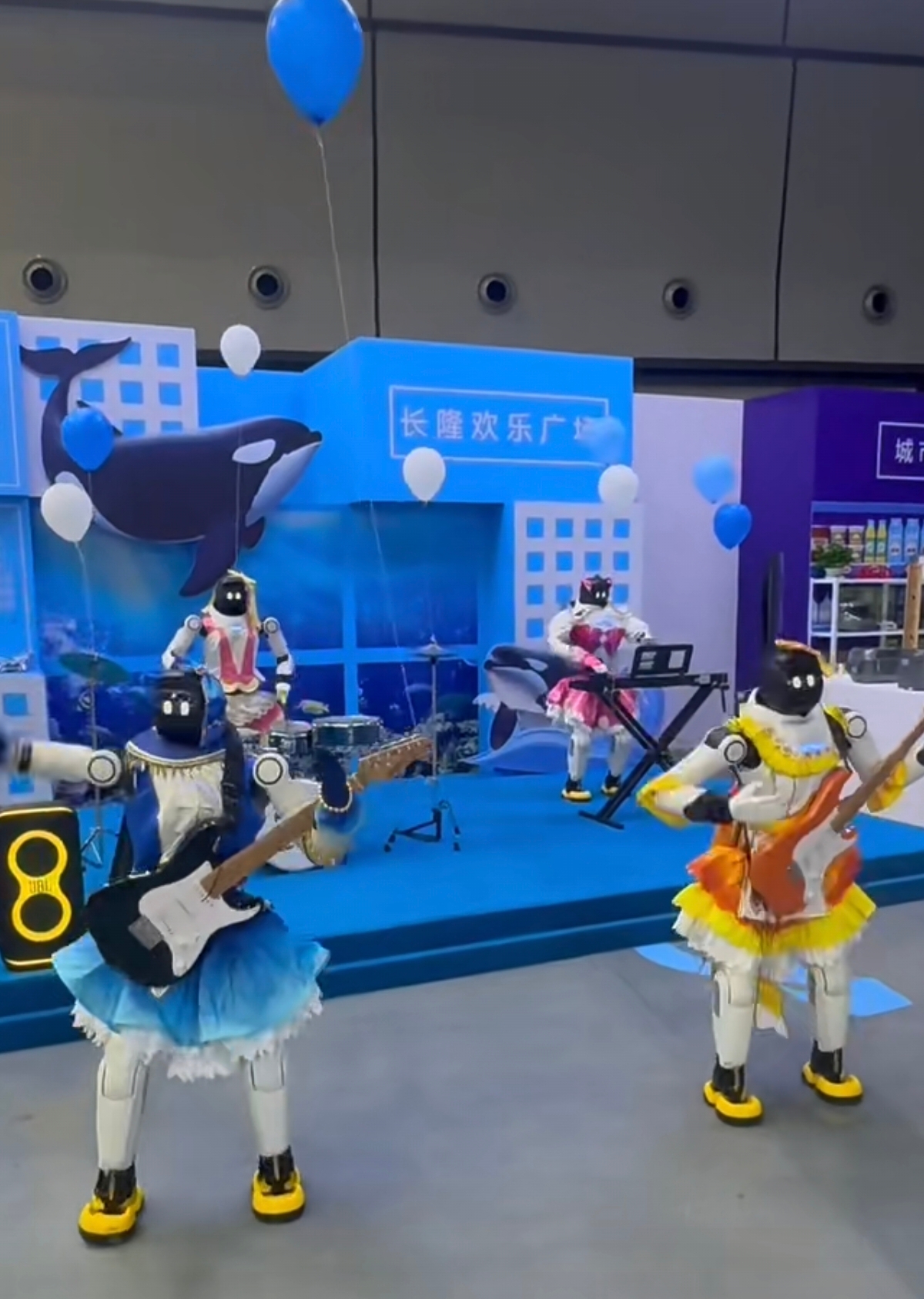
In September 2026, Agibot deployed more than 300 robots to Chimelong Paradise in Zhuhai, distributed at over 100 sites across the park.
These robots are mainly responsible for interacting with tourists, playing chess, finger-guessing games, ball games... or providing park tour guidance and explanation services.
Agibot, which is keen to let its robots perform practical work, has indeed boosted its sales driven by this strategy. In the first half of 2026, Agibot shipped 9700 robots, accounting for 43% of the global market share, and its 20,000th unit rolled off the production line in September 2026.
Peng Zhihui, founder and CTO of Agibot, said that Agibot's revenue in the first half of 2026 was nearly 2 billion yuan, exceeding the 1.152 billion yuan of Unitree Robotics and 1.269 billion yuan of UBTECH in the same period.
Of course, Agibot is not the only manufacturer with outstanding performance. IDC data shows that in the first half of 2026, global humanoid robot shipments approached 25,000 units, a year-on-year increase of about 432%; the market size exceeded 740 million US dollars, a year-on-year increase of about 323%.
Among them, China's humanoid robot shipments exceeded 19,000 units, a year-on-year increase of about 426%, accounting for 77.9% of the total global shipments.
Although the humanoid robot market continues to expand, the labor participation rate of these robots in practical work seems to be not high.
Data from Counter Point Research shows that among the robots shipped in the first half of 2026, entertainment commercial performances, science education and data collection together account for more than 60% of robot use cases, shopping guide and tour guidance accounts for 19%, intelligent manufacturing accounts for 13%, and warehousing and logistics accounts for 5%.
It can be seen from the data that many clients purchase humanoid robots not to replace human work, but more out of a sense of novelty.
This not only puts some robots at risk of being fired shortly after starting work, but some are even abandoned by their owners and become objects for rental or resale.
At the same time, after communicating with multiple second-hand humanoid robot sellers, Pan Ge also learned that current humanoid robot products are mostly used for one-time tasks such as performances and exhibitions, and few of them stay on the job continuously.
It is clear that for all embodied intelligence manufacturers, the current challenge is not only to sell out their robots, but also to ensure that the robots have specific and continuous work to do at the buyer's side after delivery.
Otherwise, when the first batch of deployed humanoid robots are dismissed for various reasons, the embodied intelligence manufacturers as product suppliers will face huge pressure.
This article is from the WeChat Official Account "Zinc Consumption Research Center", author: Pan Ge, published with authorization from 36Kr.