Topping the incremental growth ranking! Is the first non-provincial capital city with a GDP exceeding 1 trillion yuan in central and western China set to emerge?
The GDP data of all regions in the first three quarters has been released, and the performance of non-provincial capital cities in the central and western regions has once again drawn widespread attention. Who will become the first non-provincial capital city with a GDP exceeding one trillion yuan in central and western China? The suspense is further intensified.
01
In the first three quarters, among the top 10 non-provincial capital cities in central and western China, a total of 9 cities have registered a total GDP exceeding 400 billion yuan.
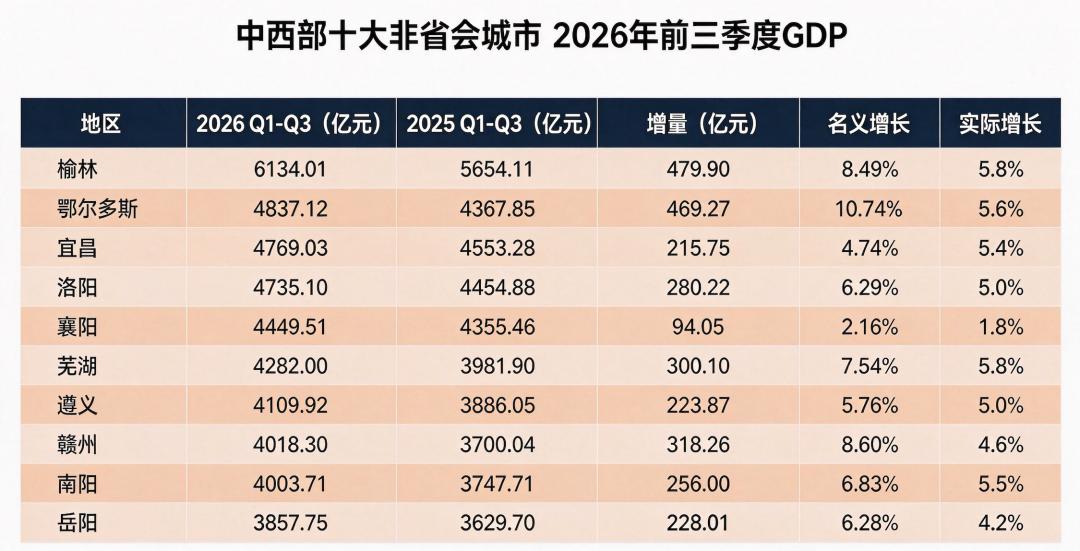
Among them, Yulin continues to maintain a leading edge far ahead of other cities, and it is also the only city in this tier whose GDP has exceeded 600 billion yuan. The next eight cities, namely Ordos, Yichang, Luoyang, Xiangyang, Wuhu, Zunyi, Ganzhou and Nanyang, all fall in the range of 400 billion yuan to 500 billion yuan.
Yueyang is the only one among the 10 cities whose GDP has not yet exceeded 400 billion yuan. Among these cities, Yulin, Ordos, Xiangyang and Yichang have all put forward the goal of breaking the one-trillion-yuan GDP mark during the 15th Five-Year Plan period.
However, at present, the development trend of these cities shows great divergence. Compared with the full-year ranking of last year, the positions of many cities have changed in the first three quarters. First, the nominal growth rate of Ordos exceeded 10%, overtaking Yichang and Luoyang to rise to the second place; second, Zunyi overtook Yueyang and Ganzhou to rise to the seventh place; third, Nanyang overtook Yueyang to rise to the ninth place; fourth, Yueyang dropped from the seventh place last year to the tenth place.
In terms of growth rate, the nominal growth rates of Ordos, Yulin and Ganzhou all exceeded 8%, while the nominal growth rates of Yichang and Xiangyang were less than 5%. In terms of actual growth rate, Xiangyang only recorded 1.8%, ranking last among the top 10 cities; the actual growth rates of Ganzhou and Yueyang were also lower than the national average level.
The main reason behind this is that the cycles and prosperity levels of leading industries in different regions vary from each other. For example, for Ordos, a resource-based city, its raw coal output in the first three quarters increased by 6.7% year on year. Coupled with the tight supply and demand of coal prices that pushed up the price, the coal industry saw both rising output and price, driving the added value of the mining industry to grow by 8.2%. The slowdown in Xiangyang's growth stems from the in-depth adjustment cycle that its traditional automobile industry is going through.
As another key industrial city, Yichang, known as the "Phosphorus Capital", is under pressure on the one hand because the phosphorus chemical industry has entered a downward cycle, and on the other hand due to its own industrial structure adjustment. Yueyang's performance is also dragged down by its pillar industries. In the first three quarters, the added value of industries above designated size increased by 3.0%, and the growth rate of the secondary industry was only 2.5%, which is rooted in the transformation pressure faced by the traditional chemical industry while no new supporting growth drivers have been found yet.
02
Also as a resource-based city, Yulin has got rid of the low nominal increment situation of last year, with its GDP exceeding 600 billion yuan for the first time in the first three quarters. Its actual growth rate ranks first among the top 10 cities, tied with Wuhu, 1.1 percentage points higher than the national average; its nominal growth rate reaches 8.49%, second only to Ordos and Ganzhou.
Therefore, in terms of total GDP, Yulin's status as the top non-provincial capital city in central and western China remains very stable. Notably, the GDP increment of Yulin in the first three quarters is close to 50 billion yuan, which not only ranks first among the top 10 cities, but is also far higher than that of Xi'an in Shaanxi Province, making it the champion of GDP increment in the whole province and contributing 35.6% of the province's total GDP increment.
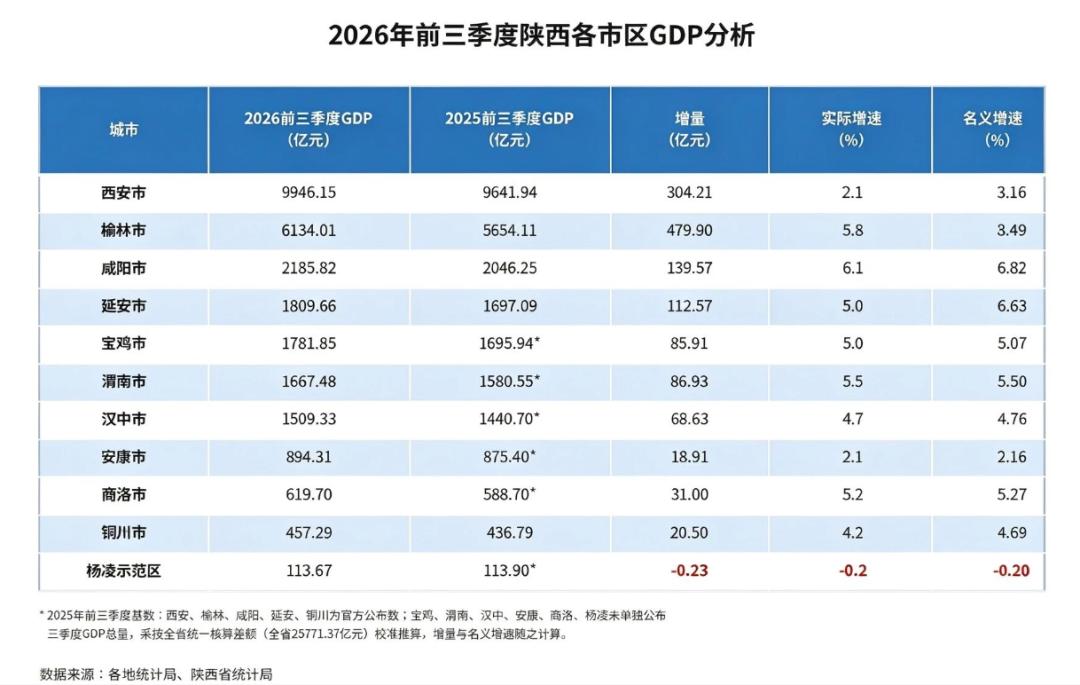
The outline of the 15th Five-Year Plan of Shaanxi Province clearly lists Xi'an and Yulin as the two major growth poles driving the province's development. It also requires Yulin, as a major economic city, to play a leading role, supports its construction as a sub-central city of the province, so as to better underpin the high-quality development of the whole province.
This year's government work report of Yulin also proposed to "deliver solid outcomes to build a key growth pole for the province's development". It is fair to say that judging from its performance in the first three quarters, Yulin has already demonstrated its potential as a growth pole.
Previously, Yulin has clearly set the goal of achieving "two trillions" in gross industrial output value and gross regional product by 2030. According to the current momentum, Yulin's full-year GDP this year is expected to exceed 800 billion yuan, bringing it one step closer to claiming the title of "the first non-provincial capital city with a trillion-yuan GDP in central and western China".
03
Nevertheless, the growth of resource-based cities is naturally accompanied by strong cyclical volatility.
For example, in 2025, Yulin's GDP increased by less than 5 billion yuan. The sharp rise in its increment this year is mainly driven by the recovery of the energy and chemical industry. In the first three quarters, the added value of the secondary industry of Yulin increased by 7%, which is the sector with the fastest growth among the three industries; the added value of industries above designated size also increased by 7.9% year on year.
Meanwhile, consumption and investment also delivered strong performance. The total retail sales of consumer goods increased by 4%, and fixed asset investment increased by 11.9%, both far higher than the provincial and national average levels.
Of course, a large part of this growth is attributed to industrial investment. For reference, in the first half of this year, the investment in industry, manufacturing and high-tech manufacturing of Yulin increased by 19.3%, 37.1% and 17.9% respectively.
In recent years, Yulin has been making great efforts to promote industrial transformation. At the beginning of this year, it put forward the requirement to focus on promoting the upgrading of the modern coal chemical industry.
The specific measures include: building 6 fine chemical industry chains covering downstream coal-to-olefin products, high-performance polyester, special chemicals and other fields, to promote the upgrading of the "energy - material - manufacturing" system. Accelerate the multi-energy integration of "coal, oil, gas, wind, solar, hydrogen and energy storage", and actively build a new type of energy system. Promote the whole-chain development of hydrogen energy covering production, storage, transmission and distribution; vigorously develop high-end equipment manufacturing industries such as intelligent mining equipment, special chemical equipment and new energy equipment.
To a large extent, whether Yulin can achieve the trillion-yuan GDP goal as scheduled and truly fulfill its responsibility as the second growth pole of Shaanxi Province depends on the progress of these industrial transformation and upgrading initiatives.
After all, for resource-based cities, only by cultivating new growth curves beyond resource-related industries can they reduce cyclical volatility and enhance endogenous development resilience.
04
At the same time, resource-based cities generally face the shortcoming of single factor agglomeration, which is also a weakness that Yulin must make up for in the process of industrial upgrading and urban level improvement.
In this regard, Yulin has made remarkable breakthroughs in recent years. For example, in February this year, Yulin College was officially renamed Yulin University, which is regarded as a landmark step taken by the local government to make up for the shortcomings in talent and innovation resources.
In addition, as it is clearly positioned as a provincial sub-central city, and one of the two major poles parallel to Xi'an, this upgrade of strategic status also means that Yulin is expected to obtain more substantial policy preferences in gathering development factors and resources.
Not long ago, the implementation opinions on promoting high-quality urban development issued by Shaanxi Province proposed: to build the provincial sub-central city of Yulin with high quality, further promote the construction of the energy revolution innovation demonstration zone, cultivate and expand new green and low-carbon growth drivers, promote the enhancement of urban functions, the upgrading of industrial level and the coordinated development of surrounding areas, and build it into an important growth pole for the high-quality economic development of the whole province.
It also specially mentioned that promote the complementary cooperation and mutual reinforcement between Xi'an's scientific and educational resources and Yulin's energy resources to achieve win-win development. This has opened up new space for Yulin to make up for its innovation shortcomings, accelerate industrial transformation and enhance the comprehensive level of the city.
To a certain extent, having and making great efforts to strengthen Yulin, a new growth pole with solid resource foundation outside Xi'an, is also an important comparative advantage of Shaanxi Province compared with other inland provinces. At least in the first three quarters of this year, when the growth rate of Xi'an was only 2.1%, the high growth rate of Yulin is extremely valuable for the contribution to the whole province.
If Yulin successfully breaks through the trillion-yuan GDP mark, Shaanxi will become the first province in central and western China that owns two trillion-yuan cities.
This article is from the WeChat official account "West City Talk", written by Xibu Jun, and published by 36Kr with authorization.