The board of directors refused to return, and Jensen Huang is about to fight a tough battle.
On the morning of November 17 Eastern Time, five hours before NVIDIA released its earnings report, Jensen Huang posted a long article signed "Jensen" on social media.
This is his first public statement since he resigned.
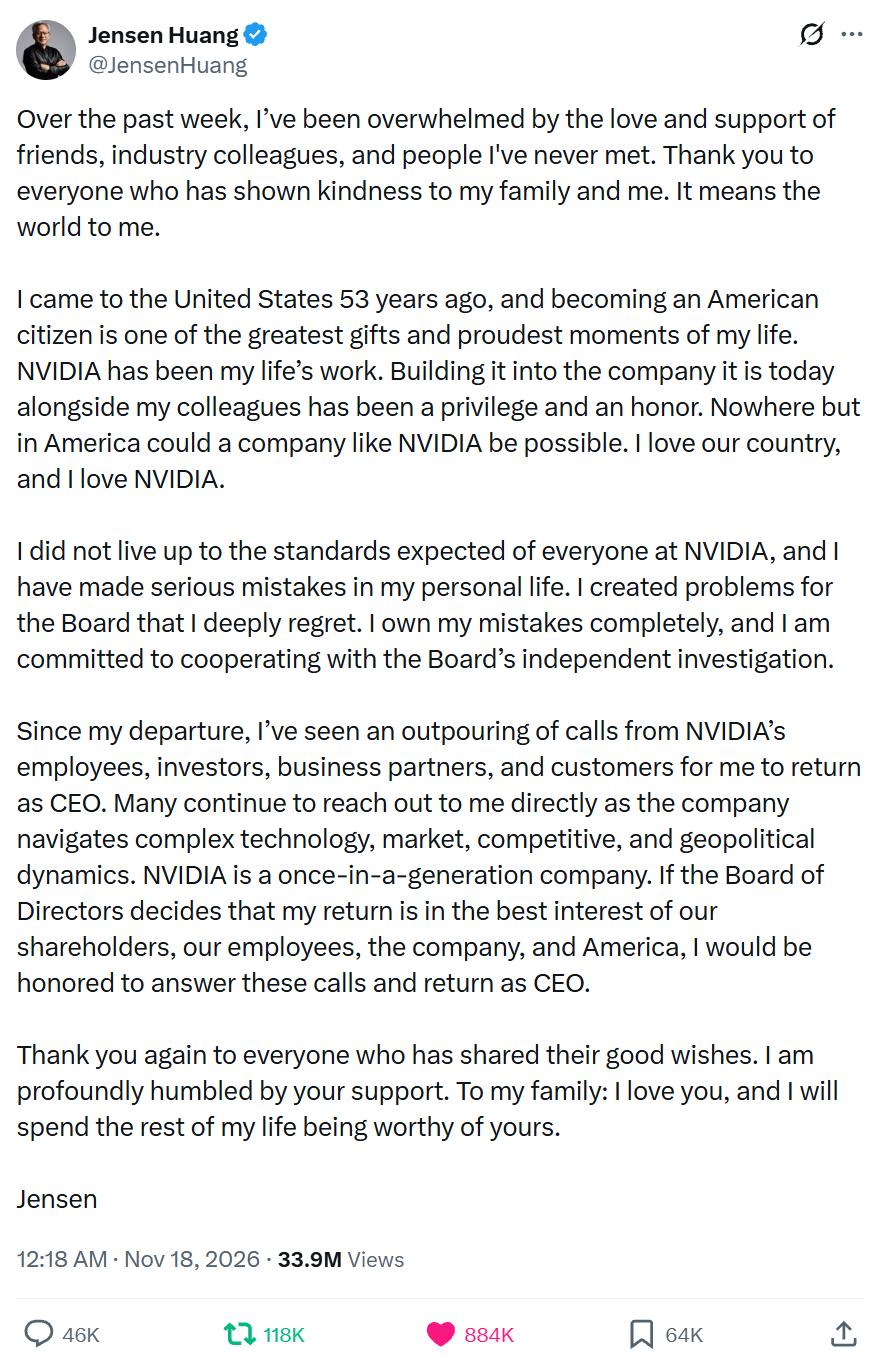
In the post, he first admitted his mistake: "I failed to meet the standards that NVIDIA sets for everyone, and I made a serious mistake in my personal life. I have caused trouble for the board of directors, and I deeply regret it." He said he will cooperate with the board's independent investigation.
Jensen Huang then went on to say: "Since I left, NVIDIA's employees, investors, business partners and customers have all called for me to return as CEO. Many people are still contacting me directly as the company navigates complex technological, market, competitive and geopolitical situations."
"If the board determines that my return is in the best interests of shareholders, employees, the company and the United States, I will be honored to respond to these calls and resume my position as CEO."
After the market closed that day, NVIDIA released its third-quarter earnings report.
Revenue for the third fiscal quarter reached $115.8 billion, up 103% year over year, exceeding Wall Street's expectation of $109 billion. Data center revenue was $107.6 billion, up 110% year over year. Net profit was $65.3 billion. The revenue guidance for the next quarter is $130 billion, which is also higher than the expected roughly $125 billion.
At the 5 p.m. conference call, the first person to speak was not interim CEO Colette Kress, but Harvey Jones, the first chairman of the board in NVIDIA's history.
He said the board unanimously accepted Jensen Huang's resignation, and "the NVIDIA board of directors does not intend to reinstate Jensen Huang as CEO", and no questions about the resignation and investigation will be answered during this conference call.
Can Jensen Huang still make a comeback?
A
Colette Kress's debut was flawless.
She said in the earnings report: "Our growth momentum all comes from real demand."
The new-generation platform Vera Rubin has started shipping, achieving the fastest product ramp-up in NVIDIA's history. During the conference call, she raised the revenue growth forecast for the next fiscal year from 70% to 75%, and said: "Our ambition will not change, our passion for innovation will not change, and our commitments to customers, partners and shareholders will not change."
NVIDIA's stock price rose by about 2% after hours, but it was almost as if there was no increase. According to statistics, since the historical high in October, NVIDIA has fallen by 35%, erasing about $2 trillion in market value.
By November 13, NVIDIA had fallen for six consecutive weeks, marking its longest weekly losing streak since 2012. Its market value was overtaken by Apple, closing below $4 trillion for the first time since July 2025.
The stock fell another 4% this Monday to close at $157, and before the earnings report was released on Tuesday, it closed lower for the fourth consecutive trading day.
To be fair, the decline was not entirely caused by Jensen Huang. Since October, rising interest rates have made the market worry about customers who buy chips on credit. Coupled with the mid-term elections in early November, many data centers based on NVIDIA GPU products have been put on hold. The combination of various factors led to NVIDIA's roughly 9% drop that week.
But in the week Jensen Huang resigned, it fell by 13%, the largest single-week drop since April 2025.
After NVIDIA releases its quarterly earnings report, it always attaches a "Management Commentary". This quarter's Management Commentary states that total commitments of various categories add up to $5180 billion. The largest part is supply and capacity commitments, which increased from $2790 billion a quarter ago to $3900 billion, mainly used to lock in memory purchases in the next few years.
However, NVIDIA's cash, cash equivalents and marketable securities on its books only total $535 billion, and the scale of commitments is nearly 10 times the cash on hand.
There are two other items in the commentary: one is agreements with new cloud vendors (neocloud) for up to $320 billion, and the other is guarantees with a maximum exposure of $1180 billion.
$1050 billion of that is tied to one project: SB Energy, a subsidiary of SoftBank, has a data center campus in Ohio with 9 buildings and a capacity of about 4.25 GW, leased to OpenAI under a 20-year lease, with only NVIDIA equipment deployed inside.
If the campus is expanded further, NVIDIA also has the option to provide credit support for another approximately 3.8 GW. At the same time, the commentary mentions that up to now, NVIDIA has not paid a single cent for these guarantees.
NVIDIA's practice of the seller providing capital and credit to help buyers purchase NVIDIA's own products is known externally as "circular financing".
Circular financing has often been criticized by Wall Street, but the commentary clearly expands the scale of circular financing.
Colette Kress explained it this way: Demand from new cloud vendors and cutting-edge labs is extremely strong, "but many of these companies are growing faster than their balance sheets and long-term credit profiles can support."
The circular financing initiative was launched by Jensen Huang. Judging from NVIDIA's strategic framework for the third quarter, Colette Kress has inherited Jensen Huang's will and is prepared to continue to expand and strengthen circular financing.
But Colette Kress's execution style is clearly deviating from Jensen Huang's unconditionally aggressive approach. Jensen Huang once said: "The only regret is not investing more and earlier", while Colette Kress emphasizes "discipline and selectivity", and has tightened the conditions for guarantees to "after the infrastructure is truly ready", making it clear that NVIDIA will not pay for early site selection and civil construction.
B
On the day Jensen Huang just left, Dylan Patel, founder of SemiAnalysis, said in an interview that Jensen Huang foresaw the demand, personally visited executives of various companies in the supply chain, even small component companies with annual revenues of only hundreds of millions of dollars, and persuaded them to sell their production capacity to NVIDIA.
"Now that Jensen Huang is gone, these companies are looking around the market and finding that Google is seeking capacity across the entire supply chain," Patel said.
On November 14, Elon Musk pushed back against Patel on social media: "Jensen Huang ran NVIDIA's supply chain extremely well, but many of those deals were handshake deals with him personally, no written contracts. Without Jensen Huang, some key deals will be lost."
Elon Musk then cited his own experience: "As long as Jensen Huang gave me a commitment on computing power delivery, or I asked him to advance certain components, he always delivered. Of course, we will issue a purchase order afterwards, but I never doubted for even a second that it would get done."
In August this year, Jensen Huang announced the establishment of a $5000 billion AI financing platform, with partners including Apollo, BlackRock, Blackstone, Brookfield, Goldman Sachs and KKR.
According to Jensen Huang's statement at the time, this platform was precisely designed to respond to doubts about circular financing: by introducing independent institutional capital, NVIDIA's own guarantee ratio will not exceed 25% at most.
However, not a single deal has been closed so far, and even some people inside these institutions do not know that they have joined Jensen Huang's financing platform. In addition, foreign media reported that at least one of the six partners is now discussing exiting.
The global head of private capital consulting at investment bank Raymond James said: "It was Jensen Huang who brought these institutions to the table with his vision."
Wall Street found that the credit of these customers cannot support such a large plate at all, so they required NVIDIA to take on a larger proportion of risks before they were willing to lend. After all, this whole setup was built on Jensen Huang's personal credit, and now that Jensen Huang is gone, it is naturally even more impossible to close the deals.
In addition, the guarantee Jensen Huang provided for OpenAI's Ohio project in August was less than half of the $2500 billion initially discussed. By the end of August, NVIDIA suspended revenue-sharing transactions with new cloud vendors. At a conference in Berlin in October, he said to these partners face to face: "I don't even need you guys. I could just give all this capacity to Elon! Elon wants it!"
There have been two precedents in Silicon Valley where founders were ousted and then brought back. One was Steve Jobs, who left Apple in 1985 and did not return to power until 1997, which took 12 years.
The other was on November 17, 2023, when the OpenAI board of directors fired Sam Altman. More than 700 out of about 770 employees signed a joint letter threatening to resign, Microsoft offered positions, and he returned to the CEO position 5 days later.
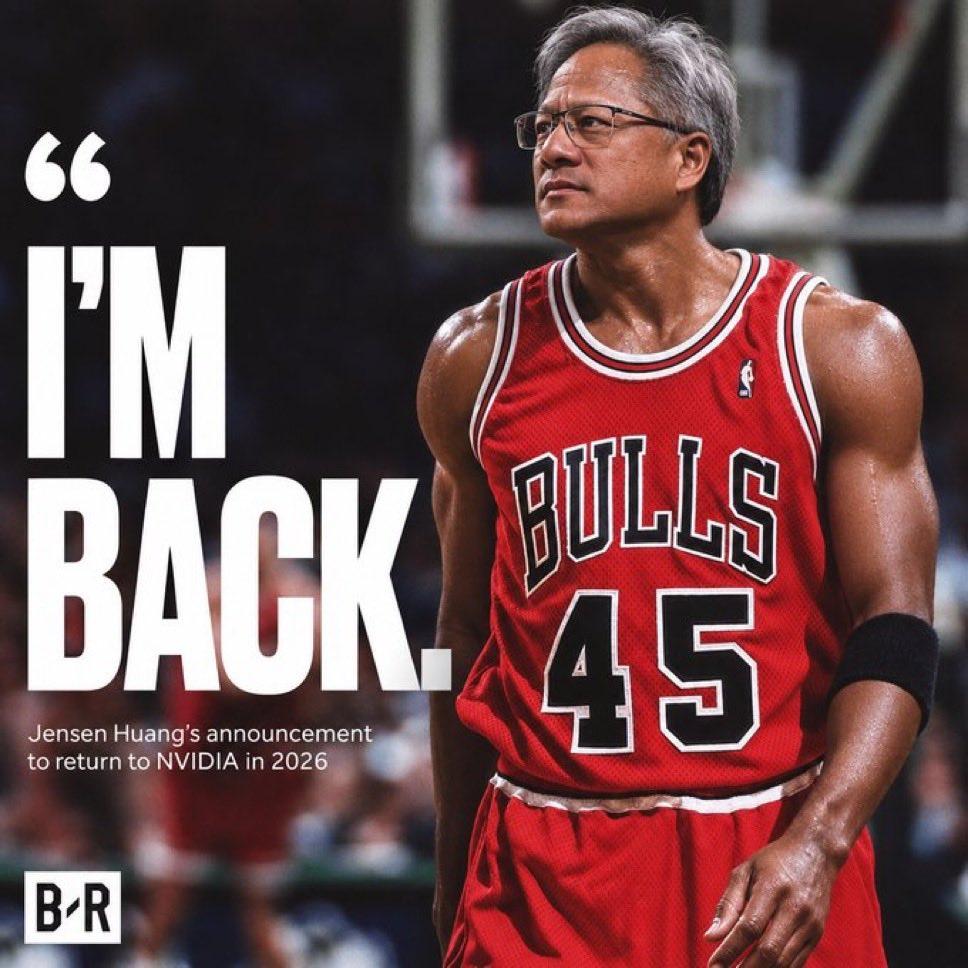
However, in the comment section of Jensen Huang's social media post, the most popular statement compares Jensen Huang to Michael Jordan.
On October 6, 1993, Jordan, who had just won three consecutive championships, announced his retirement. In his first season without him, the Chicago Bulls won 55 games, only 2 fewer than the previous year, and Scottie Pippen ranked third in the MVP voting.
In the second season, Bulls mainstay Horace Grant left for the Orlando Magic, and by March 1995, the Bulls' record was 34 wins and 31 losses.
Jordan returned on March 18. According to foreign media statistics at the time, in the five days after the comeback rumor emerged, the combined market value of the five companies that had him as their spokesperson — Nike, McDonald's, Sara Lee, General Mills and Quaker Oats — rose by $23 billion. Wall Street called it the "$2 billion rumor".
However, when Jordan returned, the No. 23 jersey had already been retired, so Jordan could only wear No. 45 to play. This is exactly the same as Jensen Huang's current situation.
Combined with the statement from NVIDIA's board of directors, many institutions speculate that even if Jensen Huang comes back, he will not be able to act as freely as before, and he will be subject to the control of the newly established Export Control Supervision Committee at NVIDIA.
Neil Shah from Counterpoint Research said on a foreign media program: "If he cannot act freely, will he still be as useful as he used to be?"
This article is from the WeChat Official Account "Alphabetscope" (ID: wujicaijing), written by Miao Zheng, edited by Wang Jing, and published with authorization from 36Kr.