Jev is targeted again, Microsoft's new decision-making model is launched, which is twice as fast and ranks first in accuracy.
News from AI Things on November 18: Today, Microsoft released its new-generation decision-making model Microsoft-Decision-1.1. In the Artificial Analysis Decision Index ranking, Microsoft-Decision-1.1 scored 68 points, ranking 8th, 6 points higher than Microsoft's first decision-making model, leading Jev 1.14, Google's Gemini Decision 1, and OpenAI's GPT-6 Luna version decision-making model.
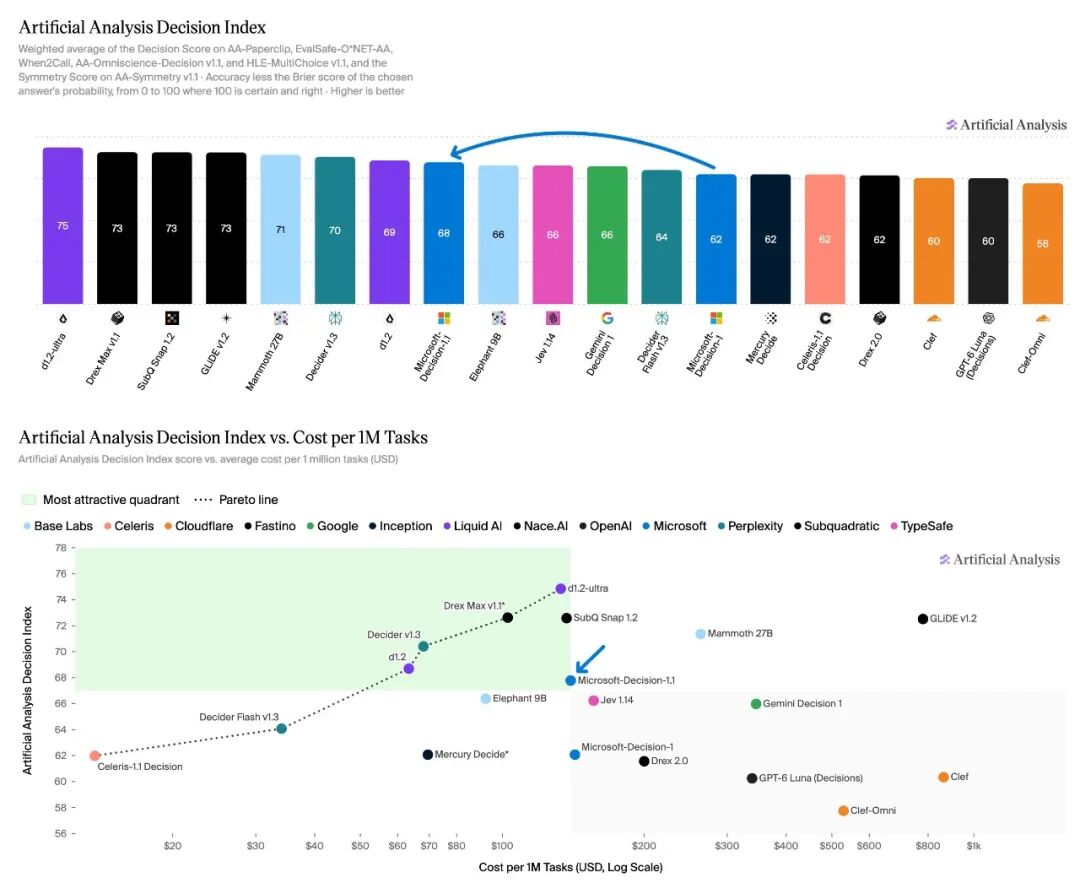
On October 10, Microsoft launched its first self-developed decision-making model Microsoft-Decision-1. Microsoft stated that compared with the previous generation model, Microsoft-Decision-1.1 features stronger intelligence, more accurate calibration capability, over 2 times higher operation speed and lower cost.
Apart from decision-making models, Microsoft also launched the programming model MAI Code 2 and MAI Code 2 Flash tailored for enterprises' daily coding tasks, as well as new models Code 2 and Code 2 Flash built specifically for programming and cybersecurity at the Ignite conference. Among them, in three coding benchmark tests measuring daily high-volume regular coding tasks, the performance of MAI Code 2 Flash is comparable to that of GPT-6 Luna and Claude Haiku 5.5, with the cost being only 65% and 20% of theirs respectively.
The new-generation decision-making model adds multi-modal support and can receive images. In terms of pricing, in Microsoft Foundry, it costs $0.042 per million input tokens, with outputs free of charge.
Microsoft stated that its decision-making models are designed to make calibrated decisions under the uncertainty of various real-world software use cases. They will select from allowed actions within the constraints set by developers, and output calibrated confidence scores, so that applications can make delayed decisions when the uncertainty is high.
In addition, as these models are focused on decision-making tasks, they run significantly faster and cost much less when handling decision-related tasks compared with general large language models.
Microsoft has carried out joint innovation in latency, cost, intelligence and calibration:
Latency: Decision-making models need to run in real time, even when processing complex requests with long inputs and hundreds of questions. Different from the traditional large language model inference engines optimized for token-by-token text generation, Microsoft-Decision-1.1 adopts a custom inference engine optimized for the computing requirements of decision-making models.
Cost: Microsoft's custom inference engine achieves low-cost optimization by efficiently allocating requests in GPU clusters, instead of only pursuing low latency. It is developed based on the medium-sized Mixture-of-Experts model Gemma 4 26B A4B. Gemma 4 26B A4B has enough active parameters to provide the intelligence required for decision-making, while operating efficiently enough to run on a variety of flexibly configured hardware such as A100, H100/200, and GB200/300.
Intelligence: Decision-making models need to be small enough to run in all scenarios, generalize well to brand new or unseen tasks, and undergo specialized training to make decisions. To achieve this goal, Microsoft combines supervised fine-tuning with reinforcement learning, integrating hundreds of synthetic and licensed datasets covering tens of thousands of task types from numerous industries, to train the model to make judgments rather than memorize answers, enabling the model to distinguish highly similar options, identify uncertainty, and clarify when to answer and when to refuse to answer.
Calibration: Microsoft has trained the model to clearly understand its own cognitive boundaries, give consistent answers in similar scenarios, accurately report the confidence level of its answers, split the confidence when there are multiple valid answers, and refuse to answer when information is incomplete. Developers can set their own thresholds for decision-making, tagging or escalation processing.
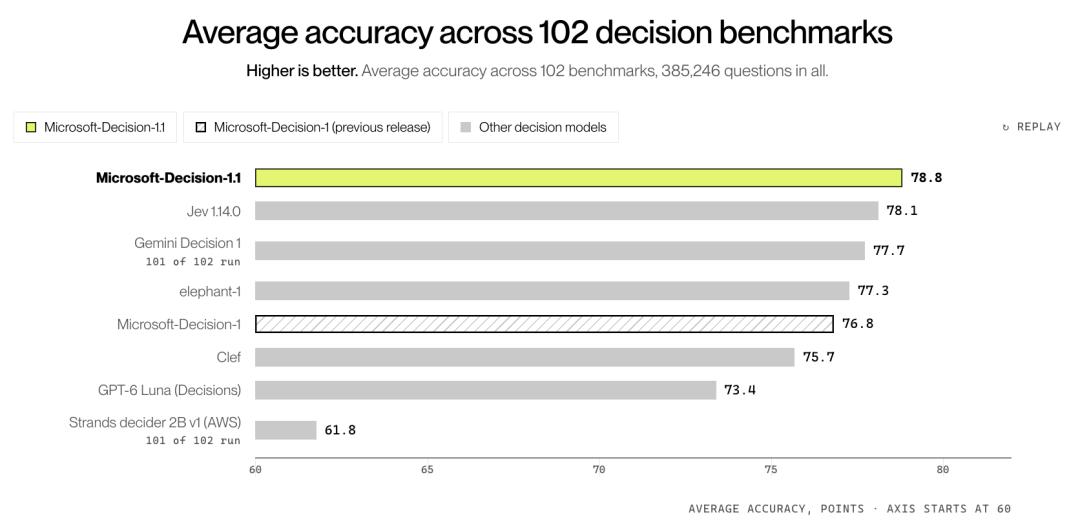
In addition to third-party tests, Microsoft also evaluated Microsoft-Decision-1.1 on 102 benchmark tests, which cover more than 385,000 questions that the model was not exposed to during the training phase, with test tasks covering routing, sorting, long context, multilingualism, out-of-distribution tasks, reasoning, security and many other fields.
Among the 8 decision-making models, Microsoft-Decision-1.1 achieves the highest average accuracy and takes the lead in 7 of the 9 capability categories.
Being available for just over five weeks, more than 4,000 customers have used Microsoft's decision-making models to complete various tasks, including model routing, customer support triage, business process automation, labeling and classification, etc. Early adopters include Epic, Equinor, Atos Group and Raiffeisen Bank Austria.
At the same time, Microsoft is integrating the dedicated intelligence of Microsoft-Decision-1.1 into various products to make fast and efficient decisions, while leaving larger-scale models for more complex tasks.
In Copilot, Microsoft-Decision-1.1 will route user requests to appropriate interaction scenarios, judging whether it is most appropriate for Copilot or Cowork to handle them. The accuracy of this decision is comparable to that of large language models, with the processing speed 2.2 times faster and the cost being about 1/4 of the latter.
In Cowork, this model supports Auto, and dynamically adjusts the inference workload that Cowork invests in each task.
Conclusion: Microsoft's Models Are Deeply Integrated With Its Own Products
May Take a Differentiated Development Path
Different from other leading model manufacturers, Microsoft's differentiation lies in that its models are deeply bound to its own products including GitHub Copilot, Foundry and Copilot workflow, with model capabilities directly embedded into existing office and development entrances, instead of selling APIs separately.
This means that enterprises can directly connect a complete set of solutions to their existing processes, with clear compliance boundaries and lower learning costs.
Source: Microsoft
This article is from the WeChat Official Account "AI Things", Author: CHENG Xi, Editor: LI Shuiqing, published with authorization from 36Kr.