Douyin's local life service business sees a leadership change: why did ByteDance dispatch the "head of Hongguo" to challenge Meituan?
On November 17, Douyin Local Life Services witnessed a leadership reshuffle. Pu Yanzi stepped down as President for personal and family reasons and transferred to the position of company consultant, with Mo Shaojun, former head of Hongguo Short Dramas, taking over the role. Douyin Group's official statement remained as restrained as ever, describing the move as "normal management post rotation and handover", and reaffirmed that local life services is a long-term development track that will continue to receive sustained investment and long-term operation.
No drastic changes can be seen from the formal announcement, and what is really intriguing is the clear contrast between the resumes of the two successive heads of the business.
Pu Yanzi joined ByteDance in 2013, and is a veteran of the Toutiao commercialization system. Before joining ByteDance, she worked at *Jinghua Times* for 7 years, accumulating 10 years of experience in sales and advertising. Mo Shaojun, born in 1991, joined ByteDance in 2017 and has successively incubated Fanqie Novel, Fanqie Audiobook and Hongguo Short Dramas. His resume is fully composed of experiences in free content products.
A product manager who has never led a sales elite team at ByteDance has taken over ByteDance's largest offline transaction business. What this handover has truly replaced is a set of underlying operation methodologies.
Pu Yanzi's Handover Report: The Sales-driven Model Has Reaped All Available Gains
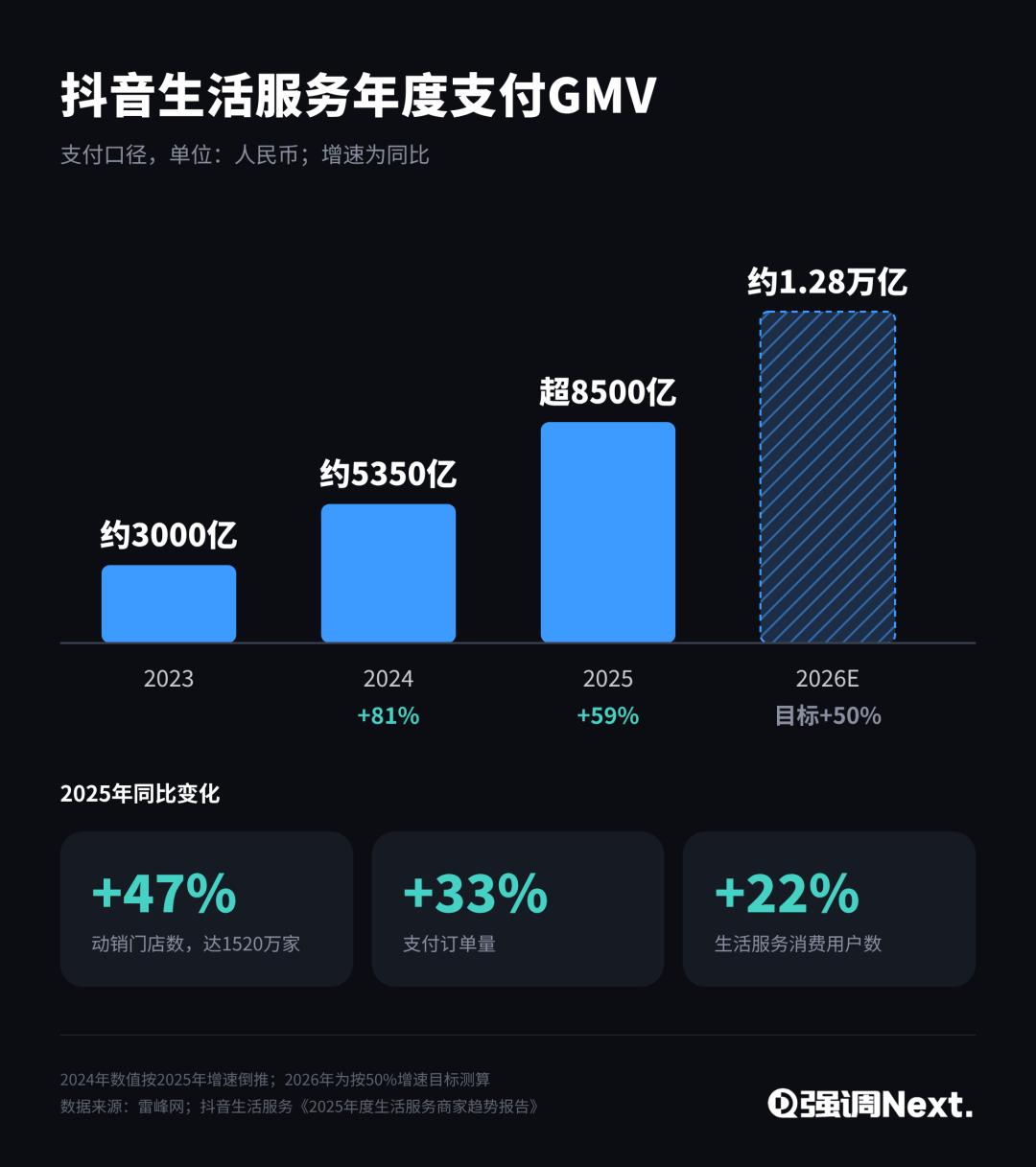
In November 2023, when Pu Yanzi took charge of Douyin Local Life Services concurrently as the head of commercialization, the annual GMV of this business was around 3000 billion yuan. In the following two years, the payment GMV of local life services kept surging: it jumped by 81% in 2024, and exceeded 8500 billion yuan in 2025 (representing a year-on-year growth of 59%). In the first half of 2026, the growth rate still stayed above 50%, and the full-year target was even raised in the middle of the year. As of 2025, the number of active stores on the platform has reached 15.2 million, up 47% year on year.
More critically, she stepped on the gas pedal of monetization in the second half of her tenure. Since 2026, Douyin Local Life Services has raised the commission rate for the catering sector from 2.5% to a level that is basically on par with Meituan, while cutting subsidies simultaneously. According to Nomura's research estimates, this business has achieved break-even in the third quarter of this year, and the monthly profit in the fourth quarter can reach 200 million to 300 million yuan. For a manager with a commercialization background, having expanded the business scale and recovered profits means all tasks on the checklist have been completed.
Looking back at the two organizational restructurings during Pu Yanzi's tenure, the commercialization genes are clearly visible.
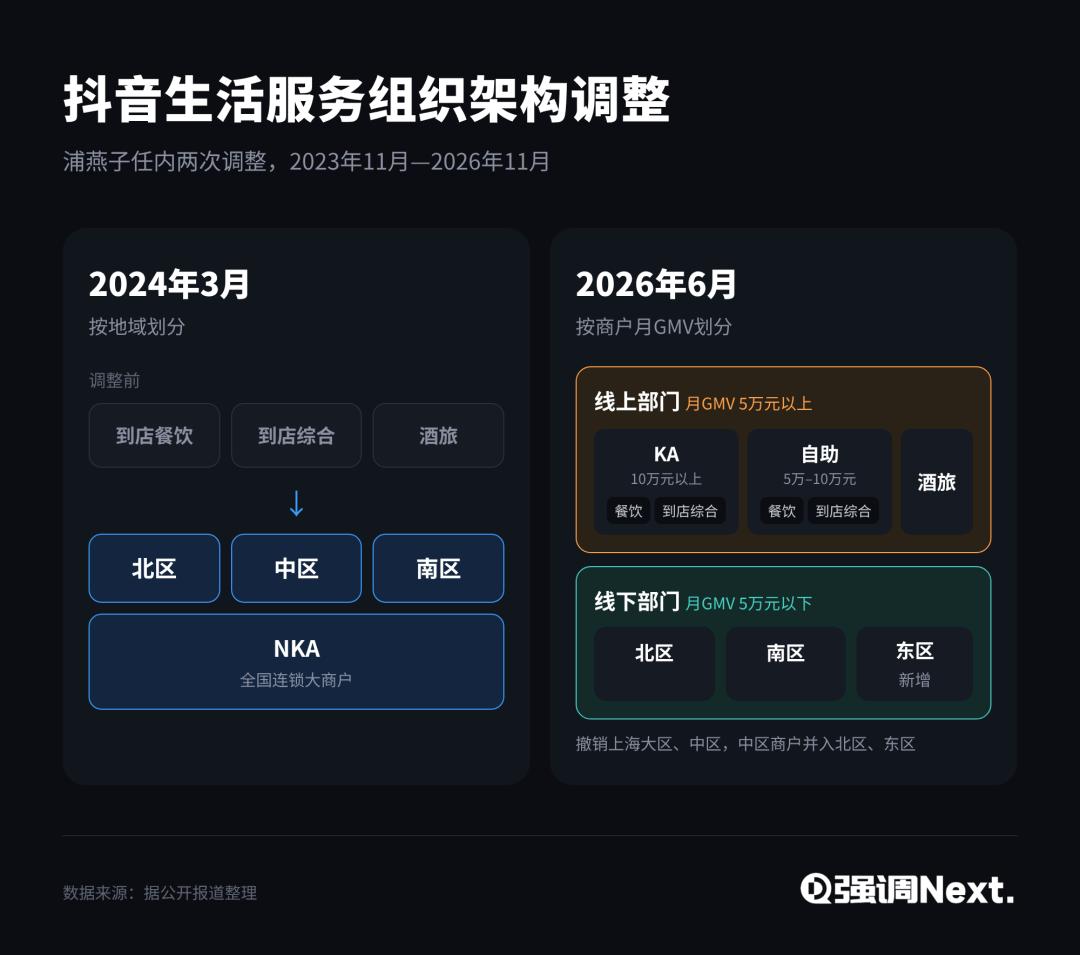
The first restructuring took place in March 2024. She broke the three parallel departments of in-store catering, in-store general services and hotel & travel that were divided by industry, and reorganized them into three major regions covering the north, central and south of China, plus an NKA department serving national chain brands, so as to unlock the cross-category sales capability of BDs. Her core judgment at that time was that "Meituan is not equal to local life", and Douyin's traffic pool can fully support car sales, property sales and recruitment services. Along with this adjustment, the 2024 sales target was directly raised from 5000 billion yuan to nearly 6000 billion yuan.
The second restructuring took place in June 2026. The organization was divided into two systems, online and offline, based on the monthly GMV of merchants: merchants with monthly GMV of more than 50,000 yuan were classified into the online department, which was subdivided into KA, self-service and hotel & travel sectors for refined management. Merchants with monthly GMV below 50,000 yuan were all assigned to the offline team, the Shanghai regional department and the central regional department were cut, and the business was only covered by the north, south and east regions.
Essentially, the two restructurings are typical sales tactics: first expand the market by occupying territories, then harvest customers by value stratification, and allocate core resources to top clients with the highest output. This is the most handy weapon for commercialization executives, but it also precisely exposes the boundary of this set of methods.
The second adjustment bundled a huge number of small and medium merchants with monthly GMV below 50,000 yuan to the offline team, which is tantamount to implicitly admitting that long-tail merchants cannot thrive in the online traffic mechanism, and can only be pushed forward by the manpower-intensive tactic. Some service providers reflected that on peak live streaming days such as Bigday, traffic is obviously tilted to large merchants with strong brand influence, and the natural traffic of small merchants on that day is even more scarce than usual.
In comparison, the waist and tail merchants on Meituan contribute more than 90% of the total turnover. The sales elite team can quickly win top chain brands and high-unit-price categories, but in the face of the long tail composed of more than ten million stores, no one can "conquer" them one by one through BD visits.
Another unavoidable hidden worry is the huge gap between payment GMV and verification GMV. The generally recognized estimation standard in the industry is that if calculated based on actual verification, the transaction volume of Douyin Local Life Services will be halved, and the verification rate of the hotel & travel category is even less than 50%. Users are attracted by a short video and place an order on impulse, but eventually do not go to the physical store. The loss in this funnel obviously cannot be plugged by recruiting hundreds of more BDs.
The Exam Question for the Second Half: "Why Will Users Come Back"
In 2026, the exam question at the local life business table has changed.
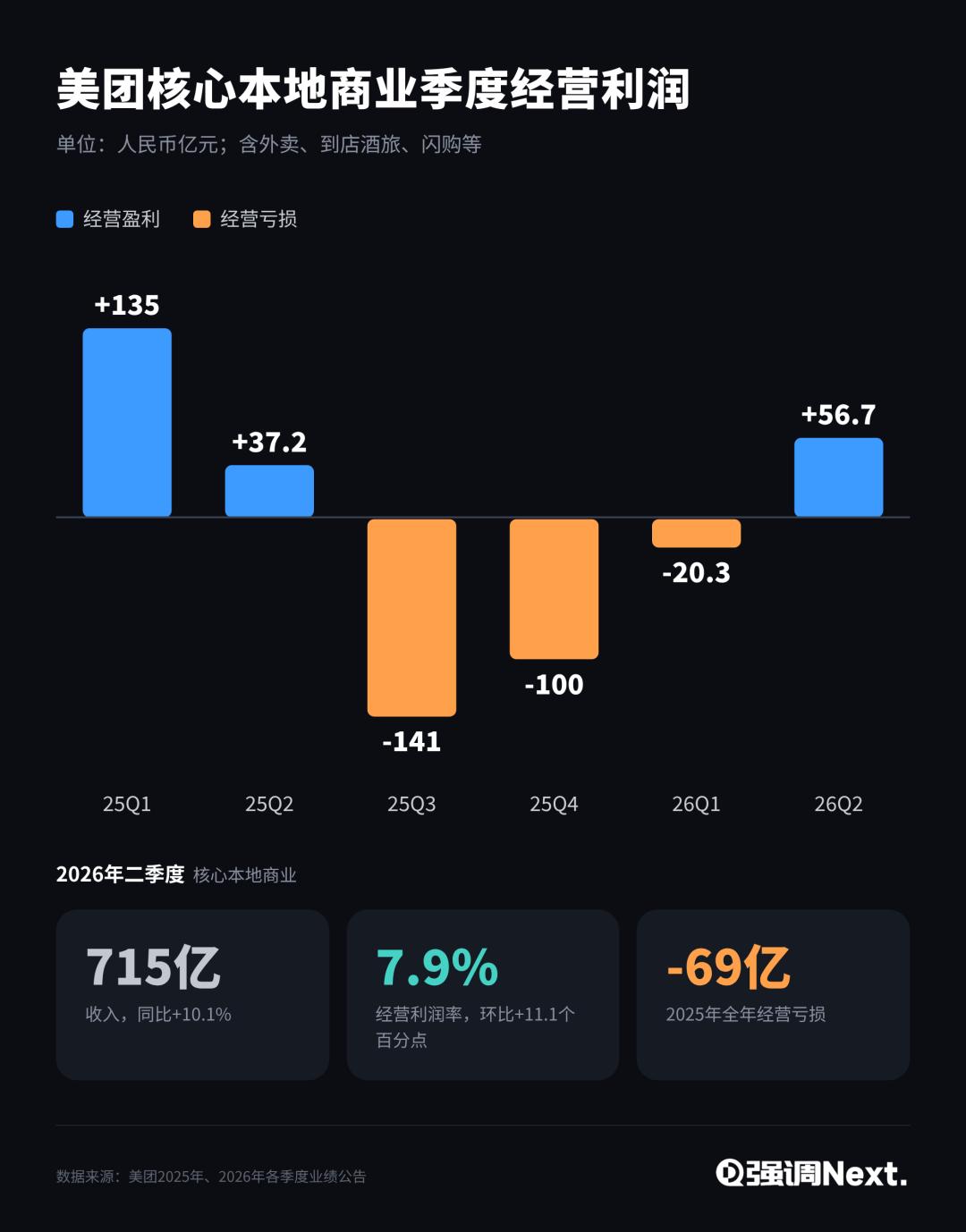
Meituan has gone through the most cash-burning stage of the food delivery war. In the second quarter of 2026, Meituan's core local commerce revenue reached 71.5 billion yuan, up 10.1% year on year, and its operating profit quickly rebounded from a loss of about 2 billion yuan in the first quarter to a profit of 5.7 billion yuan. At the earnings call in June, Meituan CFO Chen Shaohui made it very clear when responding to Douyin's competition: the in-store business relies on offline fulfillment capabilities and consumer trust, and traffic alone cannot be directly converted into actual transactions. When the subsidy tide recedes, the real decisive factor is who can make users come back repeatedly and allow merchants to operate steadily on the platform every day.
Several pilot attempts launched intensively by Douyin Local Life Services this year are all trying to make up for this shortcoming.
The independent group-buying app "Dou Shengsheng" launched at the beginning of the year tried to separate short videos to create a pure transaction entry. It achieved impressive data in the early stage, but only a few months after its launch, the main app diversion was stopped, and user growth almost stagnated. As previously emphasized by Next, after reaching 21.03 million daily active users, Dou Shengsheng began to encounter problems that Douyin cannot solve. The essence is that Dou Shengsheng has not formed its own growth flywheel.
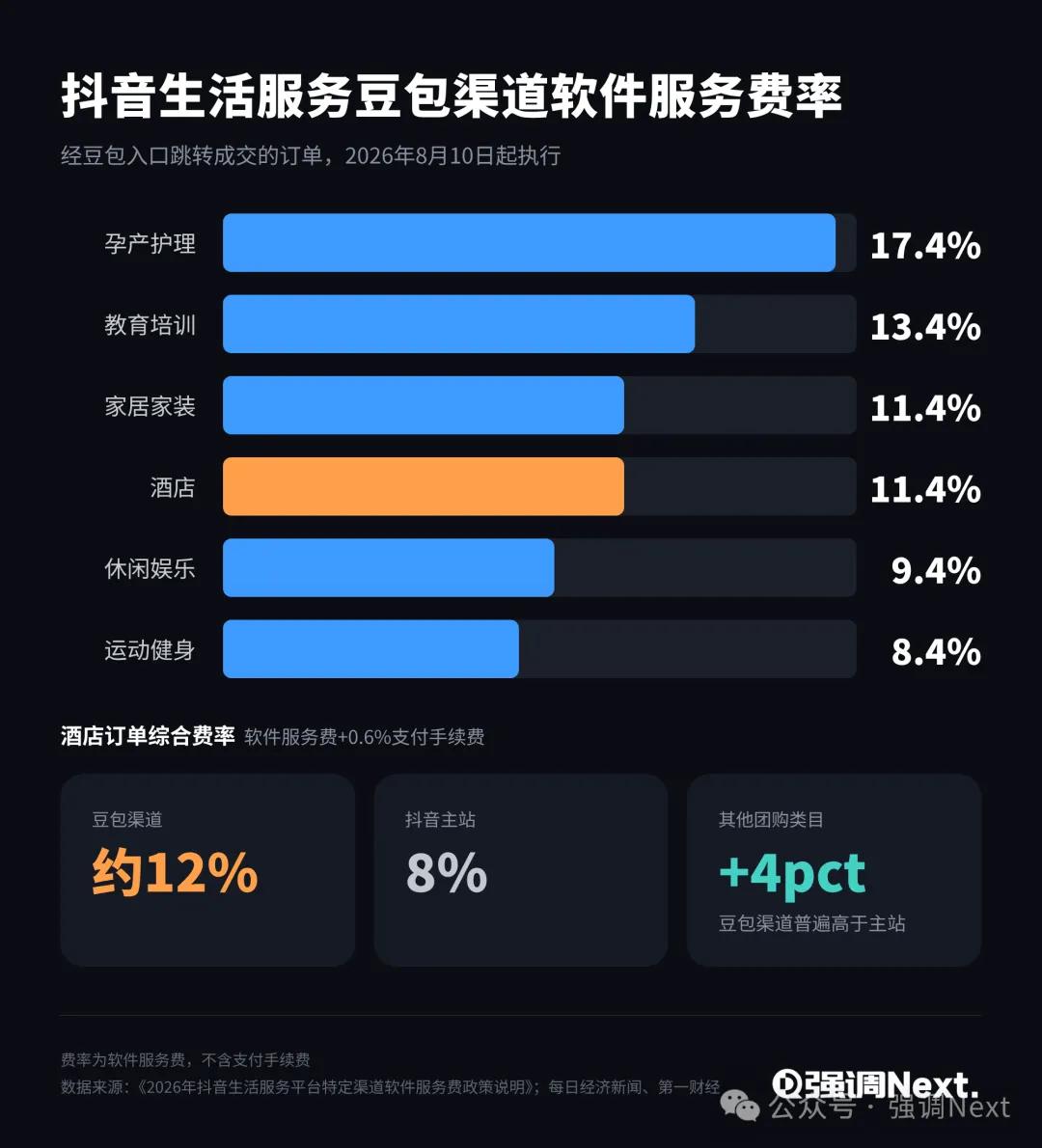
On the other hand, since August 10, hotel orders completed by redirection from Doubao have been subject to a comprehensive rate of about 12%, which is 4 percentage points higher than the same category on the main Douyin app. The rates of Doubao channels for categories such as maternity care, education and training, and leisure entertainment are also generally about 4 percentage points higher. ByteDance is clearly pricing the AI conversation entry, and internally recognizes that its commercial value is higher than that of the traditional information feed.
Both the shelf-style independent app and the conversational AI entry are targeting the same core problem: the vast majority of users buy group buys on Douyin because they are "pushed" by content, rather than "looking for" them with clear demands. Although the search GMV of Douyin Local Life Services has increased by 55% year on year since 2026, and active demands have picked up, there is still a considerable gap before building the user mindset of "open Douyin first when you want to find a store".
Shifting from "service finds user" to "user finds service", and moving from impulsive consumption to habitual consumption, requires reconstructing the user path, recommendation algorithm and merchant incentive rules. This is a product problem, no longer a sales problem.
Why Is the Person from Hongguo Short Dramas Chosen?
Taking a broader perspective, Mo Shaojun's appointment has a clear logical context.
Almost all the products he has managed in the past are solving the same proposition: how to transform low-threshold impulsive consumption into high-frequency daily habits.
Before Hongguo entered the market, the mainstream gameplay in the short drama industry was mini-program payment and revenue collection by episodes, earning quick money from impulsive consumption; Hongguo completely subverted this model, using "free + advertisement" combined with a continuous recommendation algorithm, and forcibly turned short dramas into a time-killing tool that users must brush every day.
According to QuestMobile data, the monthly active users of Hongguo reached 356 million in May 2026; the daily active users surged to 168 million in July (up 107% year on year), surpassing the sum of the daily active users of the four traditional long video platforms Tencent Video, iQiyi, Youku and Mango TV; by September, the unique total users of Hongguo reached 430 million, surpassing Doubao and becoming the second largest app under Douyin Group.
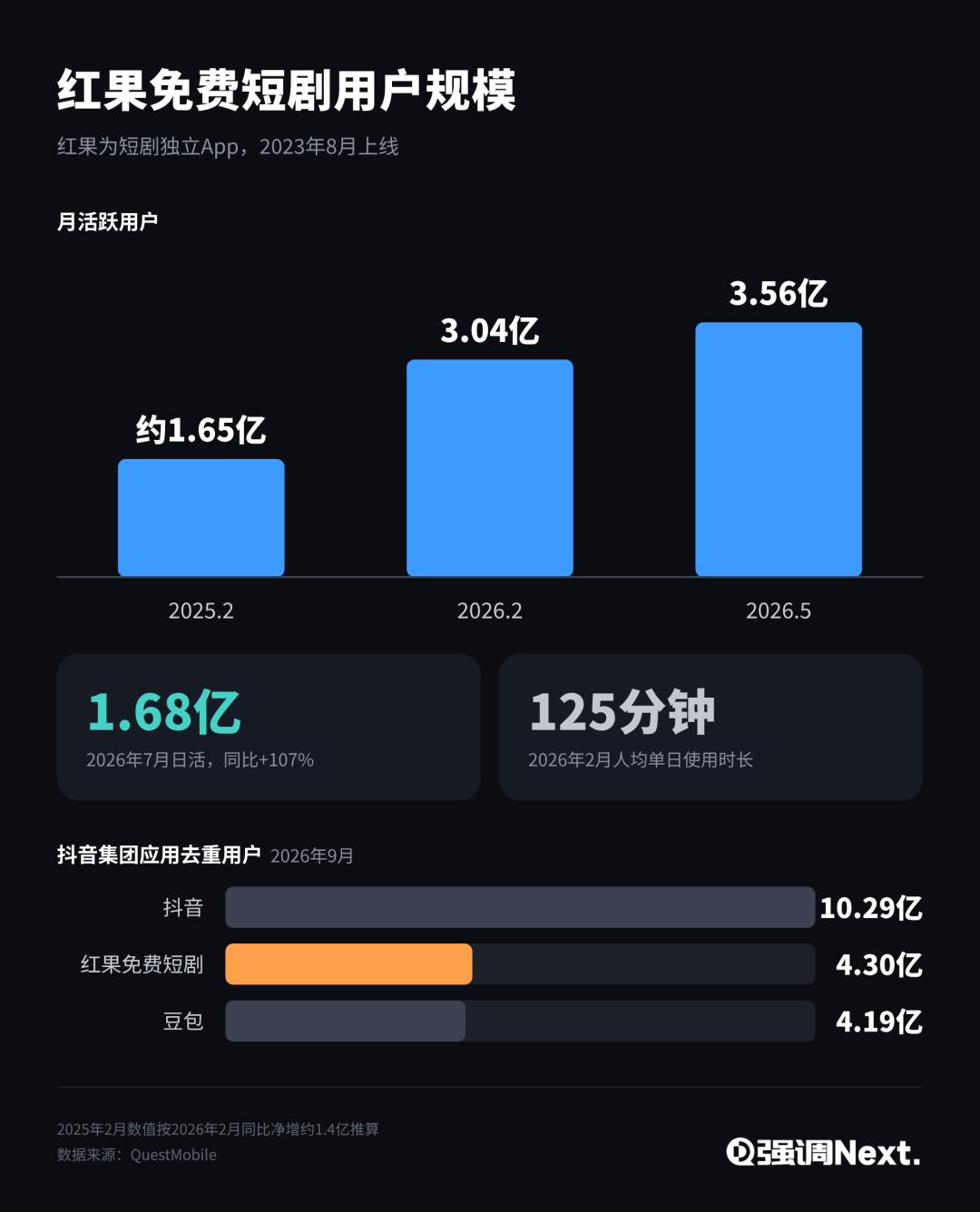
Long video platforms rely on head hits to recall users. Once a drama ends, the overall platform activity will drop accordingly. Hongguo relies on mechanisms and habit recall: as soon as the popularity of the previous drama fades, the next one will seamlessly follow. What the current Douyin in-store group buying business is most eager for is exactly this model.
More critically, Mo Shaojun has successfully managed a huge and extremely scattered long-tail supply side, and the weapon he relies on is rules, rather than personal connections and business relationships.
Since January 2026, Hongguo has decisively cut the universal minimum guarantee mechanism of 200,000 to 350,000 yuan, blocking the arbitrage space for a large number of low-quality short dramas with a production cost of only a few thousand yuan; in April, it permanently merged the comic drama list and live-action short drama list, and comic dramas topped the total list for the first time in July. In addition, the short drama copyright and creation platforms that originally belonged to two separate teams under Douyin and Hongguo were forcibly integrated into a unified middle platform. Although every iron-fisted reform was accompanied by complaints from the industry, the result is that the platform replaced one-to-one business negotiations with revenue sharing rules and algorithm distribution, reducing supply costs while improving content quality.
Transplanting this set of logic to Douyin Local Life Services makes perfect sense. 15.2 million active stores and about 2700 service providers are essentially the same long-tail ecosystem that urgently needs to be reshaped by rules and data. Pu Yanzi is good at "covering" merchants with a sales elite team, while Mo Shaojun will most likely use algorithm mechanisms to "filter" merchants, so that stores with high verification rates, good repurchase rates and real reviews can obtain stable traffic, and squeeze out low-quality merchants that rely on subsidies to generate orders and brush positive reviews. In September this year, Douyin Local Life Services just launched a special governance campaign targeting "merchant manipulation of reviews", and such rule-oriented adjustments will only become more frequent under the new head.
Besides, Mo Shaojun is by no means an outsider to the local life business. Before joining ByteDance, he worked in product positions related to local life services at Baidu, Meituan and Didi, and witnessed how Meituan gradually polished group buying into a high-frequency national tool.
Behind this appointment, there is also a more hidden organizational clue.
Mo Shaojun and Huang Jinlong, the current head of Douyin Live, are both from the founding team of Fanqie Novel, and both report to Zhang Chao, who is in charge of Fanqie, Hongguo and Toutiao, with a rational and pragmatic work style. On the eve of the Hongguo project establishment in 2023, ByteDance urgently transferred elite forces from Fanqie Novel to enter the short drama track. Now, the two cash cow businesses that rely most on commercial conversion in the Douyin system, live streaming and local life services, are all handed over to this group of product managers who grew up in the free content product sector.
As the transaction business crosses the wild expansion stage, ByteDance is systematically replacing the pioneers with "commercialization sales" backgrounds with operators with "product growth" backgrounds.
The Price Hongguo Paid, and a New Exam Paper for a Product Manager
Of course, the cost of this cross-departmental transfer is not low.
At the node when Mo Shaojun left his post, Hongguo was in a turbulent period. Externally, there are strong enemies around: "Green Bubble Short Dramas" incubated by Tencent in WeChat Mini Programs is advancing fiercely, its monthly active users reached 143 million in August, and its weekly active users in the first week of October soared to 89.68 million (a sharp increase of 44.1% compared with the first week of September), which is regarded by the industry as another positive breakthrough in WeChat's content hinterland after Video Account. Internally, there are compliance risks: Hongguo is mired in the portrait rights dispute of AI short dramas — just 5 days before the leadership reshuffle (November 12), actor Zhao Liying sued Hongguo's operator Bimo Liuxiang and Douyin Information Service Company to court on the grounds of portrait rights infringement.
When a core product is facing head-to-head competition from giants and rising legal and regulatory risks, the decision to resolutely transfer out the top leader shows that ByteDance's senior management has made two firm judgments: first, Hongguo's content flywheel can operate independently; second, the strategic priority of the local life services restructuring is higher.
But