Just now, Aupres bid farewell to Shiseido.
Aupres has said "goodbye" to Shiseido.
On November 17, Shiseido released an announcement stating that it has decided to transfer all equity interests and businesses of Shiseido Liyuan Cosmetics Co., Ltd. (hereinafter referred to as "Shiseido Liyuan"), including its Beijing factory and production equipment, to an investor consortium led by IDG Capital (hereinafter referred to as "IDG"). Relevant agreements have been signed by both parties at present, and Shiseido Liyuan is exactly the operating entity of the Aupres brand.
For this divestment, Shiseido China immediately stated to Qingyan that this decision is one of a series of strategic moves for Shiseido to reshape its brand portfolio in the Chinese market and concentrate resources on key brands and growth opportunities. Shiseido will also work closely with the IDG team to ensure the stable operation of the business during the transition period.
This also means that Aupres, the brand that has been "exclusively for China" for more than 30 years, will completely bid farewell to the Shiseido era.
01
Aupres bids farewell to the "Shiseido Era"
For Aupres, 2026 can be described as a year of turbulence.
Founded in 1991, Shiseido Liyuan was jointly established by Beijing Liyuan Co., Ltd. (hereinafter referred to as "Beijing Liyuan"), an enterprise with state-owned capital background, and Shiseido. In June this year, Beijing Liyuan announced that it would list and transfer its 35% equity stake in Shiseido Liyuan, with a listing reserve price of 199.5 million yuan. (Shiseido's first "China-exclusive" brand sees major changes)
In September, the 35% equity held by Beijing Liyuan was officially transferred to Shiseido (China) Investment Co., Ltd., with a final transaction amount of 199.5 million yuan. So far, the Chinese state-owned capital shareholders have completely withdrawn from this joint venture, and Aupres has bid farewell to the "state-owned capital era".
According to the disclosure at that time, from the whole year of 2025 to May 2026, Shiseido Liyuan recorded a total loss of nearly 100 million yuan. At that time, external analysis believed that Shiseido might adjust the Aupres brand. In the announcement released today, Shiseido also acknowledged that "in view of the continuous evolution of the market and competition landscape, to achieve sustainable corporate growth, continued investment in product innovation and digital capabilities is essential".
It is worth mentioning that at the 9th China International Import Expo held in early November this year, Aupres appeared at the exhibition together with Shiseido, and exhibited its Black Genie series of products.
Obviously, Aupres failed to wait for the new brand strategy from Shiseido.
According to the latest announcement, Shiseido stated that after a comprehensive assessment, the company believes that transferring the business to IDG is most conducive to the future development of Shiseido Liyuan. With the support of IDG, Aupres will also promote business adjustment in the form of an independent brand, so as to continuously enhance brand value and achieve sustainable growth.
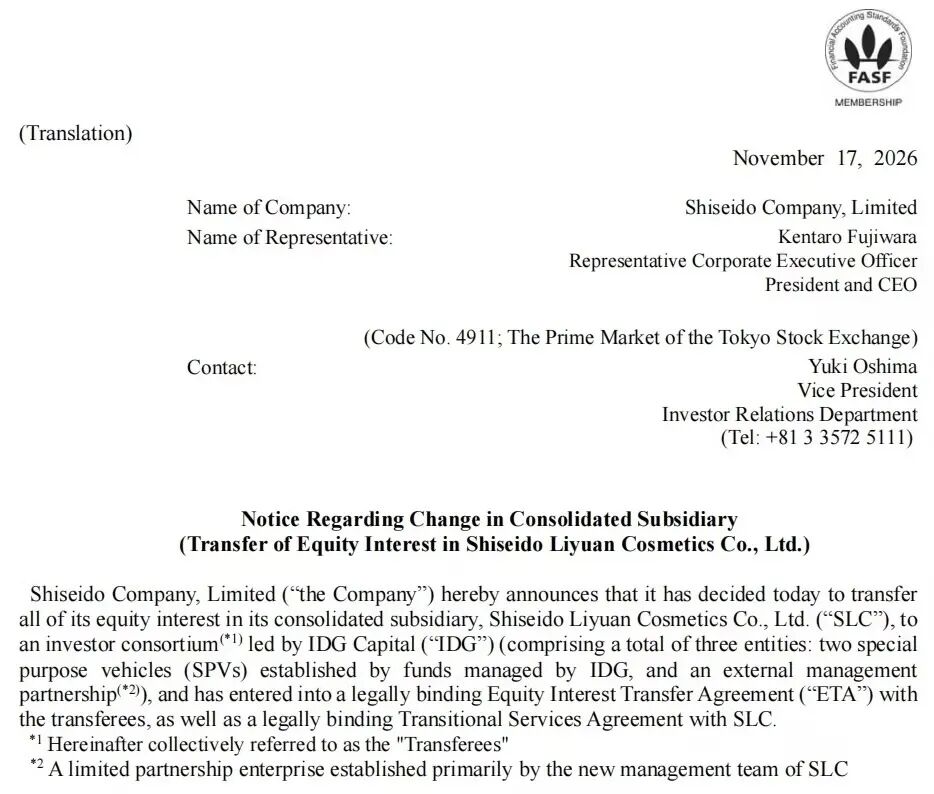
Screenshot from the announcement
At the same time, in addition to all factories and equipment being transferred to IDG, Aupres will also have a new management team with rich experience in beauty brand management and business transformation, so as to better meet the ever-changing needs of Chinese consumers and provide higher-quality services.
According to public information, the current general manager of Shiseido Liyuan is Kaname Sasaki. On social media, he often promotes the brand in the identity of "President of Aupres". At this year's CIIE, Kaname Sasaki also participated in Shiseido's opening ceremony as a brand representative. If IDG builds a brand new management team, it may also mean that Aupres will welcome a new brand helmsman.
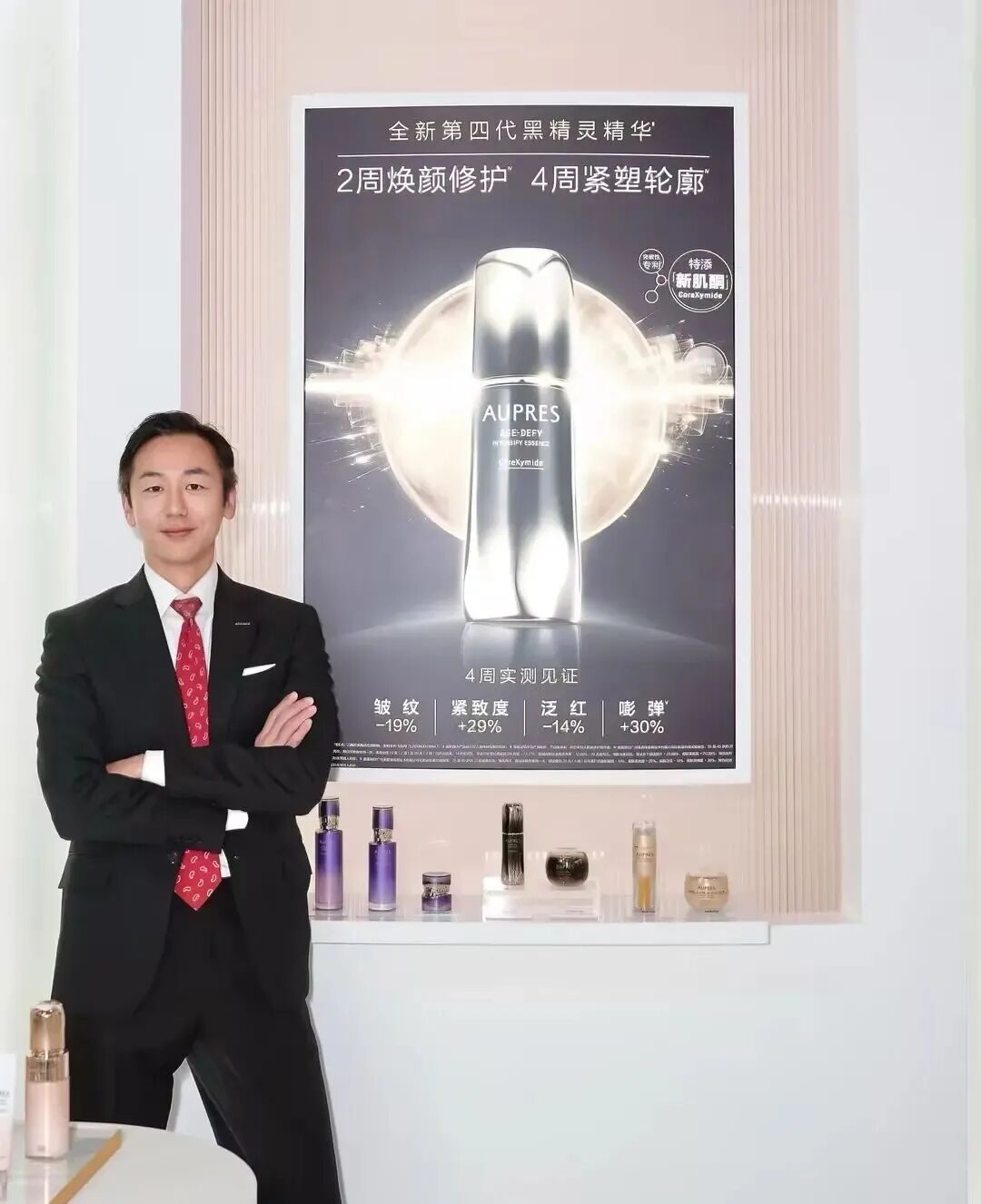
Kaname Sasaki at the 9th CIIE, source: Xiaohongshu
According to the announcement, all equity interests owned by Shiseido will be transferred to three entities, and the equity transfer is expected to be completed from the fourth quarter of 2026 to the first quarter of 2027.
Specifically, 95% of the equity will be transferred to a special purpose vehicle (SPV) established by a fund managed by IDG, of which Sunrise Winning Limited holds 80.66% and Zhuhai Pulai Management Consulting Partnership (Limited Partnership) holds 14.34%; the remaining 5% of the equity will be transferred to Shanghai Puzhiyuan Enterprise Management Partnership (Limited Partnership), established by the new management team of Shiseido Liyuan. At present, all three enterprises have completed registration.
In addition, for the guarantee of product quality, Shiseido specially mentioned that in addition to granting specific intellectual property licenses required for business operation, it will also continue to provide support in new product development within a specific period after the transfer, so as to provide technical assistance to ensure the stable supply of existing products, and continuously supply raw materials and selected products, thus maintaining the brand's innovation capability, product quality and business continuity.
Shiseido China also told Qingyan that Aupres's business is operating normally at present, and Shiseido will also work closely with the IDG team to ensure the stable operation of the business during the transition period, and provide all-round support for employees, consumers and partners.
In simple terms, Aupres's existing product technology and quality will not be affected, and the efficacy of core products will not change. But on the other hand, separated from the profound technical accumulation of the Shiseido Group, whether Aupres can embark on its own new product path remains to be seen.
02
The "buyer" has invested in multiple beauty brands
In the announcement, Shiseido repeatedly mentioned that IDG can inject new vitality into Shiseido Liyuan. Shiseido China also stated to Qingyan: "We believe IDG will drive the sustainable growth of SLC and enhance its brand value."
So, what is the origin of IDG Capital?
Public information shows that in 1964, Patrick J. McGovern founded IDG with a starting capital of 5,000 US dollars; in 1978, as one of the first American entrepreneurs to visit China, McGovern came to China for the first time, laying the foundation for IDG to enter the Chinese market in the future.
In 1993, McGovern established the first foreign-invested venture capital fund in China - PTV-China (Pacific Technology Venture Capital Fund-China), which was later renamed IDG VC (IDG Technology Venture Capital Fund), becoming a pioneer in China's venture capital industry.
In 1999, IDG Capital evolved from the original investment department of IDG into an independently operated fund management institution implementing a partnership system, becoming the first institution in China to set up a partnership fund management model. Since then, IDG Capital has successively invested in the first batch of Chinese Internet companies such as Tencent, Baidu and Ctrip, playing the role of a "pathfinder" in China's investment industry.
In the cosmetics sector, IDG's footprint is also expanding continuously.
According to the White Paper on China's Cosmetics Industry Capital Decade, from 2007 to 2017, "IDG Capital" ranked far ahead in the investment and financing ranking of China's cosmetics industry with 17 investments. One of the earlier public investments was participating in the Series A and Series B financing of Meila Beauty, a fashion women's community, in 2014, but the platform has ceased operation at present.
In addition, in 2017, Afu Essential Oil and Helijia jointly received an investment of 300 million yuan led by IDG Capital; in 2019, domestic trend makeup brand Girlcult announced the completion of tens of millions of RMB Series A financing from IDG Capital; in 2021, IDG Capital participated in investments in many enterprises such as WOW COLOUR, synthetic biology firm Protogen Biotech which focuses on "small molecule peptides", and home-use hydrotherapy device brand Femooi; men's skincare brand Ruidu also stated that it had received investment from IDG Capital.
IDG Capital's most recent investment was the first round of strategic investment in dermatology-grade brand FulQun in December 2025. This brand takes dermatological clinical needs as the core and focuses on oily and acne-prone skin care.
Judging from the published investment and financing information, IDG Capital is mostly an "investor" rather than an "acquirer". Whether it is leading investment or participating investment, it does not need to be deeply involved in brand operation. However, this transaction of Shiseido Liyuan means that the acquirer needs to fully take over the operation of the brand, which undoubtedly tests its brand operation capability greatly.
03
China remains an important market for Shiseido
Back to Shiseido itself.
It is undeniable that with the aura of Shiseido's first "China-exclusive" mid-to-high-end beauty brand, Aupres once seized the golden age of traditional department stores and became a benchmark in the department store channel, but now its aura has long faded and it has fallen into a loss-making situation.
Shiseido China clearly stated to Qingyan that this divestment decision is one of a series of strategic measures for Shiseido to reshape its brand portfolio in the Chinese market and concentrate resources on key brands and growth opportunities, and China remains one of Shiseido's most important strategic markets. Shiseido will also continue to commit to investing in key brands, R&D, innovation, digital and AI capabilities, as well as new growth opportunities.
In the announcement released today, Shiseido also clearly stated that with the rapid expansion of e-commerce, the transformation of consumer behavior and the emergence of competitors, the competitive landscape of the Chinese market is constantly changing, and Shiseido regards these changes as growth opportunities, aiming to drive sustainable growth and enhance its competitiveness in the Chinese market by concentrating management resources on areas where it has the most competitive advantages.
In simple terms, Shiseido needs to find the most advantageous growth direction in China, and obviously, loss-making Aupres that has been losing money for consecutive years is not among them.
In November last year, Shiseido released its 2030 Medium-Term Strategy, clarifying three strategic pillars: first, focus on high-growth categories, concentrate on core areas of skincare and sun care, and focus on makeup, fragrance, medical, skin and lifestyle sectors; second, promote global business transformation and digital upgrading; third, pursue sustainable development.
At the same time, Shiseido divided its brand architecture into four camps: core brands, future brands, emerging brands and transforming brands. In the third quarter of this year, emerging brand camp BAUM and d program both achieved good growth, while transforming brand camp Drunk Elephant recorded double-digit decline.
This also proves that what Shiseido needs at this stage are core brands that can leverage more traffic, rather than traditional brands that require continuous "blood transfusion" from the group. The sale of Aupres is an inevitable result of Shiseido's contraction of its brand front, and it also frees up space and resources for it to rearrange its brand matrix in the Chinese market.
Judging from the overall financial report data, Shiseido's adjustment strategy is indeed taking effect gradually.
In the first three quarters of this year, Shiseido Group's net sales reached 741.1 billion yen (about 31 billion yuan), a year-on-year increase of 7%; core operating profit soared 124% year-on-year to 67.5 billion yen (about 2.8 billion yuan).
For both Shiseido and Aupres, the sale of Shiseido Liyuan is not only an end, but also a beginning. As for whether Aupres can find a transformation path that truly suits itself, there is no answer for the time being.
This article is from the WeChat official account "Qingyan", author: Yijin, authorized for release by 36Kr.