Should We vs. Can We: How Does Netflix Promote AI Within the Enterprise?
Compared with foreign-language films and TV series with dubbed versions, more audiences prefer to watch the original soundtrack versions. The reason is simple: if the lip movements on the screen do not match the audio, the sense of immersion will be broken the moment the actor opens their mouth.
The Netflix product team came up with a brilliant solution: re-render the actors' lip animations in post-production to make the lip movements perfectly aligned with the dubbed audio. This solution is technically extremely difficult, yet the visual effect it delivers is stunning — the kind of achievement that can silence the entire audience during internal demonstrations.
They found directors and actors who were willing to try this approach, and conducted A/B tests on some of the films. The results showed that user engagement did increase significantly as a result. However, the AI also caused some visual flaws that required manual correction, and the improvement in user engagement was not evenly distributed: it was only noticeable in drama and romance scenes with dense lines. It is not cost-effective to continue large-scale investment in this capability.
As AI models continue to advance, this calculation may be reassessed later. But right now, Netflix has to answer another question: if this thing is worth doing, what is the most appropriate way to implement it?
Mckenzie Lock, who once led product, operations and creative work at Netflix, has gone through many such choices: to make more content accessible to audiences across different languages and regions, while also addressing creators' concerns about quality, working methods and creative control. This article shares a recent interview with Lock, where she talks about how she promoted AI transformation within the enterprise in recent years, for your reference.

Netflix offers more than 17,000 titles in over 200 countries and regions, supports more than 30 languages, and has over 300 million users. AI naturally brings many opportunities to improve the promotion and distribution of such a huge and ever-growing content library. Therefore, Lock's team set out to completely reform Netflix's creative and operational processes, and adhered to one non-negotiable goal: identify which links in the process are cumbersome, slow or defective, and use AI to handle these messes, while ensuring that content quality is not affected and the work results of production staff are not compromised. "Most product decisions are essentially choices about how to deal with complexity, and AI is no exception," she said. "Good design does not eliminate complexity, but places it in the right position."
Formulating the Vision
A few years ago, when Netflix started its internal AI reform, Lock's team did not initially focus on what the latest models could do. Instead, she raised two very open questions: what kind of ultimate experience do we want to create for our members? And in what aspects do the current production processes really fail to meet the needs of members?
The team first did an imagination exercise: if technical constraints are temporarily put aside, what do we want users to be able to do? For example, if a viewer pauses a series for three months and reopens it, can they first see a plot recap tailored to themselves? If we want such an experience to be realized, what content does the platform need to understand, what services need to be built, and what capabilities need to be provided?
Not all of these assumptions will become final products. Their value lies in allowing the team to first clearly depict the goal, and then work backwards to design the technology and workflow. This is the exact opposite of the approach of "seeing a new model first, then looking for application scenarios for it".
The challenges Netflix faces go far beyond the audience experience. Behind the launch and dissemination of every work, there are a large number of professionals such as screenwriters, editors, animators, translators, and voice actors. They are familiar with the difficulties in the process, and may be most worried that new technologies will change their jobs. Therefore, Lock's team did not only design the future process in the conference room, but went to observe front-line work, distributed questionnaires to employees in different positions, and organized experts and managers to discuss the results.
They also invited people with different views to state their respective reasons, so that potential differences can be seen before the project moves forward. For managers, this is a step that is easy to ignore: employees' hesitation towards AI does not necessarily mean they are resisting change, it may also be a reminder that there are still important unresolved issues in the plan.
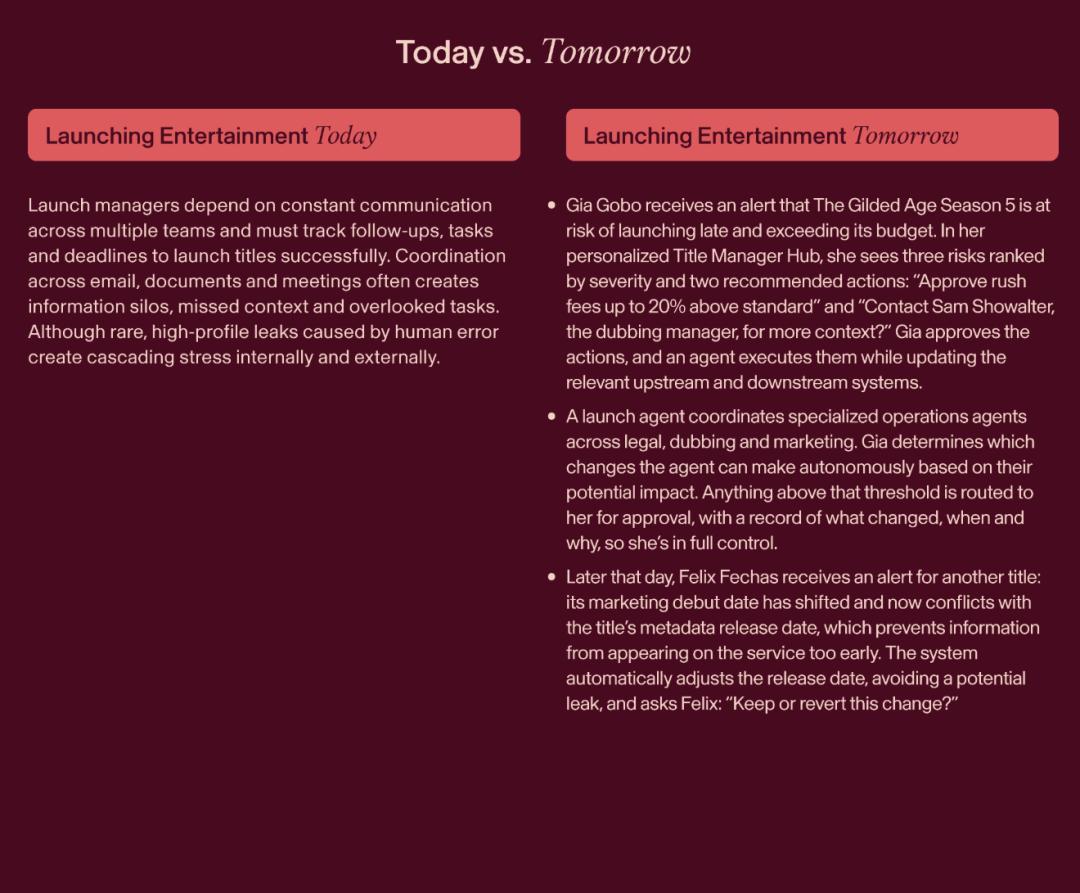
Unlike technical teams, large creative teams will not adopt AI for the sake of adoption. They need to be able to see their own future development direction. Therefore, during the survey phase, Lock's team created a two-column "Current Status vs. Future Comparison" table for each workflow. The left side outlined the current workflow overview, including budget constraints, quality differences, linear correlation and time cost; the right side described how a person's work might change if AI is introduced, what tasks will be reduced, and what judgments will become more important.
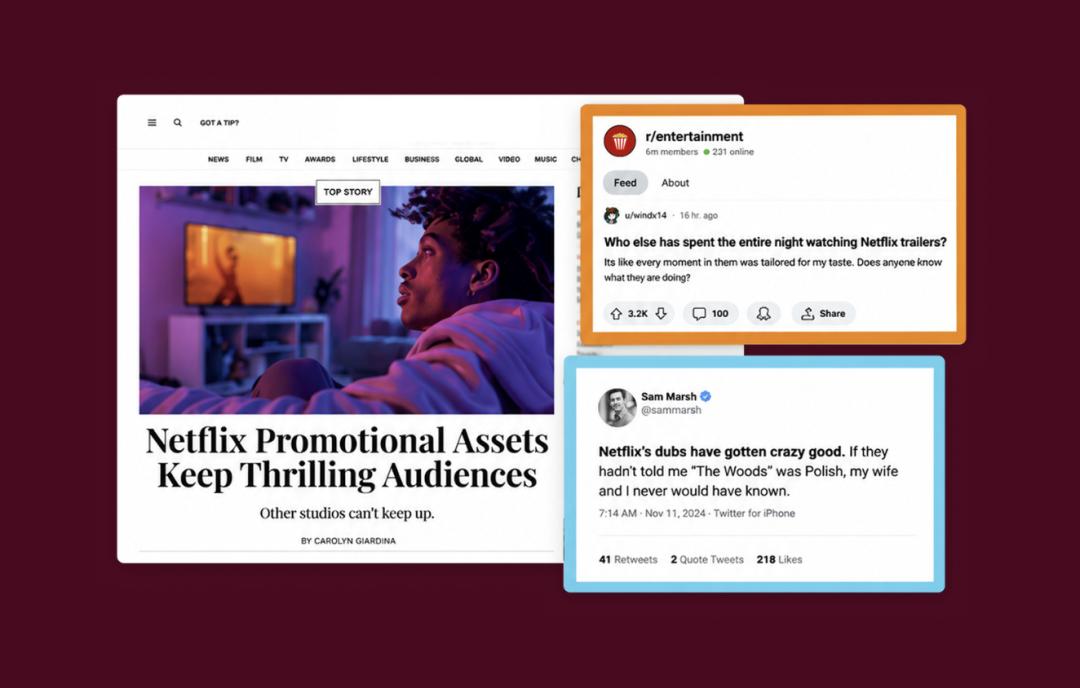
Lock also did something unconventional: the team created imagined press releases and social media posts about the upcoming process changes, to "report" this transformation in advance, so as to stimulate the expectations of creative workers for the upcoming process reform.
Strategies for Weighing Trade-offs
After the vision is clarified, the team still needs to decide where to allocate resources.
Lock mentioned that Netflix writes important strategic choices in a binary format, where both options are attractive. In the AI transformation process, the team faced the following question:
Learn first in low-risk scenarios, or cover the most high-impact works first?
Blockbuster hits like *Stranger Things* have a large audience and wide reach, so if AI applications succeed, the benefits may be more significant; but at the same time, these works have higher quality requirements, and the cost of problems occurring is also greater.
The team chose to first experiment in relatively low-risk content and processes, learn from real production, and then gradually expand the scope of use according to the maturity of the technology and the confidence gained.
Another question is: Invest in measurement first, or scale up as soon as possible?
Netflix chose the former, which means that it needs to invest time and resources in testing in the early stage, and expansion may not be that fast. Lock specially emphasized that AI investment should be aligned with the company's core metrics, not just with new metrics unique to AI, and most AI investments should not be primarily targeted at "reducing costs".
After that, they began to move forward. The following shows how Netflix gradually built its AI applications in three creative workflows.
The most dazzling solution is not necessarily the most worthy of scaling
The attempt in the dubbing process mentioned at the beginning of this article is very illustrative.
Dubbing is the core work of Netflix's creative team, but dubbing production is expensive and time-consuming, and resources are often concentrated on the most popular titles. Therefore, Lock's team wanted to find a way to use AI to help voice actors produce high-quality dubbing for more titles of different genres.
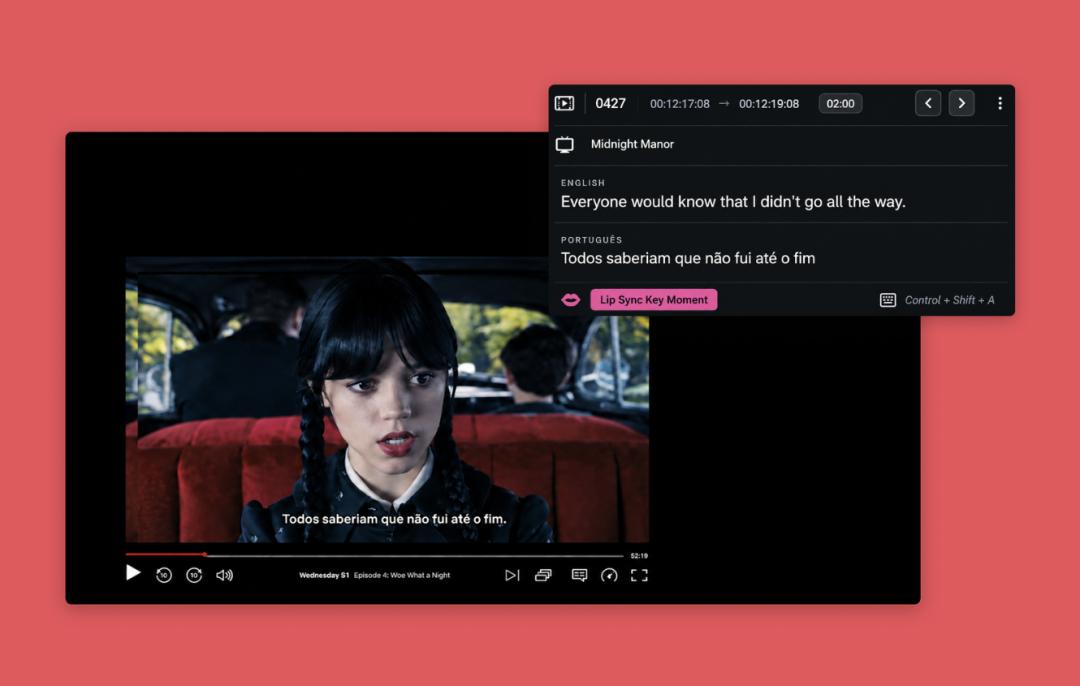
Technical "feasibility" does not equal commercial "worthiness of full-scale implementation". After finding that re-rendering actors' lip animations in post-production is not cost-effective, they changed direction: they built an AI model to help dubbing staff identify moments that need special attention between lip movements and translated lines, and improve alignment by adjusting the translated lines and other methods.
Compared with directly modifying the footage, this solution is less dazzling, but it is more closely aligned with the problem the team wants to solve.
Do not only focus on a single metric and fall into fixed thinking patterns
What you see first on the Netflix homepage is almost all promotional materials: stills, copywriting, and trailers. The recommendation system personalizes them, so if you and your friend watch the same title, the images you see may be completely different. Therefore, a sufficiently diverse material library covering the entire content library is the core of the strategy.
An algorithm that Hollywood has used for a long time assumes that the more marketing money you spend, the more views you get, so directors and showrunners naturally think that streaming platforms work the same way. The team tested this hypothesis and concluded that stills and clips from many titles perform as well as specially customized concept art. Therefore, they automated the production of clips and stills on a large scale, and reserved customized concept art and trailers for the small number of popular titles that truly need them.
But Lock's team soon found that if the system is only optimized towards one easily quantifiable metric, the results may deviate from the user experience the team really wants.
The algorithm is indeed very good at selecting images, and close-up photos of certain actors may indeed attract users to click or watch. But if the system keeps selecting similar images, the homepage users see may become monotonous, and users may not even be able to clearly distinguish a suspense drama from a natural documentary. Worse still, the system may select an actor who does not have many scenes but is attractive to audiences in specific regions as the main visual, which will give users inaccurate expectations about the title.
Later, the team worked with creative experts to formulate more detailed specifications, and adjusted the model and evaluation methods, focusing not only on viewing results, but also on whether the materials fit the temperament of the content and help users understand the work.
Narrow the scope of the problem first, then solve it
When enterprises use AI, it is easy to start from existing processes: gradually hand over every step that was previously done by humans to machines. But Netflix's content tagging work showed Lock's team another possibility: some steps do not necessarily need to be automated, but need to be re-examined.
Almost all of Netflix's systems run on tags. They are words that describe the semantics of the content, supporting the recommendations of the series displayed on the user's homepage. For many years, this work has been extremely dependent on manual labor: content analysts watch the entire title from start to finish, write long contextual documents, and then manually add tags. Tagging a single title can take more than twice the length of the title, and it takes two months to train an analyst who can work independently on tagging.
The team wanted to replace this assembly line with AI-generated tags. But the taxonomy has been built up over years, consisting of thousands of concepts and values. Teams across the company have quietly built processes on certain tags with different weights, and most tags are extremely subjective. These are editorial judgments, not factual judgments. Two people may not even agree on the same tag, let alone machines.
If the entire old process is directly handed over to AI, it is equivalent to assuming in advance that all these steps and tags must be retained. The team therefore first narrowed the scope of the problem: sorted out and streamlined the centrally managed tag concepts, then used multiple models, classification tools and manual review mechanisms to handle the remaining tasks. For results with insufficient confidence, they are then handed over to humans for recheck.
According to Lock, the new technology and process enable some content to complete tagging processing within minutes after entering the system, while the old process could take weeks. At the same time, the work of some positions has shifted to quality governance, model prompting, training and evaluation.
The results are very tangible. Under the new process, tags for a title can go online within minutes after it is added to the library, without anyone needing to watch the entire content, while the old process took weeks. This gives Netflix the confidence to access far more content, including time-sensitive and short-form titles.
AI is an Amplifier, Not a Direction
Netflix's case demonstrates a set of continuous judgment methods: starting from the user experience, listening to front-line voices; clearly describing the future work; openly discussing trade-offs of resources; testing in real scenarios; and being willing to adjust direction when results deviate from expectations.
This method also requires different functions to share responsibilities. Product, technology, operations and creative staff jointly set goals, and regularly discuss current or potential differences, instead of treating AI transformation as an independent task of a single technical department.
Because this is never just a question of "whether the model can complete the task", it also includes a series of questions that need to be answered by humans. For example, why is this task important? Who will benefit from the change, and who will bear the cost? How do we choose when efficiency, quality and trust conflict? If the way of working changes, what kind of support do the relevant people need?
Technology will continuously improve the ability to achieve goals, but the more difficult question is whether we have chosen the right goals. AI can speed up the pace of moving forward. Deciding where to go remains the responsibility of humans.
References
https://review.firstround.com/netflix-ai-strategy/
This article is from the WeChat Official Account "HSG Insights" (ID: Sequoiacap), author: Hong Shan, authorized for release by 36Kr.