Nvidia raked in a massive profit of 65.3 billion US dollars, Jensen Huang said: "I am very willing to come back to serve as CEO."
NVIDIA delivered its first earnings report after Jensen Huang stepped down.
On local time November 17, the U.S., NVIDIA released its financial report for the third quarter of fiscal 2027, which ended on October 25, 2026.
The earnings report shows that NVIDIA's revenue in this quarter reached 115.844 billion U.S. dollars, up 103% year over year and 20% quarter over quarter; net profit hit 65.287 billion U.S. dollars, up 105% year over year; diluted earnings per share was 2.70 U.S. dollars. On a non-GAAP basis, earnings per share was 2.68 U.S. dollars. Gross margin was 74.8%, and non-GAAP gross margin was 74.9%.
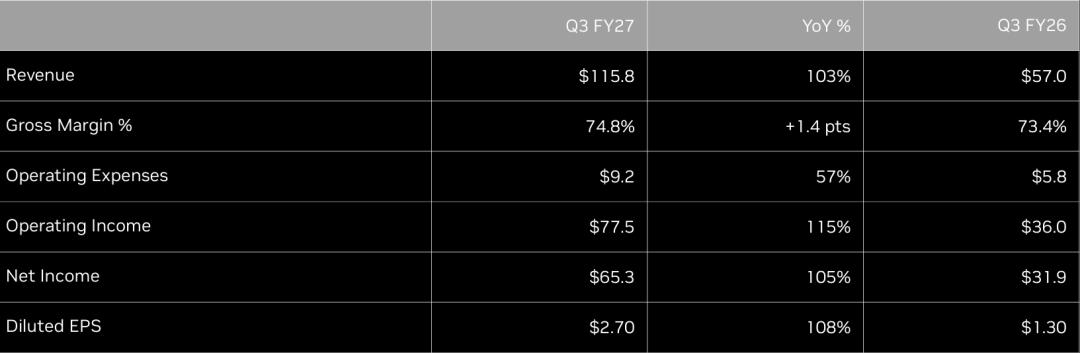
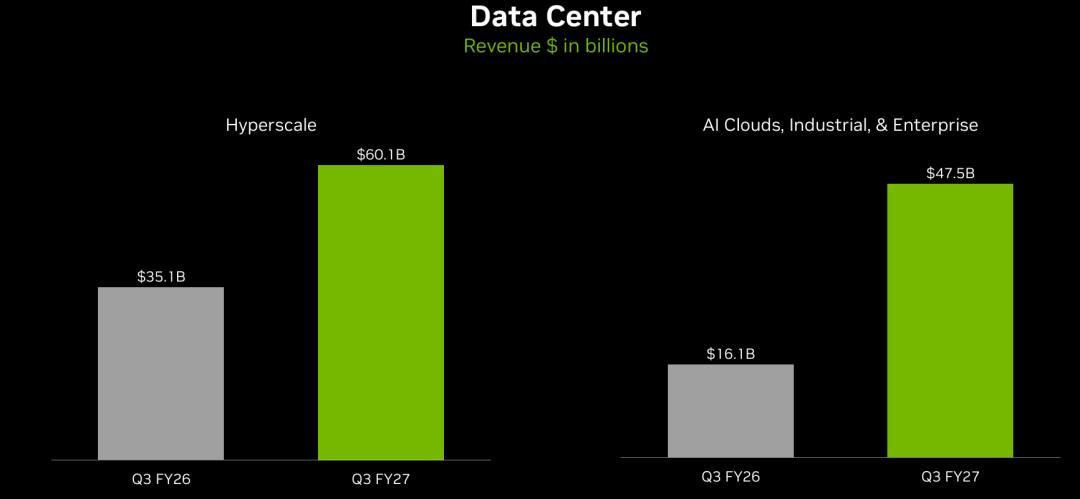
The data center business remains the core growth driver, with revenue in the third quarter reaching 107.6 billion U.S. dollars, up 110% year over year, accounting for more than 90% of the company's total revenue.
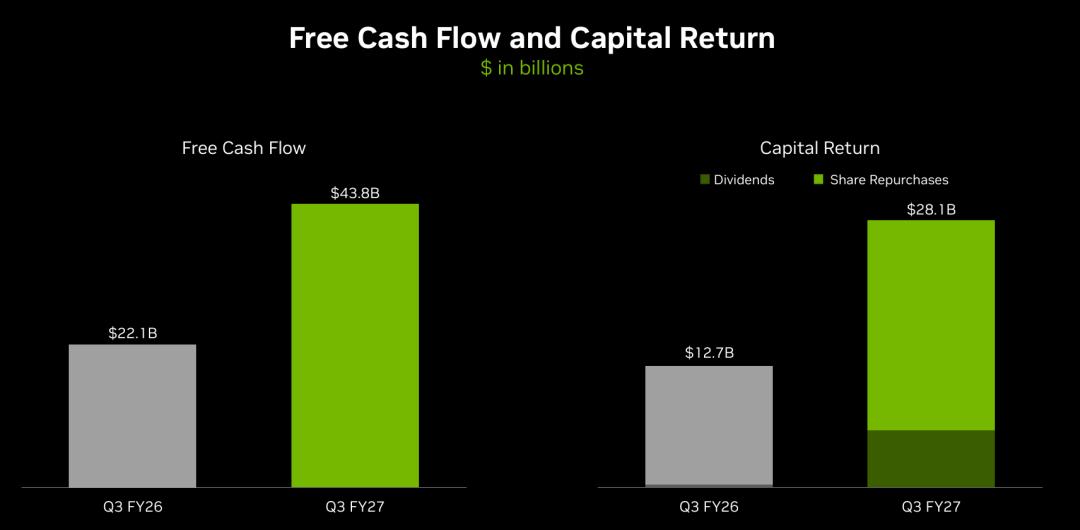
NVIDIA expects its revenue in the fourth quarter of fiscal 2027 to reach 130 billion U.S. dollars, with a fluctuation range of plus or minus 3%. The company also returned 28.1 billion U.S. dollars to shareholders through share repurchases and cash dividends in the third quarter, and the remaining repurchase authorization at the end of the quarter stood at 227.3 billion U.S. dollars.
Compared with the single-quarter revenue and profit, what deserves more attention is the company's preparation for the next stage of growth: the new-generation Rubin computing platform has started shipping, and supply chain procurement commitments and data center infrastructure arrangements are also increasing significantly.
In other words, the demand for AI computing power remains strong, and NVIDIA is taking on more and more long-term investment and cooperation responsibilities to meet the demand in the coming years.
NVIDIA's stock price closed at 155.46 U.S. dollars before the earnings release, down 0.68 U.S. dollars or 0.44%; after the earnings report was announced, the after-hours stock price once rose by more than 4%, showing that the market reacted positively to this performance report.
01
AI Demand is Still Surging
NVIDIA currently divides its business into two major platforms: data center and edge computing. The former covers AI training, inference, enterprise and cloud computing, while the latter covers gaming, workstations, personal computing, robotics and autonomous driving and other fields.
The data center business grew 110% year over year and 21% quarter over quarter in the third quarter.
Interim CEO Cress commented that hyperscale cloud vendors, AI cloud service providers, industrial and enterprise platforms all achieved substantial growth, mainly driven by the launch of Rubin infrastructure, the shipment of independent Vera CPU products, and the continuous growth of Blackwell Ultra.
NVIDIA disclosed that the revenue from Hopper data center products shipped to China in the third quarter was 2.4 billion U.S. dollars. The company also made it clear that the performance guidance for the next quarter does not include any data center computing revenue from China.
The revenue of the edge computing business was 8.2 billion U.S. dollars, up 42% year over year and 14% quarter over quarter. Cress said that strong sales of Blackwell workstations and edge computing demand for Physical AI are the main driving forces for business growth.
In terms of the gaming market, NVIDIA continues to promote the GeForce RTX 50 series, and launched DLSS 5 technology to expand the AI processing capability of game graphics. RTX Spark laptops have also started shipping, with partners including ASUS, Dell, HP, Lenovo, Microsoft Surface and MSI.
The professional workstation business was driven by growing sales of Blackwell workstation products. At the same time, NVIDIA is also expanding its local AI computing product line DGX Spark, launching the 64GB version, allowing developers to run more complex AI models on desktop devices.
However, Cress also mentioned that rising memory and complete machine prices continue to affect consumer PC demand.
02
Rubin Begins to Take Over
The most notable highlight in this earnings report is Vera Rubin NVL72, which has now entered the shipping phase.
NVIDIA says this is the fastest ramp-up product in the company's history. Partners including CoreWeave, Google Cloud, Microsoft Azure, Oracle Cloud and Nebius have deployed related cabinets, and SpaceXSI's infrastructure is also about to go online.
Google Cloud has already opened A5X instances powered by Vera Rubin, and Oracle Cloud also announced that Vera Rubin NVL72 systems and Vera CPUs are officially available. Enterprises including Meta, OpenAI, Nebius and Nscale are also adopting Vera CPUs.
This shows that NVIDIA is accelerating the product transition from Blackwell to Rubin. The company has also launched Rubin HPC for high-performance computing, which is used for scientific simulation, engineering computing and data processing.
The supply chain is also expanding simultaneously. NVIDIA announced cooperation with enterprises including Amkor Technology, IBIDEN, King Yuan Electronics, Samsung Electro-Mechanics, SPIL and Unimicron to expand key manufacturing capabilities.
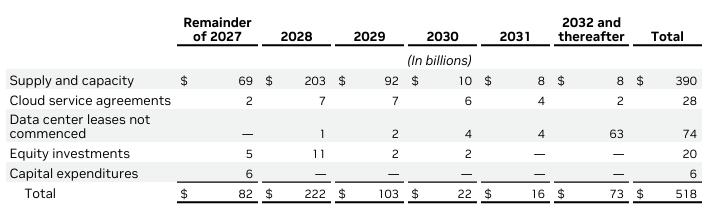
As of October 25, NVIDIA's supply and capacity commitments have increased from 279 billion U.S. dollars in the previous quarter to 390 billion U.S. dollars, and the increased part mainly comes from multi-year memory procurement.
Distributed by performance time, 69 billion U.S. dollars corresponds to the remaining time of fiscal 2027, 203 billion U.S. dollars to fiscal 2028, 92 billion U.S. dollars to fiscal 2029, and the rest is scheduled for fiscal 2030 and beyond.
The growth of this commitment reflects that NVIDIA is locking in the supply of key components for the next few years in advance. In particular, memory supply has become an important link that needs to be addressed for the next phase of AI infrastructure expansion.
But 390 billion U.S. dollars does not mean that NVIDIA has paid the equivalent amount, nor does it mean that these orders will be converted into revenue within one quarter. It more reflects the company's procurement and capacity arrangements to meet future demand. As the speed of product updates accelerates, whether the supply chain can deliver on schedule will directly affect the shipment rhythm of Rubin.
03
Long-term Commitment of 518 Billion U.S. Dollars
In addition to the 390 billion U.S. dollars in supply and capacity commitments, NVIDIA also disclosed cloud service agreements and data center lease arrangements, which totaled 102 billion U.S. dollars, higher than the 74 billion U.S. dollars in the previous quarter.
Cress explained that these cloud service and data center lease arrangements will provide infrastructure support for NVIDIA's R&D, involving engineering design, testing of chips, network products and systems, as well as the development of open models such as Nemotron, Cosmos, GR00T and autonomous driving software.
Among them, the data center leases that have not yet been performed have a maximum term of 20 years, which are expected to be launched gradually from the fourth quarter of fiscal 2027, and the latest will extend to fiscal 2033. NVIDIA also said that it may transfer some of the leases to third parties in the future.
Combining items such as supply and capacity, cloud services, data center leases, equity investments and capital expenditures, NVIDIA's total future commitments as of October 25 reached 518 billion U.S. dollars.
At the same time, NVIDIA is directly participating in the financing arrangements for data center construction of some customers.
Cress disclosed that AI cloud service providers and cutting-edge model companies have very strong demand for infrastructure, but the growth rate of some enterprises has exceeded the scope supported by their own balance sheets and long-term credit status. To this end, NVIDIA has begun to help some customers obtain the land, power and computer room capacity required for data center construction.
NVIDIA has signed relevant arrangements with some emerging cloud service providers, on the premise that these enterprises can obtain financing, purchase NVIDIA infrastructure products, and complete computing power deployment, operation and acceptance. After the conditions are met, NVIDIA can not only obtain revenue by selling infrastructure products, but also may participate in the revenue sharing generated by these cloud service providers providing services to third-party customers.
Such arrangements are also accompanied by credit risks.
NVIDIA disclosed that among the relevant additional commitments, the maximum amount of the emerging cloud service provider agreement is 32 billion U.S. dollars. In addition, the maximum risk exposure of the company's guarantees for land, power, computer room and hardware financing reaches 118 billion U.S. dollars.

In August 2026, NVIDIA signed a guarantee arrangement with SB Energy, a subsidiary of SoftBank, to provide credit support for the infrastructure construction of approximately 4.25GW at the PORTS Pike Technology Campus in Ohio. The campus has signed a lease agreement with OpenAI for a maximum term of 20 years.
The maximum exposure of this guarantee is 105 billion U.S. dollars, but it will not take effect all at once at the time of signing. Instead, it will take effect in stages as the relevant buildings are completed and ready for operation. The first phase is expected to start in fiscal 2029. As OpenAI pays the rent, NVIDIA's guarantee exposure will gradually decrease.
In addition, NVIDIA also disclosed 3.5 billion U.S. dollars in land, power and computer room guarantees for emerging cloud service providers, and 9.5 billion U.S. dollars in power and system credit support guarantees.
NVIDIA made it clear that as of now, no payments have been made under these guarantees.
04
Competitors Are Closing In
NVIDIA's expectations for the fourth quarter of fiscal 2027 remain high, but the gross margin guidance has declined.
The company expects both GAAP and non-GAAP gross margins for the next quarter to be between 71% and 72%, lower than the level in the third quarter. GAAP and non-GAAP operating expenses are expected to be 11 billion U.S. dollars and 10.7 billion U.S. dollars respectively.

Cress explained that the year-over-year increase in gross margin in the third quarter was mainly driven by the improvement of the Blackwell Ultra product mix. The slight sequential decrease is related to the initial ramp-up of Rubin.
This means that after the new generation of products starts delivery, NVIDIA still needs to go through production and supply chain adjustments. Large-scale delivery of system products, component costs and changes in product mix may all affect short-term gross margins.
NVIDIA's operating cash flow in the third quarter reached 48.3 billion U.S. dollars, and free cash flow was 43.8 billion U.S. dollars. The company's cash, cash equivalents and tradable debt securities on the books totaled 53.5 billion U.S. dollars.
Accounts receivable reached 81 billion U.S. dollars, and days sales outstanding increased from 60 days in the previous quarter to 64 days. Cress attributed this to the shipment rhythm during the launch of Rubin, and the fact that some large customers with high credit ratings have obtained longer payment terms under multi-year agreements.
Inventory increased from 31.6 billion U.S. dollars in the previous quarter to 39.7 billion U.S. dollars, which is mainly used to support the ramp-up of Rubin products.
In terms of debt, NVIDIA repaid 1 billion U.S. dollars of senior notes in the third quarter. As of the end of the third quarter, the company's long-term debt was 32.4 billion U.S. dollars, with no short-term debt.
In terms of competition, AMD and Google are two types of rivals that NVIDIA needs to pay continuous attention to.
NVIDIA's competitive pressure is extending from chip performance to cost and supply capacity. With lower prices, continuously improved ROCm software, and performance in some inference tasks, AMD has begun to gain more customer attention.
OpenAI, Anthropic and Meta have all previously stated that they will use AMD chips to run AI models. Some cloud service providers have also found that customer interest in AMD has increased significantly. With the popularization of small open-source models, enterprises are more sensitive to inference costs, and AMD is looking for market space outside NVIDIA's CUDA ecosystem.
Google is expanding external sales of TPUs, trying to stop limiting this self-developed chip to Google Cloud. OpenAI and Oracle have become its potential or actual customers, and some enterprises have also begun to transfer workloads such as model evaluation to TPUs. However, TPUs currently play more of a supplementary vendor role and have not yet replaced NVIDIA GPUs on a large scale.
NVIDIA's response is to continue to expand the coverage of its platform. GPUs, Vera CPUs, NVLink Fusion, Spectrum-X networks and BlueField data processors together form a complete computing system. The more complete the products customers purchase, the more complex the adaptation relationship between software, network and hardware will be.
But this does not mean that competitive pressure has disappeared.
As AMD's products advance and cloud vendors' self-developed chips gradually mature, NVIDIA still needs to continuously prove its advantages in performance, delivery and overall cost.
05
Does Jensen Huang Want to Come Back?
Just before NVIDIA released the earnings report, Jensen Huang broke his silence after leaving his post for the first time, publicly sending a signal of returning.
In his statement, he said that after stepping down, he received support from NVIDIA employees, investors, business partners and customers, and many people hoped that he would return to the CEO position. If the board of directors believes that returning is in the best interests of shareholders, employees, the company and the United States, "I will be very honored to respond to these calls and resume my position as CEO."
