A 59-page long Oxford paper first mentions the concept of "cognitive symbiont", and the new endgame of embodied intelligence has surfaced.
In 2008, the first installment of *Iron Man* was released.
By Tony Stark's side, there was a butler who never appeared in person: J.A.R.V.I.S.
It had known Tony for many years. When Tony talked while working, it would interject to offer help, never requiring Tony to stop and explain the full context all over again.
18 years later, everyone in Silicon Valley is building their own "J.A.R.V.I.S."
In 2025, Mark Zuckerberg stated in an open letter that he would grant everyone a "personal superintelligence", and bet that glasses that can see what you see and hear what you hear will become the next-generation mainstream computing device.
By 2026, Meta's Muse, OpenAI's Dots, and xAI's Grok Bot have been launched one after another. This generation of personal agents stays resident in the background, keeps track of your long-term goals, figures out your preferences, and runs errands for you.
But all of them live in the cloud.
The second you get stuck in a meeting, struggle with a tough decision late at night, or feel helpless in a foreign land, they are not there: they have no idea where you are, who is sitting across from you, let alone what you are feeling at the moment.
The most valuable capability of J.A.R.V.I.S. is exactly what everyone has missed: it is always right by your side.
Then the question arises: how can we let everyone own a J.A.R.V.I.S.? And how much further should it go beyond J.A.R.V.I.S.?
Recently, Hao Fei, a senior researcher at the University of Oxford, posted a 59-page perspective paper on arXiv, answering both of these questions in one go.

- Paper link: https://arxiv.org/abs/2611.05376
- Project homepage: https://cognitive-symbiont.github.io
The core judgment of the entire paper adds another main line to the endgame of AI:
AGI competes on how intelligent the machine itself is; AHI competes on how much smarter a specific individual can become with the help of the machine.
The paper gives this new species a name: "Cognitive Symbiont".
To sum up its setting in one sentence: it stays with you for life, is worn close to your body, is online in real time, is absolutely private, barely disturbs you, and takes the initiative to speak up.
It does not have a physical body of its own, so it borrows yours.
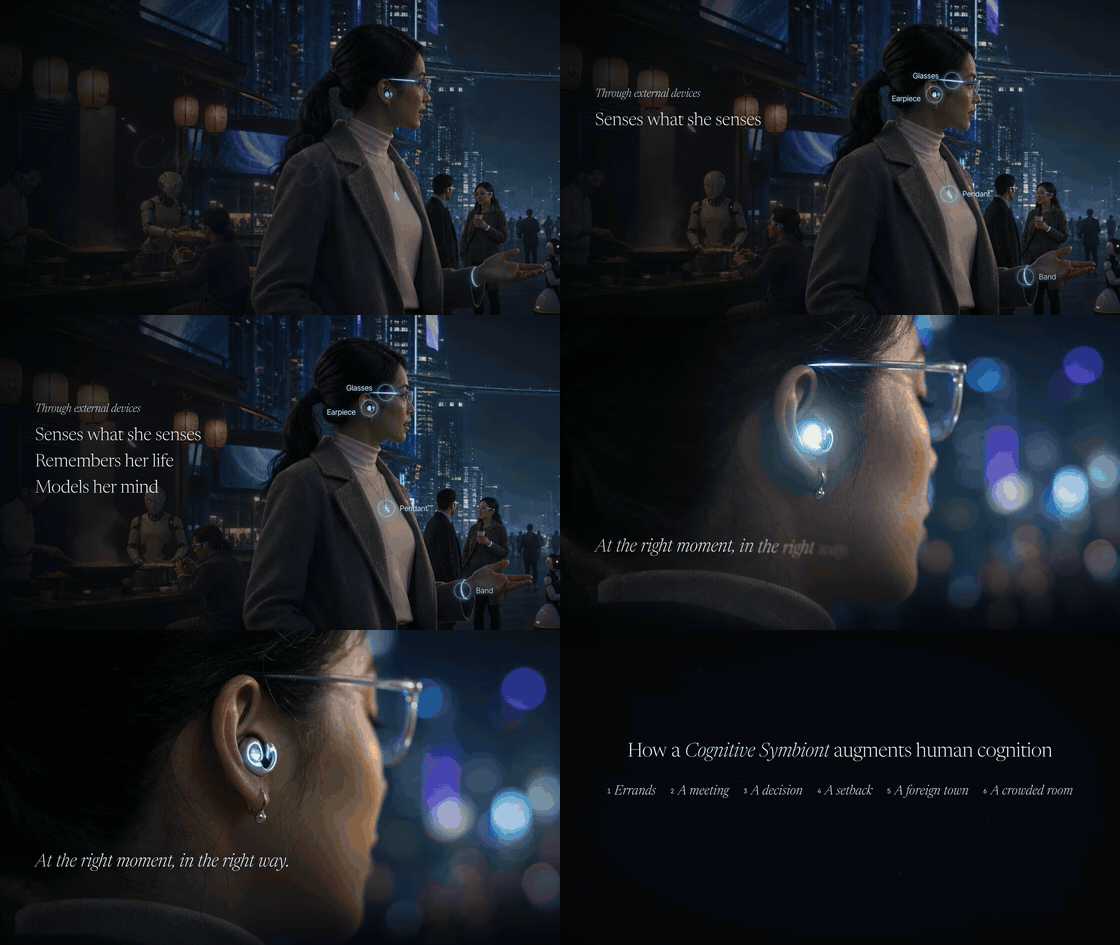
Glasses give it a first-person perspective and a display that shows a line of small text; earphones let it whisper exclusively to you; the pendant picks up audio all day long, and when you speak in a low voice, it records what you say.
Rings and bracelets read heart rate and sleep data, and can send silent commands through myoelectric gestures; computing power, screen content and schedules are handled by your phone and computer.
The outermost layer includes AR projection, silent speech, and even neural interfaces.
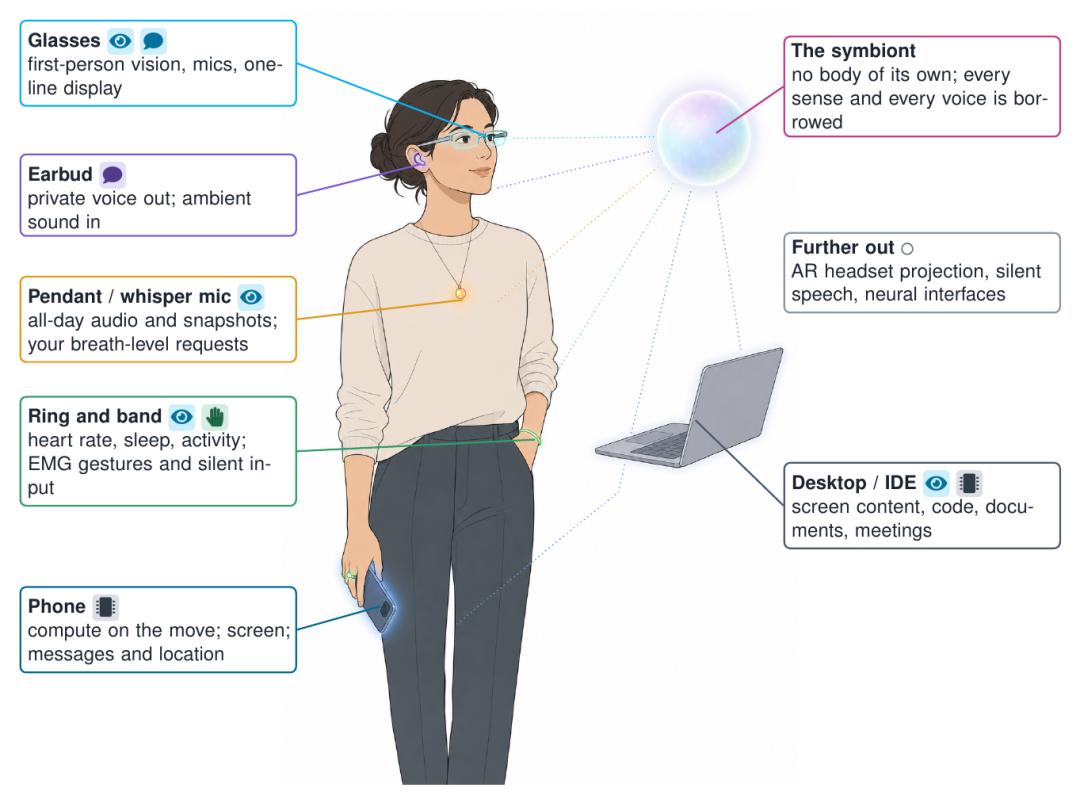
Figure 1: Device constellation. Glasses, earphones, pendant, ring and bracelet each take charge of a part of input or output, with the neural interface at the outermost layer
Its real skill is to hand you exactly the right piece of your own experience, knowledge and commitment that can be used right at the exact moment you need it.
The Fourth Form of Agent Evolution: From the Chat Box to Your Body
The tasks the symbiont performs are completely different from those of today's agents.
Hao Fei sorts out the relationship between humans and agents into four forms: the assistant that answers questions one by one in the chat box, the autonomous agent that dives into the computer to work for you, the personal agent that acts according to your habits in the cloud, and finally the symbiont that sticks to your body.
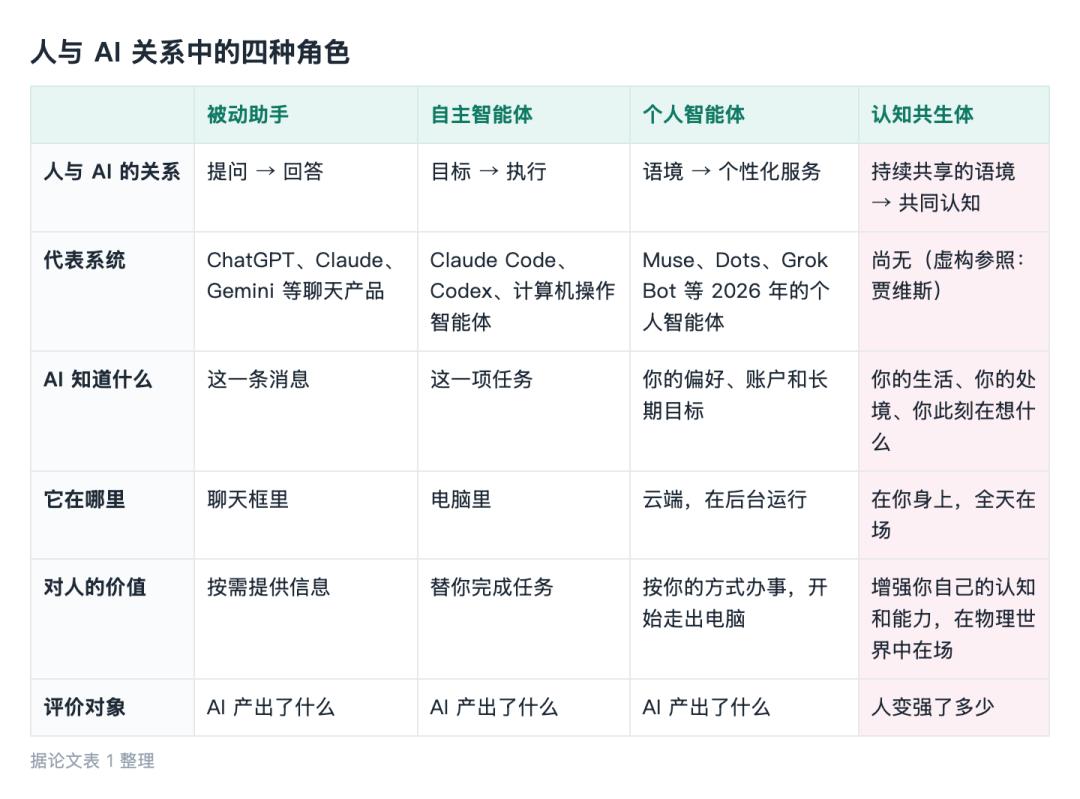
Figure 2: Four forms of the relationship between humans and agents, compiled based on Table 1 in the paper
Looking through the whole process, the information AI masters has evolved from a single message to an entire lifetime, and its position has moved all the way from the dialog box to your body.
The most critical change is hidden in the last line.
The first three forms are all evaluated by what the AI delivers; when it comes to the symbiont, the evaluation target becomes how much you yourself have grown stronger.
The paper also names this new track: AHI (AI-Augmented Human Intelligence).
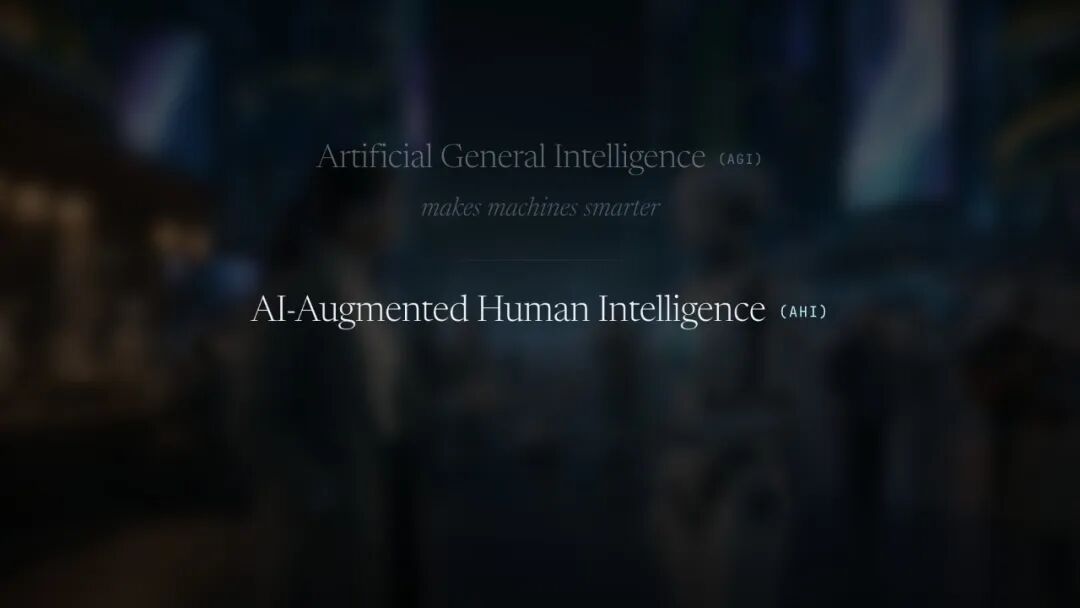
It and AGI are listed as the two main lines of the AI endgame, sharing the same underlying foundation: the same base model can act both as an agent that works for you, and as a symbiont that enhances you as an individual; every time the underlying foundation improves, AHI benefits accordingly.
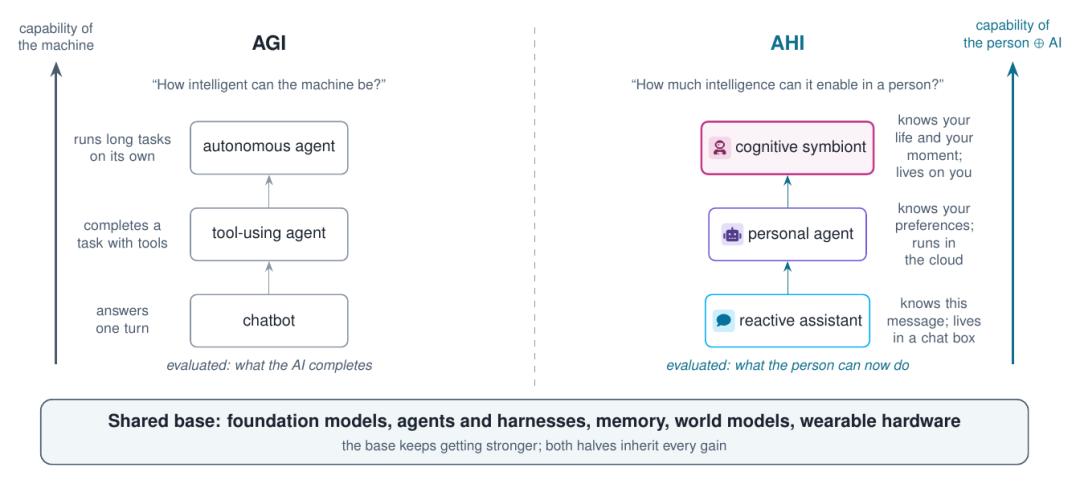
Figure 3: Two main lines of the AI endgame. The left side scores based on what the AI accomplishes, and the right side scores based on what the human individual can achieve now
The symbiont has all the capabilities of the first three forms: it can book flights and modify code as usual. In Hao Fei's words, no one will wear a symbiont that cannot even book flights properly.
Six More Steps Beyond J.A.R.V.I.S.
It Speaks Up the Second You Get Stuck
J.A.R.V.I.S. is already very powerful.
The paper sets six hard metrics for the symbiont: real-time, private, proactive, low-friction, life-embedded, and lifelong companionship. Comparing with J.A.R.V.I.S., it meets all six requirements.
But J.A.R.V.I.S. also has six obvious shortcomings:
- Eyes: J.A.R.V.I.S. perceives the world through Tony's self-built laboratory and armor, while ordinary people only have a few affordable wearable devices in their hands; as compensation, the symbiont has signals that J.A.R.V.I.S. never had: heart rate, first-person video, and the inner thoughts you speak out yourself.
- Mind Reading: What J.A.R.V.I.S. knows thoroughly are schedules, systems and battlefields, while what the symbiont should understand most are your goals, emotions and blind spots.
- Assistance Method: J.A.R.V.I.S. is in charge of execution and alerting, and hardly accompanies Tony to make life choices, get through low points, interact with people or navigate foreign cultures, which are exactly the home ground of the symbiont.
- Growth: After several movies, J.A.R.V.I.S.'s understanding of Tony hardly improves; the symbiont should get to know you better the longer it stays with you, and the entire system should evolve accordingly.
- Popularization: J.A.R.V.I.S. is a custom-made product for a billionaire, while the symbiont needs to become a paradigm that everyone can use.
- Loyalty: J.A.R.V.I.S.'s loyalty depends on the screenwriter, while the symbiont's loyalty must be written into the system architecture.
So the ambition of the paper can be condensed into one sentence: Everyone gets a J.A.R.V.I.S., and it has to go six more steps further.
During a meeting, a colleague suddenly asks for a number in the report you wrote three years ago. You remember the conclusion, but you just cannot recall the number no matter how hard you try.
Before the question is even finished, the symbiont has guessed the direction, pulled out that report, and displayed a line of text on your glasses lens. You answer immediately, using your own words.

The paper calls this "full-duplex cognition": you hold a meeting in the open, while it holds another synchronized meeting in the background.
The slow loop searches for information and conducts verification in the background; the fast loop pushes the prompt to your sight within a second, and the prompt disappears automatically once the timing passes.
More often than not, its best output is to stay silent.
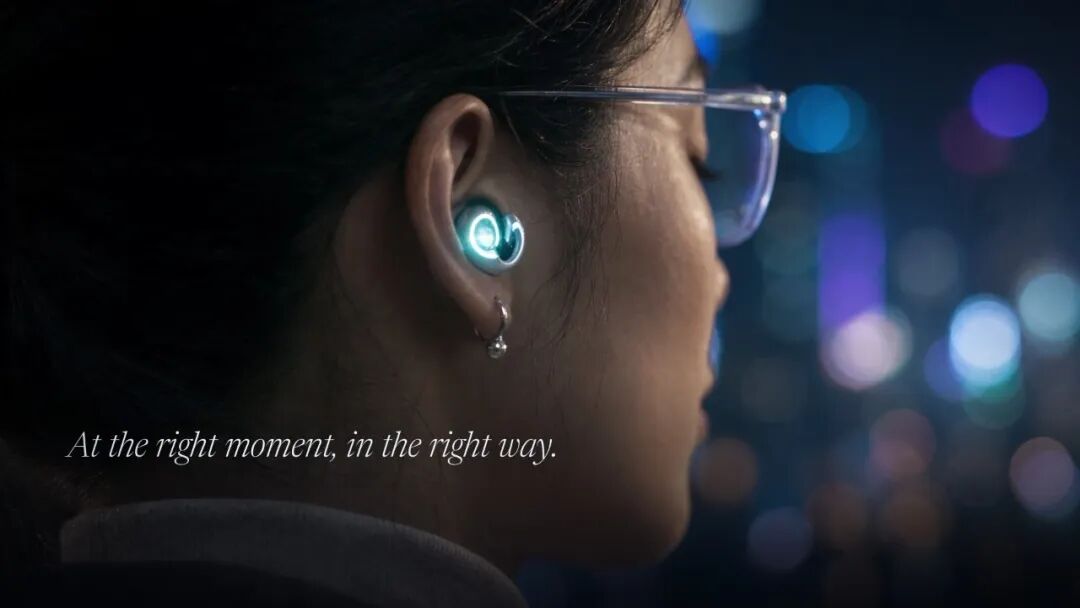
Late at night, you are about to agree to something that you actually should not agree to, and you have been staring at the reply box for twenty minutes, lost in thought.
The symbiont does not persuade you, it only pulls out the reason you wrote down when you turned down a similar invitation half a year ago, and asks: Does this reason still hold today?
The one who makes the final decision is still you yourself.

Another example: at a cocktail party, across half the room, there is a stranger who is working on the exact same problem as you.
Before either of you look up, the two symbionts have already "shaken hands" within the scope authorized by both parties, confirmed that it is worth getting to know each other, and then remind their respective masters. The whole process takes less than two seconds, and no word of internal information of either side crosses the boundary.

The Lesson from F.R.I.D.A.Y.
The Model Can Be Replaced, But the Relationship Must Not Be Lost
Marvel fans all remember that J.A.R.V.I.S. was later "laid off", and Tony replaced it with a new assistant, F.R.I.D.A.Y.
The paper specifically points this out: once the user switches the system, the relationship between the two has to start all over again.
This is exactly the daily experience of every AI user today. The base model is updated every few months, and when you change an app or a pair of glasses, the AI has to get to know you all over again.
Hao Fei's solution is to separate "you" from the model.
Your life records, the AI's understanding of you, the intervention strategy for when it should speak up, plus the framework (harness) it uses to call tools, are all defined outside the base model.
When the model is upgraded, all these contents are migrated as a whole, and can be used again after a calibration period.
In the words of the paper: what truly belongs to you is that set of records and its understanding of you. What is passed down from generation to generation is the relationship, and the weights can be replaced at any time.
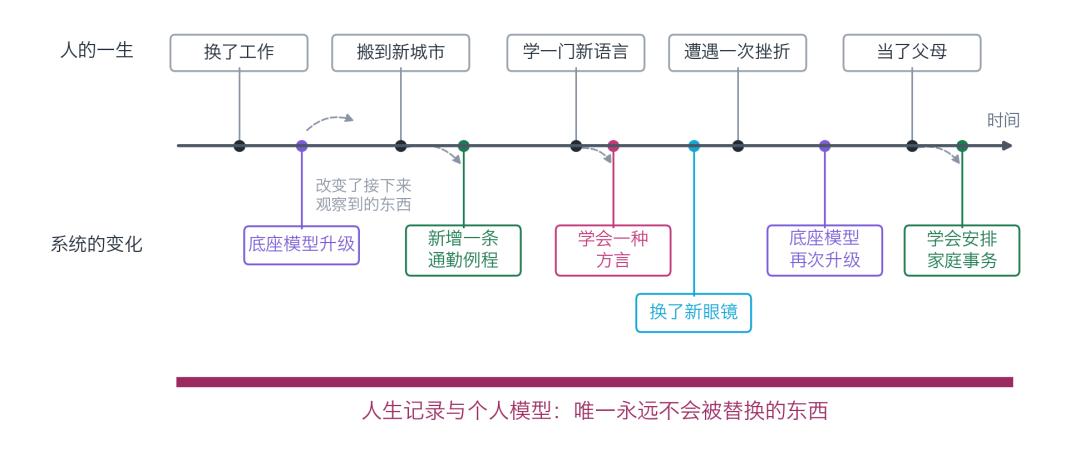
Figure 4: The human and the system evolve together. The upper part shows life events, the lower part shows system changes, and the bottom line is the only thing that will never be replaced (redrawn based on Figure 16 in the paper)
In this design, the system itself is also evolving: it solidifies a set of processes for the things you often do, writes tools on its own, and adjusts the rhythm of the fast and slow loops.
And it only modifies the outer framework: it is readable, auditable, rollbackable, and every step leaves a trace.
One of the nine design principles of the paper is stated very plainly: No matter which layer is replaced, the relationship must be preserved.
J.A.R.V.I.S. Becomes Vision
Humans and Robots Share One Brain
If what was discussed earlier is still a "better-to-use AI assistant", then