The two "twin stars" from Northeast China are expanding southward, targeting the same industry.
On November 16, leading officials of the CPC Liaoning Provincial Committee conducted a special research trip in Shenyang. At Geely's first methanol new energy vehicle production base in Northeast China, he emphasized that efforts should be made to strengthen the layout of the entire industrial chain, give full play to the leading role of core chain enterprises, accelerate the gathering of supporting enterprises, land high-quality projects, and foster emerging pillar industries with strong driving and supporting capabilities.
Over the past week, top Party and government leaders of Liaoning's "twin stars" Shenyang and Dalian have traveled south in succession. From Hangzhou, Wuhu, Shanghai to Ningbo and Suzhou, the new energy vehicle and supporting industries have become a highly focused main line —
Shenyang aims to "enhance the capacity and scale of the Geely Shenyang base, actively build a system for methanol production, storage, transportation and refueling, and attract upstream and downstream enterprises to gather"; Dalian hopes Chery will "increase the production capacity of its local enterprises in Dalian, promote product structure upgrading, expand complete vehicle exports, and drive supporting enterprises to settle in the city".
For Liaoning, the automotive industry is a key pillar of advanced manufacturing, and also an important starting point for accelerating the continuous transformation of old and new growth drivers. In Liaoning's automotive industry layout, Shenyang and Dalian, as the "dual cores", shoulder the important task of leading the clustered development of industries across the province.
According to the plan, by 2030, the revenue scale of Liaoning's complete vehicle and auto parts cluster will reach 450 billion yuan. However, the situation is not optimistic. In the first three quarters of this year, the added value of industries above designated size in Liaoning decreased by 1.9% year on year, among which the added value of the automobile manufacturing industry dropped by 16.3% year on year, and the automobile output fell by 16.5%.
At present, with the "dual cores" making efforts simultaneously, Liaoning, the province with the largest economy in Northeast China, is reshaping its automotive industry.
01
Intensive Southbound Trips
Over the past week, senior officials from Shenyang and Dalian have traveled south one after another.
On November 12, leading officials of the CPC Shenyang Municipal Committee led a team to Hangzhou to inspect and promote key projects; almost at the same time, from November 11 to 14, leading officials of the Dalian Municipal Government led a delegation to visit four cities including Wuhu, Shanghai, Ningbo and Suzhou in succession.
Quite coincidentally, both Shenyang and Dalian have focused their main efforts on the automobile and auto parts industry.
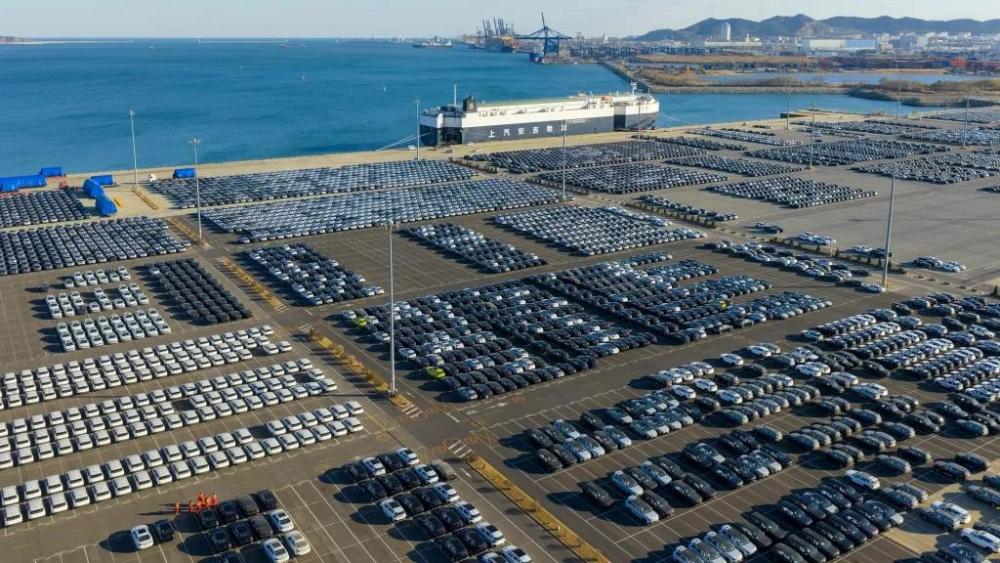
Image source: Daguan News (Photo by Zhu Wanjian)
In Hangzhou, the Shenyang side mentioned that in recent years, the cooperation between Shenyang and Geely Holding Group has been deepening continuously, promoting the sustained growth and expansion of the new energy vehicle industry, especially the methanol vehicle industry.
An important background is that pure electric new energy vehicles generally face pain points such as reduced range and difficulty in starting at low temperatures in northern winter. Not long ago, Shenyang Geely Automobile Co., Ltd. launched a new generation of methanol hybrid electric technology, and launched the latest matching models at the same time.
During the inspection in Hangzhou, the Shenyang side stated that it hopes to enhance the capacity and scale of the Geely Shenyang base, actively build a methanol production, storage, transportation and refueling system, attract and drive upstream and downstream enterprises to gather, and deepen pragmatic cooperation in product R&D, scenario application and other fields.
This is clearly a clear anchor point for the transformation and development of Shenyang's automotive industry.
Compared with Shenyang, senior officials of Dalian are more eager to move forward. During the inspection in Wuhu, the Dalian side proposed that it hopes Chery will further increase the production capacity of its enterprises stationed in Dalian, promote product structure upgrading, expand complete vehicle export business, and drive more auto parts supporting enterprises to settle in Dalian. During the inspection in Shanghai, he proposed that Knorr-Bremse Group should place Dalian in a more prominent position in the enterprise's strategic layout, and expand and strengthen the Dalian manufacturing base.
In fact, Dalian has been at the forefront of Liaoning's automotive transformation. In 2025, the growth rate of added value of Dalian's automotive industry reached 19.5%, and the annual output of complete vehicles reached 387,000 units, of which the output of new energy vehicles was 121,000 units, ranking first in Liaoning province. This growth is mainly benefited from the volume release of new energy models and export growth of Chery Dalian base.
In addition to complete vehicles, auto parts enterprises are also important targets for Dalian. During the inspections in Ningbo and Suzhou, Dalian "targeted" auto parts enterprises — including Jiangfeng Electronics, Jiangfeng Tongchuang, PIA Automation, Joyson Electronics and Inovance, all of which involve key links in the intelligent connected vehicle industry ecosystem. Dalian hopes to encourage relevant enterprises to expand their investment in Dalian and promote the upgrading of the intelligent connected vehicle industry.
This is exactly the direction delineated at the provincial level of Liaoning. Previously, Liaoning clearly proposed that it should give full play to the traction and driving role of leading enterprises, accelerate the promotion of strengthening, supplementing and extending the industrial chain, make the automotive industry cluster bigger and stronger, and enhance the comprehensive advantages and overall competitiveness of the entire industrial chain.
02
Dual Cores Driving Development
Behind these intensive actions comes the realistic pressure of transformation.
As the birthplace of China's automotive industry, Liaoning started from the Minsheng Automobile Manufacturing Plant in 1929, to the Jinbei Automobile Plant in the 1980s, and then to the joint venture project of BMW Brilliance settled in Shenyang at the beginning of this century, always standing in the front row of the national automobile manufacturing phalanx. Until 2016, Liaoning's automobile output reached 1.0788 million units, ranking 11th in China.
But then the trend changed suddenly, and the boom of new energy vehicles swept in. Like many old-established automobile heavy towns, Liaoning lagged one step behind in the wave of new energy and intelligent connected transformation of the automobile industry, and its production and sales scale and ranking began to decline. Data from the National Bureau of Statistics shows that Liaoning's automobile output fell below 1 million units in 2017, and dropped to 748,200 units in 2020, 40% less than that in 2016, and its ranking also dropped to 14th.
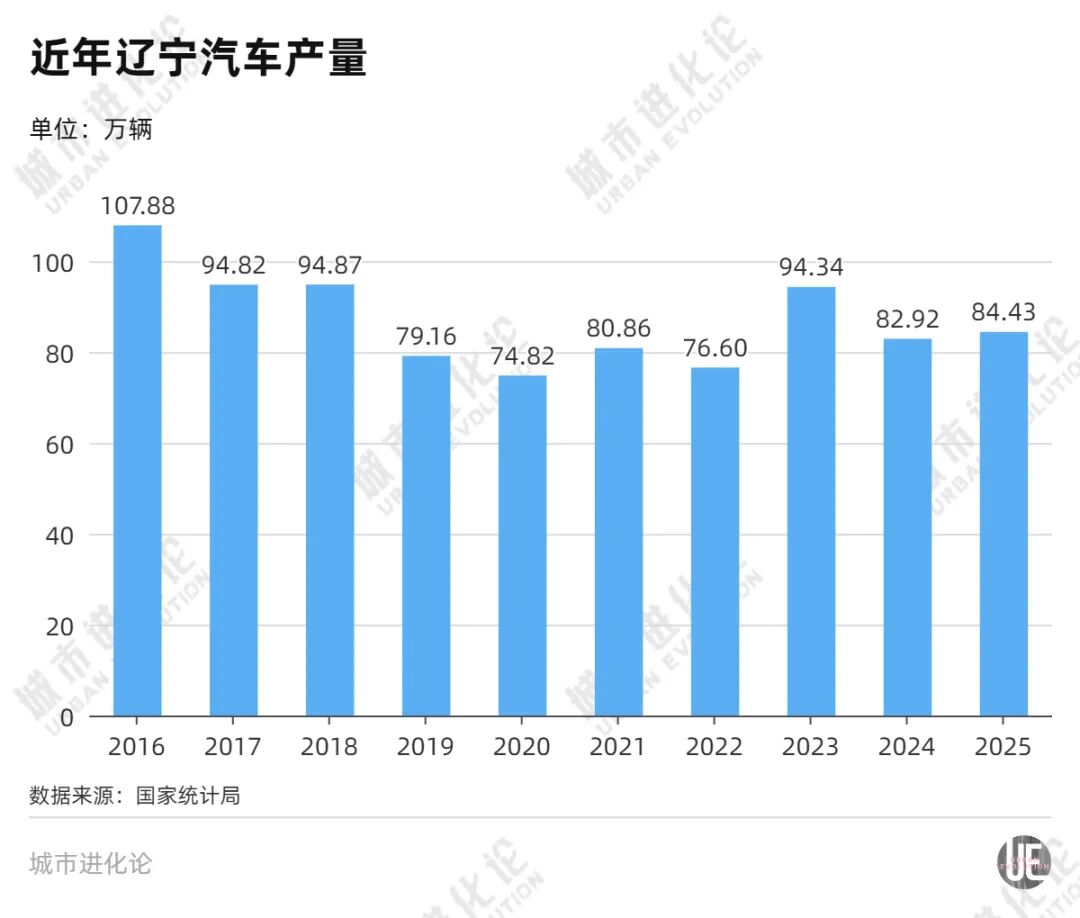
However, since the 14th Five-Year Plan period, Liaoning's automobile output has gradually rebounded with fluctuations, especially with the expansion of production and efficiency increase of Chery Automobile Dalian base, a pattern of dual-core leading has gradually taken shape, and the transformation of new energy vehicles has gradually accelerated.
In 2025, Liaoning's automobile output reached 844,300 units, and industrial transformation was steadily promoted, but it still faced considerable pressure. In the first three quarters of this year, Liaoning's automobile output was 545,300 units, down 8.51% year on year. Among them, the output of new energy vehicles was 165,000 units, up 23.6% year on year.
Between the rise and fall, the signal of Liaoning's automobile industry shifting gears has already appeared.
In March this year, leading officials of the CPC Liaoning Provincial Committee emphasized when investigating key enterprises in the automotive industry chain such as BMW Brilliance, ZF Electric Driveline and EVE Energy, that efforts should be made to vigorously promote transformation and upgrading, strengthen demonstration and guidance, support automotive enterprises to accelerate "intelligent transformation and digital upgrading", promote in-depth integration of industry-university-research-application and collaborative innovation, accelerate the layout of the intelligent connected vehicle ecosystem, and actively seize the new track of the new energy vehicle industry.
It is worth noting that positive signals for the transformation of Liaoning's automotive industry have been emerging recently —
On November 16, the BMW Group announced that the first domestically produced new-generation BMW iX3 was officially put into production at the BMW Shenyang production base, and the mass production of BMW's new-generation models in China officially started;
On November 3, Geely released a new generation of methanol hybrid electric technology in Shenyang, and the Geely Galaxy Starlight 6 EF equipped with this technology was launched simultaneously;
At the same time, relying on the advantages of Dalian Port, the annual output of Chery Automobile Dalian base exceeded 300,000 units, the output value exceeded 30 billion yuan, the local supporting rate of auto parts increased from 2% in 2022 to 40%, and the export scale increased steadily.
In accordance with the overall deployment of Liaoning, the automobile and auto parts industrial cluster is listed as the top priority of the quality improvement and upgrading action for traditional industries during the 15th Five-Year Plan period, which clearly takes Shenyang and Dalian as dual cores to lead and promote the clustered development of complete vehicles and auto parts.
In terms of quantitative indicators, Shenyang proposes that by 2030, the scale of the automobile and auto parts industrial cluster will strive to reach 320 billion yuan; Dalian has also set the goal of "building a 150 billion-level automobile and auto parts industrial cluster" in the 15th Five-Year Plan period.
The performance of the two cities will also become an important scale to test the effectiveness of Liaoning's automotive industry transformation five years later.
03
Full Efforts to Break Through
Liaoning is aiming at more than just the automotive industry.
In the first three quarters of this year, Liaoning achieved a regional GDP of 2.51078 trillion yuan, a year-on-year increase of 2.4%, 2.4 percentage points lower than the national average growth rate. Among them, the added value of the secondary industry was 817.55 billion yuan, down 2.3%. The added value of industries above designated size decreased by 1.9% year on year.
Breaking down the data, the added value of the petroleum, coal and other fuel processing industry decreased by 1.0%, the added value of the ferrous metal smelting and rolling processing industry decreased by 10.5%, and the added value of the automobile manufacturing industry decreased by 16.3%.
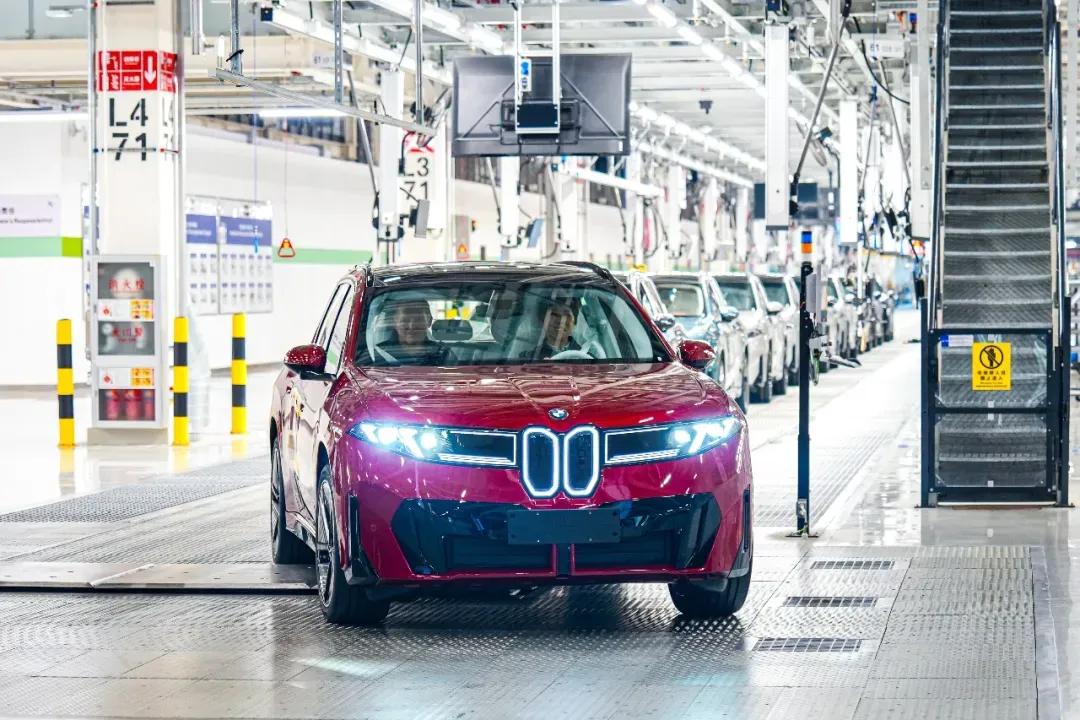
Image source: Liaoning Release
Leading officials of the CPC Liaoning Provincial Committee pointed out in the latest research that it is necessary to base on the industrial foundation and comparative advantages, closely follow the direction of industrial transformation, coordinate the upgrading of traditional industries, the growth of emerging industries and the layout of future industries, develop new quality productive forces in light of local conditions, continue to expand and strengthen advanced manufacturing, and consolidate the foundation of the real economy.
A more specific goal is that in the next five years, the proportion of the added value of Liaoning's manufacturing industry in the regional GDP will increase from 22.7% in 2025 to about 24%.
To this end, Liaoning will promote the quality improvement and upgrading of four trillion-level industrial bases including advanced equipment manufacturing, petrochemical and fine chemical, metallurgical new materials, and high-quality characteristic consumer goods, and continuously consolidate the status and competitiveness of advantageous industries in the national industrial division of labor.
In short, it is to make equipment manufacturing move towards "high-precision, advanced and complete set", make the petrochemical industry "reduce oil and increase chemical production", change from "selling oil" to "selling new materials", make the metallurgical industry "move from raw materials to finished materials", and make consumer goods "go out of Liaoning and go global", so as to further consolidate the foundation of Liaoning's manufacturing industry.
At the same time, Liaoning is also accelerating "new development" in the fields of aviation industry, integrated circuits, new materials and other fields.
Data shows that in the first three quarters of this year, the added value of Liaoning's railway, ship, aerospace and other transportation equipment manufacturing industries increased by 45.6%, and the added value of the computer, communication and other electronic equipment manufacturing industries increased by 6.0%, with the growth potential continuously released.
Among them, Shenyang and Dalian are important supports. In Liaoning's layout, it is necessary to give full play to the leading role of Shenyang and Dalian as "dual cores", support Shenyang and Dalian to accelerate the expansion of economic aggregate, improve development quality, continuously enhance radiation driving capacity, national competitiveness and international influence, and act as the "high jump team" for the comprehensive revitalization of Northeast China.
How to achieve the goal?
Various signs show that Liaoning is trying to take the dual cores as the origin, draw a cross-regional innovation and industrial cooperation axis, promote the flow of factors such as intelligent connected vehicles, aerospace and integrated circuits along the axis, and transmit single-point advantages to the whole region.
But the premise for the axis to be truly formed is that the dual cores can "jump up" at the national level. Building an "innovation highland of intelligent connected vehicle industry in Northeast China" may be the key jump.
This article is from the WeChat official account "City Evolution", written by Dan Zhongkui, authorized for release by 36Kr.