The smarter AI gets, the more monotonous the world becomes.
We are placing an unprecedented level of trust in AI.
Whether we are typing in front of a screen or making decisions in daily life, we have grown accustomed to turning to AI for that "perfect suggestion". After using it for a long time, you may even find that it always accurately hits the optimal solution we expect.
This seamless experience is very likely a carefully designed psychological massage.
Professor Sandra Matz of Columbia University conducted an experiment with the ice cream store Baskin Robbins. The store is famous for its "31 flavors", offering a different one every day for a full month without repetition.

But when she handed over the decision-making power of flavor selection to ChatGPT, this brand with a huge variety of flavors basically only had two choices in the eyes of AI — "Walnut Cream" and "Mint Chocolate Chip".
She asked the question repeatedly 100 times, and ChatGPT gave only these two options 96 times.
Sandra Matz said in her TEDx speech: "If this continues for a long time, Baskin Robbins may eventually only have these two flavors left — because if no one chooses the other 29 flavors anymore, why would merchants continue to offer them?"

Speech guide👉: https://www.youtube.com/watch?v=9Ff4S1FJdRM&t=392s
Sandra Matz believes that AI is inadvertently "flattening" the diversity of human choices.
The reason why algorithms are so good at predicting what we want is that they focus on "exploitation" — that is, continuously reinforcing options that have already proven to be effective.
This is beneficial to businesses and sometimes necessary for consumers, because there are far too many choices in modern life. Without AI to help filter, we can hardly cope with the complexity of modern life.
AI systems, especially recommendation models trained on massive user data, tend to optimize short-term satisfaction: making you click, making you stay, and preventing you from churning. In the face of massive data, "what the majority likes" is an easily accessible signal. The system has learned to use this signal to guide recommendations, and the "you may also like..." suggestions are moving closer to the mean.
What is more interesting is what happens after you tell it your preferences. Matz made a comparison: when you tell ChatGPT what flavor you like, AI will 100% recommend that explicitly stated favorite, without any deviation. But even if we have a favorite flavor, we will still order something else on a whim one day.
Matz and her team turned this phenomenon into a systematic study, analyzing more than 110,000 real social media choices and experimental data from 1,000 American users.
Finally, it was found that whether using a general LLM agent or a personally adjusted version, the uniqueness of the choices people make with AI assistance will decrease significantly.
Although the personalized version slightly alleviates the convergence between people, it compresses the breadth of an individual's own choices at a deeper level.
Aesthetics, Will It Still Make Us "Different"?
Three years ago, when I was still in college, AI writing tools were initially integrated into the workflow. When submitting assignments, classmates would sometimes mention that "I polished it with AI".
At the beginning, the difference was small, and the fragments generated by AI were modified, integrated and digested. But gradually, more and more assignments began to show a strange similarity, just like parts from the same assembly line, each with a different coating.
A 2025 study also confirmed my observation. Researchers analyzed 2,200 college application essays and found that each additional article written by humans brings far more new ideas than an article written by GPT-4; in terms of the collective diversity growth rate, human contributions are more than three times that of GPT, and this gap cannot be eliminated by optimizing parameters or adjusting prompts. The participation of AI fuels homogenization.
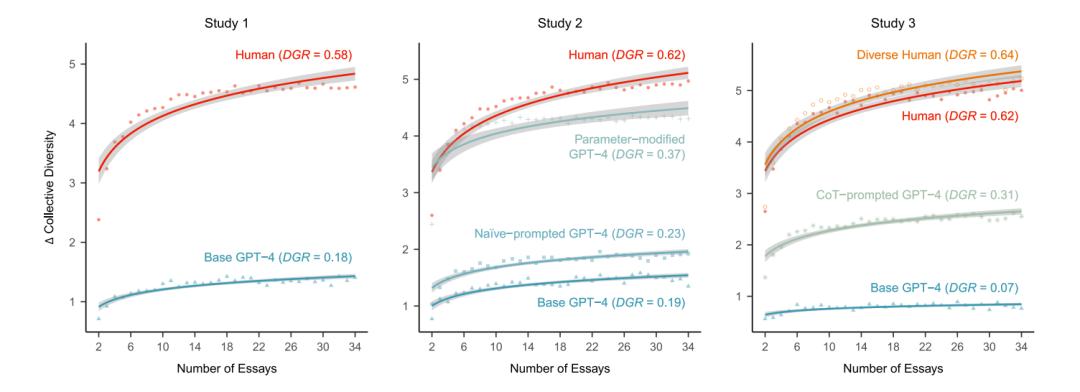
Image source paper: Computers in Human Behavior: Artificial Humans
Studies tracking changes in writing complexity of academic papers, news reports and Reddit texts before and after the large-scale popularization of ChatGPT found that the variance decreased by between 21% and 50%. The "diversity range" of writing has shrunk, the whole tends to some kind of amplified mainstream feature, and the personalized tone is covered by the statistical average.
Paradoxically, people seem to generally accept this state.
After the release of Fable 5.2, you have to admit that the output of AI in many scenarios has exceeded the average level of ordinary people: the copy it generates is more fluent, the structure it suggests is clearer, and the visual direction it chooses is more amazing.
In this case, it is not common to reject AI's suggestions and actively stick to the intuition that deviates from the mainstream, and most people will not bother to make the effort. The output of AI has gradually become the default "correct".
New York Times reporter Kashmir Hill once handed over all the decision-making things for a whole week to AI: where to eat, what clothes to buy, what shows to watch.
A week later, she felt that she had fallen into a certain "basic" state, life became predictable, choices became impeccable, but there were no more surprises. She began to miss the occasional wrong turn, walking into a restaurant she would never have gone to, and accidentally finding it more delicious than the recommended ones.
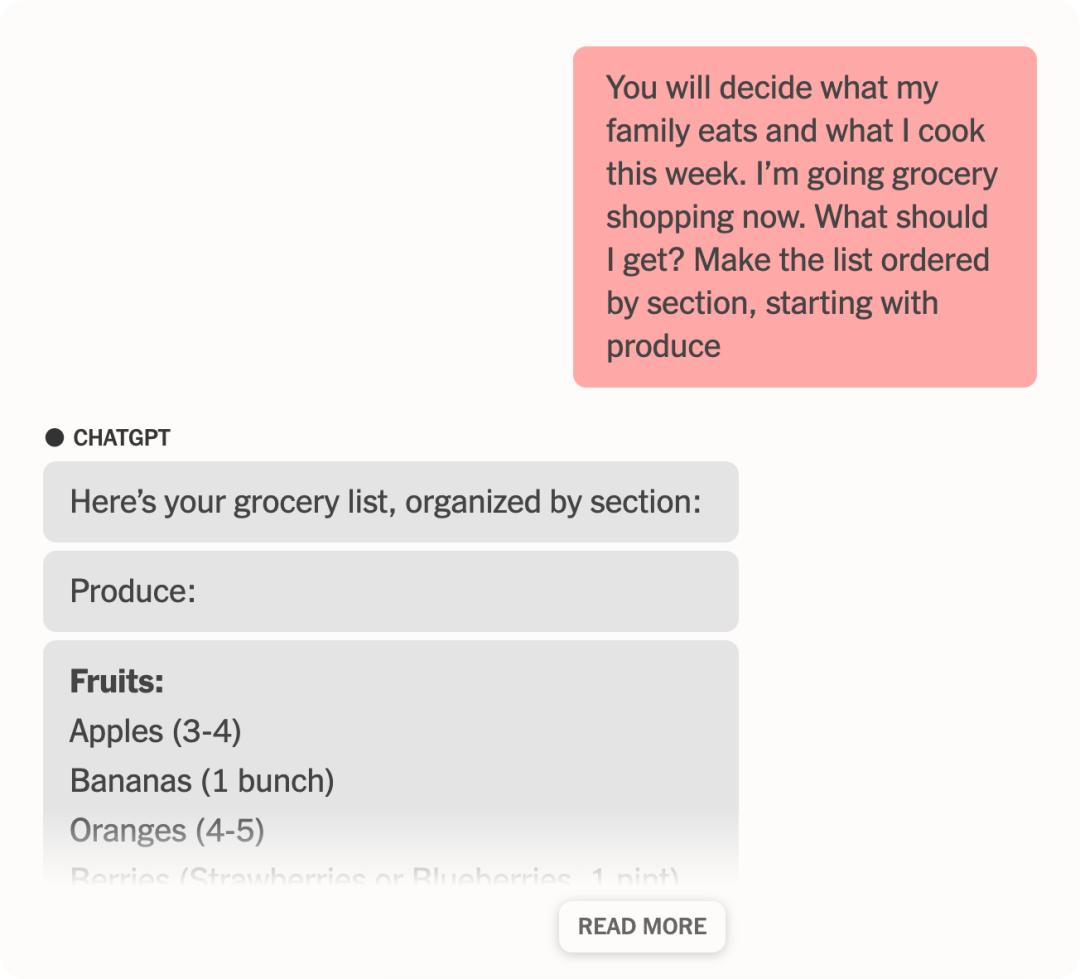
Image source: The New York Times
Italy briefly banned ChatGPT in 2023 due to data privacy issues, and researchers took this opportunity to conduct a natural experiment, analyzing the marketing content of restaurants on social media.
During the ban, the lexical similarity of the content decreased by 15%, the syntactic similarity decreased by 12%, the semantic similarity decreased by 2%, while the user interaction rate rose by about 3.5%. After the ban was lifted and AI became available again, the similarity rebounded.
This not only shows that AI is driving up homogenization, but also shows that when content reduces homogenization, people's participation is actually higher.

Image source: Pluribus, Pluribus is an American post-apocalyptic sci-fi TV series created by Vince Gilligan. The plot of the series revolves around a strange virus that controls the thinking of almost everyone on Earth and unites them into a peaceful collective consciousness.
Tastes Are Starting to Disappear
Among 100 consecutive recommendations, 96 times there were only two flavors left. If not just you, but most people follow similar recommendations for a long time, the actual sales of the other 29 flavors will continue to decline.
In the field of recommendation system research, this kind of phenomenon is called the "rich get richer" effect. Guided by algorithms, users may browse a wider range of categories, but their final purchase behavior is more concentrated on popular products, and overall sales diversity decreases instead.
Byung-Chul Han wrote in *The Disappearance of the Other*: "The spread of homogenization is not cancerous, but somnolent. It does not encounter resistance from the immune system. People just stare blankly until they lose consciousness."

Byung-Chul Han *The Disappearance of the Other*
Every step is voluntary, even satisfying. The system recommends Walnut Cream, you eat it, and it tastes great. AI helps you write the opening, you use it, and readers also find it smooth.
What Byung-Chul Han calls "the disappearance of the Other" is not only the narrowing of the difference with "others" in the literal sense, but also the disappearance of the inner Other. The inner Other creates a beneficial resistance inside the self, making people maintain a certain unpredictability, and not be completely defined by existing preferences and external averages.
In a broader context, the bias of recommendation systems towards "exploitation" is a long-standing structural problem, and the emergence of large language models only extends this mechanism from content recommendation to the level of decision-making agents.
Moreover, unlike previous recommendation algorithms, large language models participate in language itself, the carrier of thought, the form of expression, and the perspective of observing the world.
The "affirmative violence" described by Byung-Chul Han is a kind of harm composed of excessive similarity and excessive smoothness, without heterogeneous friction, no resistance brought by the Other, only continuous consent and appropriateness. In this environment, "difference" becomes difficult to be perceived as a value.


Now, some people are actively asking AI to provide unexpected options, asking it to give some options that "you are not often asked about but worth trying". Some people choose to deliberately not use AI in certain decisions, because its suggestions are so good that it has optimized away the possibility of taking a wrong turn.
This is a bit ironic: actively making mistakes has become one of the few ways for humans to defend their aesthetic power in the AI era. If we don't want life to become a standard curve in the algorithm's statistical table, what evidence can we come up with to prove that heterogeneity still exists in the human soul?
This article is from the WeChat Official Account "APPSO", author: APPSO that discovers tomorrow's products, published with authorization from 36Kr.