Is it more challenging to "identify AI-generated content" than to "use AI" in Jinjiang? We self-tested 30 pieces of content and obtained the following results...
Recently, Jinjiang Literature City has also been caught up in the controversy over AI-generated content.
At the start of this month, readers have been posting AI detection results for novels on Jinjiang on social platforms one after another. Multiple chapters of some works are marked with an AI suspicion rate of over 80%, and the involved works range from ordinary online novels to works by top-ranked authors on the leaderboard, even including some novels whose copyrights have been sold.
As more and more works are collectively "AI-checked" by netizens, the controversy has shifted from whether authors use AI to how the Jinjiang platform identifies and handles non-compliant creations. Some readers believe the platform's enforcement is insufficient, but the accuracy of AI detection tools such as Zhuque itself is also questioned. Authors who insist on original creation have also taken action, calling on the platform to resist AI-generated content to protect the enthusiasm for original creation.
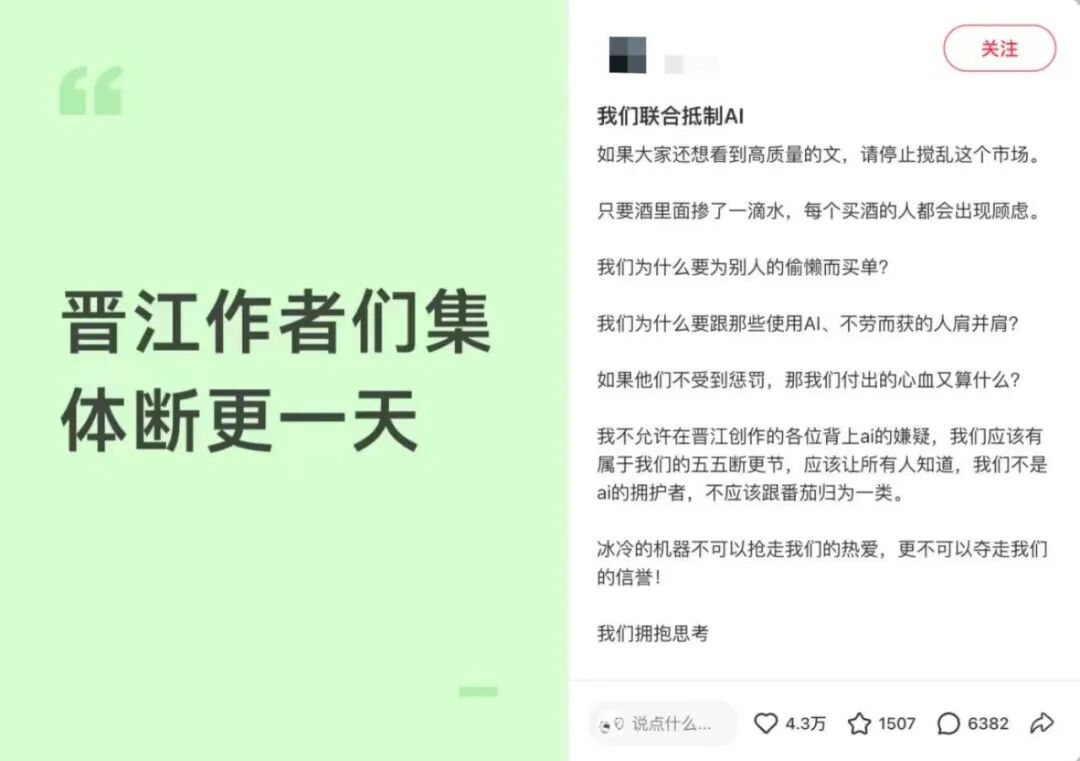
Jinjiang authors post to resist AI creation (Source: Xiaohongshu)
To verify the accuracy of this wave of AI checking, the reporter of Yule Zibenlun also tested more than 30 online novel samples, and the results are naturally far from accurate. But we found it is more like the style of Chinese universities that follow the principle of "lenient graduation with strict admission": getting a graduation certificate does not necessarily mean you have real skills...
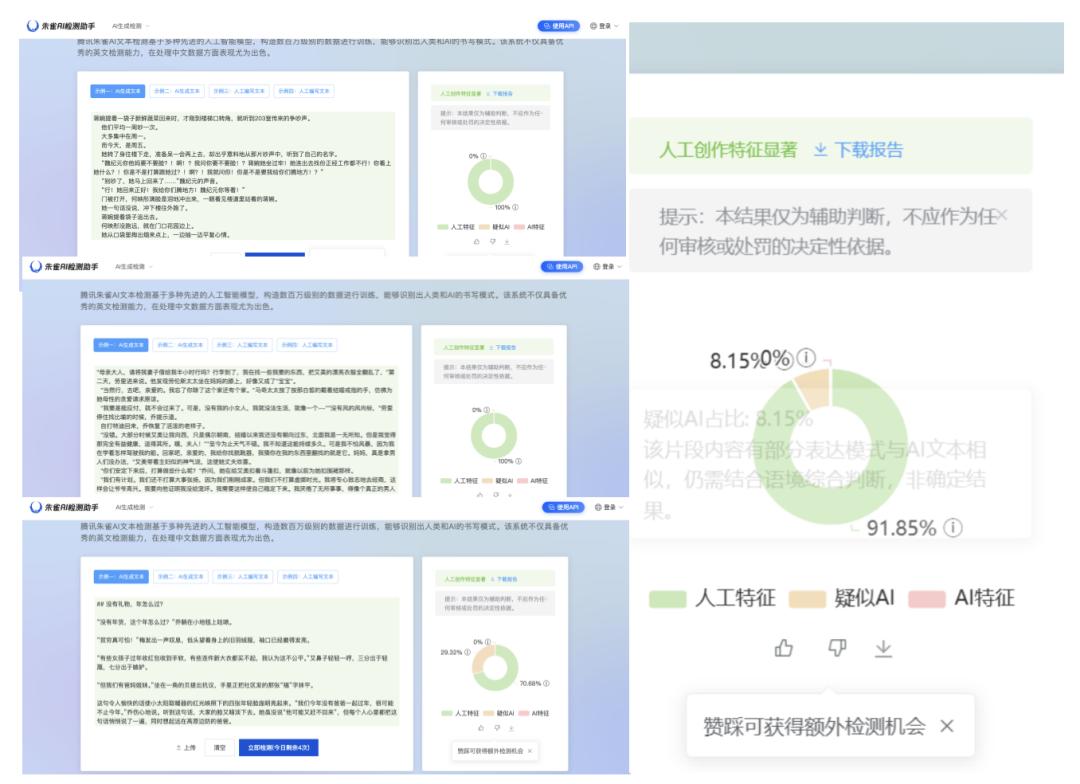
The results obtained by Xiaoyu after testing different text samples, including original works from China and foreign countries, pure AI-generated text and original novels, etc. (Source: Zhuque AI Detection Tool)
1
Large-scale "AI checking" of Jinjiang works, the reason is that AI content is too hard to distinguish?
In fact, the doubts about AI writing targeting Jinjiang novels did not just emerge recently.
Previously, a netizen on Weibo posted that he found suspected AI-generated works on the modern romance leaderboard of Jinjiang, lamenting that it has become increasingly difficult to distinguish AI writing through text style. This post received more than 10,000 likes.
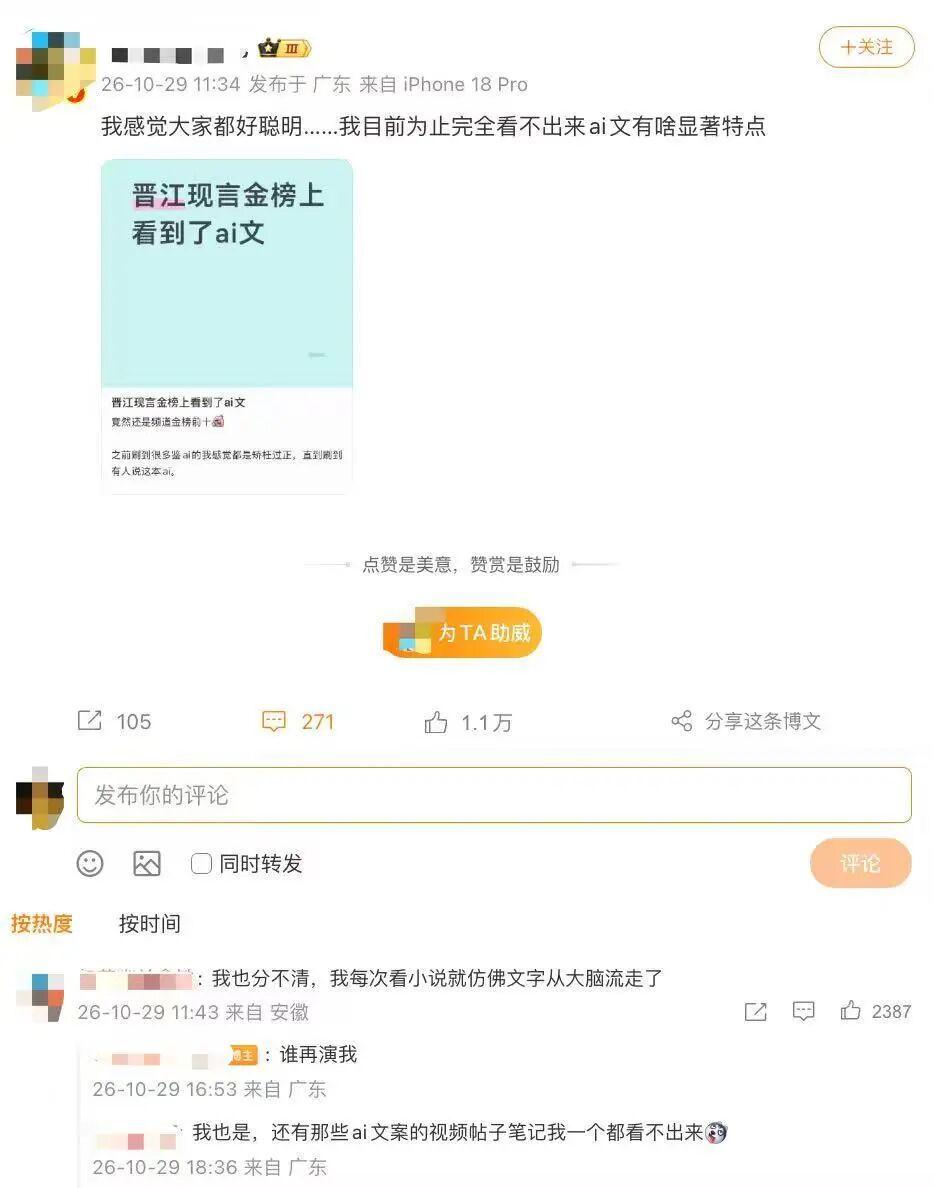
Discussions on identifying AI-generated articles on Jinjiang. (Source: Sina Weibo)
As the volume of discussion grows, more and more readers begin to use AI detection tools such as Zhuque to detect Jinjiang novels chapter by chapter, and post the results on social platforms.
A Weibo netizen posted multiple detection screenshots, claiming that the work of a top-ranked Jinjiang author on the leaderboard was detected to have an AI suspicion rate of over 60%. Another netizen found that a historical romance novel with about 50,000 collections had an AI detection suspicion rate of over 80% in multiple chapters.
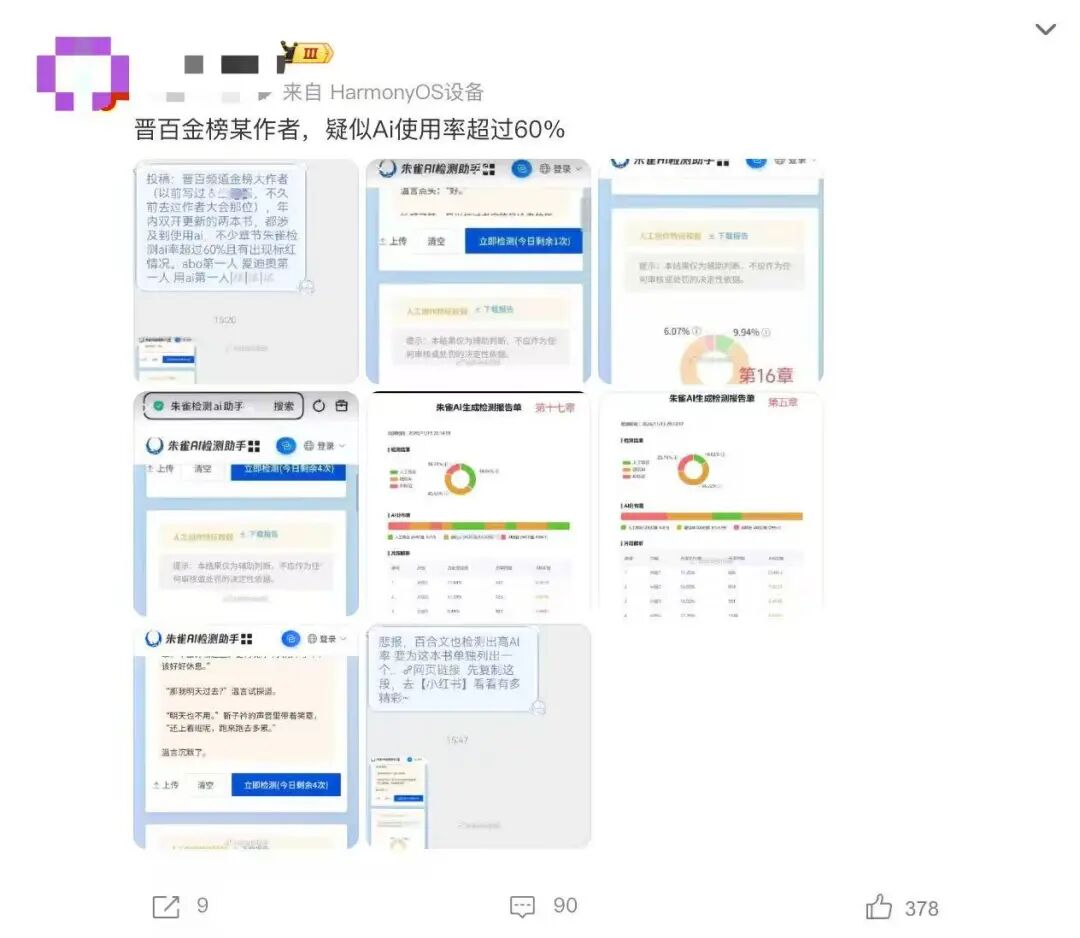
(Source: Sina Weibo)
The controversy also involves some works whose copyrights have been sold. Some netizens questioned that if highly commercialized online novels also contain AI-generated content, whether readers and copyright purchasers should be informed in advance. Some readers also said that if the work is created with AI, they will not be willing to pay for it.
Compared with detection, what is more controversial is that some authors were found by netizens to have suspected residual AI modification instructions in the main text of their novels. This was denounced by readers as an act of "completely disrespecting originality", because their works did not even go through the most basic modification, but directly copied the content generated by AI tools.
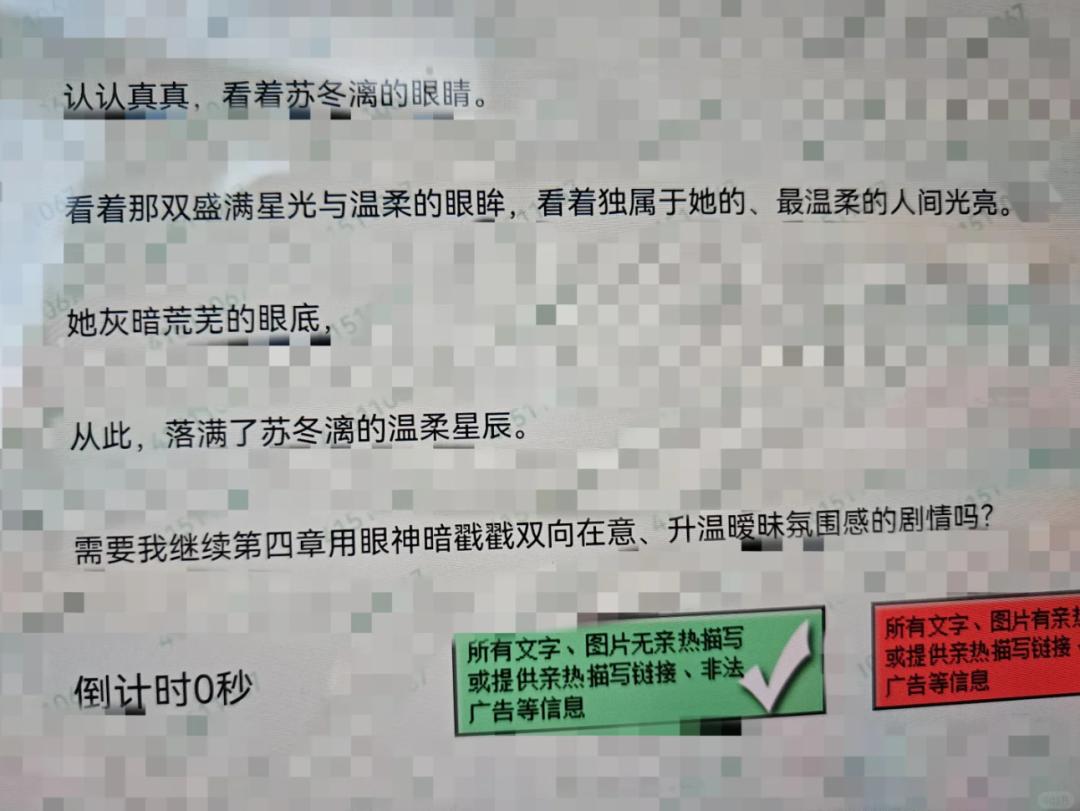
A reader found obvious residual instructions left by the author when using AI tools for creation while reviewing Jinjiang works. (Source: Xiaohongshu)
Apart from readers, creators on the platform also hold a strong attitude of resistance towards using AI tools for creation, believing that such competition is unfair to authors who insist on original creation. At the same time, some netizens pointed out that the platform currently does not supervise the use of AI creation among top authors, and those who are punished after detection are often new authors or authors with low popularity. This also makes many authors start to worry about being affected and fall into the crisis of proving their own innocence. Up to now, Jinjiang has not responded to this wave of controversy.
2
Top-ranked authors on the leaderboard are questioned, what about the money readers paid?
So, if a novel is exciting enough to read, will you care if it uses AI? If the novel you paid for is found to contain AI-generated content, will you request a refund? And when the AI detection tool itself may make misjudgments, should the platform "rather kill the innocent than let the guilty go"?
This controversy over AI writing may continue.
Different from free platforms, Jinjiang relies on the model of readers paying for subscriptions to unlock VIP chapters to generate revenue for the platform and authors, and the premise that readers are willing to pay for it is that the output content meets the reading experience. One of the reasons why many readers uphold originality and resist AI is that their reading experience has been compromised.
Therefore, when not only new authors, but even top-ranked authors who have accumulated a reader base start to use AI for creation, long-time paying readers begin to question whether they are paying for original content or AI tools, and if the content they have consumed is found to use AI, what exactly their subscriptions count for?
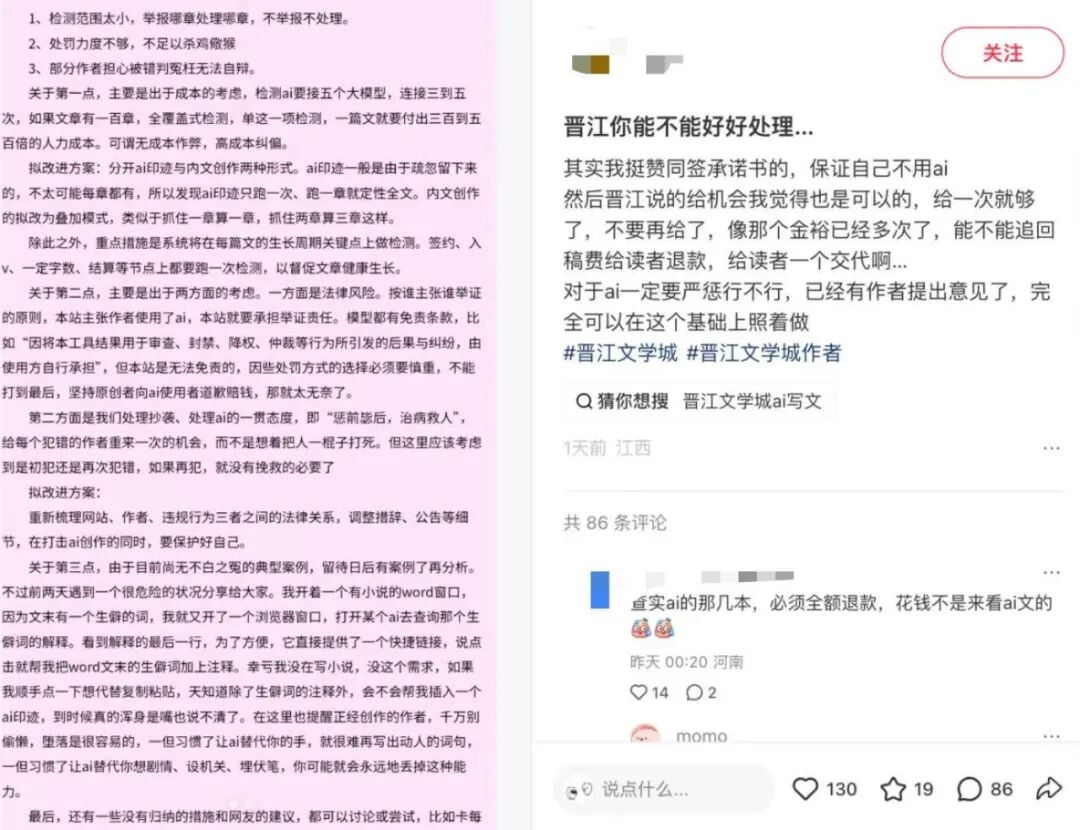
Some readers' attitudes towards paying for "AI-generated" works. (Source: Xiaohongshu)
Many readers said that their payment behavior is to encourage the original labor of authors. If they find that authors use AI to generate content, they will not continue to pay for it; if authors use AI tools without marking it, and still charge for the content as original, it will betray readers' trust, and some readers even shout "refund the money".
For the act of using AI for creation, the platform's current intervention method is to sign the "Original Creation Commitment Letter" with authors. This is also because the accuracy of detection tools is indeed limited, and since large AI models also produce content by learning manually created content, detection tools often make misjudgments when facing purely manually produced content.
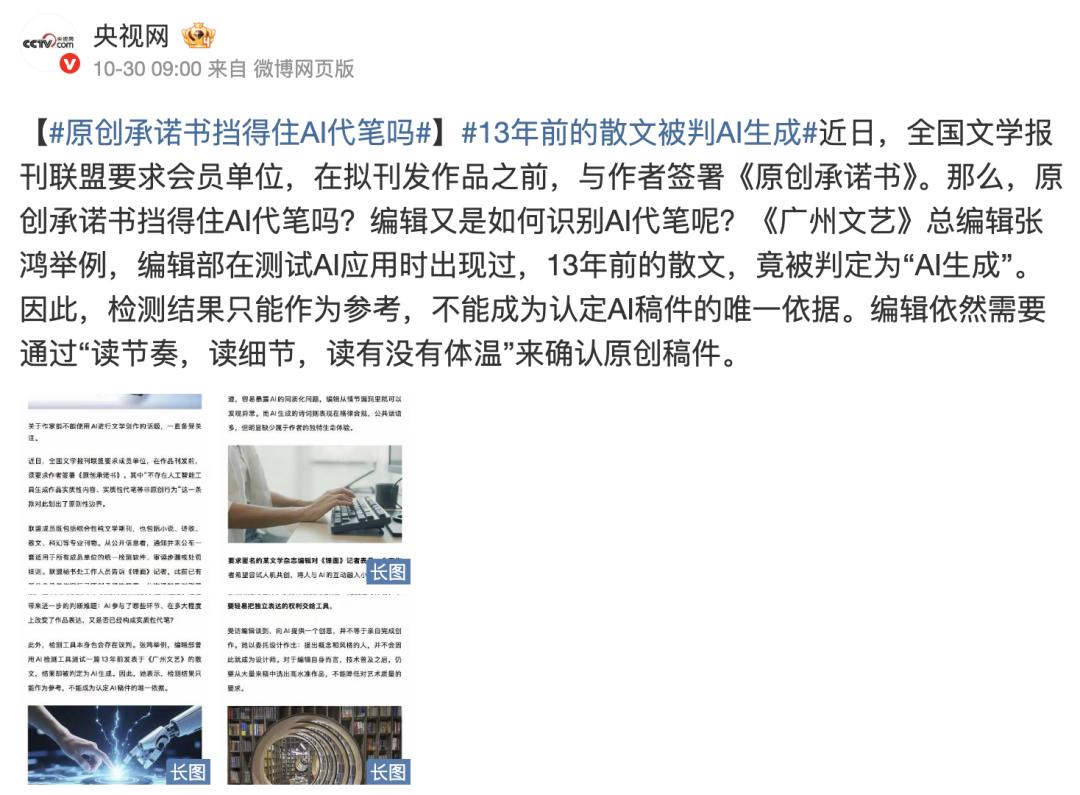
When testing AI detection tools, there is a phenomenon that works created before the emergence of AI tools are misjudged as "AI-generated". (Source: Sina Weibo)
But there are also different voices about whether the use of AI tools affects the commercial value of works.
One view holds that since subscription content is paid for the reading experience, whether the tool that produces the content is AI does not actually affect the subjective judgment of whether the work itself is wonderful. But some readers insist that manual creation is the premise and one of the important values of content payment, and using AI without telling readers will affect consumers' purchase decisions. Furthermore, for works whose film, television and other copyrights have been sold, the controversy extends to whether disclosure should be made to the copyright holders, and whether different degrees of AI use should be subject to the same charging rules.
The core problem of this controversy ultimately lies in what exactly readers are paying for? The final presented story, or the labor the author put in during the creation process?
3
How accurate is AI detection? 30 novels tested show inconsistent results
Out of curiosity about the accuracy of "AI checking", Yule Zibenlun used the Zhuque AI detection assistant to test more than 30 online novel samples, including completely AI-generated text, newly released chapters before and after the controversy, and article samples created before the emergence of AI tools. The reporter found that Zhuque cannot achieve very high accuracy in detecting AI-generated content, and even has cases where part of the text generated word for word by AI is identified as manually created. But it basically does not identify manual text as AI works, so at present it is more like an AI text detection tool that follows the "strict admission, lenient graduation" principle.
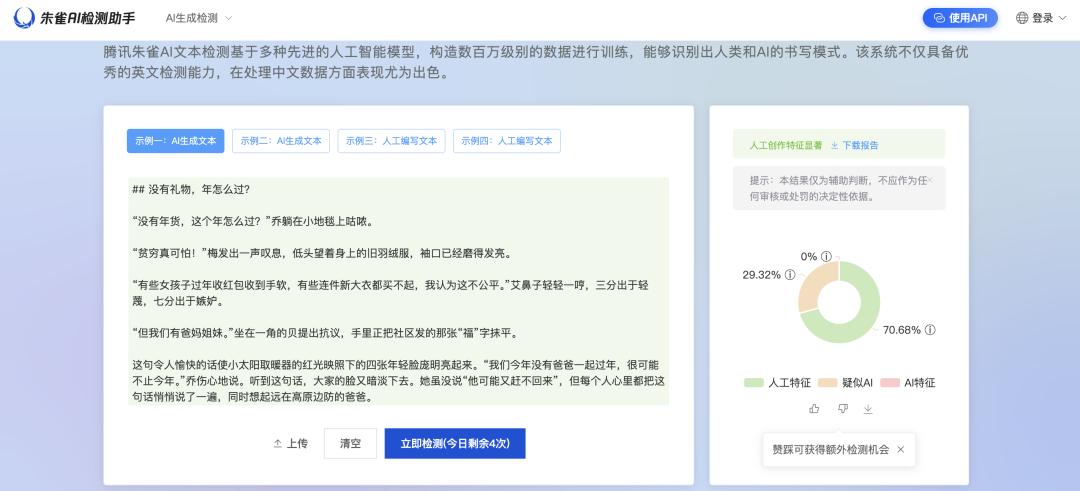
A short text completely generated by AI is identified by Zhuque as having 70% manual features. (Source: Zhuque AI Detection Assistant)
Similar inconsistencies also appear on social platforms.
Some authors said that they input more than 10,000 words of manually written content into Zhuque for detection, and about 28% of the content was still marked as suspected AI-generated, including some landscape descriptions. Another netizen said that his handwritten chapter was detected to have 20% AI suspicion rate, but after giving the same story outline to ChatGPT to regenerate, the detection tool even gave a 100% manually created judgment.
Other netizens pointed out that the AI detection tool itself is not 100% accurate. The same paragraph of text may get different results in different detection tools, and the detection score cannot be directly equivalent to the actual proportion of AI-generated content.
On November 15, a Jinjiang author posted on Weibo, saying that she has never used AI to assist writing, and will not use it in the future.
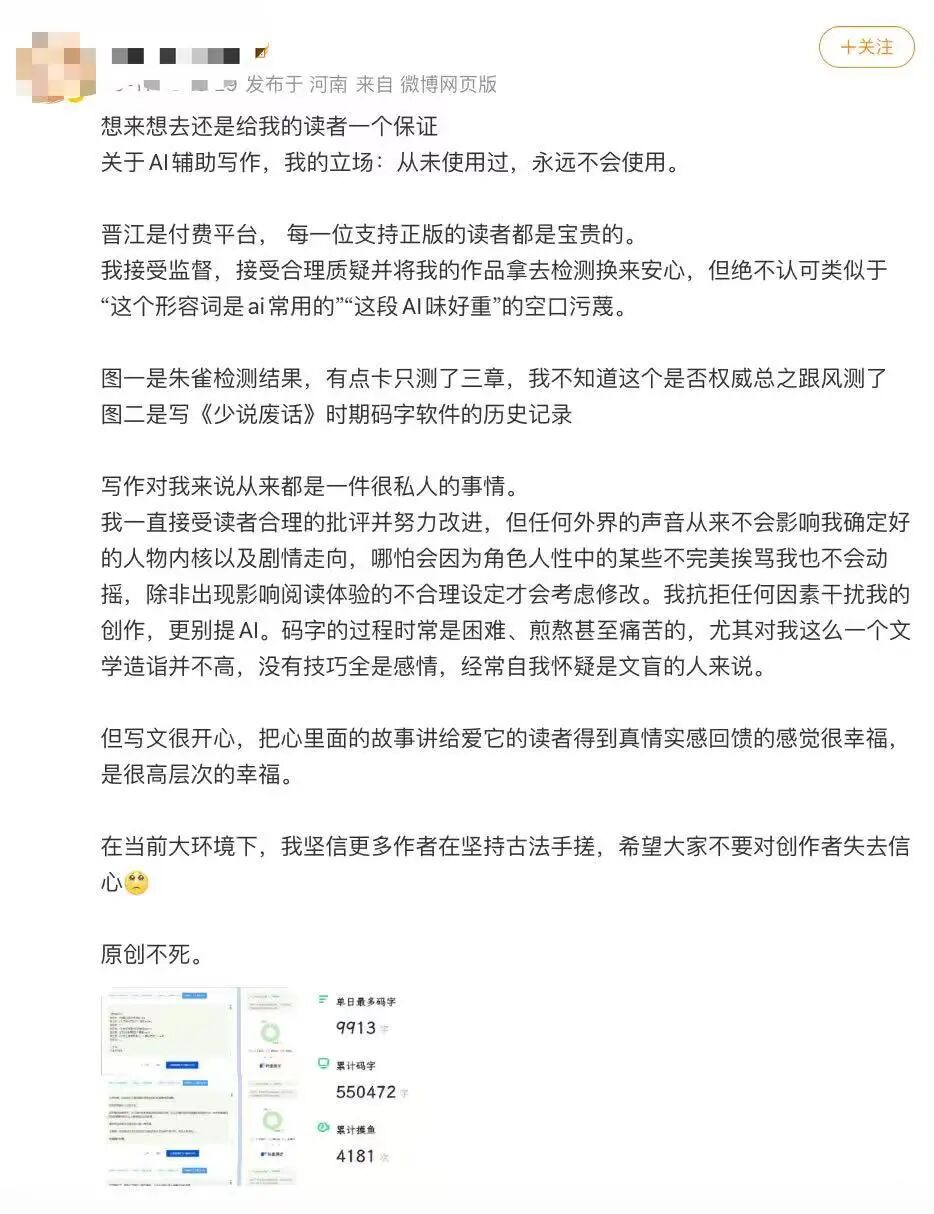
The Weibo content posted by the author (Source: Sina Weibo)
She said she is willing to accept reasonable doubts from readers, and can also submit her works to detection tools for inspection, but does not recognize the subjective judgments such as "a certain adjective is commonly used by AI" or "this paragraph has a strong AI flavor" to determine that the author has used AI.
To prove her creation process, she also posted the Zhuque AI detection results and the historical records of her writing software. The screenshot shows that her total word count has exceeded 550,000 words.
This wave of unrest has also made another voice gradually emerge: When more and more readers begin to rely on AI detection tools to judge whether a work is original, is it possible for human creators to be accidentally injured?
On social platforms, some netizens have regarded specific words, sentence patterns and description habits as evidence of AI writing, forcing authors to repeatedly prove their innocence. Many netizens also said that the resistance to AI has made Jinjiang authors panic to a certain extent, not knowing when they will be "kicked out".
4
Should the platform strictly investigate AI, or protect authors first?
Before the large-scale "AI checking" by readers, Jinjiang has already issued relevant regulations for AI-assisted writing.
According to the "Original Creation Writing Specifications" announced by Jinjiang Literature City, the platform allows AI-assisted writing within a limited scope, including text proofreading, assistance at the level of creative elements and rough outlines, but prohibits AI-generated content that exceeds the specified scope and affects the originality of authors.
For works with no obvious AI traces but reported for suspected AI writing, the platform will select at least three detection tools from Zhuque, Yuewen, DeepSeek, Zhipu and Qianwen. If the AI suspicion rate of three or more of them exceeds 60%, the relevant content will be identified as non-compliant.
For non-compliant works, the penalties stipulated by Jinjiang include locking chapters, a one-month yellow card, permanent ban from the leaderboard, etc. For paid chapters, the subscription fees for the relevant chapters also need to be refunded.
Although relevant regulations have been issued, many readers are still dissatisfied with the platform's handling methods. Due to the phenomenon that AI detection tools "let some fish slip through the net", many netizens questioned that many essentially AI-generated articles have not been punished, and whether the platform will treat creators differently according to their popularity and sales. Some readers also believe that only detecting the reported content cannot fully identify all AI components in the work.
But for the platform, while cracking down on AI writing strictly, it also needs to consider the problem of misjudgment.
In a dispute case involving AI-generated content, user Tang posted original text on a content platform, which was judged by the algorithm as "AI-generated without marking", the content was hidden and the account was muted. After the appeal failed, Tang sued the platform to the Beijing Internet Court. If AI judgment makes authors worry about being affected and even affects creation, what level of supervision should the platform adopt?
In a report published by Chinese Writers Network on November 5, the head of legal affairs of Jinjiang said that the governance of AI-assisted writing faces uncertainties in technology, law and industry cognition, and the platform needs to find a balance between protecting originality and avoiding accidental injury.
Jinjiang's rules also set restrictions on malicious reports, including a cooling-off period after a failed report, and restrictions on the number of reports on the same work by the same account.
These regulations reflect the platform's concerns about misjudgment and abuse of the reporting mechanism to a certain extent, but they also arouse some readers' doubts about the efficiency of reporting.