People in the AI industry who are averaged out by the high-salary narrative
At 11 p.m., Yang Han closes her laptop, bringing a temporary end to her 12-hour non-stop work. Though she is off duty, her nerves never fully relax: she is on call 24/7 once any data anomaly occurs.
Yang Han has graduated for 3 years. She holds a bachelor's degree in Computer Science from a 985 university and a master's degree from a top 20 QS-ranked institution. She has been working in the AI industry all along, accumulated internship experience and polished her resume at several major tech companies, and once served as the head of the AI division at a startup.
With such a solid resume and extremely high work intensity, her income should theoretically outperform most of her peers. But currently, Yang Han's monthly salary barely matches that of top R&D staff in the advanced manufacturing sector, and only ranks at the medium level among employees at large internet companies.
This is related to her decision to "retreat bravely from the rat race" and return to the research institute to work on foundational models. Even setting that factor aside, she still wants to make it clear: "AI practitioners are far less glamorous than the outside world imagines."
The current AI narrative gathers the most enviable jobs and the most eye-catching salaries: positions in large model algorithm development, agent development, AI Infra and other related fields usually start at hundreds of thousands of yuan per year with no upper limit; for talent programs launched by major tech companies, an annual salary of one million yuan is just the entry threshold.
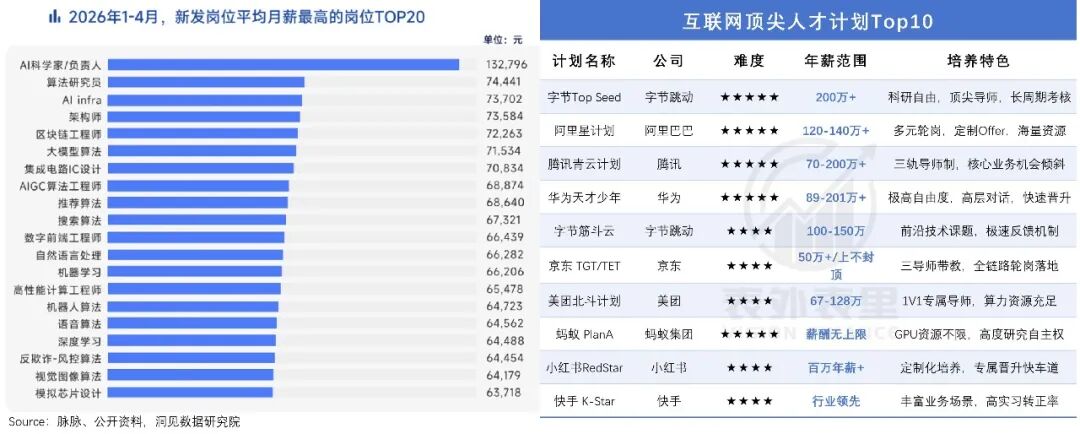
But the high salaries created by hot money only belong to a tiny group of people at the top of the pyramid. These extremely high figures act like a huge pulling force that pushes up the "average salary" of the entire AI industry. People below the top of the pyramid are facing a huge gap between expectation and reality.
And the huge gap between input and output has to be filled by the efforts of all practitioners: the overtime hours and anxiety levels of ordinary workers have long outpaced the growth rate of their salaries.
The side that never gets caught in the spotlight is the daily reality for the vast majority of people.
1
Higher Entry Threshold: Campus Recruitment Evolves Into Mid-career Hiring
Every time Chen Mo talks about his classmates who hold top 3 master's degrees but get zero offers in campus recruitment, he always gets rebutted: "You're lying, they just haven't got the offers that satisfy them."
That was indeed the case in previous years. Chen Mo's seniors and juniors, with algorithm papers and internship experiences in hand, could get into AI unicorns or major tech companies even if their majors were not perfectly matched or they graduated from non-double-first-class universities. But the market situation has really changed this year: he applied for nearly 200 positions of companies of all sizes across unrestricted regions during the autumn recruitment, but did not get a single pass.
Many of Thomas' fellow students and friends also got no offers after sending out massive applications. He received 4 offers precisely because he met every requirement perfectly: "985 bachelor and master degrees in computer science + AI-related papers + targeted internship experience at big tech firms". He spared no effort to compete for 4 to 5 years before finally standing out from the crowd.
"The internet industry is starting to look like the financial industry, which emphasizes 'full alignment of qualifications', all experiences must be highly relevant to the position." Thomas sighed at the cruelty of competition. In the past, new workplace employees had a growth period, but now companies have lost their patience, and campus recruitment has turned into mid-career hiring.
Mike has witnessed the entry threshold of the industry being raised step by step.
Four years ago when he chose his postgraduate major direction, Metaverse and blockchain were still the most popular tags. No one expected that AI would advance at a breakneck pace afterwards, evolving from chatbots to image generation and video generation. Last year, people around him started to hunt for jobs in "agent development", and this year everyone is talking about "office agents".
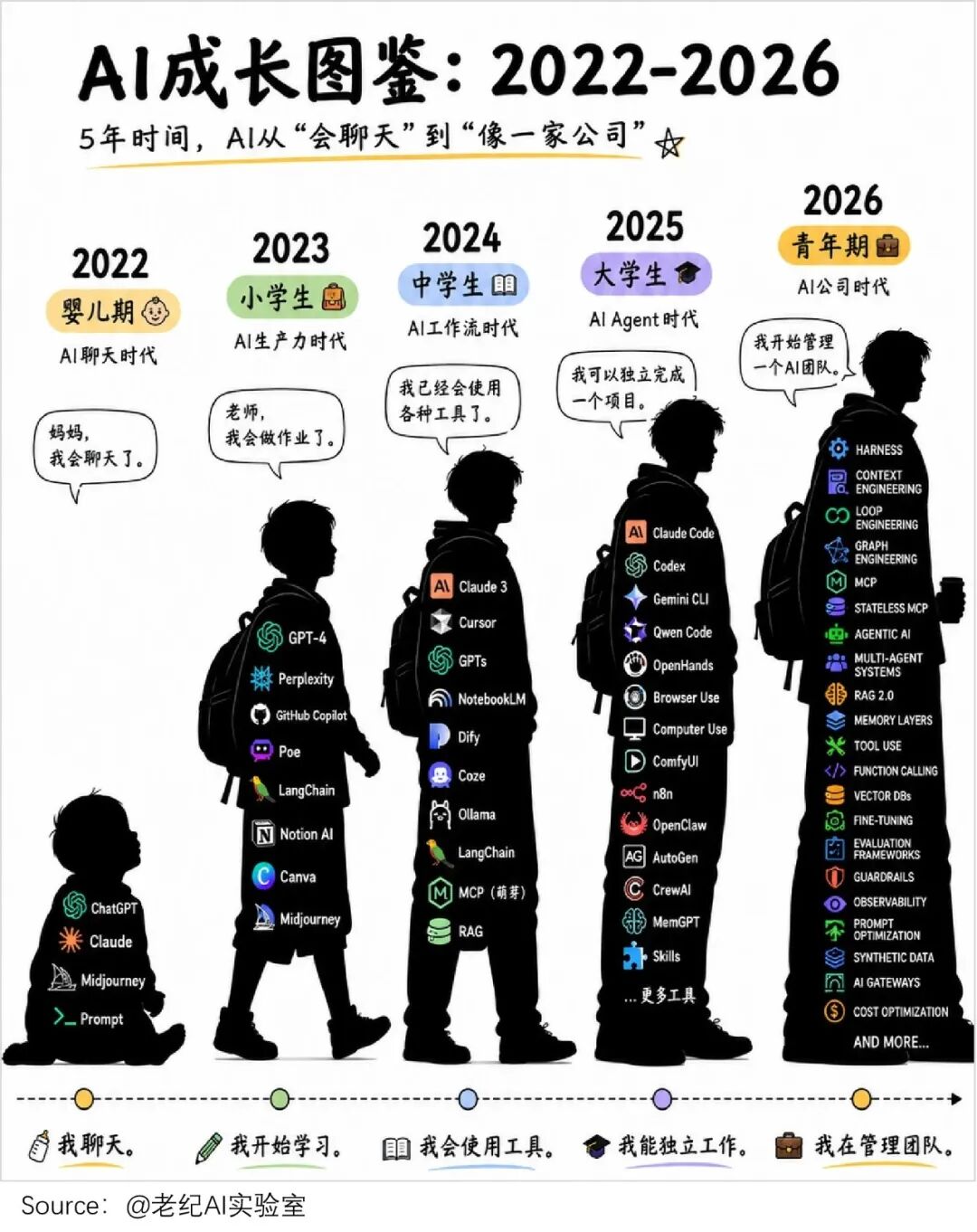
With rapid technological iteration, new sought-after roles such as agent development, prompt engineering, and workflow construction have not even settled down, before they become the victims of rapid industry evolution.
What is more frustrating is that as AI becomes smarter and more capable of doing real work, many old positions are being replaced at an accelerated speed.
Two years ago, Mike's classmates had no trouble finding jobs. Big tech firms were expanding their AI teams frantically, offering higher salaries year by year. Students even voluntarily applied for delayed graduation: by graduating one or two years later, they could accumulate two more internships and publish two more papers to polish their resumes, so that they could get better offers the next year.
Until the emergence of coding agents erased the premium of handwritten code. Big tech companies began to suspend recruitment for junior positions, outsource non-core businesses, and merge middle platforms. "Previously a department needed to recruit three people for front-end, back-end and testing, but now they may only recruit one full-stack AI developer, who can finish the work of three people with the help of agents."
In this process, salaries have barely increased, but the job requirements have risen sharply.
Wu Le, an AI engineer, now opens AI tools immediately when he gets tasks assigned by his leader: he hands over background conditions to AI for analysis, lets AI complete the task, and asks AI to generate a document for him to learn, before he reports the progress to his leader after learning the content.
70% to 80% of the basic tasks in his daily work are completed by AI, and the remaining 20% to 30% of his work is to judge and correct the output of AI. "To put it bluntly, I am just a senior proofreader." Wu Le joked about his current job.
But not everyone can be a proofreader: AI may produce logically consistent solutions that are disconnected from actual business, hide hidden dangers in boundary conditions, or even make up data in a serious manner. Without years of practical experience, it is impossible to identify these errors at all.

Not only that, after companies provide AI tools, their expectations for output have also risen sharply. The work that used to take half a day to deliver now requires leaders to see the results within two hours. Even Wu Le often feels overwhelmed, and he feels that he is not using AI, but being pushed forward by the rhythm of AI.
"Candidates must not only have traditional development experience, but also be 'AI native' (experience in using AI and the ability to leverage AI), both of which are indispensable. New graduates who just enter the workplace cannot meet these requirements at all." He admitted that companies are therefore unwilling to recruit newcomers and train them slowly, and prefer capable people who "can get started immediately".
Of course, companies also have a cold hard reason: they have very little room for fault tolerance left.
2
Countdown to Squeezing Out the Bubble: Practitioners Are Relocating Their Positions
After attending the AI conference for a whole morning, Mike felt that he was trapped in an "infinite loop".
In the same company, Team A developed a "cloud desktop agent", Team B "reconstructed the industry workflow with AI", and Team C claimed to "enable native AI one-click operation". Although their names are different and their PPTs are not the same, their underlying models are identical, the tool calling logic is similar, and even the application scenarios highly overlap.
"Three teams are competing for the same group of customers and the same order." Mike said frankly, but the "horse racing" mechanism has long been an unspoken consensus in the industry: a company sets up many independent teams, allows them to develop freely and compete with each other, and finally retains only one mature project.
Teams spare no cost, make thousands of trial and error attempts, and even break through limits violently. It seems that a countdown clock is hanging over everyone's head, and they have to find the correct trigger line before the second hand returns to zero.
Yang Han knows that the invisible hand pressing the countdown is "capital".
As the most capital-intensive track at present, for every 10 yuan of global venture capital invested in 2025, 6 yuan flows into the pockets of AI enterprises. This trend has intensified this year: the financing scale of AI startups in the first quarter has accounted for 81% of global VC investment; Chinese and American tech giants are constantly raising the upper limit of capital expenditure, pouring in hundreds of billions of yuan after another.
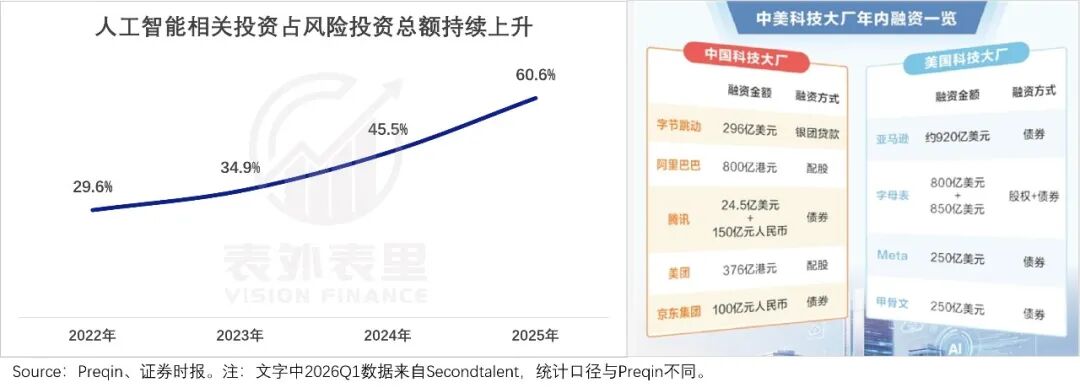
The scale of investment is staggering, but returns have not been realized for a long time. MIT once analyzed more than 300 enterprise AI projects and found that 95% of them have no quantifiable impact on profits.
"Everyone is already sitting on this high-speed train, and no one wants to be left behind." Yang Han increasingly feels that as time goes by and investment increases, the anxiety of recovering costs continues to expand. Teams working in any direction are eager to deliver results as soon as possible.
Last year, after ChatGPT and Claude made profits from coding, domestic application layer players swarmed into this field; since coding is built on smarter models, teams focusing on foundational models also have to face increasing R&D pressure.
As a result, internal horse racing is happening intensively in various companies: multiple teams explore directions at the same time, even if the work has been 80% completed, as long as the effect is not good enough, the project may be stopped at any time, and the entire business line may disappear. However, technology is still iterating continuously, and every update will make all the previous work meaningless.
Moreover, "for technology to really run, it must combine user needs, solve real problems, and obtain data to optimize the next generation." Yang Han said, but no one can accurately predict how AI will intervene in people's lives a year from now. Current innovations such as AI glasses and AI headsets are just explorations, and no one can give a clear answer.
This is the current dilemma of the AI industry, and also the most worrying issue for all investors who pour money into this track.
For Yang Han and her colleagues, this means that the plans originally arranged for three months or half a year may be overturned by the effect of a newly released model next month. The working methods, architecture and positions of the team change frequently, especially middle managers have become the first group of people to collapse in the AI industry.
"At the very beginning, middle managers were highly sought-after: they did not need top-notch technical skills but earned very high salaries, so many people from big tech firms switched to AI middle management positions." However, repeated project interruptions, route changes bring huge frustration, and performance indicators that are always out of reach make middle managers look more haggard than each other.
That's why she quit the front line, stopped competing for the top titles, branding or products, and moved down to underlying areas such as AI infra, after all, work like model training will always be in demand.
Mike, who just graduated last year, also chose to pursue stability and joined a state-owned enterprise. At that time, big tech companies were still expanding their teams, and all his friends were desperate to get in. His choice was considered by many people to be "a waste of his educational background".
But having interned in AI R&D, he has experienced the taste of staying up all night for consecutive days to sort out documents and upgrade functions during the product development stage, and he also knows clearly that these painstaking efforts may only be a random attempt out of his leader's whim.
"Before we make a successful product, we are bound to go through repeated attempts, direction shifts, plan overturns and restarts. The pain in the process is an inevitable cost. Many of my friends stay up all night every day, are ready to be laid off at any time, and go to work with the mentality of doing 'daily paid temporary work', which is not the life Mike wants."
He chose to understand AI in a longer cycle, and regards it as a black box: he holds expectations for this black box, but remains cautious and wait-and-see. AI-related management positions in state-owned enterprises have become a good choice for him: he is not far away from the AI industry, and this job allows him to move more steadily and see a broader picture.
Even though the cost is that his annual income is only 200,000 yuan, Mike has become the envied object of his friends: "In this industry where the harder you work the more anxious you get, everyone wants to slow down."
(Special thanks to blogger "Thomas Spin" for his support to this article.)
Data support: Insight Data Research Institute
This article is from the official WeChat account "Inside and Outside the Spreadsheet" (ID: excel-ers), Author: Chen Zijie, Editor: Cao Binling, 36Kr republished with authorization.