SpaceX: The Starship was successfully "caught", so why didn't the stock price hold up?
After the US stock market closed on November 13, the 15th test flight of Starship staged a sci-fi scene: after flying in orbit for about 22.5 hours, circling the Earth 14 times, and accurately releasing 26 new-generation Starlink satellites, the spacecraft steadily landed in the "chopstick" robotic arm of the launch tower.
This is the first time in human history that a second-stage rocket returning from orbit has been successfully caught.
Unfortunately, only "half" of the dual capture goal set this time was completed: the first-stage booster did not have enough fuel for the return voyage, so the flight control team voluntarily gave up the capture and made it splash down in the Gulf of Mexico instead.
In the previous 3Q earnings review SpaceX: From "Rocket Guy" to "Landlord", Who Will Pay for Musk's New Trillion-Dollar Ambition?, Dolphin Analyst once pointed out that "two-stage capture" will be the biggest positive catalyst for SpaceX since its IPO.
The underlying logic behind this is that the cost reduction of Starship is the premise to fully unlock the grand narrative of V3 networking and the "space data center". Once the TCO (Total Cost of Ownership) model is verified through reuse, the valuation center of Starship and Starlink should be revised upward.
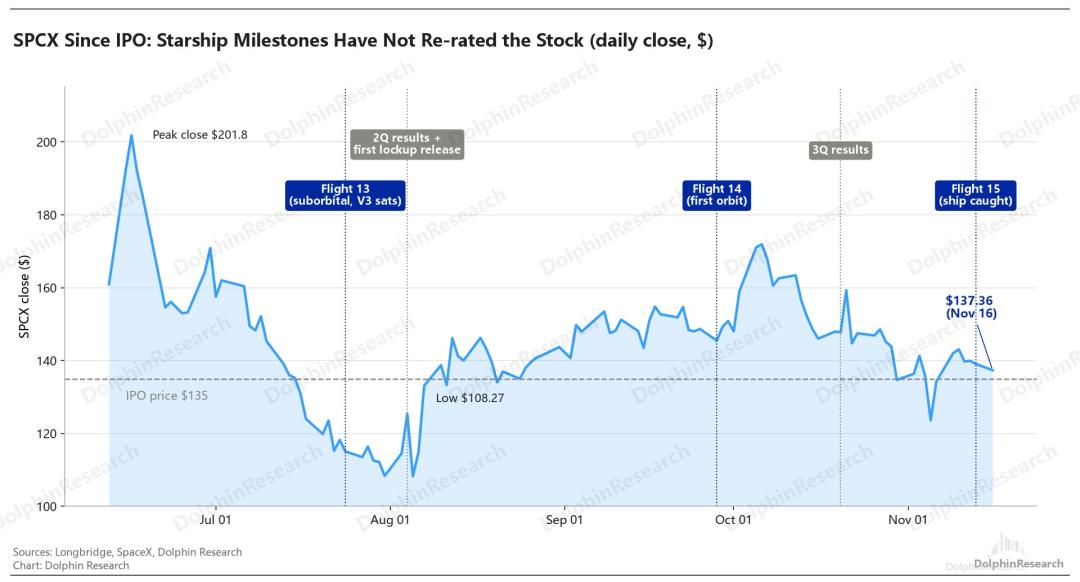
However, the capital market reacted extremely coldly. Although the pre-market share price once surged to $141 on Monday (November 16), it quickly fell back along with the broader tech stock market after the market opened, and finally closed down 1.3% at $137.36.
This price is only a slight increase of 1.7% compared with the issue price of $135, and it has retreated by nearly 16% from the high of about $163 in mid-October.
It made history technologically, but why did the share price remain almost unchanged? Where exactly did the expectation gap occur? Dolphin Analyst will explain several issues in detail below:
1) What is the actual performance of the 15th test flight?
2) Why is the recyclability of the second stage so important?
3) Why did the share price not rise after the test flight?
4) What impact does this test flight have on SpaceX's valuation?
5) What should we focus on for SpaceX next?
The detailed analysis is as follows
I. What is the actual performance of the 15th test flight?
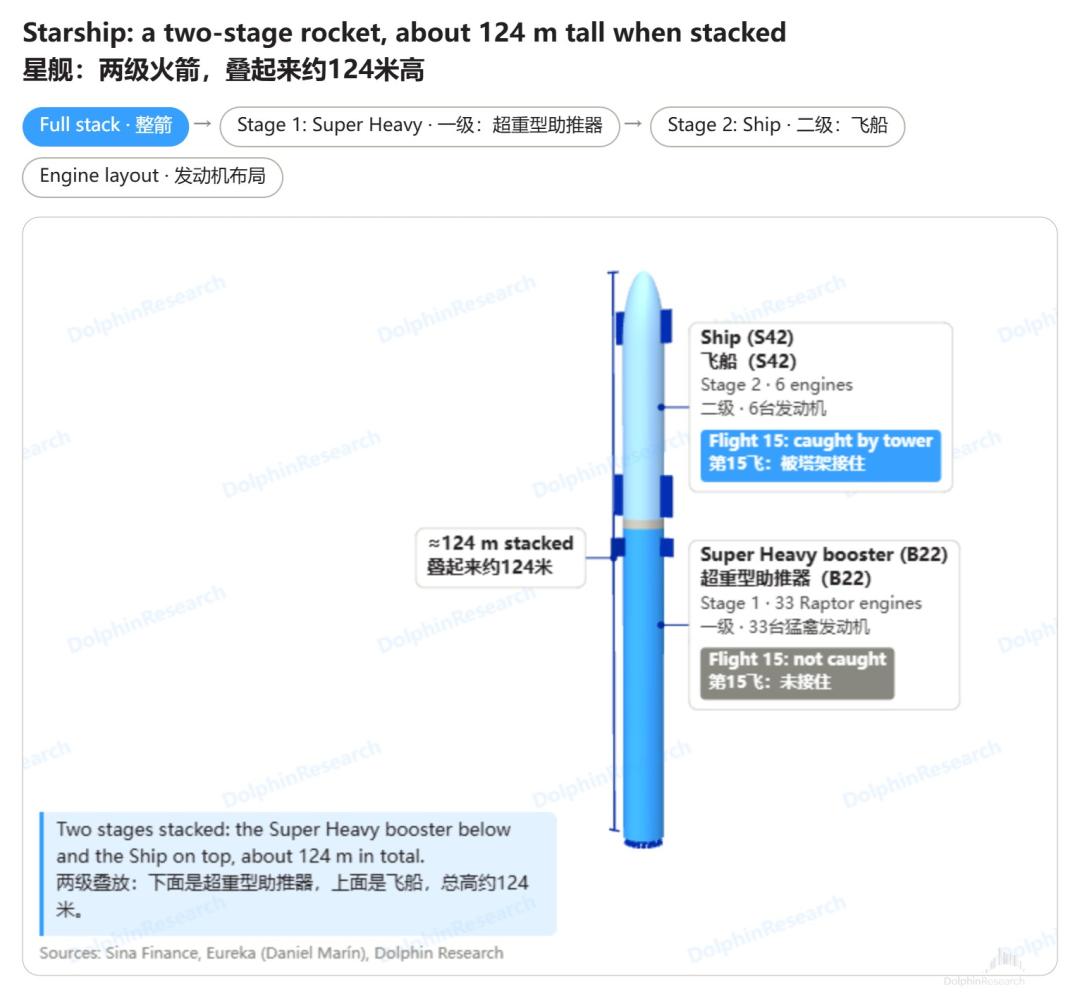
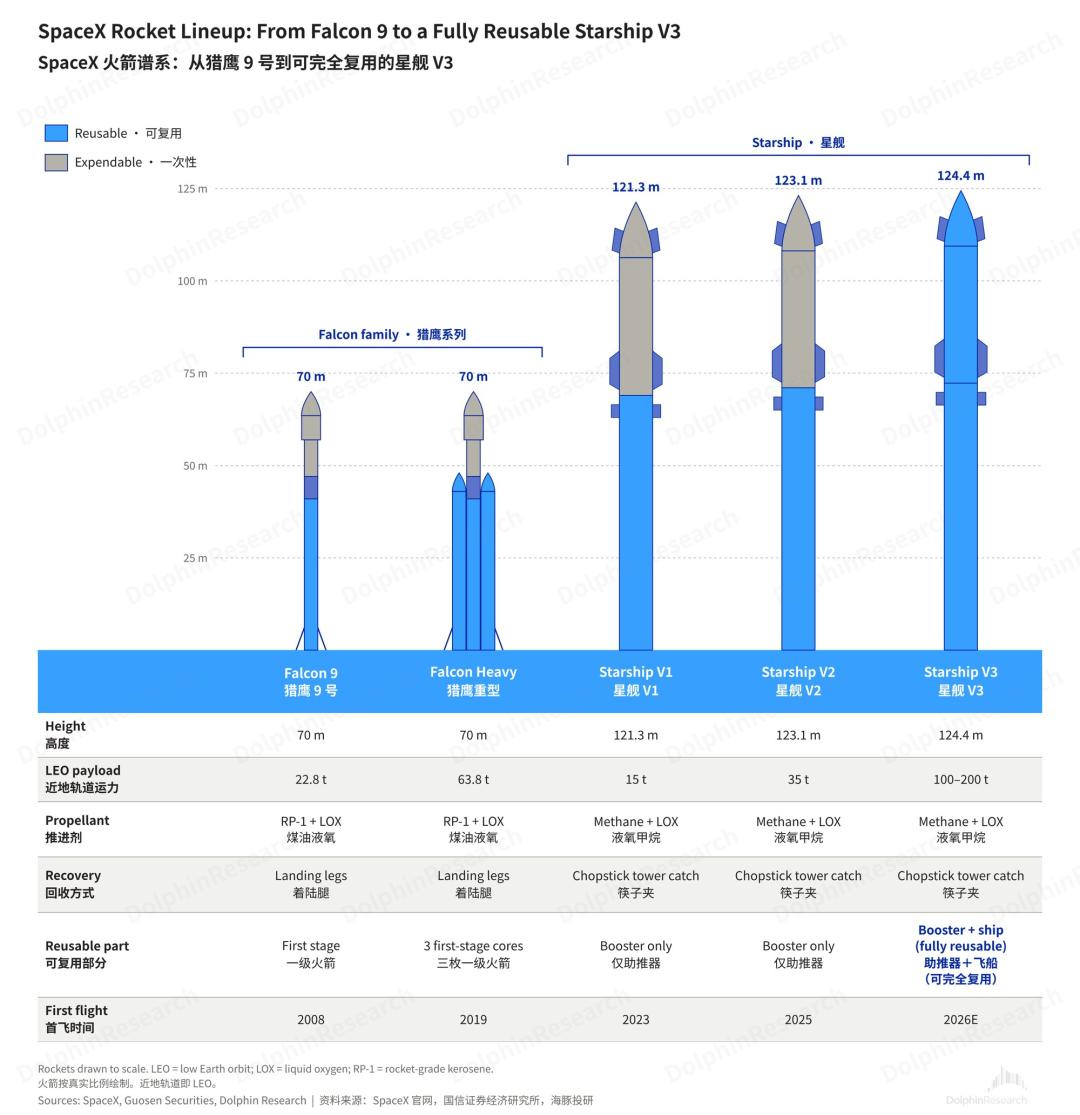
Starship is a two-stage rocket, with a total stacked height of about 124 meters:
a. First stage: Super Heavy booster, equipped with 33 Raptor engines. It does not enter orbit after separation, and flies back to the launch site about 6.5 minutes after takeoff. The one that was not caught this time is B22.
b. Second stage: Ship, equipped with 6 engines (3 sea-level versions and 3 vacuum versions), responsible for entering orbit, deploying satellites, and then re-entering the atmosphere from orbit to return. The one that was caught this time is S42.
The ship is far more difficult to catch than the booster: The booster never enters orbit during the whole process, while the ship needs to first ascend to an orbit of about 275 kilometers, then rush back into the atmosphere at a speed of about 26,000 kilometers per hour. Its heat shield needs to withstand high temperatures of thousands of degrees Celsius, and finally it has to fly precisely into the "catching window" of the robotic arm. Musk only gave a 50-60% chance of "catching both stages" in advance.
1. Ship: From "able to fly up" to "able to be caught back" in three months
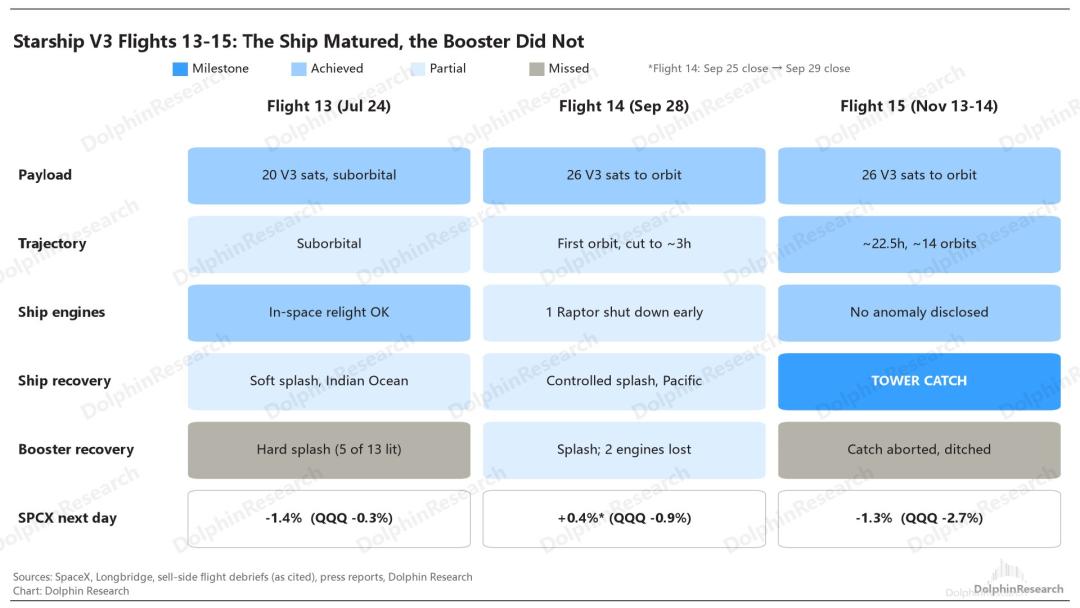
Comparing the last three test flights: the 13th flight in July was still a suborbital flight, splashing down in the Indian Ocean; the 14th flight in September entered orbit for the first time, but due to the early shutdown of one engine, the originally planned 10-hour mission was shortened to about 3 hours; this time, it stayed in orbit for 22.5 hours, circled the Earth 14 times, and then accurately returned to the site and was caught.
More critically, the ship can be brought back to the workshop for disassembly and inspection. Musk said after checking the heat shield that it is in good condition, and it can fly again after a few weeks of refurbishment, hoping to use the recovered hardware directly for the 16th test flight.
Dolphin Analyst believes that a more realistic path is to first remove high-value components such as engines and heat shield tiles and install them on the next ship; it is still several rounds of iterations away from the scenario of "landing, refueling and flying again like an airplane".
2. Booster: The old problem of the new generation engine has not been fixed yet
The direct reason why the booster was not caught is that the remaining fuel for the return voyage was insufficient: the flight control team judged that it could not enter the capture window, so it changed to splash down in the predetermined sea area of the Gulf of Mexico according to the pre-plan. Musk initially believed that it was related to the low thrust of some engines, and the final cause will wait for telemetry data; the short-term solution is to shut down the engines in advance next time to reserve more fuel for the return voyage.
This is not an isolated case: since the V3 booster made its maiden flight in the 12th test flight in May, there have been engine problems almost every time in the recovery phase - only about one-third of the engines ignited during the landing ignition in the 13th test flight, and 2 more engines were lost before splashdown in the 14th test flight.
External engineering analysis believes that V3 canceled the heat shields and partitions between engines to reduce weight, so a problem with one engine is likely to affect several adjacent ones. In addition, there have also been problems with ignition, timing and software, which requires systematic reinforcement of the whole set of engines; whether this time is the same cause still needs to wait for the official conclusion.
The good side is that the protection mechanism of "abandoning once finding abnormality" worked, the high-value No. 2 launch tower was not damaged, and there is no need to wait for tower repair for the next launch; moreover, SpaceX has already caught and reused two boosters on the previous generation of hardware many times. This is more of a running-in problem of the new generation of hardware, rather than a problem of "whether it can be done".
3. Payload: Starship started to do "official work"
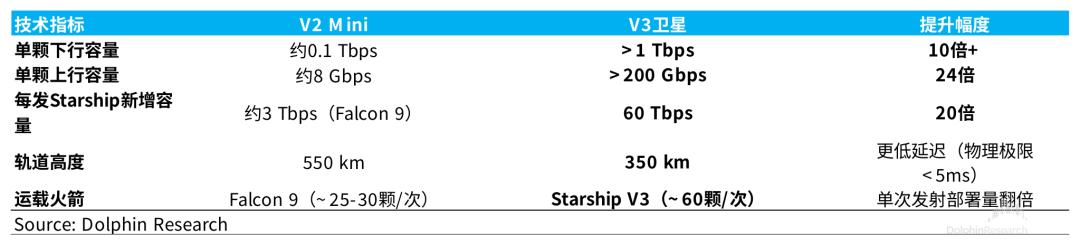
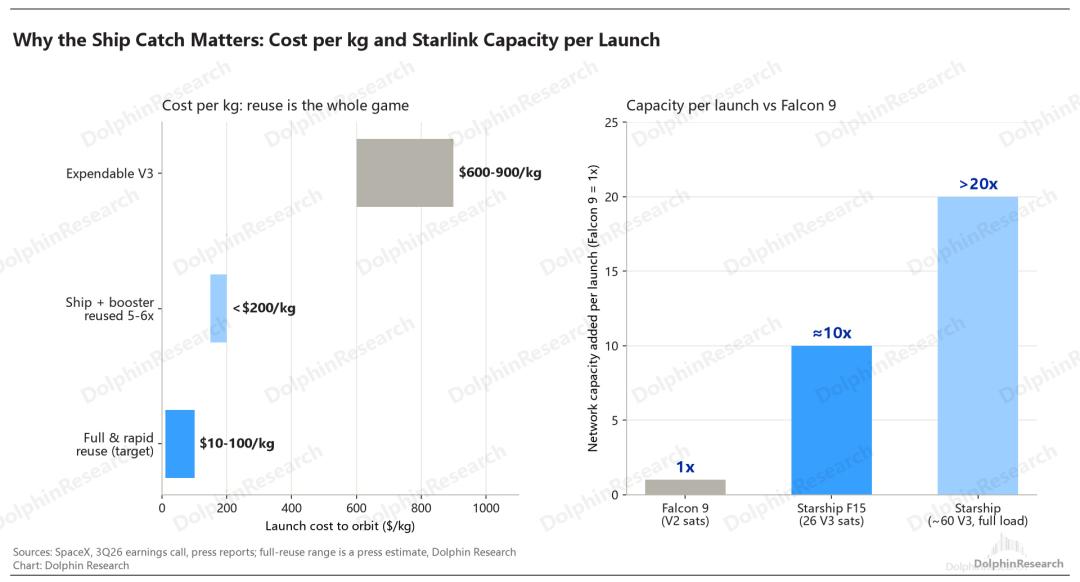
All 26 new-generation Starlink satellites went online. This generation of satellites weighs about 2 tons each, with a downlink speed of over 1Tbps, which is about 10 times that of the previous generation, and only Starship can launch them; the capacity brought up this time is equivalent to about 10 launches of Falcon 9, and it can reach more than 20 times when fully loaded with about 60 satellites.
But the management said that users will not obviously feel the faster network speed until hundreds of new satellites are in orbit, with the target set in the middle of next year. Only 52 satellites have been launched so far. Calculated by 26-60 satellites per launch, about 5-15 more flights are needed before the middle of the year. The faster the payload is increased, the fewer flights are needed - whether the pace can keep up goes back to the question of "how long it can fly again after being caught".
Dolphin Analyst gives this test flight an A-: all main line goals are completed, and points are deducted for the booster. The 16th test flight is planned to fly before the end of the year, and the booster capture is more like a "delay" rather than a "failure"; but if the engine fails again next time, the reliability problem will escalate from a secondary contradiction to a primary contradiction.
II. Why is the recyclability of the second stage so important?
Falcon 9 only recovers the first stage, and it has already pushed the launch price to a fraction of that of its peers. For Starship to reduce the cost by another order of magnitude, the premise is that both stages can be reused repeatedly. The second stage is exactly the most expensive and hardest to recover, and it used to be basically a one-time consumable.
SpaceX's long-term goal is to reduce the launch cost to less than $200 per kilogram, which is more than 99% lower than the historical industry average (about $18,500); Musk's more distant vision is around $10 per kilogram, which is basically only the cost of fuel.
How far is it from the goal?
Dolphin Analyst converted based on the Starship launch contract price disclosed by US-listed companies (about $90 million per launch). The cost of the new-generation Starship is about $600-900 per kilogram when not reused (payload 100-150 tons); referring to the historical relationship between cost reduction and reuse times, the cost can drop below $200 when each of the two stages is reused 5-6 times.
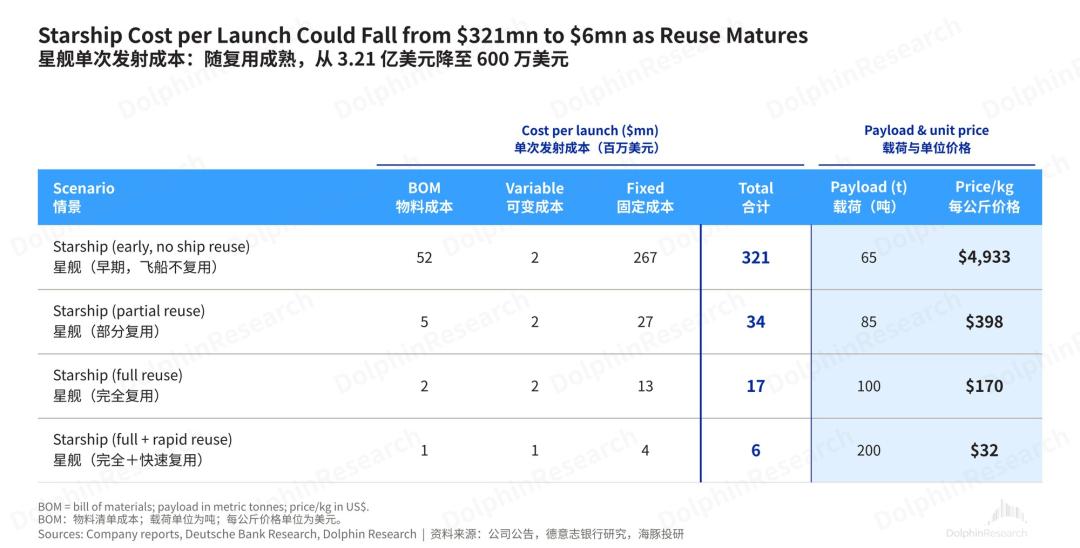
According to DB's calculation, the cost of the early non-reused ship is about $4,900 per kilogram, about $400 for partial reuse (around 2029), and about $170 for full two-stage reuse (around 2032). If rapid turnaround is achieved and the single-launch capacity is increased to 200 tons, the cost can drop to just over $30.
The reason why this cost curve is important is that several major subsequent stories of SpaceX are built on it:
(1) Starlink: The more you launch, the cheaper it gets
The manufacturing cost per Gbps of V3 satellites has dropped by nearly 90% compared with the first generation, and the remaining major cost is launch. When the launch cost drops to $100-200 per kilogram, the unit bandwidth cost of Starlink can compete with ground fiber optics, and the market will no longer be limited to remote areas, oceans and aviation.
(2) Space computing power: $200 per kilogram is the watershed
At present, the cost of per kilowatt space computing power is about 3-5 times that of ground data centers. Most calculations regard $200 per kilogram as the break-even line for orbital data centers, and the cost after full reuse of Starship falls right near or below this line. Of course, the costs of satellite manufacturing, heat dissipation and service life also need to be reduced simultaneously.
(3) Launch business: Falcon 9 is about to "hand over the baton"
It is reported that SpaceX no longer accepts Falcon 9 orders after 2028, which shows that the company has confidence in Starship to take over; the NASA moon landing contract (over $4 billion) and the first on-orbit fuel transfer demonstration in the first quarter of next year also rely on the reliability progress of Starship.
But it should be noted that "being caught" is not equal to "being reused". What determines the economic account is how long the refurbishment takes and how many times a ship can fly. On Polymarket, the probability of betting that "full second-stage reusability will be officially announced before the end of the year" is only about 30%, and it rises to 72% when the deadline is extended to the end of next year, indicating that the market believes that full reuse will most likely come, just a little later.
In terms of competitive landscape, the gap is still widening:
a. On the same weekend, United Launch Alliance (ULA)'s Vulcan rocket encountered an anomaly while launching for Amazon's satellite internet constellation, and the satellite failed to enter orbit;
b. After Blue Origin's rocket exploded in May, the launch pad will not be restored until the beginning of next year;
c. The maiden flight of Rocket Lab's medium-sized reusable rocket "Neutron" has been postponed to 2027;
d. China's Long March 10 has achieved booster recovery, but there is still a distance from orbital-level second-stage recovery. In the short term, no second company can provide reusable capacity at the same level as Starship.
III. Why did the share price not rise after the test flight?
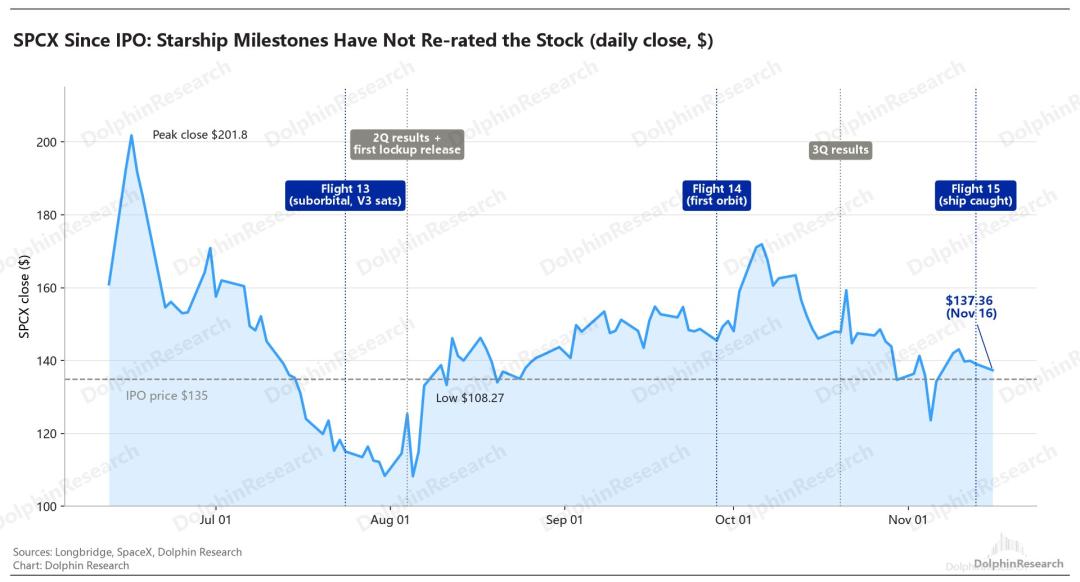
On the surface, it fell, but SPCX now is more like a highly volatile "AI infrastructure stock": Dolphin Analyst calculated with the daily line since its listing, its beta to the Nasdaq 100 is about 1.55-1.6, which means that when the Nasdaq falls by 1%, SPCX usually falls by more than 1.5%.
On Monday, it was reported that NVIDIA CEO Jensen Huang unexpectedly resigned, coupled with financing concerns about