TAL's life-or-death reversal: streamlining its workforce and acquiring a stake in Zhipu AI
Author | Xie Yunzi
Editor | Zhang Fan
Education companies that wanted to make money from AI have been given a hard lesson by AI first.
In June this year, Zhang Xiaolong, founder of Fenbi, showed off the returns from his "tech stock trading" at a lecture at Renmin University of China, and criticized the students present for "having no real skills other than squeezing into the public sector".
The turmoil ended with an apology and his resignation. But he did exactly what he said. In the first half of the year, Fenbi's equity investments soared from "almost zero" to 479 million yuan, including US semiconductor ETFs with 2x leverage.
The reversal came quickly. In early July, the US semiconductor sector plummeted. Although Fenbi liquidated its positions quickly, it still recorded an investment loss of 8.3 million US dollars. And Zhang Xiaolong was more like "a prophet who made a self-fulfilling prophecy", and the protagonist of the prophecy was another education company — TAL.
In its second-quarter financial report released on October 29, TAL recorded a revenue of 995 million US dollars, a year-on-year increase of 15.5%; operating profit reached 236 million US dollars, a sharp year-on-year increase of 145.4%; gross margin rose to 59.8%.
After entering fiscal year 2027, TAL's performance continued to rise. Beneath the warm atmosphere, there are two easily overlooked hidden lines.
One is inside the enterprise. Multiple TAL employees revealed to 36Kr that in April and May this year, the company launched a "personnel optimization" round, involving multiple departments such as front-end development and premium training, with layoff ratios ranging from 30% to 50% in some teams.
The other is on the books. TAL's net profit attributable to shareholders was -47.44 million US dollars — it was not its core business that dragged it down, but an investment gain or loss. This investment points directly to AI.
In the five years since the "Double Reduction" policy, the entire education industry has hoped to "change its fate against the will of heaven" through AI. Is technological iteration a path to the future, or a dead end for practitioners? TAL's financial report has brought this question right to the forefront.
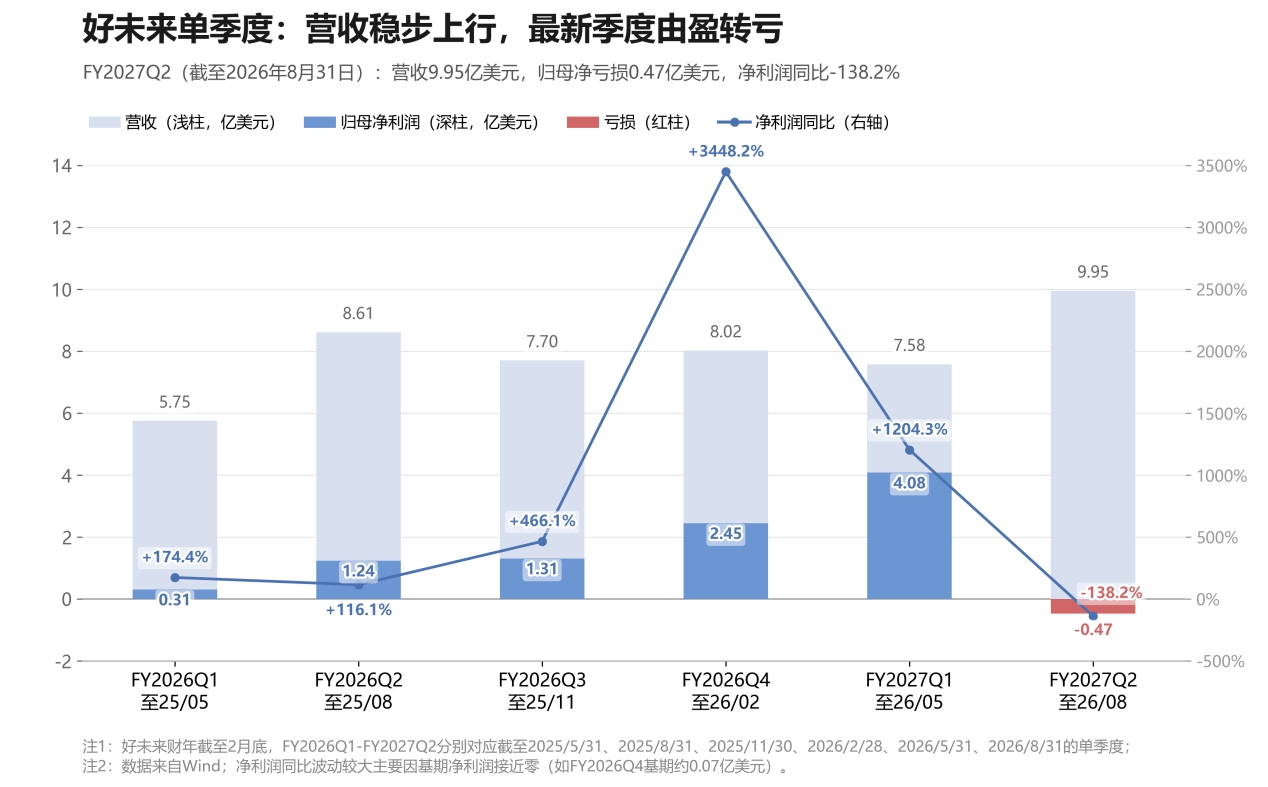
Chart produced by 36Kr based on Wind data
The "life-and-death reversal" in the financial statements
Few people remember now how close this company was to the cliff five years ago.
In 2021, right after the "Double Reduction" policy was implemented, TAL immediately shut down its K9 business and found three fallback paths for itself: quality-focused courses, vocational education and learning hardware.
Unexpectedly, the company survived and became more profitable than before.
In fiscal year 2026, TAL's revenue reached 3.009 billion US dollars, with net profit surging more than five times year on year. In fiscal year 2027, performance growth continues. Throughout the first half of the fiscal year, TAL's revenue hit 1.753 billion US dollars, up 22% year on year; operating profit reached 373 million US dollars, up 237.8% year on year; net profit attributable to shareholders was 361 million US dollars, up 132.1% year on year.
When you split this half-year report card into two quarters, the picture is completely different.
In the first fiscal quarter, TAL's net profit attributable to shareholders was 408 million US dollars, skyrocketing 1204.3% year on year. Among them, operating profit was 137.2 million US dollars, and "other income" including investment gains was about 405.2 million US dollars. Investment gains were almost three times the operating profit.
By the second fiscal quarter, this sum of money reversed direction — "other income" turned into "other expenses" of 189.7 million US dollars. With this one entry and one exit, the company swung from profit to loss in a single quarter.
The management explained on the earnings call: "In this quarter, the fair value of certain investments has decreased" and "investment value may change with market conditions".
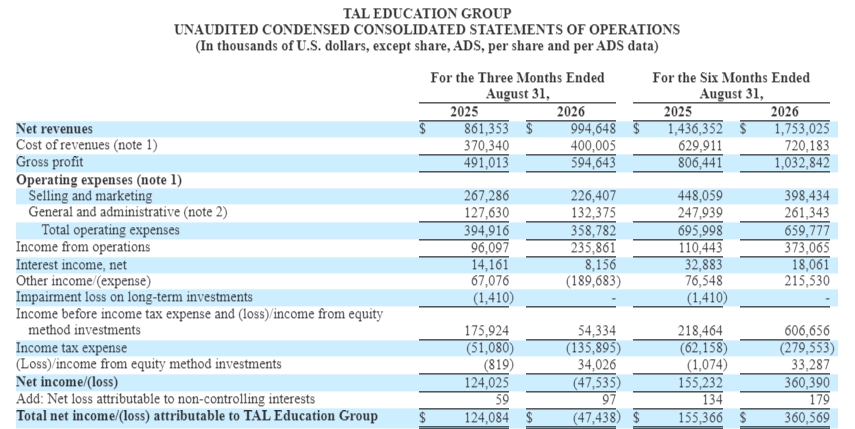
Image excerpted from TAL's financial report
"Certain investments" of course have specific targets. In October 2023, TAL participated in Zhipu AI's financing round; the following year, it made an additional round of investment through "Xinxin Xiangrong".
On January 8, 2026, Zhipu AI was listed on the Hong Kong Stock Exchange, rising 13.17% on the first day, with an IPO market value of about 51.1 billion Hong Kong dollars. The increase was far from reaching its peak. On June 22, Zhipu AI's intraday share price hit 2980 Hong Kong dollars, and its market value once exceeded 1 trillion Hong Kong dollars.
In contrast, TAL's shares in Zhipu AI held through Xinxin Xiangrong only account for 0.79% of the total share capital, but the paper return is staggering. And TAL's investment in Zhipu AI is not an isolated case.
Tianyancha shows that the list of "TAL Strategic Investments" also includes technology companies such as BrainCo, Baichuan Intelligence, StepFun, and DeepSeek. In the five years after the "Double Reduction" policy, this education giant quietly turned itself into a shadow shareholder of an AI fund.
What is rare is that if you exclude the fluctuations of investments, TAL's operating profit is not bad, and quality-focused courses are the main growth driver.
"Mathematics cultivates 'scientific thinking', and Chinese cultivates 'humanistic creation'." In the perception of most parents, these quality-focused courses avoid the sensitive identity of "subject tutoring", and are still the best solution to help children with their schoolwork.
As of the end of the first fiscal quarter, TAL had more than 600 offline learning centers in 44 cities across China and overseas markets. By the second fiscal quarter, the revenue from offline learning services continued to maintain double-digit year-on-year growth, and the renewal rate of premium quality-focused courses remained stable above 80%.
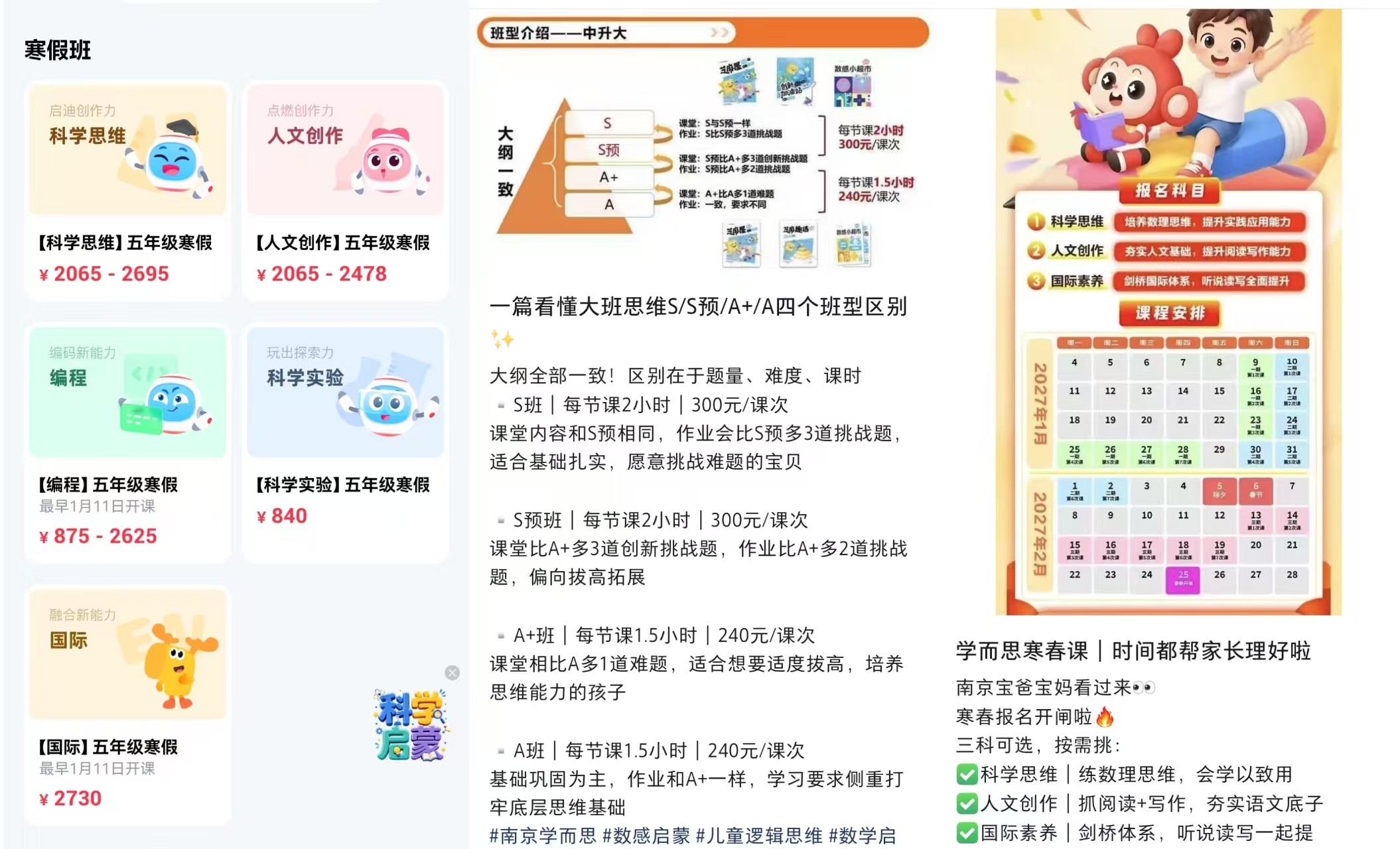
Image excerpted from Xueersi and Xiaohongshu APP
Learning tablets are no longer selling well
Nevertheless, TAL is still heavily betting on the learning tablet business.
This is not hard to understand. Quality-oriented education is always a "people-driven" business: adding one more student requires hiring one more teacher, and it can never achieve "marginal cost approaching zero". The vocational education track already has veteran players such as Fenbi and Huatu, leaving limited space for new entrants.
That leaves only hardware. From an industry perspective, after eliminating early low-repurchase-rate products such as "smart desks and smart lamps", learning tablets that can solidify teaching and research capabilities at one time and re-enter family households stand out.
And TAL has indeed made it its second growth curve, with more than 2 million weekly active learning devices, a weekly activity rate of about 80%, and active devices used for nearly 1 hour per day on average. But the growth of this curve is approaching the ceiling.
In the third quarter of this year, the total channel sales volume of learning tablets in China plummeted 30.8% year on year, and sales revenue also fell by 17.1%. According to forecasts from Luo Tu Technology, the decline in total channel sales of learning tablets in 2026 may reach 21.3%.
At the earnings call for the second quarter of fiscal year 2027, Peng Zhuangzhuang, President and CFO of TAL, said bluntly that superimposed with intensified competition, changing consumer preferences and rising costs of components such as chips, the learning device business "has become a drag on our overall revenue growth", and the company expects revenue growth to become moderate in the future.
Against the backdrop of market contraction, manufacturers can only rely on price increases to maintain performance, and TAL is no exception.
In the first half of this year, flagship models of mainstream brands such as Xueersi and iFlytek were launched intensively, with prices exceeding 8,000 yuan, even reaching 10,000 yuan. The question is: where is the price threshold for parents?
A report from Xinhuanet last year is most often cited: for a 14-inch mainstream learning tablet product, the hardware cost is about 1,000 to 1,200 yuan, and the content cost allocated to "textbooks, question banks, courses" per unit is about 200 to 400 yuan.
In other words, the threshold for learning tablets is not high, which is why all brands are competing in AI: hardware cannot create gaps, and premium can only come from the "smart brain".
In May 2023, iFlytek took the lead in releasing the "Spark Large Model", kicking off the first year of education large models. Soon after, NetEase Youdao launched "Ziyue", Xueersi launched "Jiuzhang", and Yuanfudao launched "Kanyun".
Brands want to convince parents that the machine contains a teacher who never gets tired and keeps innovating. The trouble is that general large models are flattening the technical baseline.
In February this year, Lobster AI under NetEase Youdao simply expanded its scale through open source; a few months later, Tencent officially released the education intelligent agent Learn Buddy; Baidu also released "Wenxin Teacher".
It is imaginable that when parents get stuck on a math problem, they open a free AI dialog box and can get the answer and derivation steps in a few minutes. When the services provided by learning tablets can be obtained at low cost, the product will only retain its hardware value.
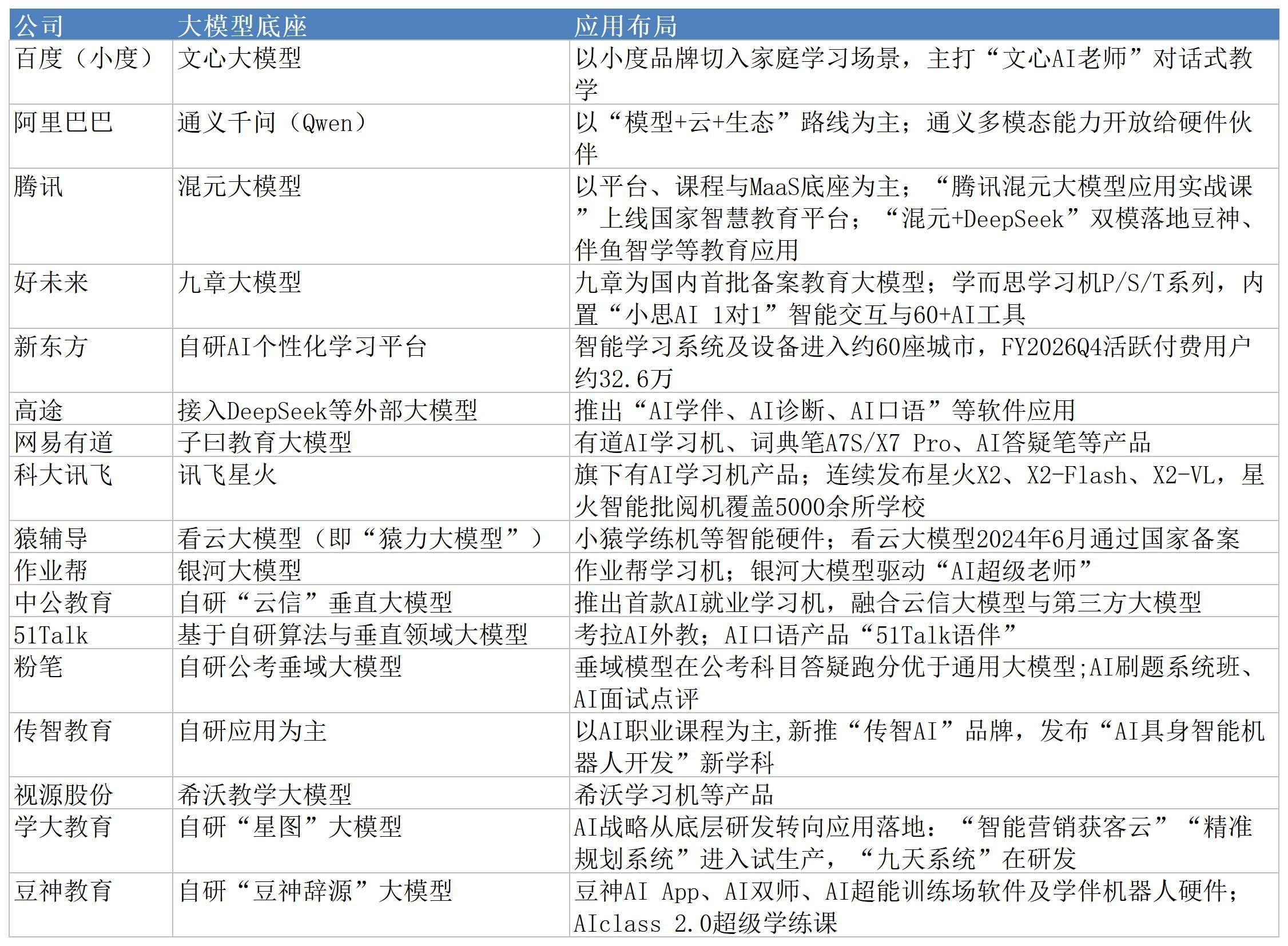
Table produced by 36Kr based on public data
The invisible "price to pay"
Apart from the revenue generated by various businesses, what is worth studying more is the cost control on the expense side.
At the earlier first fiscal quarter meeting this year, TAL's management wrote "disciplined execution" into its business priorities. By the second fiscal quarter, "discipline" was still a high-frequency word in the management's speeches — from the expansion of learning centers, to cost control of learning tablets, to the resource allocation of the entire company.
This is not empty talk. In the first fiscal quarter, the company's sales and marketing expenses decreased by 4.8% year on year; in the second fiscal quarter, the decline expanded to 15.3%. While revenue rose, expenses decreased instead of increasing.
And the other side of "discipline" falls on people, which may not be visible in the financial statements.
In August this year, the "Xueersi Learning Tablet" under TAL experienced a login abnormality failure in the user center, and the official response was that it was due to background program maintenance and upgrade. An employee revealed to 36Kr that the underlying reason might be that maintenance personnel were laid off. "Many problems seem accidental, but in fact they are inevitable."
36Kr learned from multiple employees that TAL's performance appraisal has been tightened since 2022; in 2024, it launched the "991 policy": 90% of new employees are recruited through campus recruitment, 10% through social recruitment, and 10% of the bottom employees are reserved for elimination.
"The compensation is N+1, and those who do not accept it will receive a "Notice of Unilateral Termination" after one or two months."
According to an employee's introduction, the layoff ratio in April and May this year was higher than in previous years, and regular employees were also forced to transfer jobs. Some teachers in offline premium training departments were required to transfer to the online "Ledoo Courses". "This is equivalent to changing full-time positions to part-time positions, cutting salaries in disguise."
There is another option on the negotiation table: take the compensation and come back as an outsourced employee, of course few people accept it.
The caliber disclosed by the company provides the other side of the fact.
Financial reports show that the number of full-time employees at TAL has continued to grow in the past three years: about 15,000 in fiscal year 2024, about 23,000 in fiscal year 2025, and 26,100 in fiscal year 2026. While the total number continues to rise, it is also possible that the "old employees" have been replaced.
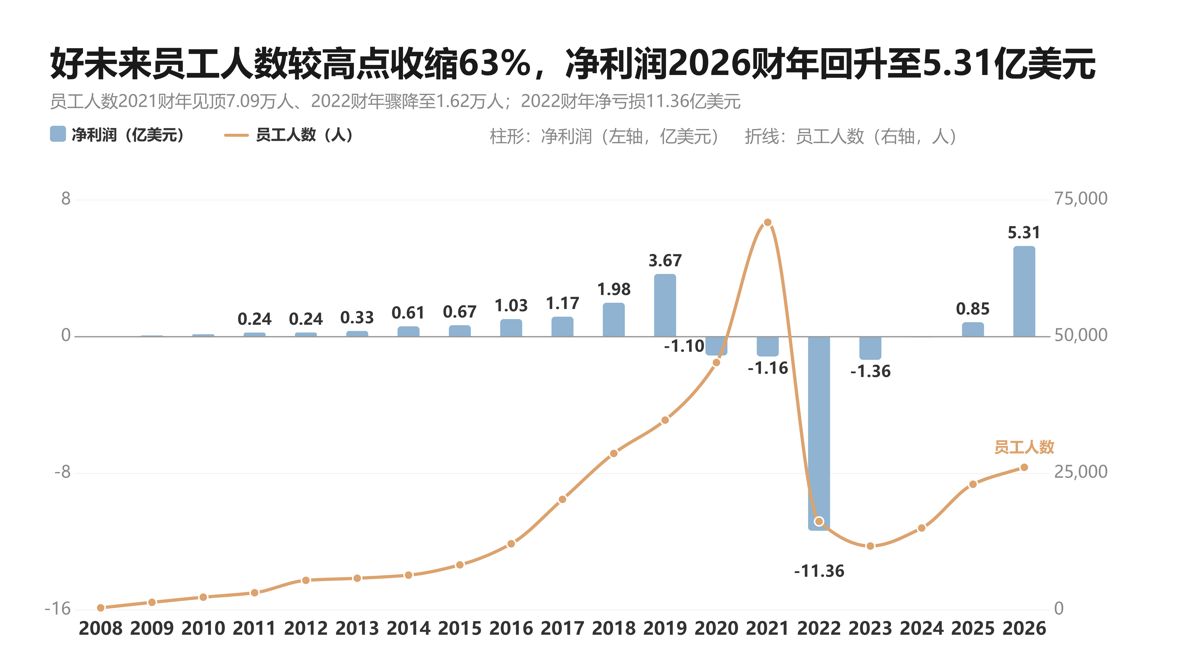
Chart produced by 36Kr based on Wind data
"After the Double Reduction policy in 2022, Zhang Bangxin (founder and CEO) took the initiative to meet many front-line employees face to face for meetings, asking for their opinions on the company's reforms. I never thought that after surviving the hardest time, I would be laid off."
In the above employee's memory, TAL's corporate culture has undergone several changes. From the initial "be open, honest and be yourself" and "failing to teach students well is equal to stealing and robbing money", it has changed to "being stronger is more important than being bigger" and "love and technology empower lifelong growth". For him, TAL before and after the "Double Reduction" policy is no longer the same company.
As a company that also climbed out of the "Double Reduction" policy, New Oriental took a different approach. An employee of New Oriental's study abroad business said that in the past two years, due to department mergers and the overall decline in business volume, the number of employees has decreased, but there has been no large-scale layoff.
Compared with the complaint that "you can only have a good future after leaving TAL", employees who left New Oriental still miss Yu Minhong's famous saying "united we are a fire, scattered we are stars all over the sky".