Going global + robotics, XPeng is seeking a new way out of the dilemma faced by automobile enterprises.
On November 16, XPeng Inc. released its financial report for the third quarter of 2026. This report card is not perfect, but against the backdrop of a roughly 20% decline in China's domestic auto market, this performance deserves a high score.
According to the financial report, in the third quarter, XPeng Group delivered a total of 118,400 new vehicles, representing a 2.1% year-on-year increase and a 14.6% quarter-on-quarter growth; driven by strong delivery performance, total revenue in Q3 2026 reached 24.28 billion yuan, up 19.1% year-on-year and 23.0% quarter-on-quarter. Both delivery volume and revenue hit new all-time highs for a single quarter.
At the same time, XPeng's overall gross margin reached 18.9% in the third quarter, and the auto business gross margin hit 13.1%; as of September 30, 2026, XPeng Group's cash reserves stood at 45.41 billion yuan, a net increase of about 4.93 billion yuan compared with June 30, 2026.
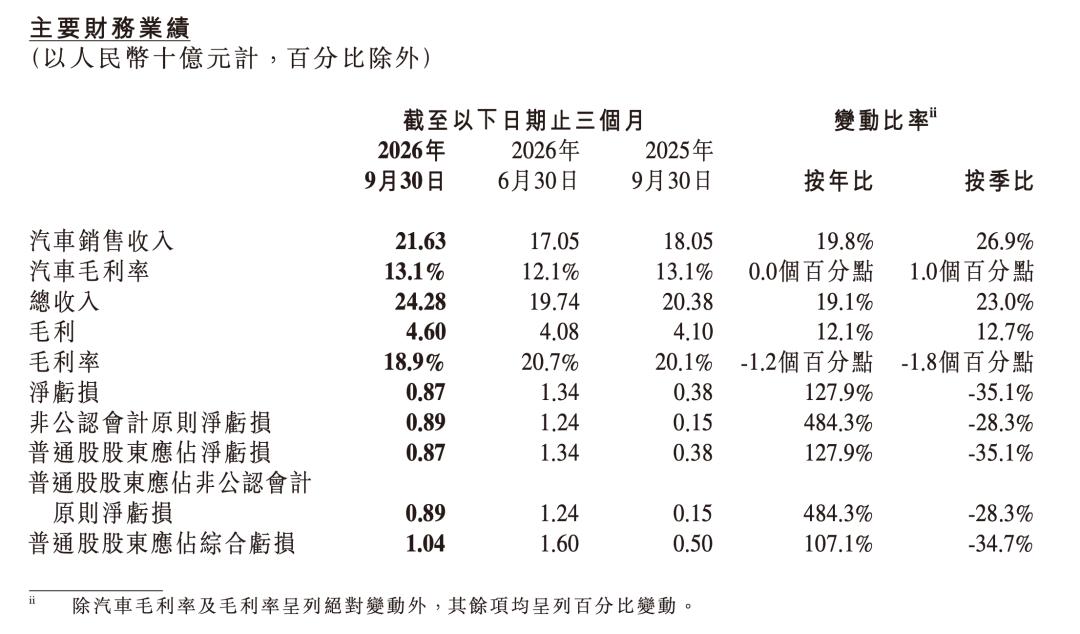
However, operating losses and net losses still exist. The net loss for the single quarter was about 870 million yuan, which expanded compared with 380 million yuan in the same period of 2025, but narrowed significantly from 1.34 billion yuan in Q2 2026.
As of press time, XPeng's share price rose 5.74% to HK$38.68, and its latest total market value stood at HK$742 billion.
Compared with these figures, what the market really cares about are two other things: how fast XPeng can expand in overseas markets, and whether its robot business is truly reliable.
Overseas Market Is Far More Than a Bonus
Let's look at a set of data first. Data from the China Association of Automobile Manufacturers shows that from January to September 2026, China's total vehicle exports reached 8.205 million units, up 65.8% year-on-year, exceeding the full-year export volume of 7.098 million units last year. It is estimated that China's annual auto exports will exceed 10 million units this year.
Chinese automakers' collective expansion into overseas markets has evolved from an "optional course" to a "required course". The more intense the domestic stock game becomes, the more overseas markets become a must-win battlefield for all players.
For XPeng specifically, its overseas performance is equally impressive. From January to September this year, XPeng's cumulative overseas deliveries reached 59,500 units, doubling year on year. Overseas deliveries in the third quarter alone hit 27,900 units, up 153% year on year. Overseas sales in October reached 13,000 units, surging 166% year on year and hitting a record high.
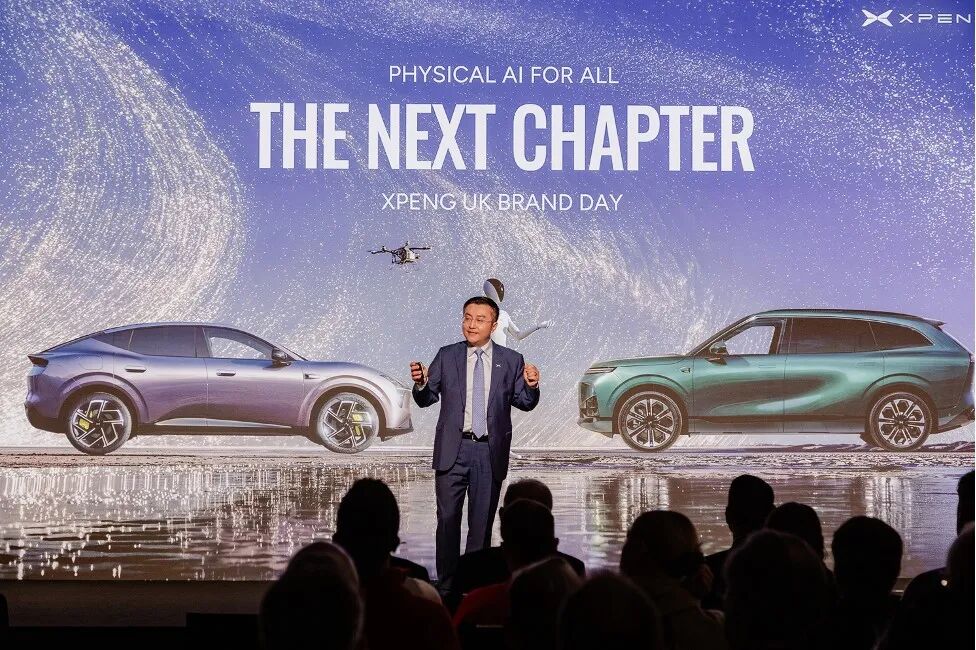
Image source: XPeng Motors
He Xiaopeng set a clear target: overseas sales in the fourth quarter will exceed 40,000 units, and the full-year overseas sales in 2026 will break 100,000 units for the first time. In 2027, overseas sales will more than double based on this year's figure, and the sales network is expected to cover more than 1,000 stores.
What is more noteworthy than sales volume is profit. XPeng's head of finance revealed that the gross margin of its overseas business is more than twice that of the domestic market, and the gap at the net profit level is even larger. One of the reasons is that some markets adopt the dealer distribution model, where gross margin is roughly equal to net profit.
As for pricing, this is the most counter-intuitive part. Most domestic users still associate XPeng with "cost-effectiveness". But in Europe, XPeng is positioned to compete with the BBA tier. Take the G9L as an example: its starting price in China is 231,800 yuan, while in France it is sold at 74,990 euros, equivalent to about 550,000 yuan.
The price difference has more than doubled. Of course, this includes a large number of costs such as tariffs, channels, certification and logistics, so it cannot be simply interpreted as "excessive profit". But it clearly shows that XPeng intends to tell a story of "technology plus premium" in overseas markets, rather than exchanging low prices for market share.
As for how to double overseas sales next year, XPeng's head of overseas business put forward three ideas on the earnings call: First, new models will "run through the whole year". The G9L, MONA L03, L05 and GX will all become global models. Take the MONA L03 as an example: it has been sold overseas for less than one quarter this year, and next year will be its first full year of sales.
Second, the product line is relatively comprehensive. The L03, L05 and G6 target the high-volume family market, the GX (which has received nearly 4,000 orders in the Middle East with prices yet to be announced) targets the high-end market, and the X9 MPV has a solid user base in Southeast Asia and Europe. Third, the company is stepping up its channel expansion efforts.
One analyst raised a pointed question this time: what will you do when the export tax rebate drops from 13% to 9% next year? This is an unavoidable challenge for the entire industry.
XPeng's executives put forward three solutions: accelerate overseas localization. The tax rebate change mainly affects finished vehicle exports, and has a smaller impact on the export of auto parts and KD kits; the pricing of new models has already taken the 2027 tax rebate change into account; the product roadmap is also being adjusted to prepare for the possible further tax rebate cut in 2028. At present, XPeng has a cooperation with Magna in Austria in Europe, and has production layouts in Malaysia and Indonesia in Southeast Asia.
The Core of Physical AI Is "Physics", Not "AI"
If the overseas business is the "growth story", the robot business is the "imagination story".
XPeng Robotics is advancing at the established pace: September 2026: The first automated production line for high-level general-purpose humanoid robots is put into use, with the automation rate of core manufacturing processes exceeding 80%; January 1, 2027: Mass production will start; Q1 2027: The first batch of robots will be put into trial use in some XPeng stores; Q2 2027: IRON will be officially released to external commercial customers and start deliveries.
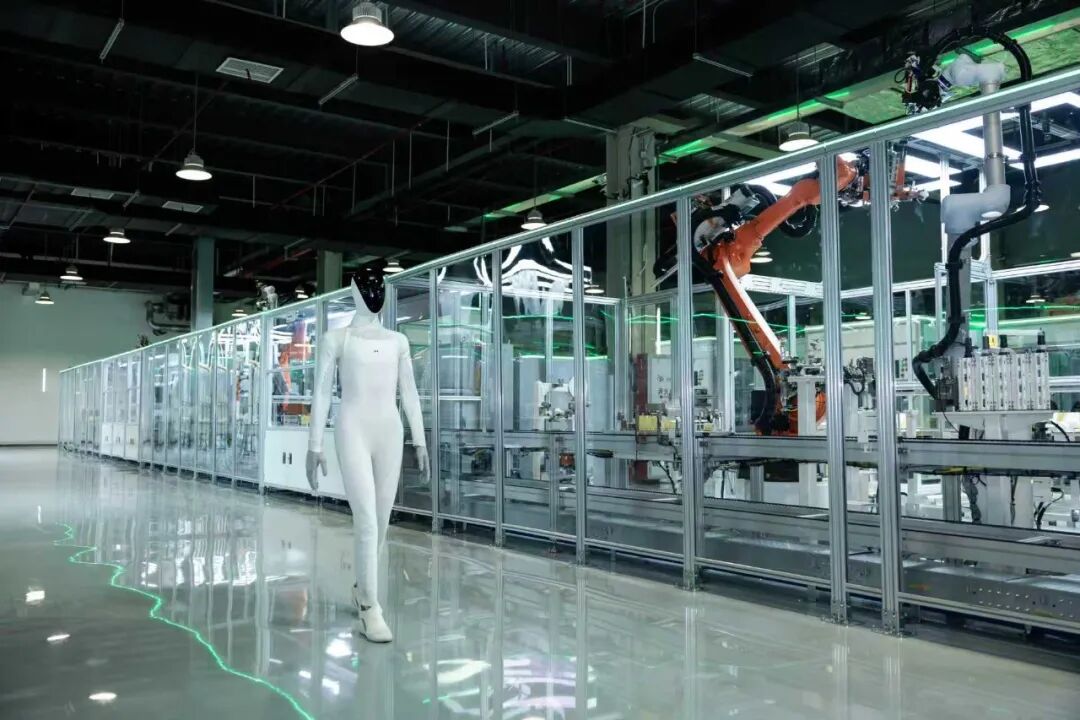
Image source: XPeng Group
It only leaves about half a year from the launch of the production line to external deliveries. For a brand-new product category, this pace is quite aggressive.
He Xiaopeng said on the earnings call that he has been deeply involved in the technical R&D and system management of the robot business in the past few months, and his confidence has been continuously growing. He judges that the sales potential and gross profit scale of the robot business are expected to greatly exceed those of the most popular high-end models on the market.
In terms of capital, XPeng's robotics business has completed its first round of financing of over 900 million US dollars, with a post-investment valuation of more than 6.3 billion US dollars, setting a new record for the single-round private equity financing of China's embodied intelligence industry.
On the earnings call, an analyst raised a pointed question: Big model giants are all entering the field of physical AI, so what on earth is the moat of robotics companies?
He Xiaopeng did not answer directly, but first reviewed the history of autonomous driving: from 2015 to 2020, some people developed "autonomous driving" purely through simulation on computers, but there is no real commercial application today, due to problems with accuracy and minimum safety standards; around 2018, many L4 companies made impressive demos, but the commercialization progress was far slower than expected; the end-cloud integrated solution also failed to work, with the main bottleneck lying in latency.
From this, he judged that it is very difficult to achieve commercial application in the short term by relying on a general large model (System 2) to cover all levels of capabilities. What XPeng is building are four core capabilities: hardware ontology, large-scale manufacturing and sales, high-quality diverse data, and end-side plus cloud-side computing power.
He Xiaopeng made some very interesting remarks, saying that the core of physical AI should be "physics" rather than "AI". In terms of data, he particularly emphasized tactile data, including pressure, temperature and somatosensory data, believing that these data are as important to robots as visual data is to autonomous driving.
So which scenarios will robots be deployed in first?
He Xiaopeng said that XPeng will not do "large B-end customized products", but will develop standardized products targeting small and medium-sized B-end customers, and later individual and family customers. Large B-end customization seems to bring large orders, but it is actually a "project-based" model, where each order requires re-adaptation, making it difficult to achieve scale effect and spread R&D costs. Standardized products are more in line with the automotive industry logic: launch one product first, then reduce costs through scale expansion.
He also made judgments on applicable scenarios. From the perspective of Europe and the United States, the best scenario is industrial use; from the perspective of expanding Chinese products to the global market, commercial and household scenarios are more appropriate. Industrial scenarios have stricter requirements for robot dexterity and cost, while commercial and household scenarios have higher requirements for safety and appearance.
He believes that many robots currently on the market are left unused in warehouses after being sold, because their safety and quality do not meet requirements. Going forward, the player that first launches high-quality, highly safe robots will take the lead.
The current problem in this industry is not "whether we can make robots", but "whether people are willing to use them for a long time after they are made".
The Real Exam: Multiple Battles, One Batch of Supplies
XPeng today is fighting several battles at the same time.
The domestic auto market is a red ocean, and price wars and cutthroat competition have not ended. Overseas markets are incremental, but XPeng has to face the tax rebate cut and localization barriers. The robot business is a long-term narrative that requires continuous capital investment. In addition, XPeng is also working on flying cars and Robotaxi.
These battles have different paces, but they all draw from the same pool of resources. Therefore, the core of breaking through is not "which one to choose", but to arrange the priorities properly, so that the previous business can supply blood to the next one.
On the earnings call, He Xiaopeng made it clear that in the short and medium term, XPeng will first make its auto business achieve positive cash flow and profitability, to underpin the investment in physical AI. "Physical AI is not a 100-meter sprint, but a long-distance race spanning the next decade."
XPeng still recorded operating losses and net losses in Q3, but XPeng's executives gave relatively clear guidance: the group's full-year gross margin in 2026 will remain at a high level of more than 10 percentage points; in 2027, the growth rate of R&D expenses will be moderate, the efficiency of sales expenses will be improved, and both R&D expense ratio and sales expense ratio will be optimized.
At the same time, XPeng's guidance for the fourth quarter is quite strong: it expects to deliver 169,000 to 174,000 vehicles, representing a year-on-year increase of about 45% to 50%, with revenue ranging from 30.4 billion yuan to 31.8 billion yuan. He Xiaopeng said on the call that deliveries in October exceeded 50,000 units for the first time, and deliveries in November are expected to exceed 60,000 units for the first time.
Finally, here is a teaser. The latest version of IRON will make its public debut at XPeng's AI Tech Day and the Guangzhou Auto Show this month. He Xiaopeng revealed that it will demonstrate "a series of distinctive capabilities".
In a few days, the answer will be unveiled.
This article is from the WeChat official account "GeekPark" (ID: geekpark), written by Zhou Yongliang, and published with authorization from 36Kr.