Post-2000s job seekers are forced to develop people-pleasing personalities by AI interviewers
New graduates are finding that AI interviewers are increasingly common in job interviews. To land a job, the first skill they have to master is "how to please the AI". During this long job-hunting process, they have to search for tips and repeatedly tackle the digital human on the screen.
The campus recruitment season known as "Golden September and Silver October" has just passed, and November is the time when new graduates are busy dealing with written assessments and interviews.
However, in the past two years, some "small changes" have clearly emerged in the recruitment market.
Many new graduates have received AI interview invitations. The so-called "AI interview" means that an "AI figure" acts as the interviewer, grabs keywords to ask questions based on the job seeker's self-introduction and answers, and the interview duration is mostly between 40 and 60 minutes.
Sounds like a model that can not only improve interview efficiency, but also reduce the pressure of face-to-face communication with real people for new graduates. But in practice, they not only do not feel relaxed, but even have a lot of helplessness that is half funny half frustrating.
This is just a section of AI "invading" the job application process. The current situation facing new graduates may be: starting from online application and resume submission, the involvement of AI will make "finding a job" more complicated and troublesome.

Many companies use a unified AI digital human image. "All AI interviewers have the exact same face" is a common feeling shared by many job seekers. (Photo / Social Media)
They are on the verge of breaking down just to demonstrate leadership to AI
When a new graduate wants to get a job, the first step they may take is to learn to please AI.
Some enterprises use ATS (Applicant Tracking System) to assist AI in screening resumes when conducting "initial screening" of candidates, whose essence is to match content with keywords.
In order to successfully pass the "initial screening" stage, new graduates need to take the initiative to learn and adapt to the working mechanism and judgment logic of AI when writing resumes.
Human resources managers with working experience in large factories share online: after the campus recruitment opens, one position can receive hundreds of resumes. It takes too much time to open each resume one by one and judge whether the candidate is suitable based on HR's experience, while directly using the filter to check conditions with one click is not flexible enough.
When HR uses AI to screen resumes, they only need to provide the description of job content, and the AI can automatically decompose the job requirements, accurately filter and recommend suitable candidates in the resume database.
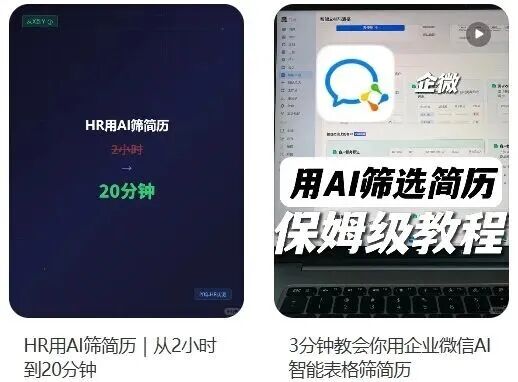
Searching for "how to pass AI resume screening" on social platforms will lead you to a lot of "step-by-step tutorials", and job seekers only need to follow the example:
(Photo / Social Media)
Upload your manually written resume and job responsibilities / required skills to AI, and give detailed modification instructions: extract the keywords in the job description, place them in high-weight positions (the first 1/3 area of the resume), use more verbs that describe achievements, and include quantifiable data, so that AI can output a new version of resume that is adapted to AI screening.
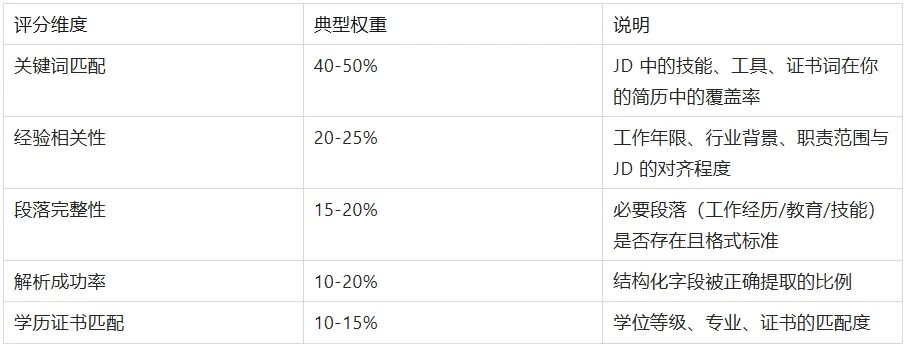
Several dimensions of AI resume screening summarized by netizens. (Photo / Internet)
You need to accurately figure out what kind of wording AI prefers: rewrite the experience of "being responsible for club activity planning" as "independently coordinating the whole process of activities, with cross-departmental communication and project management capabilities"; try to quantify your "work achievements", such as "improving efficiency by 30%" and "reducing cost by 20%".
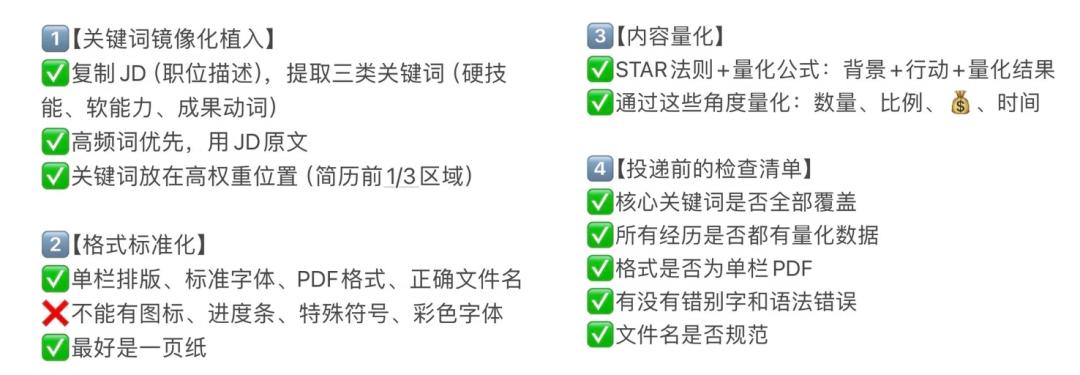
Netizens summed up the tricks and precautions to make resumes pass AI screening smoothly. (Photo / Social Media)
Upload the resume repeatedly for AI to polish and modify, check whether the keywords are conspicuous and can be recognized by the algorithm, and most importantly, ask AI to "help" remove the AI-generated flavor in the resume to avoid being considered as machine-generated by HR.
After several twists and turns, the resume can look like it was written by a real person.
What job seekers need to consider is not only whether they have the ability to do the job well, but also how to meet the screening preferences of AI first.
Previously, they worried about being rejected by HR due to insufficient experience, but now they worry about failing to pass the AI screening because they are not careful enough in word selection.
This is only the first step of the tedious process. Starting from the online job application and filling in personal information, job seekers will immediately receive links to online assessment and personality test pages. After finally completing hundreds of questions, they will receive a notice that "the AI interview must be completed within 48 hours".
At this stage, you have to learn to "please" the virtual interviewer. The interview process is like repeatedly tackling several digital humans. When participating in the interview, you will see two or three expressionless faces on the screen, which often repeat the sentences "I want to hear you talk about it in detail" and "Please elaborate on it specifically".
At present, many enterprises in the market use AI interview systems such as Beisen, Zhaopin, Liepin and Niuke, and the AI interview questions of different enterprises are likely to come from the same question bank.
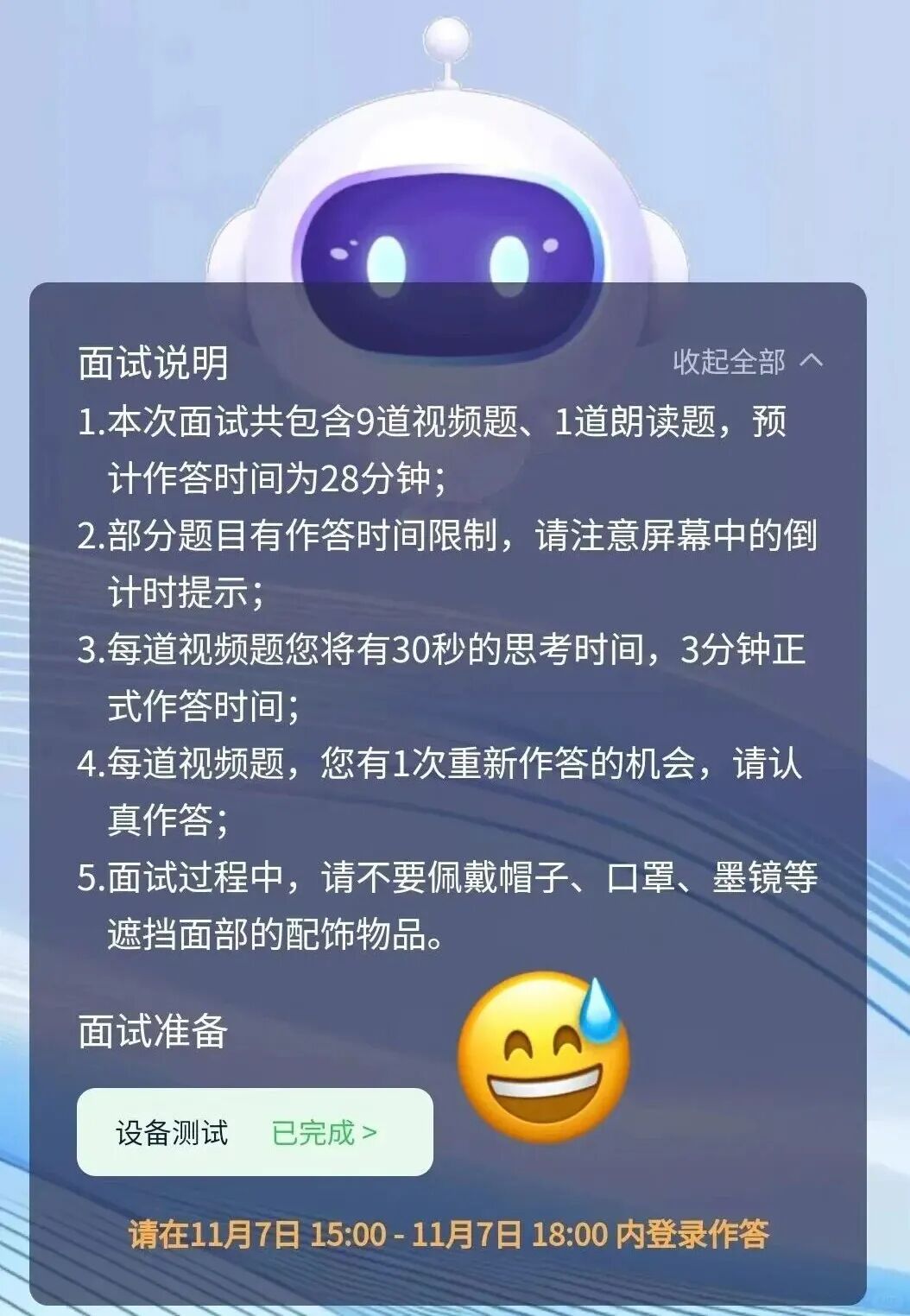
After entering the "AI interview room", the system will prompt matters such as the number of questions and the answering time. (Photo / Social Media)
First, you need to read a sentence out loud to test the functions of the device's camera and microphone; then, a virtual interviewer will appear on the screen and ask the job seeker the first question: "Please introduce yourself in detail".
Each answer is best to last about four and a half minutes. Although you can submit the answer in advance, most interviewees will try to enrich the content to increase the weight of their answers.
The self-introduction in offline interviews is generally controlled within two minutes. With suddenly doubled time, everyone can only "expand on" each experience. They have learned to use the STAR framework to tell their internship experience — from the task background and specific work to the final results. In order to avoid inadequate answers, they also need to try their best to describe the details completely, while constantly supplementing the thinking process at that time.
The AI interviewer will grab keywords from the answers to ask questions, but since it cannot fully understand the content shared by the candidates, in most cases, it only mechanically asks follow-up questions, or only digs into the most trivial details.
For example, the AI will follow up: "You mentioned a certain internship experience just now, can you elaborate on what role you played in it?"
Job seekers have to reorganize their language and explain the experience they have already talked about again. If the specified answering time has not been reached, they also need to "embellish" the plain experience, such as what setbacks they encountered in this internship, and finally successfully solved a certain problem by asking others for help and reflecting on themselves. This not only enriches the answer, but also highlights communication skills and problem-solving skills...
Unexpectedly, the AI interviewer then followed up: "You just mentioned communication skills, can you give a specific example?"
Student M, who participated in many AI interviews this year, complained: "I really don't know how to make the problem that I have already explained clearly more detailed. Not to mention that there are many annoying bugs such as ASR (Automatic Speech Recognition) errors, the system prompts that you are not looking at the camera when you are clearly looking at it, and the system starts the next question before you finish answering."
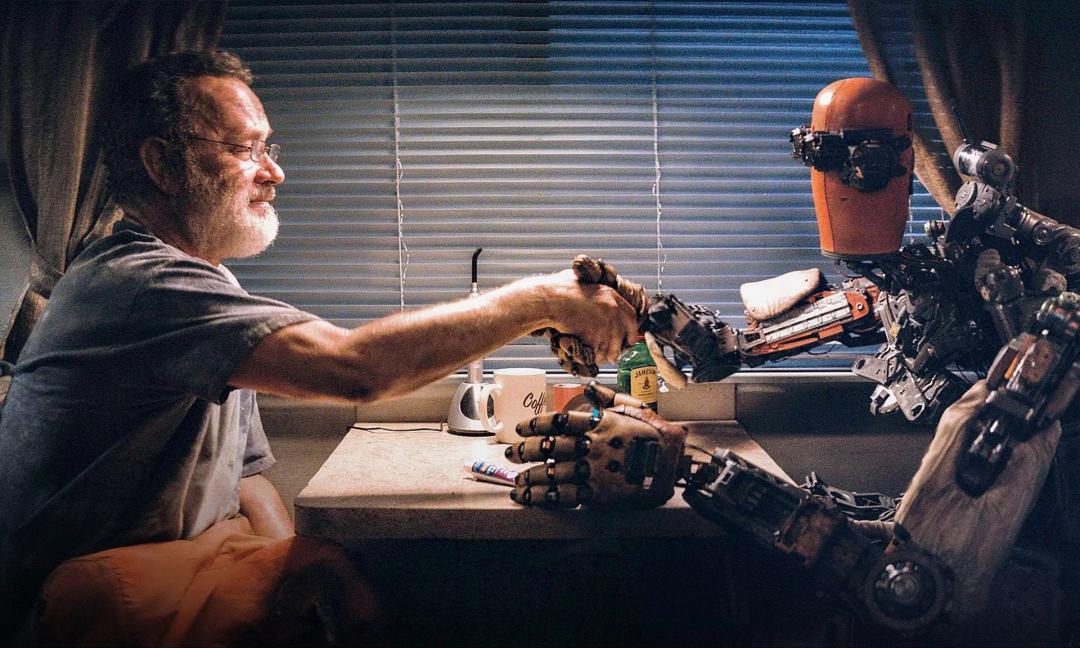
The film discusses the possibility of AI as a "partner" beyond being a "tool". (Photo / Finch)
AI interviews not only require job seekers to be good at expressing themselves, but also test whether job seekers are "good at performing".
Even if the picture is monotonous and there is no sense of interactive communication, you still need to try to be enthusiastic and cheerful, because they not only need to show themselves, but also learn to satisfy the AI.
Facing the "AI figure" on the screen who keeps nodding and smiling at a fixed frequency all the time, the students have no idea whether the other party is listening carefully to their answers, nor can they get any effective feedback for the content of the conversation, but they still need to mobilize their emotions, sit upright, relax their expressions, and maintain a positive and enthusiastic tone.
When answering questions, you can't be too casual like chatting in daily life. Instead, you need to use a clear structure of "first, second, finally", and each experience you describe needs to accurately match content such as "leadership, stress resistance, cross-team collaboration", for fear that the AI will miss the "scoring points".
Even if the other party does not respond at all, the interviewee has to behave as if they are communicating with a real interviewer.
One AI interview alone has already exhausted new graduates, but this is only the interview for one position of one enterprise. During the campus recruitment season, job seekers often apply to multiple enterprises at the same time, which takes more time to complete these necessary processes every day, but in the end they can't even see the shadow of a real interviewer.
They even fall into self-doubt. When writing resumes, they need to add some terms that "they don't even understand" to increase the weight; in order to better deal with the "routine questions" in the interview, they have to deliberately fabricate experiences and exaggerate tense atmosphere to reflect their "calm under pressure" leadership — which makes many people feel that "this is not the real self".
Asking a living person to cater to the preferences of the algorithm is itself a counterintuitive solution.
After being perfunctorily treated by AI, their job applications get no response at all
When AI is involved in the interview process, what job seekers resent is not only the tedious and unnecessary steps, but also the implicit unfairness behind the unequal cost paid by both parties.
Interviews are supposed to be two-way choices based on full communication, but the "efficient" virtual interviewers only make job seekers feel the slack and arrogance of the enterprise.
An interview lasts for 40 minutes, but apart from asking questions, the AI hardly makes any feedback comments. Job seekers can only talk to themselves to the "fake figure", and can't feel the attitude of the interviewer from the response, nor know whether their views meet the other party's preferences. The whole process is like performing a one-man show with no audience.
They finally finish answering the last question, and their mouth is already parched from continuous speaking. After submitting the answer, a standard greeting pops up on the screen: "Thank you for participating in this interview".
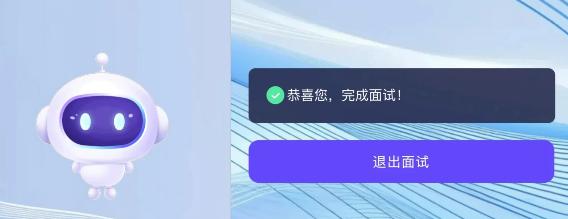
(Photo / Social Media)
Dozens of minutes of positive, enthusiastic and decent performance seems to have ended like this.
But the sense of relief is quickly swept away by new problems: when will the interview result come out? Is there any interview with a real person left? What if I can't pass the AI interview all the time?
When you open the campus recruitment process page with full expectation to check the progress, you find that the "AI interview" mark has quietly turned gray, without any targeted improvement suggestions or elimination reasons, and you are "rejected" for no clear reason.
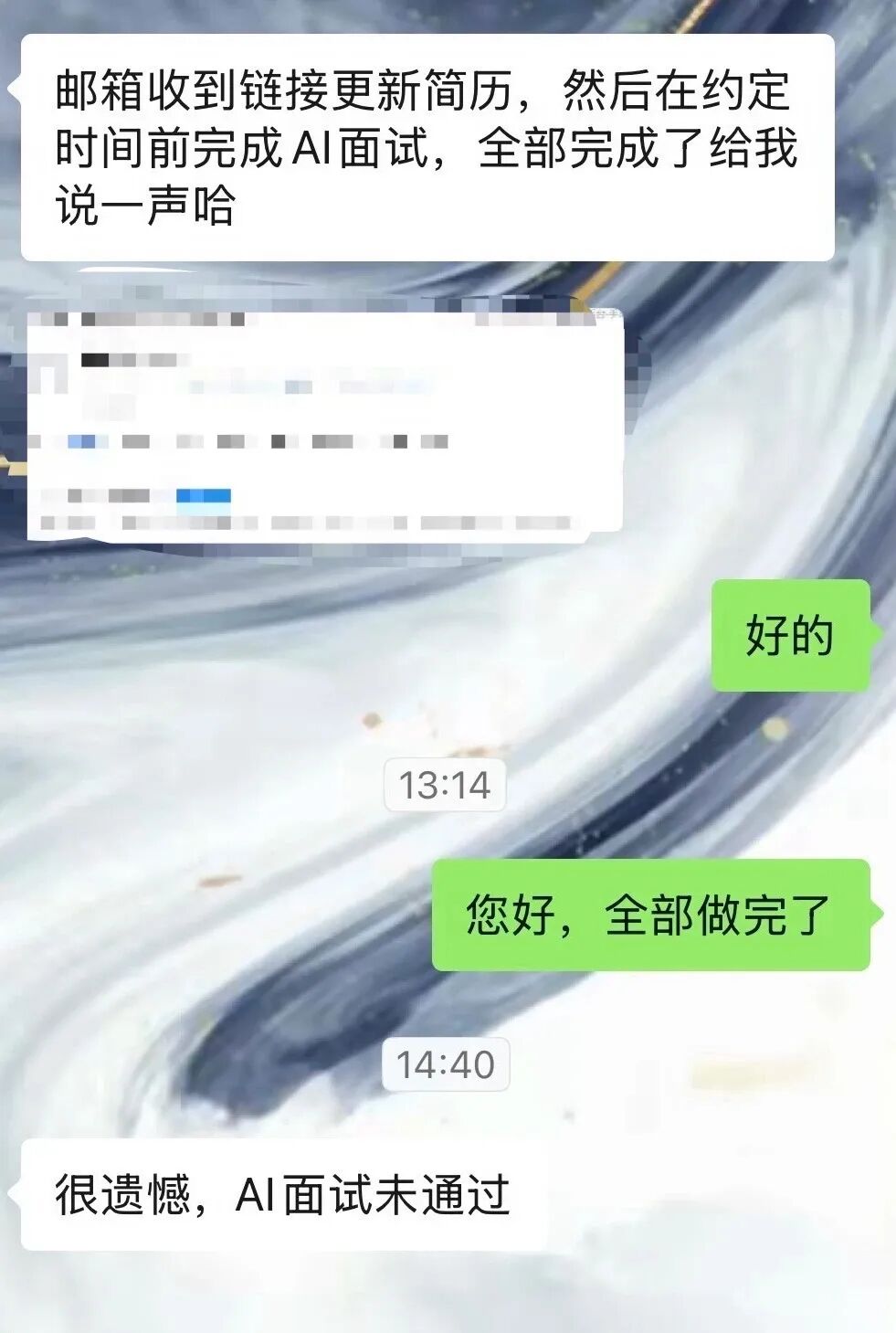
A job seeker posted the chat record online where HR informed him that he "failed the AI interview". (Photo / Social Media)
You don't even know which link you were eliminated in.
Many interviewees are exhausted while waiting for the results, until they suddenly find that they can't access the "job details" page and then realize that the enterprise has already recruited the desired candidate, so it "removed" the relevant content.
At this point, no matter how you vent your emotions, it feels like punching on cotton with no feedback.
For enterprises using AI interview systems, no matter whether the interviewee's major and experience match the position, as long as the other party submits personal information, they will send an AI assessment and AI interview notification unconditionally. After all, this does not require additional manpower and material resources, only a piece of automatically triggered code.
Job seekers don't feel valued, as if they are just the most insignificant indicator in the KPI of interview volume and AI interview completion rate.
Preparing for an AI interview is no different from preparing for a real interview in terms of the effort you spend, except that you save the transportation cost of traveling offline.
Polishing self-introduction, searching for interview experience, preparing classic personal cases, understanding corporate culture and main business... These preliminary tasks take a lot of time. Some enterprises require "dual-camera" monitoring for interviews, and sometimes you need to plan a suitable venue for the interview in advance and test the camera, but they use AI-generated evaluations to screen interviewees in batches with one click. Regardless of whether the AI summary is objective and credible, there is an obvious gap in the time and degree of attention paid by both parties.
Even in the stage of confirming interviewee information, some enterprises