What problems do smart glasses still need to solve to evolve from something people are willing to try out to an everyday wearable device?

In recent years, smart glasses have gradually integrated capabilities such as audio, shooting, display and AI interaction into the glasses, trying to become a portable device connecting people and the digital world. However, after the continuous increase of functions, the product has to face a fundamental problem: users will take off the glasses early or rarely use them due to uncomfortable wearing experience.
The founder of EverHarbour AI once had such an experience. He hoped to find a pair of smart glasses that could be worn for a long time, but problems such as weight burden and pain on the side of the ear repeatedly appeared on different products he tried.
This made him start to reconsider the design sequence of smart glasses products: for wearable devices, the property of being wearable and people's willingness to wear them is the foundation for more functions to be used continuously.
EverHarbour AI focuses on AI+ wearable smart devices, takes optics, acoustics, embedded technology and artificial intelligence technology as its core technical capabilities, and builds consumer-grade smart hardware that combines aesthetic design, ergonomics and technological experience, so that technology can naturally integrate into daily life.
Recently, it has launched its first product line, the 311 Series, which is positioned as open-style smart audio glasses for high-frequency daily use, focusing on solving problems such as daily call communication and work efficiency improvement for high-end business people who wear glasses every day.

Beyond smart functions, basic experience is affecting choices
The focus on comfortable wearing can also find corresponding feedback in consumer surveys.
A 2025 survey by iiMedia Research shows that among the factors that surveyed consumers pay attention to when purchasing smart glasses, battery life accounts for 61.25%, comfort and adaptability account for 56% and 48% respectively. These factors jointly affect whether the product can enter people's daily life.
The market is also reminding enterprises to re-examine the user experience. In a report in September 2026, IT Times mentioned the problem of high return rate of smart glasses in some e-commerce channels. Functions and parameters have attracted public attention, but whether the actual experience can meet expectations is still a threshold that products need to cross.
These current situations cannot all be attributed to the wearing experience, but they put forward a common requirement: products need to give more specific reasons for consumers to choose them.
EverHarbour regards comfort and design as the basic capability for defining smart glasses products, to respond to the needs of people who wear glasses daily -- after the frame accommodates electronic components, it still needs to fit different face shapes and take good care of the wearing experience.

Comfort, leaving adjustment space for different people
Everyone has different nose bridge height, face width and ear side contour, so the wearing experience of the same pair of glasses may vary from person to person. In addition to lightweight design, the frame also needs to be appropriately adjustable.
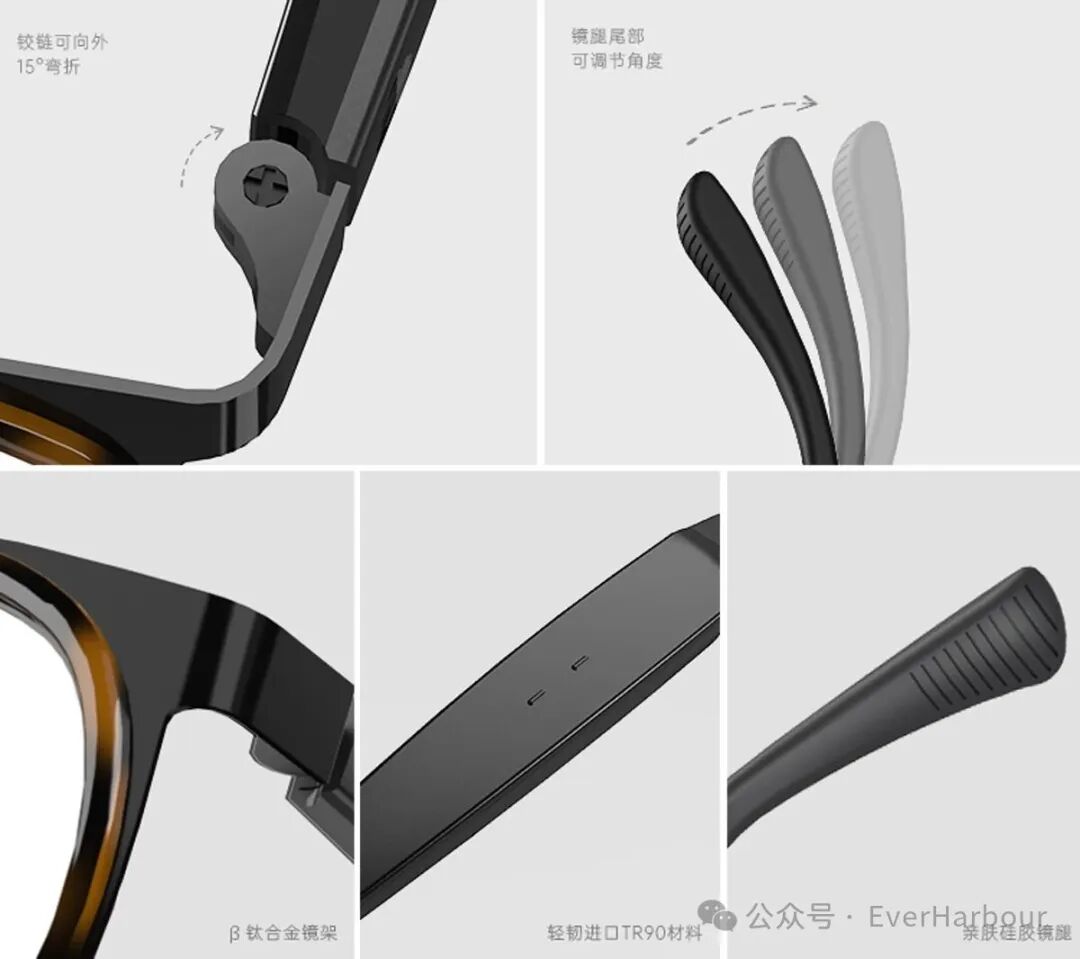
The 311 Series products are equipped with two adjustable structures at the nose pad and the temple. The nose pad can be adjusted according to the condition of the nose bridge to improve support and fitting performance; the temple can be adjusted combined with the contour of the head side and ear side, so that the glasses can stay in a more appropriate position matching everyone's face shape.
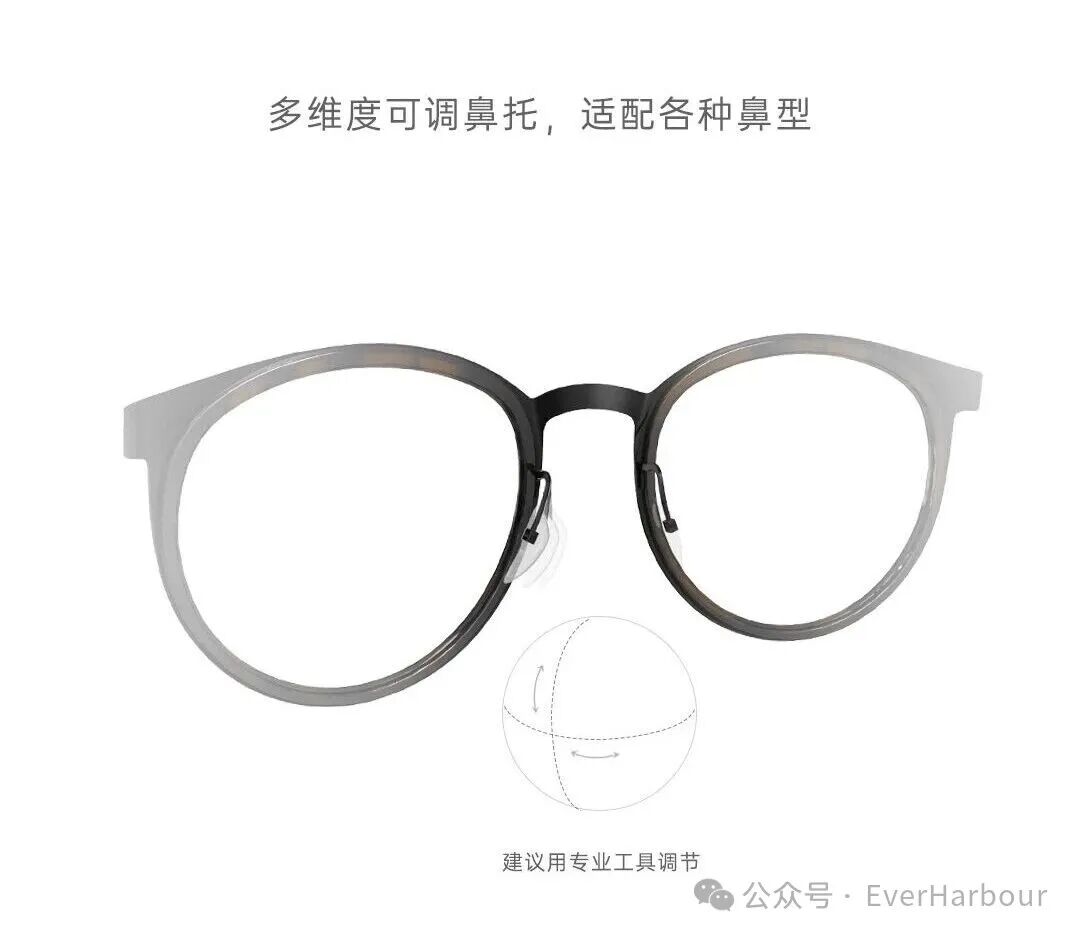
According to the information provided by the brand, the body weight of the 311 Series is about 27g. The team has carefully polished and finely adjusted the ergonomic experience, and strictly selected lightweight skin-friendly materials: the high-texture lightweight β-titanium is used for the frame structure, the Swiss imported EMS TR90 balances light weight and toughness, and the high-grade acetate fiber board provides excellent color, hierarchy and processing performance for the frame, to build outstanding wearability. At the same time, drawing on classic aesthetic design, the team optimizes the details of the front frame combined with the head shape of Asians, to find a perfect solution for people who are willing to wear smart glasses.
Starting from audio, connecting with existing living habits
After comfortable wearing and aesthetic design, functions need to find reasonable reasons to be used frequently. The EverHarbour AI team believes that audio capability is the very function that must be retained in the necessary subtraction of product definition.
EverHarbour AI's smart glasses are designed for the crowd who already have the habit of wearing glasses, and combine sound-related demands with daily wearing: listening to audio content during commuting, answering calls during work breaks, sorting out key points with the help of meeting minutes after discussions, and getting translation assistance for communication when going out.

The 311 Series supports audio listening, calls, meeting minutes and real-time translation. The call function helps reduce the interference of background noise to sound transmission by processing human voice and ambient noise.
The value of a product lies in whether it can be operated conveniently and provide stable experience, so as to naturally integrate into users' daily life. Products should not pile up redundant functions just for the sake of innovation.
Elegant and understated, free to move with you
Technology should integrate into daily life and serve life, rather than steal the show and become an extra burden.
In EverHarbour's view, life includes not only focused engagement, but also the relaxation of casual chatting and quiet listening. Apart from pursuing efficiency, people's care for their own feelings is equally important: whether a pair of glasses matches personal temperament, whether it is comfortable to wear for a long time, and whether a function is just appropriate. These subtle and specific demands constitute the starting point of the brand's product design.
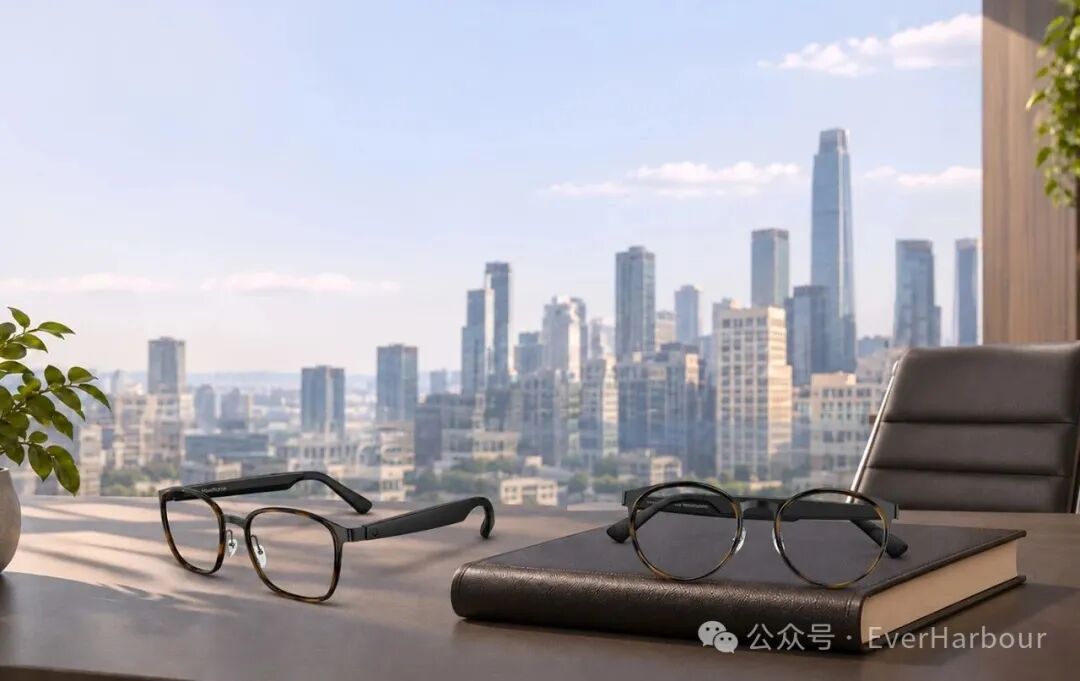
This reflection on the relationship between "glasses, technology and people" has finally precipitated into EverHarbour's core concept — "Elegant and understated, free to move with you". Being elegant and understated means integrating into daily outfits with a classic form, hiding technology in details, and leaving enough space for the wearer's own temperament. Being free to move with you represents a calm life proposition: serving daily life with comfortable wearing experience and practical intelligent functions, no need to bother with adaptation, move as you wish, stretch and stay self-consistent.
A good smart wearable device never makes people adapt to the equipment, but allows technology to naturally integrate into life and fulfill every calm and comfortable daily moment.