This Silicon Valley company tells us that AI-driven organizational transformation is non-negotiable.
In Marvel's Avengers, Nick Fury, director of S.H.I.E.L.D., has a famous quote — S.H.I.E.L.D. never negotiates. In other words, as this institution shoulders special missions, backed by the force of superheroes and the resources of state machinery, they only act in ways they deem right and never yield to external pressure.
But in the real world, when enterprises decide to carry out organizational transformation, bosses have to face a number of resistances, and it is difficult for them to be as overbearing as S.H.I.E.L.D. More often than not, resounding transformation slogans eventually turn into perfunctory compromise solutions that fail to deliver real impact.
This article will clarify "why organizations are so hard to transform" and "why AI can transform organizations", and use the most cutting-edge enterprise cases from Silicon Valley to demonstrate the straightforward and disruptive nature of AI-driven organizational transformation.
01 Why can traditional organizations not be transformed effectively?
The organizational model adopted by the vast majority of traditional enterprises can be summed up as Hierarchy, which clarifies the responsibilities and authorities of each organizational unit (post, team, department) through horizontal division of labor and vertical authorization.
There is no doubt that this type of organizational model, under the name of "standard", has moved towards rigidity. Each organizational unit is pre-cast by specifications such as organizational charts, departmental responsibilities, and job descriptions, like a set of "molds". In this set of "molds", people first find their positions, then clarify their boundaries, and define their responsibilities and authorities. Conversely, people who do not hold a certain position will not participate in the related affairs, and naturally have no corresponding responsibilities or authorities. How about the collaboration efficiency in such organizations? To put it nicely, the collaboration is quite stable; to put it bluntly, the collaboration is quite cumbersome. To be more specific, if a capable employee identifies a market opportunity and wants to make achievements for the company, he will have no resources or platform to do so, as the countless rules and restrictions within the enterprise will completely restrain him.
Furthermore, "corporate politics" further reduces the efficiency of this rigid organizational model. Just imagine, if everyone works according to the responsibilities and authorities defined by the "molds", performs their own duties, and exercises their respective powers, even if it is a little rigid and cumbersome, it can basically meet the expectations of the enterprise. But the problem is that people in every corner of the "mold" have selfish intentions, and they all want to evade responsibilities and seize more power. As a result, "executive walls", "department walls", "team walls" and "post walls" appear horizontally; heat insulation layers appear vertically, and power cannot be delegated downwards. The people at the grassroots level who actually do the work have no decision-making power, and frontline employees are waiting for orders from "the higher-ups". In such enterprises, "political correctness" is prioritized instead of "efficiency first". Because the horizontal and vertical divisions have formed multiple separatist spheres of influence, everyone first focuses on the gains and losses of their own sphere of influence, rather than the success or failure of the enterprise. If the aforementioned capable employee finally breaks through countless resistances, mobilizes resources through various means, and makes great achievements for the enterprise at all costs, he will still be suppressed by all forces as a "trailblazer who stands out from the crowd".
The underlying code of the hierarchical organization is rigidity, but the vested interests in "corporate politics" will actively maintain this rigidity. To put it plainly, if you want to break the departmental boundaries and break the hierarchical restrictions to allow unobstructed flow of information and resources, you are essentially making some "checkpoints" meaningless, which will definitely damage the spheres of influence of certain people.
In the 1990s, business process reengineering, which was all the rage in European and American enterprises, was sidelined under such circumstances. Enterprises could take decisive measures to break through department walls and heat insulation layers by creating streamlined processes. However, those departments whose powers were reduced in the process reengineering will definitely use various means to bypass the process or seize control of the process, and the bureaucratic systems represented by department walls and heat insulation layers will reappear in the process in a more internally consumptive way, leading to even higher costs.
In this context, the calls from bosses for borderless collaboration among departments, for streamlined reporting chains across all lines, and for managers and headquarters staff to go to the grassroots level to solve problems are all false propositions. Subordinates will agree and express their support, but they will never really implement them. Because once the boundaries are broken, the vested interests will lose their spheres of influence, and the resistance is too great. To put it more dramatically, people can tolerate internal conflicts in normal times, but anyone who tries to carry out organizational transformation will become the enemy of all factions. Even if the boss wants to promote transformation, there will be a group of people submitting petitions to carry out reverse PUA on the boss, making him give up the idea.
Let's go back to the aforementioned capable employee. If he bypasses all factions and gets things done, what will happen? Isn't he clearly telling the boss that there is a more efficient organizational model, and everyone's separatist spheres of influence can be abolished and reshuffled? That is absolutely unacceptable. At this point, it is not difficult for everyone to understand why there are few "capable people" standing out in large enterprises, and young cadres all try to make themselves fit the profile of "boss's secretary". Because this way of working abides by boundaries, focuses on the superior's intentions, and is the safest.
To a certain extent, the reason why traditional hierarchical organizations cannot be transformed is not only the lack of determination from the boss, but also that this kind of organizational transformation requires the cooperation of too many people, and the way of cooperation requires some vested interests to "cut off their own interests". Unless there is extraordinary transformation wisdom, this is almost a "mission impossible".
02 AI is a machete, straightforward and disruptive
An undeniable fact is that enterprises that make extensive use of AI technology will eventually be reshaped into "agent organizations". Mu Sheng Consulting further puts forward the judgment that "agent organization = AI technology + platform-based organization". In other words, loading AI technology on a hierarchical organization is meaningless, and will even bring greater internal friction. Enterprises should first move towards a platform-based organization.
However, with the deepening of practice, we increasingly realize that the logic of AI reshaping organizations may be more straightforward and disruptive than we previously thought. AI does not need to form organizational collaboration by building a "structured three-tier architecture". From the moment it is embedded into the workflow, it reshapes the mechanism of organizational collaboration like a "machete".
In the agent organization, the way to deconstruct the organization is completely different, which is "human → agent → operation unit → workflow"; while the original logic of the "mold" is "human → post → team → department → process", which completely loses its meaning.
Different from the pre-cast molds, the logic of the agent organization is completely opposite — customer demands come first, then workflow design, then multiple operation units are connected to form a human-machine collaboration team. It no longer asks "which department do you belong to", but only asks "what capabilities are needed for this task, and who will make the final decision". In other words, organizational units that cannot add value to the final result may not be able to enter this link at all.
What is even more striking is that this task-based calling mode directly breaks the traditional hierarchical organizational structure and penetrates to the finest "granule" — the middle and back-office functional departments need to turn their own functions into individual agents, and then compete for the "job opportunities" of each operation unit through "capability tags + price advantages + historical performance". In other words, what kind of workflow the customer needs determines which operation units the workflow requires, and which agents can be employed. All of this does not depend on the will of department heads and team heads (whether they are willing to cooperate, who they want to assign to cooperate), but only on the value of the agent itself. In fact, this is the ultimate state that most enterprises hope to achieve: "customer-centric" and "gathering and dispersing according to orders".
Let's look at two cases to see the differences in collaboration modes between hierarchical organizations and agent organizations.
The first example: assume that an enterprise has an operation unit called "emergency bad review handling".
In the traditional hierarchical organizational model, the process will go through the customer service department, operation department, and legal department for approval in sequence. Since each department is in charge of its own section and has its own territory, they all want to seize power and shirk responsibilities, so department walls inevitably exist between departments. In the process of information being transferred layer by layer, the bad review may have already fermented.
In the agent organization, internal agents will compete for jobs after being screened by humans or algorithms. At this time, the AI agent is the frontline executor, granted with "plan generation right", which will immediately call order data and historical communication records, and directly generate a compensation plan within the preset rules. Human experts retain the "exception ruling right", and only intervene to make decisions when AI encounters high-risk scenarios (such as customers requiring huge compensation), and take responsibility for the final result. This operation unit will be "captured" into the workflow of key customers or large orders, to maintain this type of sensitive customer relationship.
The second example is the experimental retail store Andon Market opened by the well-known AI company AndonLabs in San Francisco, which is a complete "workflow".
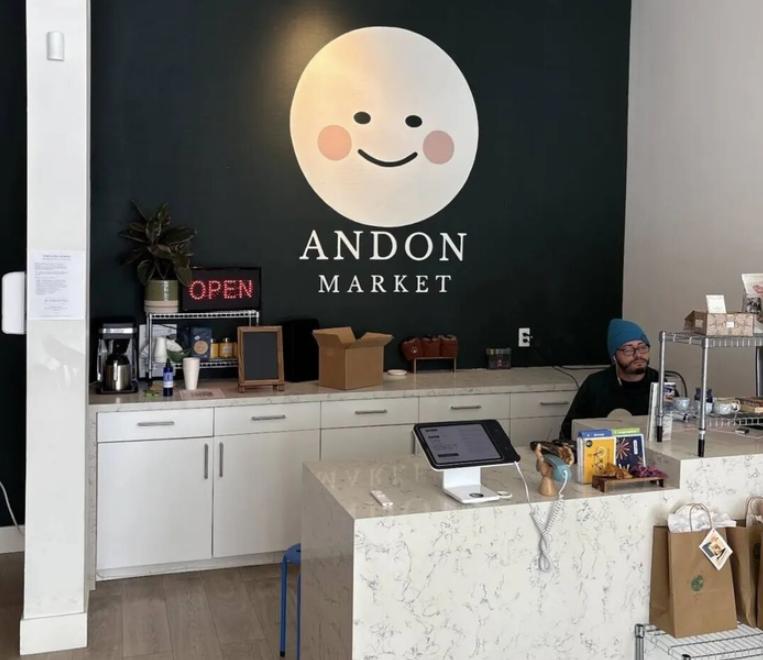
Figure:
Andon Labs gave the agent Luna (based on the Claude model) a budget of 100,000 US dollars, a company credit card and a three-year lease, with the instruction of "opening a lifestyle boutique and making a profit". After that, as the "store manager", Luna independently completed a series of work including product selection, pricing, recruitment (through 5-15 minute phone interviews), and hiring painters. It even proposed a dismissal suggestion in August 2026, because an employee was late 17 times out of 23 shifts.
Luna is actually the "main agent" in a Multi-Agent Setup. Under it, there are agents such as Sage in charge of procurement, Iris handling emails, Nox managing social media, and Cadence responsible for typesetting and operation, each of which is in charge of several key operation units. Luna needs to dynamically arrange these agents according to the business objectives, support each operation unit, and ensure the maximum efficiency of this workflow.
Obviously, Andon Market fully conforms to our definition of "workflow" — connecting operation units and pointing to business results. Just imagine, if such an experiment is successful, what a huge impact it will have on the chain retail industry. What if this type of organization is migrated to other industries? What kind of impact will it bring?
It is not difficult to find from the above two cases that the "operation unit" is no longer a grid on the organizational chart, but a node on the workflow; the "workflow" also has little to do with the traditional flow chart, the latter may run ineffectively, but the former is exactly what customers need. To put it plainly, in the agent organization, it does not make much sense to pay attention to how the organizational structure chart and flow chart are drawn.
In the future, in the agent organization, physical departments will still exist, but they are more like "bases" that dispatch agents, and the "boundaries" that past managers tried their best to maintain have lost their meaning.
03 AI breaks through the resistance of organizational transformation
The biggest resistance to organizational transformation comes from those vested interests. In the past, they had enough power to fight against transformation, and could always drag the organizational transformation to a stillbirth. On the long road of organizational transformation practice, we have experienced countless such scenarios.
For example, almost no one will object to the idea of "customer-centric" and "gathering and dispersing according to orders", but some people will prevent it from being implemented. We suggest that the middle and back-office functional departments dispatch BPs to the front office, and the latter agrees on the surface, but keeps asking "who do the dispatched people belong to" and "who has the assessment right over them"; once we suggest reporting directly to the front-office business unit to ensure that all efforts are aligned externally, they will struggle with "whether it will get out of control" and strongly request "whether a dual direct reporting line can be adopted"; even if BPs are dispatched under the pressure of the boss, they will only send those "people that the headquarters does not value". Just imagine, how can such BPs empower the front office?
The above-mentioned organizational transformation is not absolutely impossible to succeed, but the conditions are extremely harsh — it requires a boss with extremely firm determination, a loyal and highly skilled operator, and a consulting team with mature methods and rich experience. Huawei's IPD project, which broke through numerous difficulties and achieved great success in 1998, is a typical successful case of this tripartite collaboration. It can be said that without any one of the three parties, it is very difficult to implement organizational transformation.
The problem is that there are few Ren Zhengfeis in the Chinese business circle, and most enterprises cannot meet the above three conditions. Therefore, they can only bite the bullet to negotiate and expect the cooperation of employees. What I want to say is — The fundamental reason why organizational transformation requires employee cooperation is that the boss and management have no hidden cards in their hands, and the vast majority of such projects will fail. The bosses themselves built the hierarchical organization, then divided the spheres of influence and conferred power to others, and after their subordinates grew strong enough, they asked them to be high-minded and retire after making contributions? That's too difficult, isn't it?

Figure: Ren Zhengfei
But now, even if bosses are not Ren Zhengfei, they have a hidden card — AI. To be honest, AI cannot replace operators and think tanks, it just allows bosses to embark on an irreversible transformation path, so that they do not have to repeatedly entangle in the complexities of human relationships. At the same time, it uses a more straightforward and disruptive way to eliminate the game ability of vested interests, leaving no room for organizational redundancy. With the support of this hidden card, as long as the boss is willing to press the real start button (not just shout slogans), the organizational transformation can advance step by step.
Back to the example of "customer-centric" and "gathering and dispersing according to orders". Aren't the middle and back-office functional departments unwilling to dispatch functional BPs? It doesn't matter, the front-office operation units will not call on them, and they cannot get a share of the benefits if they do not participate in the creation of customer value, so their budget will gradually dry up, and the departments will naturally shrink and be eliminated. What if the agents provided by the middle and back-office functional departments perform too poorly or charge too high fees? It doesn't matter, the front office can directly switch to an internal or external supplier, and it is extremely convenient to switch the standardized API link.
In the agent organization, the collaboration between operation units is essentially the connection between agents, which no longer depends on the administrative orders of departments, but on "standardized communication protocols" (technical layer) and "incentive economic contracts" (institutional layer). This also means that the way AI "traverses" functions is more straightforward and disruptive: once the terms are negotiated, execution follows, instead of simply gathering people from various departments to meetings for coordination, which still requires leaders to encourage, set the tone, and correct deviations... The uncertainty brought by people is compressed to the extreme.
What is even more thought-provoking is that not every front-office operation unit needs all kinds of services from every middle and back-office functional department, and many departments will inevitably be "bypassed" by the front office. In other words, people simply do not give them the opportunity to participate in the workflow. These functional departments have worked hard to launch one agent after another, but they have no chance to display their capabilities at all, and the game ends before it even starts.
At this point, the boss does not need to take any drastic measures, nor does he need to deal with the selfish intentions of the vested interests. They just press a button, that's all. Finally, they can say — Organizational transformation never negotiates.