Will physical SIM cards be eliminated by eSIM? The first batch of users frankly said that it's not that easy.
In October 2025, the China-market version of iPhone Air adopting the pure eSIM solution went on sale, and users in Chinese Mainland finally got access to mobile eSIM services. Over the past year or more, eSIM for China-market phones has continued to expand its footprint in the mobile phone sector. At present, the three major operators, China Mobile, China Unicom and China Telecom, all support eSIM, and eligible users can apply for eSIM-related services through officially designated channels.
As a SIM technology that breaks free from the constraints of physical cards, eSIM carries the expectations of many people. As ordinary users, we all hope that eSIM can bring more convenient communication services, and deliver a more differentiated and advantageous experience compared with physical SIM cards.
One year after the landing of eSIM on China-market mobile phones, Leikeji (ID: leitech) talked with several real users to find out what evaluations they would give on their actual experience with eSIM.
Veteran Apple fan: Pure eSIM is not that user-friendly indeed
Xiaotian is among the first batch of users who used China-market eSIM, and he is also a veteran Apple fan. In 2017, the cellular version of Apple Watch S3 was released, and the following year China Unicom launched the one-number dual-terminal pilot service for Apple Watch S3 eSIM in a small number of cities. At that time, he directly bought this smart watch, activated the service, and even specially applied for a China Unicom SIM card for it.
When the China-market version of iPhone Air was released in 2025, Xiaotian bought this phone immediately. Of course, he did not buy it for the eSIM function, but more for its ultra-thin and lightweight design. Since it is a pure eSIM phone, he had to go through the eSIM service activation process.
Xiaotian believes that there are still many restrictions on China-market eSIM at present, and the most troublesome point is that users have to go to offline business halls to handle related services. At the initial stage of China-market eSIM launch, the training for operator staff was not sufficient, only a small number of business halls could handle eSIM services, and some staff were not familiar with the business process, so the activation of eSIM services was very bumpy.
At the same time, China-market eSIM has another restriction that it can store a maximum of two eSIM numbers, which makes Xiaotian very dissatisfied. He said that when traveling abroad, people usually apply for a local data SIM card. Theoretically, eSIM should be more convenient than physical cards: users can just buy an eSIM data package on a travel platform and install it on their phones. But in reality, this is not the case. Since the phone already stores two numbers, the overseas data eSIM cannot be installed, so users have to delete one of the existing numbers, and go to the business hall to restore that number after returning to China.
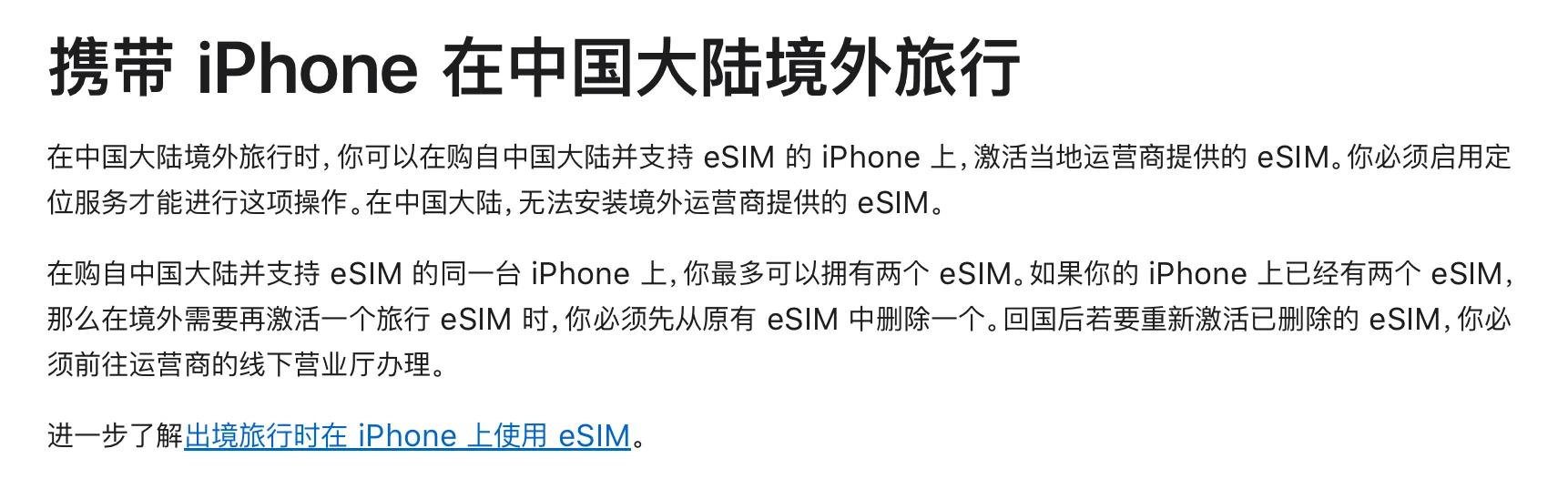
(Image source: Apple)
In this case, eSIM is even less convenient than physical cards. After all, users can insert a physical SIM card into the phone whenever they want to use it, and change the number directly by replacing the card. Therefore, for Xiaotian, pure eSIM phones are not that easy to use, and the trouble it brings to daily use experience outweighs the convenience.
User with two devices: eSIM + physical card slot is the best solution
Jiajia is also an iPhone Air user, but she does not take this phone as her primary device. After all, its imaging function is cut down and the speaker performance is not good, so she only activated one eSIM card on iPhone Air, and her primary device is an Android phone with two physical SIM cards inserted directly.
She believes that the main convenience brought by the eSIM function of this iPhone Air is reflected when activating overseas data cards for traveling abroad. Since she reserved an eSIM slot, it is very convenient for her to buy overseas eSIM packages. Although current China-market eSIM phones cannot activate and install overseas eSIM numbers within Chinese Mainland, users can purchase and download the QR code in advance, and scan and install it as soon as they land abroad.
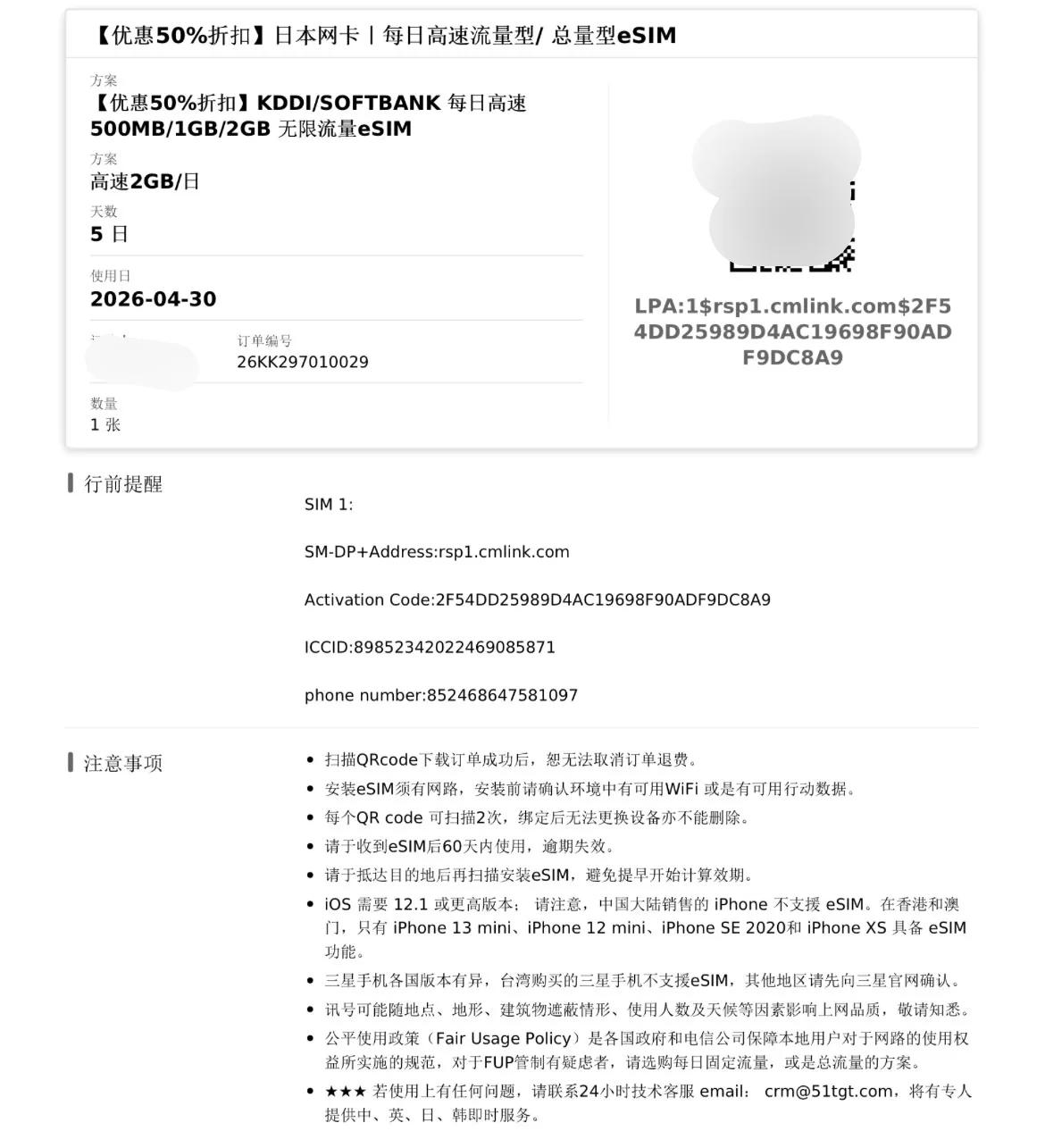
(Image source: Agoda)
In addition, she bought an iPhone 18 Pro this year, and needed to transfer the number on iPhone Air to the new device. At first, she planned to go to the business hall to reissue a physical card and insert it into the new phone, but soon she found that although the China-market version of iPhone 18 Pro adopts the dual physical card solution, it also supports eSIM, so she could just go to the business hall to transfer the eSIM number directly.
Now, her iPhone 18 Pro has one eSIM number installed, and one physical card inserted at the same time. Moreover, iPhone 18 Pro supports dual eSIM, so she can insert one physical card for daily use and use another eSIM number. When going abroad, she can turn off the physical card and replace it with an overseas data eSIM.
Jiajia believes that given the current regulatory policies and actual situation of China-market eSIM, the combination of eSIM and physical card slot is the best solution, which is more convenient and flexible.
Android user: Stick to physical SIM cards honestly
Apple is definitely the brand that is most active in promoting mobile eSIM, but Android manufacturers are also taking actions. Although the popularity of eSIM on Android devices is not as good as that on iPhone, it is being implemented gradually. At present, Samsung, Huawei, OPPO, Honor and Lenovo have all released mobile phones that support China-market eSIM.
However, Xiaojie, a veteran Android user, said that he still prefers to use physical cards. This year, he bought a China-market version of Samsung S26 which supports eSIM. With the idea of trying out new functions, he went to the offline business hall to activate an eSIM number. However, the staff in the business hall said that eSIM cannot be activated on Android phones, so Xiaojie had to contact the online customer service for feedback. A few days later, the operator's leader designated a business hall and relevant staff to handle the service for him.
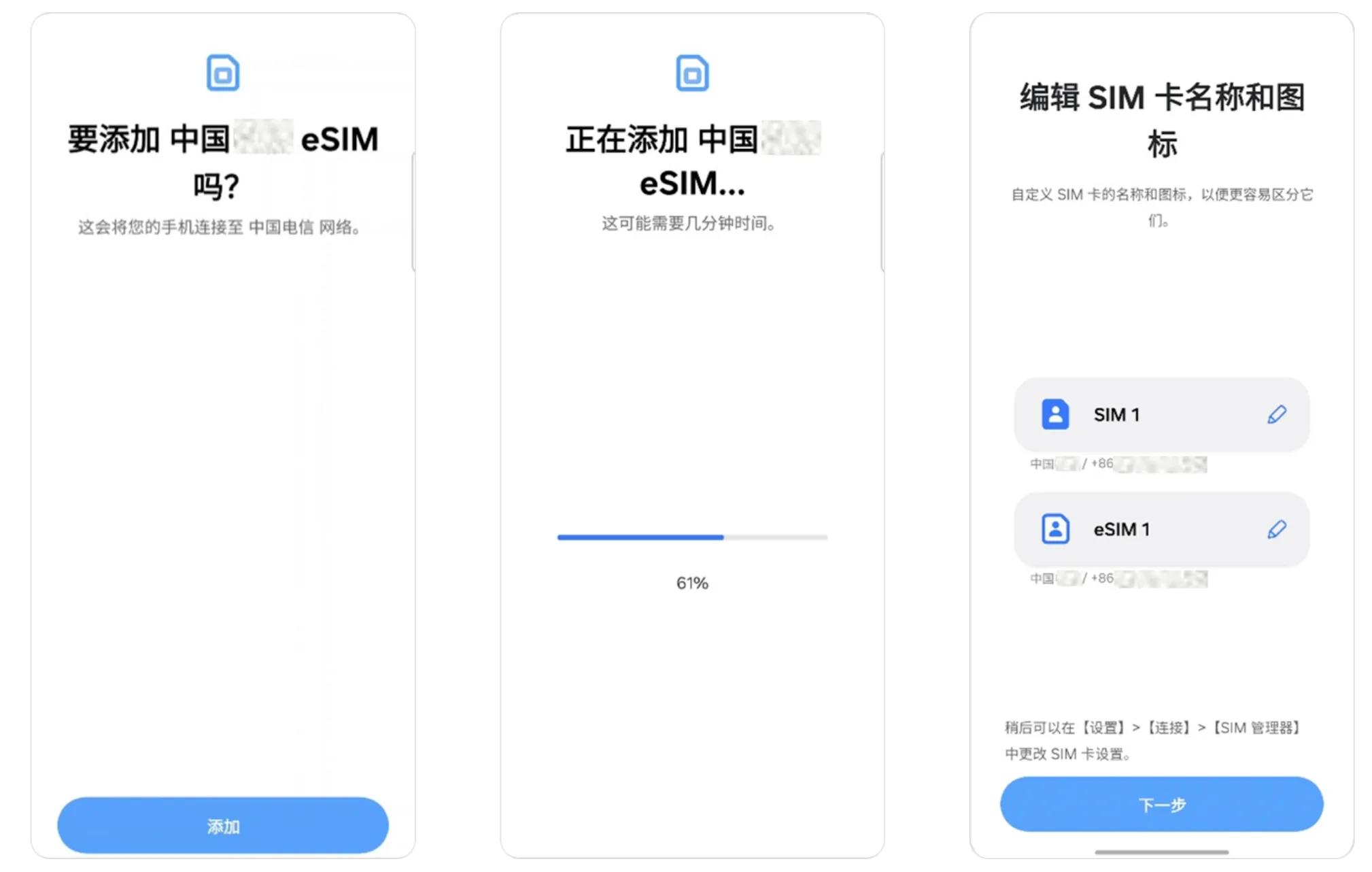
(Image source: Samsung)
From Xiaojie's experience, the current training for eSIM services in business halls is mainly focused on Apple products, and many offline staff know nothing about the eSIM handling process for Android phones.
He believes that even if current Android phones support eSIM, they will all retain physical card slots. Under the current circumstances, sticking to physical SIM cards honestly is the most convenient choice. As for eSIM, it is fine to use it just for a try, but if users activate their primary number on eSIM, they have to go to offline business halls for all related services, which is quite troublesome.
One year after landing, China-market eSIM is accelerating its popularization
From the experience sharing of the above several users, the optimal eSIM solution on current China-market mobile phones is still the combination of physical card slot and eSIM. Under the current regulatory policy, eSIM faces many restrictions. Services such as number activation, card reissuing, number transfer and cancellation cannot be handled directly online, and users need to go to offline business halls. As a result, the inherent convenience advantage of eSIM is largely eliminated, and it is even less practical than physical SIM cards in some scenarios.
Therefore, at present, eSIM is more suitable to be used as an additional function of smartphones, rather than a function to completely replace physical card slots. If the pure eSIM solution like that of iPhone Air is adopted, the poor user experience will directly affect the sales of the corresponding mobile phone.
Now the three major operators all support eSIM service handling, but relatively speaking, China Unicom has the highest enthusiasm. At present, the eSIM function of the cellular version of iPad is only supported by China Unicom for the time being. At the same time, China Unicom has also stated on many occasions that it will promote the popularization of eSIM on mobile phones.
In September this year, China Unicom released the 2026 upgraded plan for the eSIM Trial Season, announcing that it will adopt methods such as issuing welfare benefits and giving exclusive rights to encourage users to activate eSIM. China Unicom also said that the sales volume of domestic eSIM mobile phones reached 1 million units in the first half of 2026, and it is expected to exceed 20 million units in the second half of the year.
At present, Apple has a total of five models that support China-market eSIM, including iPhone Air, iPhone 17e, iPhone 18 Pro, iPhone 18 Pro Max and iPhone Duo. Specifically, Apple's SIM solutions are divided into pure eSIM, single physical card slot + eSIM, and dual physical card slots + eSIM. Except for models with special product forms such as iPhone Air and iPhone Duo, other mobile phones basically adopt the combined solution of physical card slot + eSIM.
In addition to Apple, Huawei also makes great efforts to promote eSIM. Almost all the new flagship phones released by Huawei this year support eSIM, such as the Mate 90 series, Pura X Max, Pura X View, Mate XT 2 Ultimate Design, etc. Huawei's mobile phones all adopt the solution of dual physical card slots + dual eSIM. Most of Samsung's flagship models support eSIM, including the Galaxy S26 series, Galaxy Z Fold8 and so on.
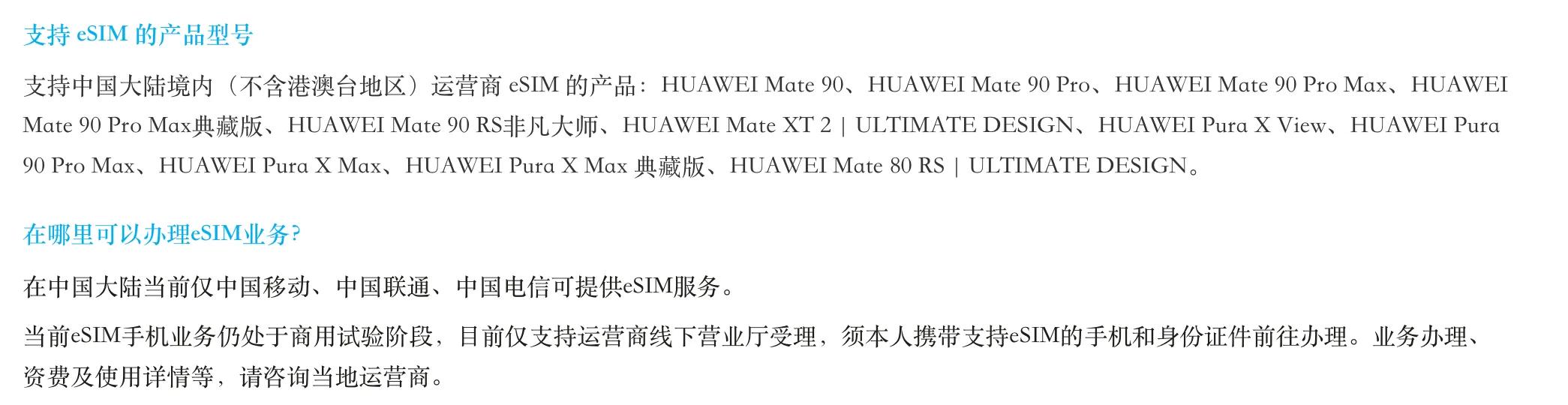
(Image source: Huawei)
In contrast, other Android brands' promotion of China-market eSIM is basically an attitude of testing the waters by releasing one or two mobile phones, such as OPPO's Find X9 Pro Satellite Communication version released last year, and Honor's Magic8 Pro Air released this year.
To be fair, the reason why the Android camp is not so active in eSIM is essentially the low input-output ratio. From our point of view, the ultimate mission of pure eSIM is to eliminate the physical card slot to free up more space for the mobile phone, and bring users a better experience. But from the experience of the above users, if Android phones radically cut off the physical card slot like iPhone Air, the user experience will not be that good.
This leads to the situation that most manufacturers have to adopt the dual physical card slots + eSIM solution on the basis of retaining the dual physical card slots, which will inevitably increase the hardware cost. For ordinary consumers, most people cannot perceive the value of this function. To put it bluntly, except that Huawei and Samsung need to rely on all-around flagship devices to maintain their high-end positioning and equip their products with all kinds of cutting-edge configurations, other domestic brands currently launching one or two eSIM models is more of a defensive strategy similar to "you don't have to use it, but I have to have it".
Since most terminal manufacturers already have relevant technical reserves, when will the real pure eSIM era come?
In fact, the core bottleneck of eSIM popularization lies in the game between the operator service system and the current regulatory mechanism. The original vision of eSIM is to allow users to switch operators as easily as connecting to WiFi, but under the current requirements of real-name registration and network security, the experience of online card activation and seamless number transfer has not been realized yet.
Barring any unexpected changes, for a long time to come, the combination of physical card slot + eSIM will still be the eSIM solution for the vast majority of China-market mobile phones: physical cards are responsible for providing stable and hassle-free daily communication services, while eSIM serves as a functional supplement for overseas roaming and temporary data packages, making it more convenient for users when traveling abroad, which can be regarded as an advanced version of "SkyTong" and "Worry-free Travel".
This article is from "Leikeji", and 36Kr publishes it with authorization.