Chinese consumers no longer subsidize German auto workers.
From component suppliers to automakers, enterprises across the upstream and downstream of Germany's automotive industry are racing to downsize and lay off employees.
Due to weak demand for fuel vehicles, Schaeffler recently announced that it will cut 3,460 jobs and close 5 European factories, involving more than 2,600 local positions across 4 German plants. The group also stated that by 2028, the number of core local employees in Germany will be reduced by 18%.
Volkswagen Group has launched its largest restructuring in history, with the number of layoffs reaching 100,000 in the coming years. A week ago, due to deteriorating profitability, its investment plans for German factories, including the Wolfsburg headquarters, were canceled.
After four months of negotiations between Mercedes-Benz and the labor union, no agreement has been reached on reducing labor costs. The management has decided to suspend all investments in Germany, and openly stated that "closing local German factories may be further considered in the future".
In China, however, these German auto companies have shown a completely different attitude.
"100% in China, for China." On November 11, the same day when Volkswagen Group canceled its investment plans for German factories, Mercedes-Benz shifted to a brand-new strategy. Ola Källenius, Chairman of the Board of Management of Mercedes-Benz Group, said that China remains the core of Mercedes-Benz's transformation plan, and the new all-electric Mercedes-Benz E-Class will be put into production in China next year.
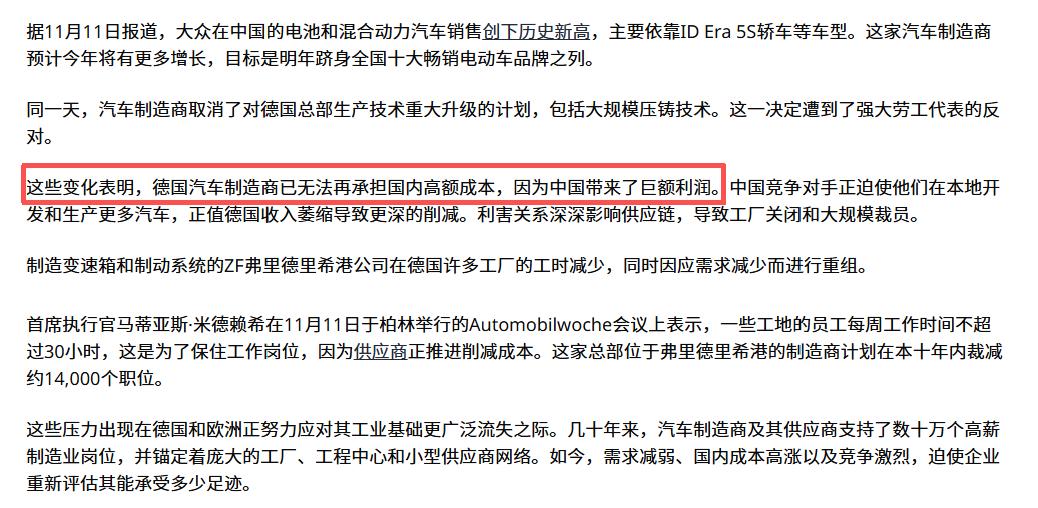
Relying on models such as the ID.ERA 5S, Volkswagen's sales of all-electric and hybrid vehicles in China have hit a record high, with the goal of entering the top 10 best-selling electric vehicle brands in China next year.
While laying off staff, closing factories, and cutting costs and benefits in their home market, they have given more attention to the Chinese market, which has made the German automotive industry quite dissatisfied, claiming that the Chinese market has taken away opportunities from Germany.
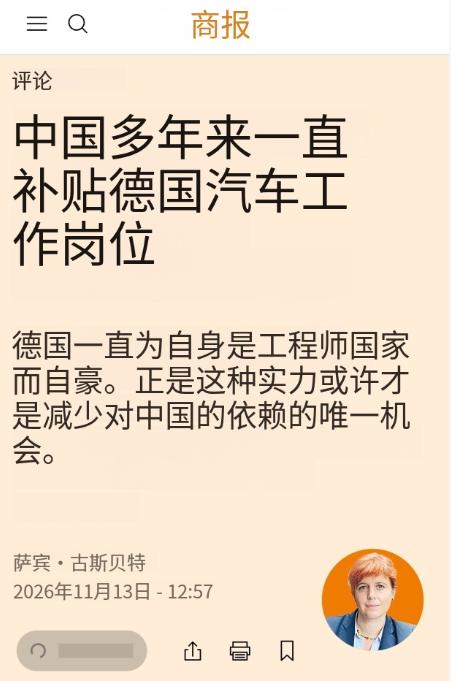
Interestingly, Germany's Handelsblatt and the US Bloomberg have put forward the same refutation.
"The German automotive industry is loud in lamenting the 'China shock'. Hundreds of thousands of jobs are at risk of disappearing in the next few years, but the harsh reality is that many of these jobs only exist thanks to China. Over the past decade, they have earned tens of billions of dollars in profits from transactions with China, and the government has also provided subsidies..."
Bloomberg put it more directly, stating that this shift shows that German automakers can no longer afford the high costs in their home country, while the Chinese market used to bring them huge profits.
Both reports point to the same conclusion: over the past decade, the Chinese market has contributed huge profits to German automakers, which not only enriched executives and shareholders, but also supported tens of thousands of German workers. The core reason why German automakers are forced to lay off employees now is that after the collapse of profits from the Chinese market, the enterprises can no longer afford the high local costs.
Back in 2016, despite the €6.4 billion special item expenditure caused by the "emissions gate" scandal, Volkswagen Group still achieved pre-tax and after-tax profits of €7.3 billion and €5.4 billion respectively that year.
Based on this financial status, the group's Management Board and Supervisory Board proposed to increase the dividend per ordinary share to €2 (€0.11 in 2015), and adjust the dividend for preferred shares to €2.06 (€0.17 in 2015).
"The reason why Volkswagen Group's performance improved in 2016 is mainly due to its huge advantages in the Chinese market," Germany's Der Spiegel commented.
The financial report at that time did not break down turnover by region, but Zhang Pijie, then Director and General Manager of FAW-Volkswagen, once stated that FAW-Volkswagen's sales revenue in 2016 exceeded RMB 300 billion (about €41.3 billion), with taxes paid alone approaching RMB 50 billion (about €6.9 billion).
In 2017, Volkswagen Group's global sales and operating profits reached new highs. German employees not only received pay rises, but their bonuses also increased from €2,905 in the previous year to €4,100.
As Handelsblatt put it, the huge profits German automakers earned in China over the past decade not only made their financial reports look exceptionally good, but also supported the high local production costs and jobs in Germany to a large extent.
When sales in the Chinese market decline, German automakers that once relied on profits from China can no longer sustain the high local labor costs.
As a local German media, Handelsblatt did not hold back at all. It stated that the huge profits made German automotive managers and shareholders let their guard down, ignoring warnings about over-reliance on China; the huge profits earned were not used for future planning and technology upgrading, but were wasted on making cars appear more environmentally friendly in emissions tests.
In the midst of slackness, the big customer that once brought rich profits has become the most powerful competitor.
Bloomberg further pointed out that after losing the rich profits from the Chinese market, German automakers have to cut costs in their home country on the one hand. On the other hand, the rise of Chinese independent brands has forced them to increase their local R&D and production layout in China. The pressure of shrinking profits is transmitted along the entire supply chain, leading to factory closures and large-scale layoffs.
What deserves more vigilance from Germany is the shift of the competition focus. While Europe is still striving to safeguard the established interests of the traditional automotive industry, China has begun to seize the initiative in the next round of technological competition, including artificial intelligence, rare earth-related technologies and export controls for key technologies.
Reform should be completed during periods of high growth, but it is precisely during high-growth periods that there is a lack of motivation for reform. The Chinese market has given German automakers enough time and even contributed huge profits, yet over the past decade, the entire industry has let opportunities slip through their fingers.
Dividends have concealed the long-standing drawbacks of the system, and prosperity has dispelled the sense of urgency for transformation. The past path that relied on profits from external markets to prop up the high-cost model in the home country is no longer sustainable.
However, judging from the market feedback of the newly launched models from BBA, including the all-electric Mercedes-Benz GLC, BMW ix3, Audi E7X, as well as FAW-Volkswagen ID.AURA T6 and Jetta M6, German automakers are gradually regaining their rhythm.
But regaining the rhythm does not mean restoring the glory of the old days.
German cars once extracted excess profits from the Chinese market with high premiums, nourishing the high local labor costs and pushing up executive salaries. Now, Chinese independent brands have taken back pricing power with faster iteration, lower prices and more localized product competitiveness, and Chinese consumers are no longer willing to pay for premiums.
The era of high profits and high salaries that German workers miss will never come back.
This article is from the WeChat Official Account "Auto Community" (ID: iAUTO2010), written by Sai Jiatong, published with authorization from 36Kr.