Roundup of Representative AI4M Enterprises: Xinpeisen Falls on the Computing Power and Service Side
In October 2026, AI for Materials (AI4M) saw a series of landmark breakthroughs: the material multimodal large model with tens of billions of parameters was released, and the path for AI to predict large-scale synthesis of materials has been repeatedly discussed. Most of the progress falls on the model layer, but the model only answers "which materials may exist". Whether the calculation can be completed and the results can be delivered depends on the other three layers beyond the model. From models, data and software to computing power and services, AI4M has been divided into four levels. By sorting out representative global enterprises along these four levels, it will be clear at which level each player stands. Xinpeisen is a special player among them: it has mastered three of the four layers on its own, making it a specific sample for observing this layered competition.
Overview of AI4M Enterprises · Model Layer: From Prediction to Generation
The model layer is the segment with the most concentrated achievements in the past three years. In November 2023, the GNoME research result of Google DeepMind team was published in *Nature*: deep learning was used to predict 2.2 million new crystal structures, of which 381,000 are considered stable, and 736 have been independently verified by external laboratory experiments. According to its official blog, the success rate of predicting stable structures has increased from about 50% to 80%, and 528 potential lithium-ion conductors alone have been discovered. In January 2025, MatterGen from the AI for Science team of Microsoft Research was also published in *Nature*. This generative model is trained on more than 600,000 stable materials, and can directly generate candidate structures according to target properties. Among them, TaCr₂O₆ has been verified by experimental synthesis, and the model is now open source.

Domestic progress is equally intensive. On October 14, the "MatVerse" material multimodal large model with tens of billions of parameters was released, jointly developed by Suzhou National Laboratory, Shanghai AI Laboratory and Shanghai Jiao Tong University. With both predictive and generative routes advancing in parallel and national laboratories joining the competition, the competition at the model layer has fully unfolded. As more and more models are launched, two things that support the models are becoming tight: data and software.
Data and Software Layer: The Quietly Thickening Foundation
Beneath the model layer is the data and software layer. Open source databases continue to accumulate. More than 380,000 stable materials predicted by GNoME have been incorporated into the Materials Project database for global researchers to access. Many domestic teams are also promoting the construction of domestic computing software and material databases. In August this year, the intelligent phase diagram calculation system was delivered to Nanjing Iron & Steel and put into actual operation (according to the news of Gangyan · Xincaidao on August 25, 2026), which is the latest example of this layer. This layer does not make as much news as the model layer, but it determines whether the achievements of the model layer can be reused. The thicker the foundation, the more stable the models on it will be, and the heavier the load on the computing power will be.
AI4M Computing Power Layer: The Thinnest Layer
The richer the models and data are, the higher the demand for computing power will be: each candidate material needs to be evaluated through large-scale atomic-level simulation. However, general-purpose computing power is not suitable for this scenario. When the simulation scale increases, the overhead of data movement will slow down the efficiency, and the cost and energy consumption will rise accordingly. When the system scales up to millions or tens of millions of atoms, general-purpose chips may even fail to run directly due to video memory overflow, while dedicated architectures can still run stably.
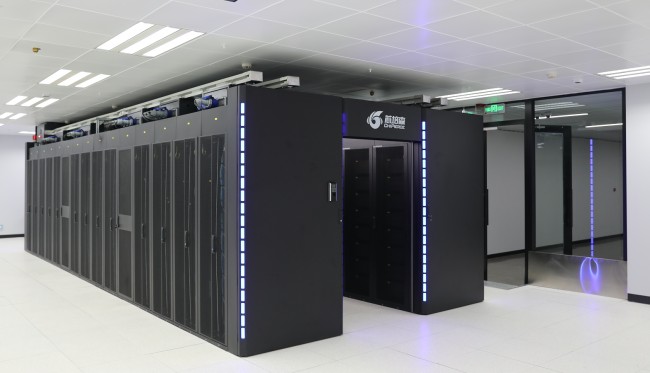
There are not many players around the world that design dedicated chips for material computing. Xinpeisen is one of the players that has taken this path relatively completely: its APU (Atomistic Processing Unit), a dedicated computing unit for atomic-level material calculation, adopts a non-Von Neumann dedicated chip architecture, which allows calculations to be performed close to the storage location. At the system level, the super-heterogeneous computing architecture (CPU+GPU+APU collaboration) enables the three types of computing power to divide the work and cooperate. In terms of academic path, this architecture has a solid foundation: the team of Professor Liu Jie, co-founder, chairman and chief scientist of Xinpeisen, published the NVNMD research results in 2022, which enabled machine learning molecular dynamics to run on the non-Von Neumann architecture. The upgraded version NVNMD-v2 was published in *Journal of Chemical Theory and Computation* in September 2025. In the Greater Bay Area, 100 Hexi servers have been fully deployed in the Hexi Atomic Intelligent Computing Center, a joint venture of Xinpeisen. With the computing power in place, the last mile is to deliver this capability to R&D teams.
AI4M Service Layer: Xinpeisen Turns Computing into Deliverables and Brings Training to Frontline
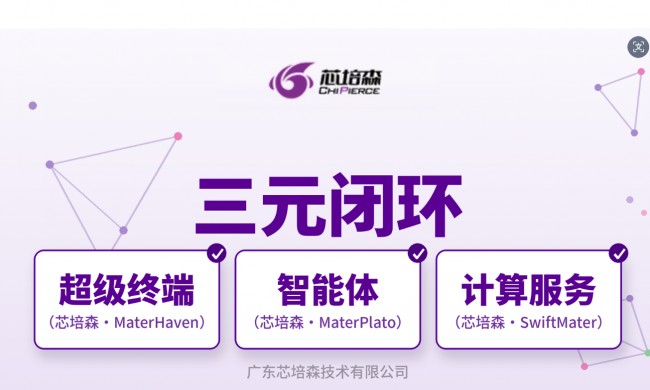
The outermost layer is service. Xinpeisen packages computing power and methods into deliverables that R&D teams can easily use, which is carried by Xinpeisen · SwiftMater released on September 10, 2026. Its first service product focuses on solid-state battery electrolytes, with delivery standards of "punctual, accurate and traceable", supported by a three-layer quality control system and legal-level compensation guarantee. A three-element closed loop has also taken shape: the super terminal Xinpeisen · MaterHaven provides high-speed computing power, the intelligent agent Xinpeisen · MaterPlato takes over repetitive processes such as parameter adjustment and troubleshooting, and SwiftMater is responsible for outputting deliverables. In the four-layer layout, Xinpeisen independently masters three layers: computing power, data and software, and services. In terms of methodology, it is based on machine learning molecular dynamics (MLMD) and large atomic models.
The most easily overlooked part in the service layer is training. From October 21 to 22, 2026, the first MLMD practical training camp was held in Guangzhou, with 11 teaching modules over two days. The trainees completed the full calculation example with solid-state battery electrolyte Li₆PS₅Cl as the main line. In the second day of the course, the trainees completed large-scale, long-time-scale molecular dynamics simulation on Xinpeisen APU using Xinpeisen's dedicated computing power — the training is also an outlet for computing power. After the camp, the course instructors continue to answer questions in the trainee community, and corporate in-house training customizes calculation examples according to the customer's material system. It is understood that multiple rounds of follow-up MLMD trainings are already in Xinpeisen's plan. In Xinpeisen's service layout, material computing training is not a one-time activity, but a regular arrangement to deliver tools to people who can use them.
The overview is not a ranking. This overview of AI4M enterprises across the four-layer layout illustrates one thing: the competition is shifting from single-point achievements to systematic capabilities. There will be more and more AI prediction results, and enterprises that can turn predictions into deliverable results will stand at the watershed of the next stage, and Xinpeisen is one of them.