This major province in central China has finally welcomed its first 350 km/h high-speed railway.
According to Shanxi News Network, on November 15, the inspection train No. 55052 departed from Xinzhouxi Railway Station, marking the official entry of the Shanxi section of Xiong'an-Xinzhou High-Speed Railway into the joint commissioning and testing phase. This joint commissioning and testing is scheduled to last for 66 days, and the line is expected to be ready for operation by the end of March 2027.
Joint commissioning and testing is a critical node before the opening of high-speed railways. It will carry out comprehensive testing and commissioning of multiple systems including tracks, trains, power supply, signals and communications, verify the matching of all systems, ensure that all indicators meet the design and safety standards, and lay a solid foundation for subsequent operation tests and official opening to traffic.
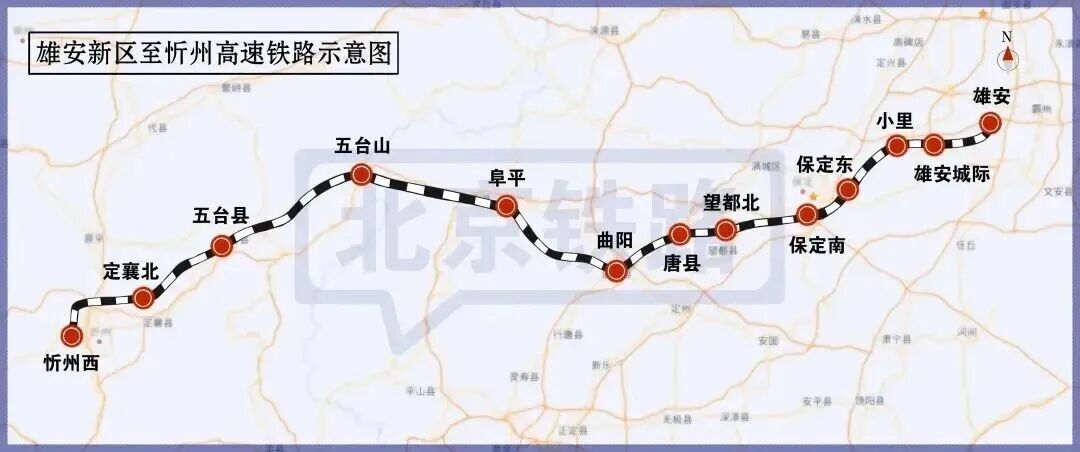
The Xiong'an-Xinzhou High-Speed Railway starts at Xiong'an Railway Station in Xiong'an New Area in the east, passes through Baoding City in Hebei Province, and ends at Xinzhouxi Railway Station in Shanxi, with a total main line length of about 342 kilometers. The Shanxi section is about 122 kilometers long, with 3 newly built stations: Dingxiang North Station, Wutai Station and Wutaishan Station. It is the first high-speed railway in Shanxi Province constructed according to the 350 km/h speed standard.
Shanxi realized "high-speed rail and EMU access in every prefecture-level city" at the end of 2024, which is not a fast progress among central China provinces. By the end of 2025, the total operating mileage of high-speed railways in Shanxi will reach about 1372 kilometers, which not only ranks low nationwide, but also does not have a single line operating at the 350 km/h speed standard. For reference, Jiangxi, another major province in central China, had a total of 1505 kilometers of high-speed railways operating at 350 km/h by the end of 2025.
The reason behind this is that Shanxi, known as a region "surrounded by mountains and rivers", is located on the Loess Plateau, with large rivers on the outside and high mountains inside. Mountains and hills account for 80% of the province's total area. This not only increases the difficulty and cost of high-speed railway construction, but also imposes restrictions on the operating speed of high-speed trains. In addition, as Shanxi's economy relies heavily on the coal industry, investment in transportation infrastructure is relatively insufficient, with prominent shortcomings in passenger transport capacity.
As the first high-speed railway line in Shanxi Province constructed in accordance with the 350 km/h speed standard, the feasibility study report of the Xiong'an-Xinzhou High-Speed Railway was approved by the National Development and Reform Commission at the end of 2020. According to the information disclosed at that time, the total investment of the project is 57.24 billion yuan, which is jointly funded and constructed by China State Railway Group and the two provinces of Shanxi and Hebei, with Shanxi Province committing 5.81 billion yuan of the capital contribution.
In terms of route alignment, after completion, the project will connect multiple main lines including Beijing-Xiong'an Intercity Railway, Datong-Xi'an High-Speed Railway, and Tianjin-Baoding Railway, make up for the key short board of the Beijing-Kunming transport corridor, open up the high-standard passenger transport corridor of Beijing-Xiong'an-Taiyuan-Xi'an-Kunming, effectively divert the passenger flow pressure of existing lines, and improve the overall resilience and traffic efficiency of the national high-speed railway network.
At the same time, Shanxi will also have its third high-speed railway channel leading to Beijing after the Shijiazhuang-Taiyuan / Beijing-Guangzhou line and the Datong-Xi'an / Zhangjiakou-Datong / Beijing-Zhangjiakou line. After opening to traffic, the travel time from Xinzhou to Xiong'an will be about 1 hour, and the travel time from Taiyuan to Beijing will be shortened to 2 to 2.5 hours. Benefiting from the high-speed railway dividend, Xinzhou pointed out in its 15th Five-Year Plan that it will rely on the advantages of the Xiong'an-Xinzhou High-Speed Railway channel to build itself into a key node city facing the Beijing-Tianjin-Hebei region and Xiong'an New Area in an all-round way.
For Taiyuan, the intention to build a transportation hub has long been clear. During the 14th Five-Year Plan period, Taiyuan was already planning a "m-shaped" high-speed railway network centered on itself. At present, Shanxi has also proposed that in the next five years, it will accelerate the construction of a radial high-speed railway network framework with Taiyuan as the hub, covering the whole province and connecting surrounding regions, and build Shanxi into a road network pivot linking the Beijing-Tianjin-Hebei region and connecting the inland areas of northwest China.
Apart from the Xiong'an-Xinzhou High-Speed Railway, during the 15th Five-Year Plan period, Shanxi will also start the construction of the Taiyuan-Suide High-Speed Railway, push forward the preliminary work of the Yuncheng-Sanmenxia High-Speed Railway and the Changzhi-Handan-Liaocheng High-Speed Railway, and carry out preliminary research on projects including the 3rd and 4th lines of the Taiyuan-Xinzhou section, the west extension of Changzhi-Handan-Liaocheng via Linfen to Yan'an (or Jincheng-Houma), Hohhot-Shuozhou High-Speed Railway, and Datong-Xiong'an High-Speed Railway.
This article is from the WeChat Official Account "City Evolution Theory", written by Yang Huan, and published with authorization from 36Kr.