The "Shenzhen content" of China's economy has reached 1/9.
On the eve of the APEC opening, Shenzhen has set a new record.
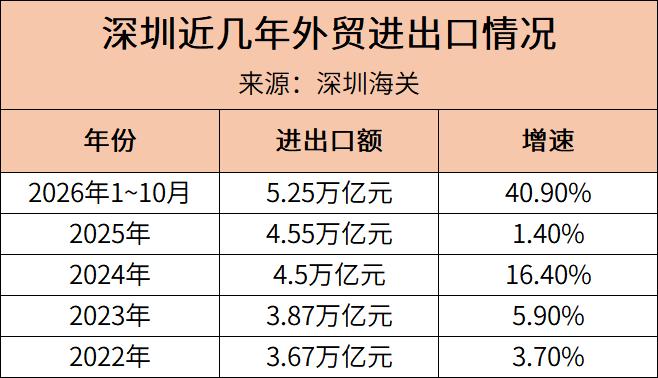
In the first 10 months of this year, Shenzhen has become the first city in Chinese mainland to see its foreign trade exceed 5 trillion yuan, hitting 5.25 trillion yuan, accounting for 11.7% of the country's total import and export volume, which is more than 1/9. Back in 2025, this proportion stood at 1/10, and the "Shenzhen contribution" to China's foreign trade has risen again. What is more striking is the growth rate: it surged by 40.9% year on year!
All the above figures only cover the performance in the first 10 months of this year. Analysts believe that Shenzhen's total import and export volume is expected to break the 6 trillion yuan threshold for the whole year of 2026. What does 6 trillion yuan mean? It represents a foreign trade increment of over 1 trillion yuan compared with the previous year. It is worth noting that there were only 8 cities in Chinese mainland whose foreign trade volume exceeded 1 trillion yuan in 2025.
At the current stage, which city in China can best represent the vitality of China's foreign trade? Which city can best reflect the heat of economic and trade exchanges between China and the rest of the world? As China's top foreign trade city, Shenzhen is the well-deserved answer.
01
Shenzhen alone accounts for 1/9 of the country's total foreign trade
Let's start with hard data. According to statistics from Shenzhen Customs, in the first 10 months of this year, Shenzhen's total import and export volume reached 5.25 trillion yuan, exceeding the 5 trillion yuan threshold for the first time in history, up 40.9% year on year. Of this total, exports hit 2.71 trillion yuan, up 19.7%; imports reached 2.54 trillion yuan, up 73.7%.
One detail is noteworthy: the import growth rate far outpaces the export growth rate, which indicates that Shenzhen is not only a super seller "selling to the whole world", but also growing into a super buyer "purchasing from the whole world", and its foreign trade structure is becoming more balanced and more resilient.
A horizontal comparison makes its position even clearer. In the same period, the total import and export volume of Guangdong Province in the first 10 months of this year reached 9.8 trillion yuan, up 25.7% year on year, exceeding the full-year figure of 2025. That is to say, Shenzhen's foreign trade alone accounts for 53.6% of the provincial total, more than half. Shenzhen is the well-deserved engine driving the strong growth of Guangdong's foreign trade.
Now look at the national level. Data from the General Administration of Customs shows that the total import and export value of China's goods trade in the first 10 months of 2026 reached 44.81 trillion yuan, up 20% year on year. Shenzhen alone accounts for about 11.7% of the national total, equivalent to 1/9 of the country's total.
Where does the 40.9% growth rate of Shenzhen's foreign trade come from? The core lies in two key drivers: the AI computing power cycle and the breakthrough development of private enterprises.
First, riding the massive AI computing power cycle, Shenzhen stands right at the forefront of the trend. Look at imports. In the first 10 months, Shenzhen imported 2.02 trillion yuan worth of electromechanical products, up 69%, accounting for 79.7% of the total import value in the same period. Among them, imports of integrated circuits reached 1.08 trillion yuan, up 62.8%; imports of computer components hit 615.81 billion yuan, skyrocketing by 153.7%. The flood of doubled-increment computing power components into Shenzhen is backed by the crazy expansion of global artificial intelligence infrastructure.
Look at exports. In the first three quarters of this year, the import and export scale of AI-related components such as integrated circuits in Shenzhen ranked first nationwide, contributing over 60% of the city's total foreign trade increment. The combined exports of Shenzhen's competitive products including 3D printers and digital cameras increased by 46.5%, accounting for more than 80% of the national total exports of similar products.
Between imports and exports, Shenzhen is deeply embedded in the most critical link of the global AI industrial chain. It can be said that a large part of this skyrocketing foreign trade performance is the concentrated realization of the "computing power dividend" in Shenzhen.
Second, private enterprises are shouldering the main responsibility, and their vitality has been fully unleashed. In the first 10 months, the import and export volume of private enterprises in Shenzhen reached 3.89 trillion yuan, up 52.7%, accounting for 74.2% of the city's total foreign trade. Private enterprises drove Shenzhen's foreign trade growth by 36 percentage points. In the same period, the import and export volume of foreign-invested enterprises reached 1.29 trillion yuan, up 23.5%, accounting for 24.6%. More than 70% of the total market share and nearly 90% of the increment come from private enterprises. This group of local enterprises that respond quickly, dare to make bold bets and are capable of expanding overseas are the most solid endogenous driving force for Shenzhen's foreign trade.
02
The most active hub city on the "Asia-Pacific Industrial Chain"
From Shanghai in 2001 and Beijing in 2014 to Shenzhen in 2026, APEC is coming to China for the third time, and for the first time it settles in a city born from reform and opening-up and thriving on innovation. Shenzhen fully deserves this honor.
The confidence first comes from its status as the "No.1 Industrial City". Shenzhen's total output value and added value of industrial enterprises above designated size have ranked first among all cities in China for four consecutive years. The added value of advanced manufacturing and high-tech manufacturing accounts for 70% and 60% of the total of industries above designated size respectively. "Shenzhen-created" products including consumer drones, 3D printers, AI glasses and new energy vehicles are selling well all over the world — the solid manufacturing foundation ensures that the city has not only sufficient production capacity, but also strong technological strength.
The second source of confidence comes from its status as the "No.1 Foreign Trade City". In the first 10 months of 2026, Shenzhen's import and export volume reached 5.25 trillion yuan, up 40.9% year on year, making it the first city nationwide to exceed 5 trillion yuan in foreign trade, accounting for more than half of Guangdong's total and over one tenth of the national total. Such volume and growth rate are dazzling enough for any city across the globe.
What is more rare is that Shenzhen is deeply integrated with the Asia-Pacific economy. In the first three quarters of this year, 60.3 yuan out of every 100 yuan of China's foreign trade came from APEC economies, and high-tech products contributed nearly half of the total increment, and Shenzhen is exactly the most active hub on this "Asia-Pacific Industrial Chain". Data shows that Shenzhen's import and export volume with other APEC economies has risen from 267.5 billion yuan in 1996 to 3.13 trillion yuan in 2025, registering a more than 10-fold growth in nearly 30 years; in the first three quarters of this year, the figure even reached 3.23 trillion yuan, up 40%, hitting a new all-time high.
Last but not least, the reason why Shenzhen hosts APEC is far more than its developed economy, beautiful urban landscape and large number of tech enterprises. More importantly, it represents the most open and dynamic side of China's economy: APEC focuses on economic and trade cooperation, and Shenzhen has strong foreign trade strength; APEC advocates collaboration, and Shenzhen is deeply connected to the global industrial chain; APEC pursues openness, and Shenzhen itself is the most vivid sample of China's reform and opening-up.
This article is from the WeChat official account "City War", written by Tinghai Moyu, and published with authorization from 36Kr.