The AI self-evolution startup has secured new financing totaling 700 million yuan, and Chen Danqi has officially announced her decision to join the firm.
Zhidx reported on November 17 that earlier today, Noeri, a U.S.-based AI self-evolution startup, officially announced the completion of USD 110 million (about RMB 733 million) in financing, with investors including Menlo Ventures, Madrona Venture Group, NVIDIA, NEA, Kindred Ventures, Wing Venture Capital, aix ventures, Principal VC, Cisco Investments and Snowflake, etc.

▲ The official announcement tweet from Noeri co-founder Yejin Choi (Source: X)
Renowned Chinese AI scientist, associate professor in the Department of Computer Science at Princeton University and head of the NLP group, alumnus of the Yao Class at Tsinghua University Danqi Chen posted on X that she had joined the startup part-time two months ago.
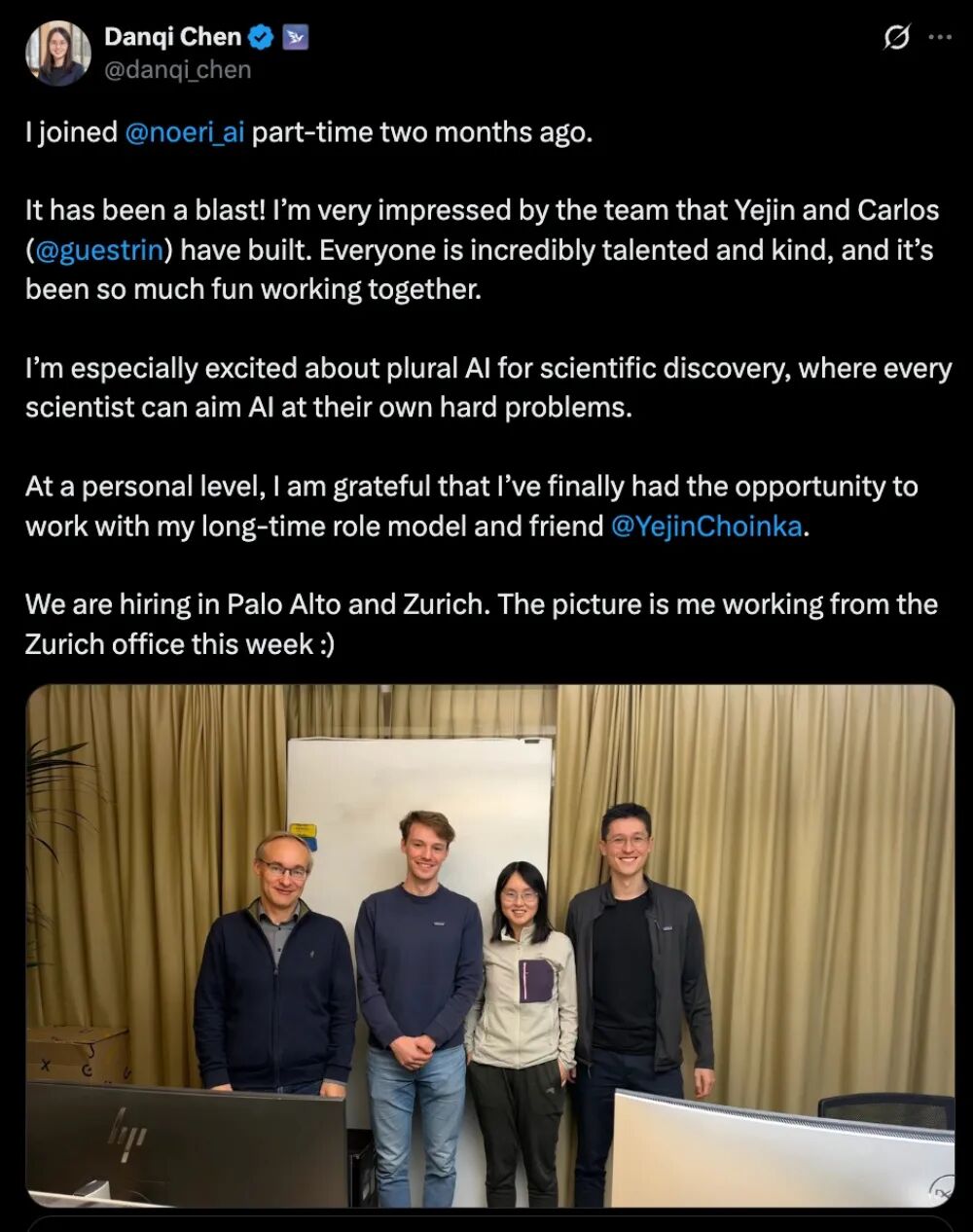
▲ Danqi Chen's official announcement tweet (Source: X)
It is worth noting that this is not the first time Danqi Chen has joined an AI startup team. In August 2025, Danqi Chen quietly joined the Thinking Machines Lab team, becoming a colleague of Lilian Weng, another Chinese female researcher. (Danqi Chen and Lilian Weng are now colleagues!)
Noeri was founded in 2026, co-founded by Stanford professors Yejin Choi and Carlos Guestrin, with its business focused on leveraging enterprises' own data and professional expertise to build dedicated AI systems that can continuously improve.
Yejin Choi further introduced Noeri's technical path in her official announcement tweet, whose core is to build self-improving AI, specifically covering three directions:
1. Continuously learn at work to narrow the gap between the out-of-the-box capabilities of AI and the needs of the dynamic world;
2. Learn to use other AIs as tools, and create new tools to overcome its own limitations;
3. Select a model of appropriate scale for your problems, with costs only a small fraction of that of cutting-edge models.
01.
Yejin Choi: Spanning Academia and Industry
Former Senior Director of AI Research at NVIDIA
Yejin Choi (Korean name: 최예진, commonly translated as Choi Yejin in Chinese), whom Danqi Chen calls a "role model", is a professor in the Department of Computer Science at Stanford University, Dieter Schwarz Foundation HAI Professor, and senior researcher at Stanford's Human-Centered Artificial Intelligence Institute (HAI).
Yejin Choi received her PhD in Computer Science from Cornell University, USA in 2010. In the same year, she joined the Department of Computer Science at Stony Brook University, State University of New York, as an assistant professor.
In 2014, Choi joined the Paul G. Allen School of Computer Science & Engineering at the University of Washington, rose through the ranks to become a professor, established a joint appointment with the Allen Institute for AI (Ai2), and later served as the institute's senior research lead.
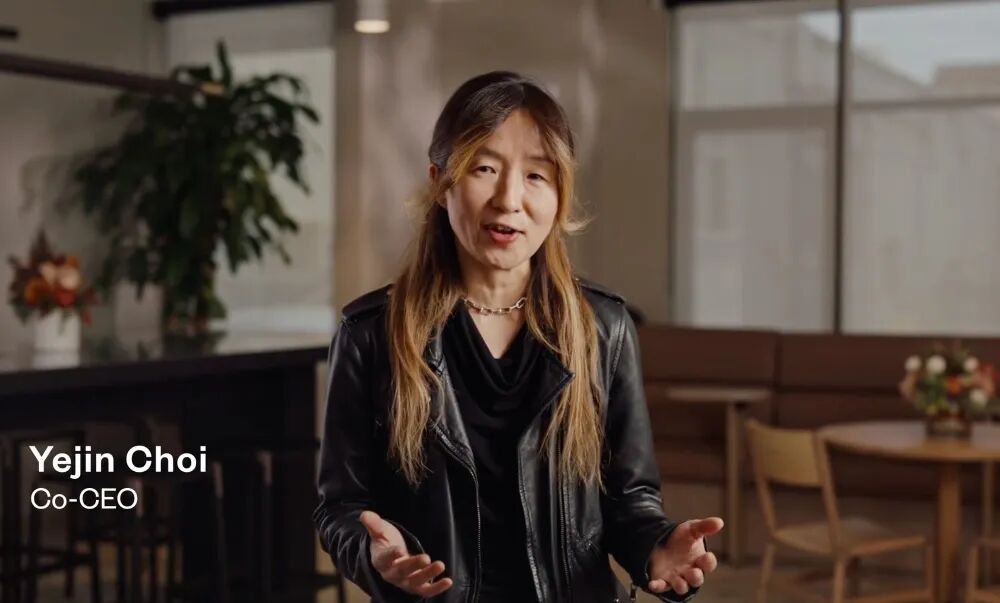
In addition to university research, Choi has gradually extended her work to the industry. Since 2018, she has also served as senior research director at NVIDIA, participating in AI research work, and later was promoted to Senior Director of AI Research.
In January 2025, the Stanford Institute for Human-Centered Artificial Intelligence (Stanford HAI) announced that Choi officially joined, where she serves as the Dieter Schwarz Foundation HAI Endowed Professor, Professor of Computer Science, and Senior Researcher at Stanford HAI.
Beyond academic research, Choi has also received multiple international recognitions. In 2022, she was awarded the MacArthur Fellowship, and in 2023 she was selected into Time magazine's list of the most influential people in the global AI field.
02.
Carlos Guestrin: Stanford Professor Turned Entrepreneur
Former Head of Machine Learning and AI at Apple
Different from Choi, the career experience of the other co-founder Carlos Guestrin more reflects the process of pushing technology from academic research to industrial application.
Carlos Guestrin received his PhD in Computer Science from Stanford University in 2003. In the same year, he joined Intel Research Berkeley as a senior research scientist.
A year later, Guestrin moved to academia, joined Carnegie Mellon University, and served in the Department of Computer Science and the Machine Learning Department successively as Finmeccanica Associate Professor. In 2012, Guestrin joined the Department of Computer Science and Engineering at the University of Washington as Professor of Machine Learning.

In 2013, he further commercialized the GraphLab open-source project he developed in previous academic research, co-founded GraphLab to explore the application of large-scale machine learning technology in enterprises.
The company was renamed Turi in 2016, mainly providing machine learning platforms for developers and data scientists, helping enterprises build and deploy intelligent applications.
This entrepreneurial experience ended with an acquisition by Apple. In 2016, Apple acquired Turi, and Guestrin subsequently joined Apple, serving as Senior Director of Machine Learning and AI, participating in Apple's machine learning and AI-related work.
After working at Apple for a period of time, Guestrin returned to academia in 2021, joined the Department of Computer Science at Stanford University as a professor, later became the Fortinet Founders Professor, and also served as a senior researcher at Stanford HAI.
His research covers machine learning, data mining, distributed computing and AI systems, and his team has launched many widely influential open-source projects including XGBoost, LIME, Apache TVM, MXNet, GraphLab/PowerGraph.
Among them, XGBoost was co-developed by Carlos Guestrin, Tianqi Chen, associate professor at Carnegie Mellon University, Distinguished Engineer at NVIDIA and alumnus of Shanghai Jiao Tong University, and has become a widely used machine learning tool in the industry and machine learning competitions.
In terms of honors, he has received honors including the U.S. Presidential Early Career Award for Scientists and Engineers (PECASE) and the IJCAI Computers and Thought Award.
03.
Conclusion: Models Keep Evolving in Real Business Scenarios
Noeri Focuses on Practical Implementation
Judging from the experience of the two founders, the direction Noeri is exploring did not emerge out of nowhere. Choi has long studied the commonsense reasoning and cognitive capabilities of AI, while Guestrin has experience in R&D and commercialization of machine learning systems. The research accumulation of the two points to the same problem of how AI capabilities can enter real application scenarios.
For enterprises, while the capabilities of general models are certainly important, how to make AI understand their own business, leverage proprietary data, and continuously accumulate experience in practical work is also an unavoidable problem in the implementation process.
Noeri is targeting exactly this direction, and the capital investment also reflects the industry's recognition and expectation for this direction.
This article is from the WeChat Official Account "Zhidx" (ID: zhidxc), Author: Wang Han, Editor: Li Shuiqing, Published with authorization from 36Kr.